The U.S. Central Command issued a statement on April 12, local time, confirming that effective 10:00 a.m. Eastern Time on April 13, it would impose a blockade on all maritime traffic entering and leaving Iranian ports and coastal areas. It also made clear that it would not hinder vessels traveling to and from non-Iranian ports from transiting the Strait of Hormuz. The move came after the stalled Iran-U.S. negotiations in Islamabad, which lasted more than 20 hours without results, and was followed by significant volatility in global energy markets and cryptocurrency prices.
Scope of the Blockade Measures and Policy Boundaries
According to the official statement released by U.S. Central Command, the blockade applies to all vessels entering and leaving Iranian ports and coastal areas, covering all Iranian ports located in the Persian Gulf and the Gulf of Oman. During the implementation, no distinctions will be made based on the vessel’s nationality or ownership.
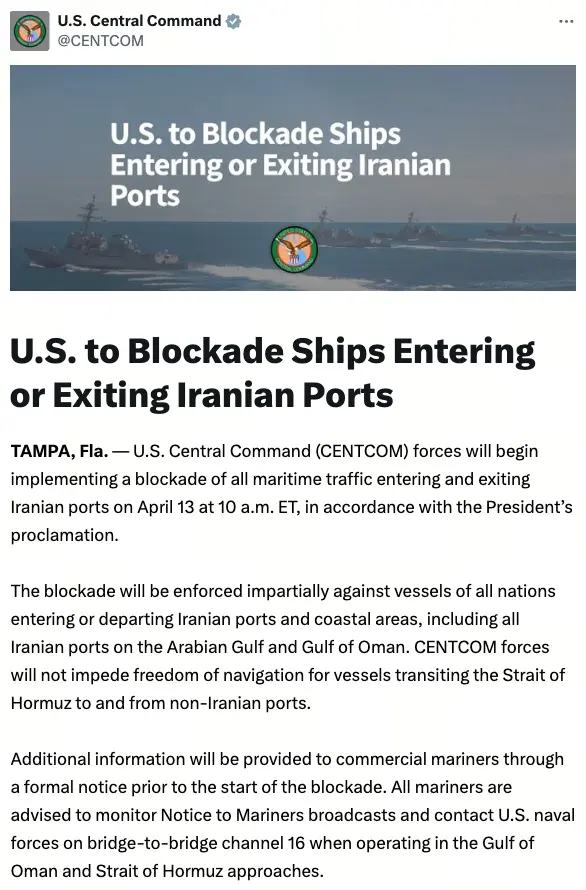
The statement also sets clear policy boundaries: U.S. Central Command forces “will not interfere with the freedom of navigation of vessels traveling to and from non-Iranian ports through the Strait of Hormuz.” This wording is intended to separate the economic blockade targeting Iranian ports from the Strait of Hormuz as an international shipping lane, as much as possible avoiding a complete disruption to the world’s main arteries of energy transport.
At the level of operational implementation, the U.S. Navy will issue guidance to commercial shipping through an official “Notice to Mariners,” and advises that vessels operating near the Gulf of Oman and the Strait of Hormuz maintain bridge-to-bridge communication with U.S. Navy units via very high frequency channel 16.
Diplomatic Negotiation Background and Conflict Timeline
The immediate trigger for this blockade action was the breakdown of ceasefire talks between the U.S. and Iran held in Islamabad, Pakistan. The negotiations lasted more than 20 hours, and both delegations had already left Islamabad. In the statement, President Trump said “most of the content was agreed, but the one truly important issue—the nuclear issue—was not resolved,” and ordered the U.S. Navy to implement the blockade accordingly.
The timeline for this round of U.S.-Iran military confrontation began on February 28, 2026, when the U.S.-allied coalition launched a large-scale military operation against Iran. Since the outbreak of hostilities, the average daily oil transport volume through the Strait of Hormuz has fallen from roughly 20M barrels under normal conditions to between 2 million and 3 million barrels. The main destination has been Iranian oil exports to China.
Alongside announcing the blockade, Trump said the U.S. may resume limited military strikes against Iran, with potential targets including desalination plants and power plants. He also warned that any Iranians who fire on U.S. forces or peaceful vessels will face a strong response.
Iran’s Official Response and Retaliatory Stance
On his way back, the Chairman of the Iranian Islamic Consultative Assembly, Kalibaf, issued a statement saying that within less than a year, Iran had been attacked twice while negotiations were ongoing, and that it is up to the U.S. to “earn our trust.” Iranian President Pezeshkian, during a phone conversation with Russian President Putin, said that the biggest obstacle to reaching a fair agreement is the U.S.’s “double standards and insatiable greed.”
In a statement on the same day, the Iranian Revolutionary Guard Corps said that the Strait of Hormuz is “fully under control,” and any military vessels approaching would be regarded as violating the ceasefire agreement and would be hit with strong force. Iran’s parliament is pushing forward a new bill concerning prohibiting hostile state naval fleets from transiting the Strait of Hormuz.
Global Energy Market Price Reaction
After the blockade news was released, the international crude oil futures market opened with sharp volatility. WTI crude futures briefly touched $105.34 per barrel, up about 9% from the previous trading day’s close of $96.57. Brent crude futures opened up nearly 8%, at $102.45 per barrel.
Market analysis firms said the blockade measures are expected to cut off the circulation of roughly 2 million barrels per day of oil related to Iran. Against the backdrop that strategic petroleum reserves coordinated for release by the International Energy Agency are nearing their limit, there is a risk that the supply gap will widen further. Spot gold prices also opened lower sharply, falling below the $4,650 per ounce level, with a roughly 2% intraday decline, reflecting a trend of funds concentrating toward U.S. dollar cash.
Crypto Asset Market Trends
According to Gate’s market data, as of April 13, 2026, Bitcoin’s current price is $71,041.2, with a 24-hour decline of about 0.82%; Ethereum’s current price is $2,191.54, with a 24-hour decline of about 1.26%.
After the blockade news was announced, Bitcoin’s price fell back from a high near $73,773, synchronizing with the broadly lower opening of U.S. stock index futures by more than 1%. This indicates that, at this stage, the link between crypto assets and global risk appetite remains fairly significant. Compared with WTI crude’s rise of more than 8% and gold’s decline of about 2%, Bitcoin’s price fluctuations have been relatively moderate.
Positions of Third Countries and International Organizations
A spokesperson for the U.K. government said it is working with France and other partners to build a broad alliance to protect freedom of navigation through the Strait of Hormuz, while ruling out the possibility of directly participating in the U.S. blockade action. After the talks ended, Pakistan’s foreign minister emphasized that all parties should strictly comply with their ceasefire commitments.
Informed officials said the second round of U.S.-Iran talks could take place within a few days, but as of the time of this report, no specific schedule has been announced.
Summary
The blockade action by U.S. Central Command against Iranian ports shows, in policy design, clear boundary separation: a maritime blockade targeting Iran’s economic lifeline is advanced in parallel with international shipping freedom in the Strait of Hormuz. The move both continues the U.S.’s strategy of maximum pressure on Tehran and, objectively, preserves a core corridor for global energy transport. After the incident, WTI crude prices jumped above $105, while Bitcoin simultaneously retreated to around $71,000. Large asset classes reflected the market’s repricing of heightened geopolitical risk and rising inflation expectations through differentiated movements. Key variables in how events evolve next will be whether U.S.-Iran diplomatic engagement can be restarted in the short term, and how effectively each party can actually control the order of navigation through the strait during blockade implementation.
Frequently Asked Questions
Does the U.S. blockade of Iranian ports equal the closure of the Strait of Hormuz?
No. U.S. Central Command explicitly stated that the blockade applies only to vessels entering and leaving Iranian ports and coastal areas, and will not hinder vessels traveling to and from non-Iranian ports from transiting the Strait of Hormuz. The main shipping route for global energy transport is still theoretically open.
What is the current situation regarding passage through the Strait of Hormuz?
Since the conflict broke out in February 2026, the Strait of Hormuz’s average daily oil transport volume has fallen from roughly 20M barrels to between 2 million and 3 million barrels. Elevated shipping risk premiums and skyrocketing insurance costs are the main reasons commercial vessels voluntarily avoid this route, rather than the strait itself being physically blocked.
What impact does this event have on the cryptocurrency market?
In the short term, escalating geopolitical conflict puts broad pressure on global risk assets, and Bitcoin prices fall in sync with U.S. stock index futures. The medium-term transmission path is: higher oil prices lift inflation expectations, which then affects the Federal Reserve’s rate-cut timing and global liquidity expectations, suppressing crypto asset valuations.
Related Articles
Bitcoin ETF Sees Daily Outflow of $16.03M While Ethereum and Solana ETFs Record Gains on April 27
Gate News message, according to the April 27 update, Bitcoin ETF recorded a daily net outflow of 209 BTC ($16.03 million), while maintaining a weekly net inflow of 9,987 BTC ($767.27 million). Ethereum ETF showed a daily net inflow of 24 ETH ($56,000) and a weekly net inflow of 41,013 ETH ($93.35 mi
GateNews1h ago
MicroStrategy increases its position by an additional 3,273 BTC: average price $77.9万, total cumulative holdings 81.83万 BTC
According to Strategy Inc.’s April 27 press release and disclosures in a Form 8-K filed with the U.S. Securities and Exchange Commission (SEC) on the same day, the company increased its purchases again last week (April 20 through April 26), buying 3,273 bitcoins (BTC). Cumulative total holdings reached 818,334 bitcoins, all funded with the $255 million raised through ATM (at-the-market) share issuances.
4/20-4/26 added 3,273 BTC at an average price of $77,906
This week’s trading window runs from April 20, 2026 to April 26, 2026. The company purchased 3,273 BTC with a total outlay of $255 million (including fees), and an average purchase price of $77,906 per coin. Compared with the spot bitcoin price during the same period, it fell within
ChainNewsAbmedia1h ago
Fidelity Digital Assets Q2 Report: Bitcoin Dominance Rising, On-Chain Data Shows Stabilization Signals
Gate News message, April 27 — Fidelity Digital Assets released its Q2 2026 Signal Report, highlighting stabilization signals across multiple on-chain metrics despite early second-quarter consolidation in the crypto market.
Bitcoin's market dominance continued to rise, with capital concentrating
GateNews1h ago
Nasdaq-Listed DDC Enterprise Plans to Increase Bitcoin Holdings to 5,000 BTC by Year-End 2026; Benchmark Initiates Coverage with 'Buy' Rating and 70% Upside
Gate News message, April 27 — Nasdaq-listed DDC Enterprise (ticker: DDC), an Asian food e-commerce platform, received its first coverage from Benchmark with a 'Buy' rating and a $3 price target, implying approximately 70% upside from its current stock price of $1.65. The firm outlined a "clear
GateNews1h ago
DeFi United Hits $300M With Consensys, Lubin 30K ETH Pledge
## Consensys and Joseph Lubin Pledge 30,000 ETH to DeFi United
On Monday, Ethereum development studio Consensys and founder Joseph Lubin jointly announced a contribution of 30,000 ETH to DeFi United, a coordinated effort to cover losses from the Kelp DAO exploit, according to Aave's announcement on
CryptoFrontier1h ago
Major news week: U.S.-Japan interest rate decisions, earnings reports from the five largest tech giants, and employment data land one after another
This week, the Bank of Japan and the Federal Reserve’s interest-rate decision are set to be released soon, and among the seven major U.S. stock giants, five have published earnings reports, with U.S. employment data coming out at the same time. This article analyzes the transmission paths of macro events to the crypto market and their potential impact.
GateInstantTrends1h ago


