1. From Research Strategies to Trading Systems: Same Logic, Two Worlds
The research environment is typically an “ideal world”:
- Data is complete and can be retrospectively accessed
- Trade execution assumptions are relatively smooth
- Parameter updates have low costs
The live trading environment, however, is a “friction-filled world”:
- Order book depth changes constantly
- Slippage and fees continually erode returns
- Execution paths can become distorted during extreme market conditions
Therefore, automation is not as simple as connecting a backtest script to an API; it requires rewriting strategy logic into a comprehensive system workflow. A deployable framework generally consists of four layers:
- Signal Layer: Generates direction, intensity, and confidence
- Decision Layer: Handles position mapping, threshold triggers, and trade frequency control
- Execution Layer: Manages order routing, fill optimization, failure retries, and exception rollbacks
- Risk Control Layer: Oversees stop-loss, circuit breakers, position limits, anomaly monitoring, and manual intervention
All four layers are essential. Missing any layer can amplify “model errors” into “systematic losses.”
2. Backtesting Doesn’t Prove Strategy Validity—It Filters Out Invalid Ones
Before automation goes live, backtesting serves as a “filter,” not a “guarantee.”
A mature backtesting process should cover at least these five aspects:
- Time-based Validation: Strict chronological separation of training, validation, and testing
- Out-of-Sample Evaluation: Must maintain stable performance in unseen market periods
- Walk-forward Testing: Simulates continuous strategy updates in real time
- Cost Injection Testing: Assesses return resilience under various fee and slippage assumptions
- Stress Scenario Testing: Simulates performance during high volatility, low liquidity, and sudden gaps
Backtesting conclusions should answer three main questions:
- Does the strategy demonstrate statistical significance?
- Are returns highly dependent on specific market phases?
- Is risk concentrated in a few tail events?
If these questions are not clearly addressed, the faster the strategy goes live, the faster risks are realized.
3. The Execution System Determines the Strategy’s “Actual Return”
In automated trading, the execution layer is often the most underestimated return variable.
The same strategy logic can yield vastly different return curves depending on execution quality. The execution system must address:
- Order Type Selection: Weighing limit orders, market orders, and split orders under varying market conditions
- Trade Impact Control: Preventing large single orders from causing excessive price impact
- Failure Handling Mechanisms: Retry and order supplementation strategies for network issues, interface timeouts, or partial fills
- Temporal Consistency: Preventing mismatches between “signal timestamps” and “execution timestamps” that lead to false fill results
In highly volatile markets, execution errors are often more fatal than model errors.
Therefore, live evaluation shouldn’t just focus on “signal win rate”—it should continuously monitor the deviation between “signal returns” and “execution returns.” Persistent widening indicates the execution layer has become a major risk source.
4. Automated Risk Control: Strategies Can Err—Systems Cannot Lose Control
The core principle of automated trading is: small mistakes are allowed; loss of control is not.
Risk control systems should be dual-tracked with “routine risk control + extreme risk control.”
Routine Risk Control (Daily Constraints)
- Position limits per strategy
- Maximum exposure per asset
- Automatic frequency reduction after consecutive losses
- Capital utilization and leverage caps
Extreme Risk Control (Abnormal Protection)
- Volatility spikes trigger leverage reduction
- Sharp liquidity drops trigger reduction-only mode
- Data source interruption triggers strategy circuit breaker
- API anomalies trigger manual intervention mode
A truly robust system isn’t one that “never makes mistakes,” but one that remains controllable when errors occur.
Essentially, the risk control layer converts unknown risks into preset actions to prevent loss of boundaries during stress scenarios.
5. Production Governance: From “Can Run” to “Sustainable Operation”
After going live, managing the strategy’s lifecycle is more important than day-one returns.
It’s recommended to establish three ongoing governance mechanisms:
- Monitoring Dashboard: Synchronously tracks key metrics such as signal accuracy, execution deviation, risk triggers, and return drawdowns
- Version Management: Models, parameters, and execution rules must be versioned to ensure all changes are traceable and reversible
- Review & Attribution: Every period of abnormal volatility or loss must be attributed to either a signal issue, execution issue, or risk control issue—avoiding ambiguous handling
An automated system without governance is essentially just a “continuous order placement program,” not an “operable trading system.”
6. Gate for AI’s Role in the Automation Pipeline
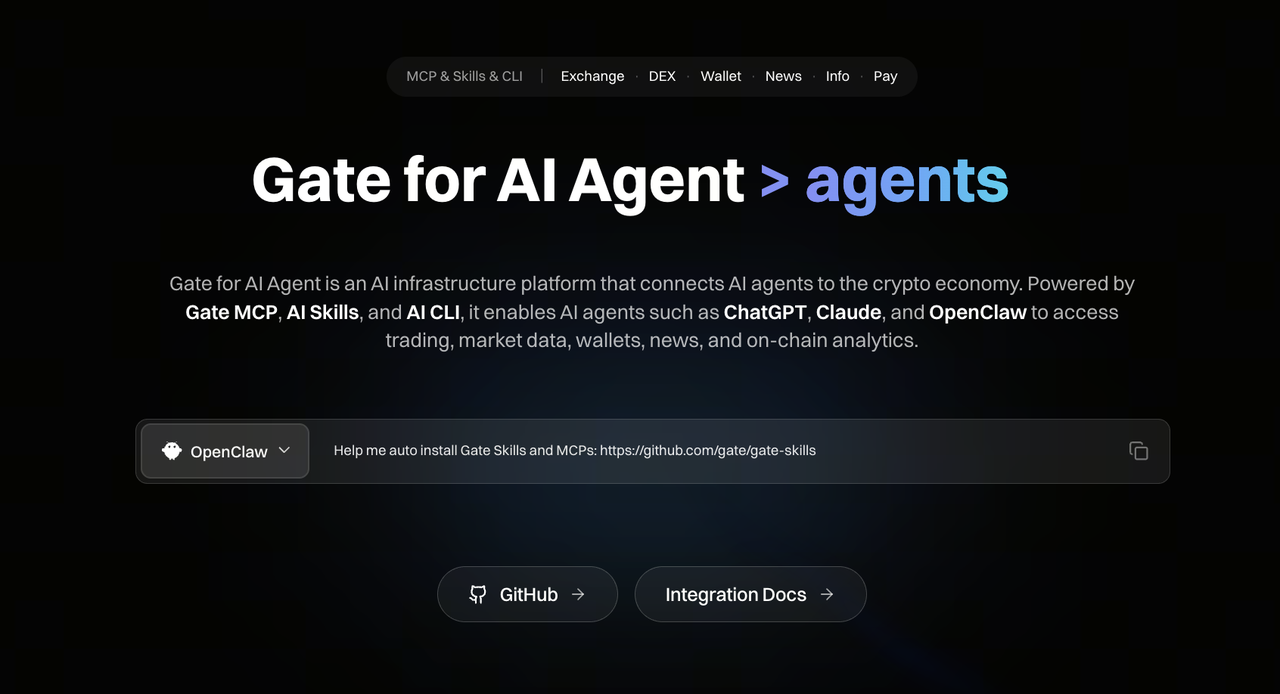
In practice, trading team bottlenecks often lie not in single models but in cross-stage collaboration: data processing, signal orchestration, execution tuning, and alert monitoring are usually handled by separate tools, leading to high maintenance costs and slow iteration.
The real value of infrastructures like Gate for AI lies in shortening the engineering chain from “research to execution,” making strategy development, deployment, and monitoring more standardized. The main advantages are:
- Integrated Workflow: Reduces interface and timing friction from multi-tool integration
- Efficient Iteration: Lowers waiting costs between model updates and strategy releases
- Structured Governance: Facilitates accumulation of monitoring, alerting, and audit trails
It’s important to emphasize that infrastructure enhances execution efficiency and stability but does not replace strategy accountability. Strategy objective definition, risk constraint settings, and exception handover rules must still be explicitly managed by the trading system governance framework.
7. The Minimum Viable Path (MVP) for Practical Implementation
To avoid “over-engineering” stalling deployment, adopt the minimum viable automation path:
- Start with a single strategy and single asset to validate closed-loop operation
- First implement basic signals + fixed positions + basic stop-loss
- Conduct small-scale live observation with a focus on recording execution deviations
- Gradually add dynamic positions, split execution, and state filtering
- Finally expand to multi-strategy coordination and portfolio-level risk control
The core advantage of this path is that every stage is observable, reversible, and reviewable—significantly reducing uncontrollable risks from deploying overly complex systems at once.
8. Lesson Summary
This lesson addresses automation implementation from backtesting to live trading with four core conclusions:
- Automated trading is a systems engineering process—signal generation, decision-making, execution, and risk control must be designed in tandem
- The purpose of backtesting is to filter out invalid strategies—not to guarantee future effectiveness
- Execution quality directly determines actual returns—live deviation monitoring is essential
- Risk control and governance mechanisms are core to long-term operation—not optional features


