For many newcomers to financial markets, derivatives often appear to be complex, specialized tools—even carrying a reputation for high risk. Whether in traditional finance or the crypto market, when people hear about futures, options, perpetual contracts, or swaps, their first thoughts usually revolve around leveraged trading, price speculation, and market volatility. However, if we only view derivatives as “high-risk trading instruments,” we miss their deeper significance within the financial system.
In fact, derivatives were not created for speculation. Their core purpose at inception was to help market participants manage uncertainty. Whether it’s agricultural producers facing future price fluctuations, companies confronting changes in exchange rates and interest rates, or institutional investors needing to lock in future costs and returns, the essential function of derivatives is to transfer risk from those unable to bear it to those willing to assume it. For this reason, derivatives are not a peripheral product in the financial system—they are a crucial risk management infrastructure in modern markets.
To understand the logic behind various contract products in today’s crypto market, we must first return to this starting point: Why do financial markets need derivatives?
I. What Are Derivatives?
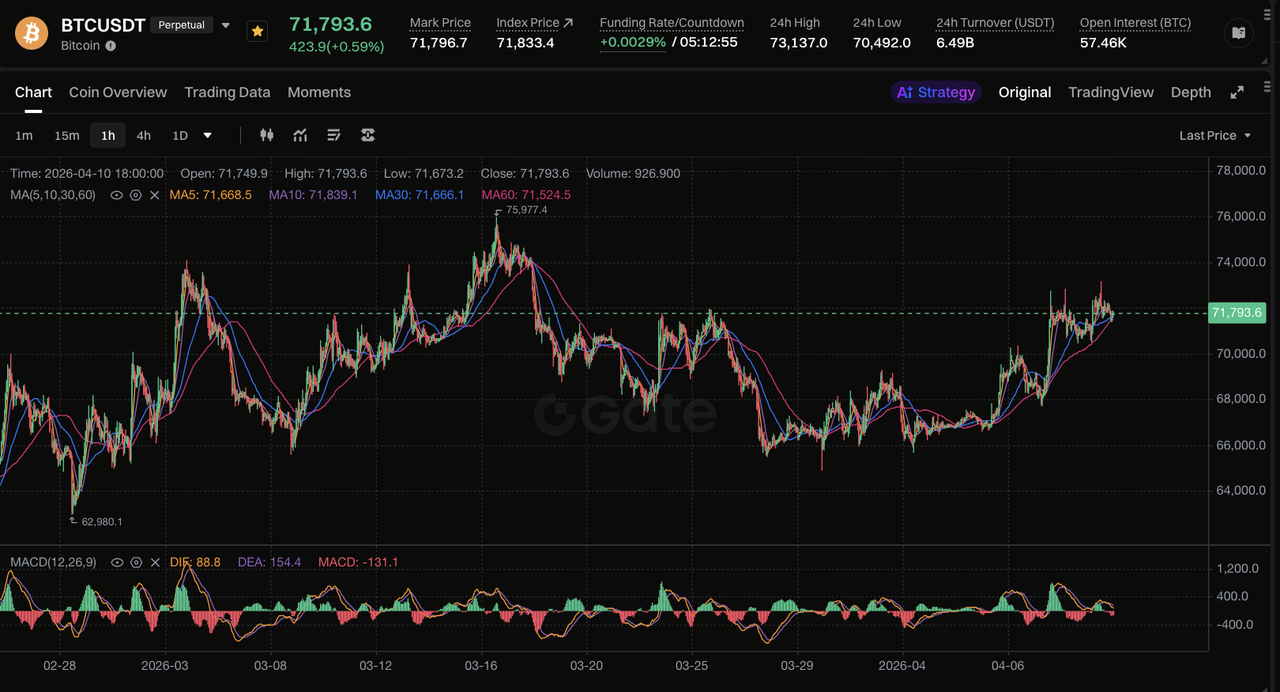
By definition, derivatives are financial contracts whose value is derived from other underlying assets or variables. These “underlying assets” can include commodities, stocks, bonds, interest rates, exchange rates, indexes, and in the crypto market, the prices of digital assets like Bitcoin or Ethereum. In other words, derivatives themselves are not the origin of independent value—their price and function come from a “reference object.”
Source: Gate Market Page
For example, a Bitcoin futures contract derives its value from the market price of Bitcoin at a specific future point; a Bitcoin perpetual contract’s price fluctuates around the spot price and is anchored through a funding rate mechanism; a Bitcoin option’s value is closely tied to the magnitude and direction of Bitcoin’s price movements. Because they “derive” from underlying assets, these instruments are called derivatives.
However, understanding derivatives cannot stop at definitions. More importantly, derivatives are a “contractual arrangement.” They are not simply about buying or selling an asset; they are a set of rules designed around future prices, obligations, and rights. This means that derivative markets focus not just on how much an asset is worth today, but more importantly on how to arrange future risk and reward relationships.
II. Why Aren’t Spot Markets Enough?
If there is already spot trading in the market, why do we need derivatives? Why not just buy and sell the asset itself instead of creating another, more complex layer of contracts?
The answer is that spot markets mainly solve the problem of “trading now,” while many critical needs in finance actually relate to the “future.” Producers care about future prices; companies care about future financing costs; investors care about future return volatility; financial institutions care about future risk exposure. These issues cannot be effectively addressed by spot markets alone.
Consider a simple example: When farmers plant crops, they don’t know what wheat prices will be at harvest time. If prices drop sharply in the future, they may not cover their costs despite working hard all year. For flour processors, they also don’t want raw material prices to suddenly surge and squeeze their profit margins. In other words, producers worry about “selling too cheaply,” while buyers worry about “buying too expensively.” Spot markets only allow transactions when future prices actually materialize—they cannot lock in acceptable price ranges ahead of time.
Derivatives emerged in this context. They provide both parties with a mechanism to agree today on future trading conditions, turning otherwise uncontrollable price fluctuations into a risk structure that can be arranged in advance. In short, spot markets solve the transaction itself; derivative markets solve the uncertainty around transactions.
III. The Primary Mission of Derivatives: Risk Management
If we were to summarize the core reason for the existence of derivatives in one sentence, it would be risk management. Their primary function is not to amplify returns but to allow market participants to control future uncertainty.
This is especially important in traditional finance. Companies use currency derivatives to manage exchange rate risk in international business; banks and asset managers use interest rate derivatives to adjust financing costs and portfolio sensitivity; commodity firms often rely on futures and forwards to stabilize procurement or sales prices for raw materials. For these players, derivatives are not “extra gambling tools”—they are stabilizers for business operations.
Understanding this is crucial because it helps correct a common misconception: The high leverage and volatility associated with derivatives are not their entire essence. Speculation is just one part of what derivatives can do—indeed, it developed as an additional function after risk management needs arose. What truly makes derivatives a vital infrastructure for modern finance is their ability to allow market participants to redistribute risk according to their own needs.
From this perspective, derivatives don’t eliminate risk—they price risk, transfer risk, and reorganize risk.
IV. Who Uses Derivatives?
Derivatives do not serve only a single group; rather, their market ecosystem consists of multiple types of participants:
- Hedgers: Use derivatives to offset spot market risks and reduce uncertainty.
- Speculators: Actively take on risk to profit from price fluctuations.
- Arbitrageurs: Earn low-risk profits by exploiting price differences across markets or maturities.
- Market Makers: Continuously quote prices to enhance liquidity and trading efficiency.
It’s the matching of these different objectives among participants that enables stable operation of the derivatives market.
V. Why Does the Derivatives Market Keep Expanding?
Historically, as financial markets develop, derivatives tend not to decrease but become increasingly prevalent. This isn’t because markets have become more speculative—it’s because modern economic activity itself has grown more complex and risk structures more diverse.
Initially, derivatives focused on agricultural products and commodities since price fluctuations in these areas directly affected production and trade. As financial systems expanded, risks were no longer confined to commodity prices but extended into interest rates, exchange rates, credit, stock indexes, and cross-border capital flows. Accordingly, the scope of derivatives widened as well—becoming important tools linking businesses, financial institutions, and investment markets.
In modern financial systems, many operations can hardly run efficiently without derivatives. Large institutions use them to adjust asset-liability structures; funds use them to manage portfolio exposures; multinational companies use them to stabilize financial expectations; financial intermediaries employ them to boost market liquidity and price discovery efficiency. In many scenarios, derivatives are not merely supplements to spot markets—they are essential components for normal market functioning.
VI. From Traditional Finance to Crypto Markets: Why Are Derivatives Once Again Crucial?
This logic applies equally to crypto markets. Although crypto assets emerged much later than traditional financial instruments, once the market grows larger, participants increase, and price volatility intensifies, demand for risk management and price discovery rises rapidly.
Early crypto markets mainly relied on spot trading because the market was small and dominated by early speculators and holders. As assets like Bitcoin and Ethereum became larger trading targets, miners, long-term holders, institutional investors, quant teams, and trading platforms began needing more sophisticated risk management tools. Miners want to lock in future earnings; traders want directional bets; institutions want portfolio volatility control; platforms want deeper and more active markets. Against this backdrop, derivatives markets developed rapidly.
That’s why futures, options, and perpetual contracts have become so important in the crypto world. They aren’t simply traditional financial tools mechanically transplanted onto blockchains or exchanges—they’re needed because the crypto market itself has entered a stage where risk transfer and price management are essential. Fundamentally speaking, whenever a market is large enough, volatile enough, and has enough participants, derivatives are almost certain to emerge.
VII. Lesson Summary
The central question of this lesson is: Why do financial markets need derivatives? The answer is straightforward. The fundamental reason for their existence is not to make markets more complex or simply amplify speculation—it’s to help market participants handle future uncertainty. Spot markets can only address “present transactions,” whereas derivatives offer a mechanism for arranging future risk and reward relationships.
We’ve also seen that the essence of derivatives is as contract tools designed around future prices, rights, and obligations. They allow risk redistribution among participants—creating a market structure where hedgers, speculators, arbitrageurs, and market makers all interact. Because this structure meets diverse needs in real economic and financial activity, derivatives continue expanding within traditional finance and further into crypto markets.
In the next lesson, we’ll discuss several foundational and most important tools in the derivatives market—focusing on futures, options, and swaps—and explain how they organize risk in different ways.