I. Hedgers: Why Are Some Willing to “Reduce Risk”?
The most fundamental and original participants in the derivatives market are hedgers. Hedging, at its core, means using derivative contracts to offset risk exposure in the spot market. In other words, these participants are not seeking to profit directly from derivatives themselves but to reduce the impact of future uncertainty on their business or assets.
For example:
- Agricultural producers worried about falling prices sell futures to lock in income
- Airlines concerned about rising fuel costs buy commodity contracts to manage expenses
- Exporters fearing exchange rate fluctuations erode profits use FX derivatives for hedging
- Asset managers concerned about interest rate changes affecting bond prices use interest rate tools to adjust risk exposure
These examples show that hedgers usually already bear some real risk in the spot market. Their entry into the derivatives market is not to create additional risk, but to rearrange existing risk.
This is a key point in understanding derivatives: in many cases, derivatives are not tools for “increasing risk,” but for “redistributing risk.” For hedgers, the goal is not to win every price swing, but to make future income, costs, or asset values more predictable.
Of course, hedging usually isn’t free. Hedging means giving up some potential gains or paying a certain cost for protection. Therefore, hedgers are not aiming for maximum returns, but for controllable volatility and stable outcomes.
II. Speculators: Why Does the Market Need People Willing to Take on Risk?
If all participants only wanted to avoid risk, the derivatives market would barely function. For every party wanting to transfer risk, there must be another willing to take it on. This is exactly why speculators exist.
Speculators may not have real risk exposure in the spot market; they enter the derivatives market based on their views of prices, volatility, or market trends, hoping to profit from future changes. For instance:
- Believing a commodity’s price will rise, they buy futures
- Expecting an index’s volatility to increase, they deploy options strategies
- Seeing short-term overvaluation or undervaluation of an asset, they use derivatives to express directional views
Speculators are often seen as sources of increased market volatility. But structurally, they play a crucial role: because they are willing to take on price risk, hedgers can successfully transfer theirs. Without speculators, many who need to hedge would struggle to find enough counterparties.
More broadly, speculators provide two key values:
- Supplying liquidity so more trades can occur
- Reflecting dispersed market expectations into prices more rapidly
Speculation isn’t blind gambling. Experienced speculators make judgments based on macro environment, market structure, capital flows, volatility, and pricing logic—not just betting on price moves. Because they’re willing to take risks, the derivatives market is not just a “risk avoidance tool,” but a dynamic arena that absorbs expectations and adjusts prices.
III. Arbitrageurs: Why Does the Market Need People “Looking for Mispricing”?
Besides hedgers and speculators, arbitrageurs are another critical group in the derivatives market. Arbitrage is not about taking directional bets, but about finding price discrepancies between markets, instruments, or maturities and profiting from them.
For example:
- Abnormal divergence between spot and futures prices for the same asset
- Inconsistent volatility pricing among similar options
- Temporary price differences for identical contracts across exchanges
- Deviations from normal term structure relationships among contracts of different maturities
When arbitrageurs spot these discrepancies, they typically buy undervalued assets and sell overvalued ones simultaneously to lock in spreads. Since their goal is to exploit mispricing, arbitrage trades often push prices back toward more reasonable levels.
Arbitrageurs play three major roles:
- Improving market pricing efficiency
- Narrowing price gaps across markets
- Keeping derivatives prices closely linked with spot markets, term structures, and theoretical values
From this perspective, arbitrageurs aren’t “fringe players,” but vital forces maintaining price order. Without them, many pricing errors might persist longer, making price discovery less efficient and weakening derivatives’ role in risk management and price discovery.
In crypto markets especially, arbitrageurs are highly active due to greater frictions between exchanges, products, and on-chain environments compared to traditional finance. Their activity more directly impacts price alignment.
IV. Market Makers: Who Maintains Continuous Trading?
If hedgers bring risk management needs, speculators provide risk appetite, and arbitrageurs correct mispricing, then market makers ensure the market itself remains “continuously tradable.” Market makers continuously quote both buy and sell prices in the market, acting as counterparties for other participants. Regardless of whether the market is rising or falling, they typically maintain two-way quotes so traders can buy or sell contracts at any time.
Market makers’ main revenue sources usually include:
- Bid-ask spreads
- Returns from inventory management
- Liquidity incentives from exchanges or platforms
But market making is not without risk. Challenges faced by market makers include:
- Inventory risk from rapid price swings
- Execution risk from sudden liquidity dry-ups
- Hedging pressure during one-sided markets
- Quote distortions and exposure during extreme volatility
Despite these risks, market makers remain a key part of effective derivatives markets infrastructure. Without continuous quotes, slippage would increase, spreads would widen, trading experience would deteriorate, and both hedgers and speculators would struggle to enter markets efficiently.
In highly active markets, market makers do more than provide liquidity—they also influence depth, execution quality, and price stability. Especially in crypto derivatives markets, their relationship with trading platforms is even closer since platform liquidity largely depends on professional market making teams.
V. How Do These Four Participant Types Form a Market Together?
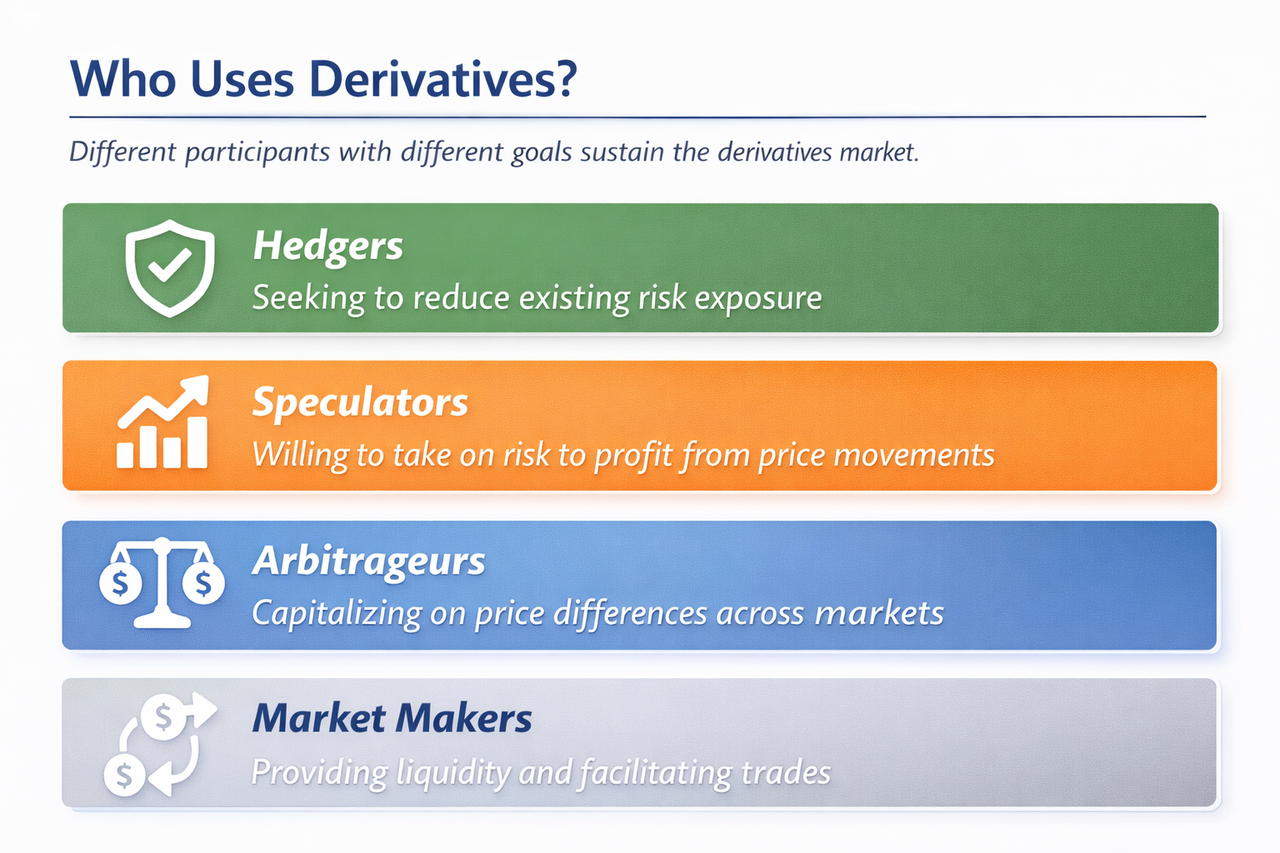
With an understanding of these four main participant types, it’s clear that the derivatives market isn’t driven by a single logic—it’s an ecosystem where different objectives are matched together.
Simply put:
- Hedgers create demand for risk transfer
- Speculators assume and express risk judgments
- Arbitrageurs correct price deviations
- Market makers maintain trading continuity and liquidity
Because all four roles coexist, the market can serve real risk management needs while sustaining sufficient activity and pricing efficiency. If any one role is missing, overall market function suffers.
For example:
- Without hedgers, there’s no real demand for risk management
- Without speculators, risks cannot be fully absorbed
- Without arbitrageurs, prices become less accurate
- Without market makers, trading costs rise significantly
This shows that the derivatives market isn’t “just a game dominated by speculators,” but a core piece of infrastructure supported by multiple participant types.
VI. How Are Derivatives Prices Formed?
Having understood the participants, we can now address another question: how exactly are derivatives prices determined?
On the surface, derivatives prices are set by trading between buyers and sellers. But fundamentally, they result from multiple forces acting together:
- Market expectations about future prices
- Spot prices and carrying costs
- Interest rates, time factors, and volatility
- Liquidity conditions and market sentiment
- Price corrections driven by arbitrage activity
Different instruments have different pricing mechanisms.
For futures, prices typically revolve around spot prices, carrying costs, and future expectations.
For options, underlying price is important—but so are volatility, time value, and strike price.
For swaps, pricing reflects the exchange value between different cash flow arrangements.
But regardless of instrument type, prices don’t emerge out of thin air—they’re constantly adjusted through ongoing competition among participants.
VII. Why Do Derivatives Markets Often Reflect Expectations Better?
In many financial markets, one observes that derivatives often react faster and more sharply to expectations than spot markets do. This isn’t because derivatives are inherently more “advanced,” but because their structure better expresses expectations.
There are three main reasons:
- Leverage amplifies information: Derivatives allow participants to express stronger views with less capital; expectations get priced in faster.
- Short selling is usually more direct: While shorting is limited in many spot markets, derivatives make it easier to express negative views—so price information flows both ways.
- More professional participation: Institutions, arbitrageurs, market makers, and quant teams are typically more active in derivatives markets—prices absorb information more rapidly.
That’s why in both traditional finance and crypto markets, many see derivatives as a key window into market sentiment and expectations. Indicators like futures premiums/discounts, implied volatility in options, open interest changes, and funding rates often provide richer signals than spot prices alone.
VIII. How Is Participant Structure Different in Crypto Markets?
Turning our focus to crypto derivatives markets reveals both similarities and differences with traditional finance.
Similarities include:
- The same needs for hedging, speculation, arbitrage, and market making
- Price formation relies on interaction among diverse participants
- Liquidity and price efficiency heavily depend on market making and arbitrage mechanisms
Differences include:
- Retail traders usually make up a larger share
- High leverage and short-term trading are more common
- Price frictions between exchanges are more pronounced
- Platform rules, funding rates, and liquidation mechanisms have a bigger impact on prices
This means that in crypto markets speculation and liquidity structure often stand out even more than in traditional markets; while hedging needs are growing, they don’t yet dominate as in mature traditional markets. As a result, crypto derivative prices sometimes show stronger emotional features and higher short-term volatility.
IX. Lesson Summary
This lesson explored the question “Who uses derivatives?” by breaking down the four core participant types: hedgers, speculators, arbitrageurs, and market makers. We saw that the derivatives market isn’t a battlefield for one type of player but an ecosystem built from different objectives and risk appetites.
Hedgers need to transfer risk; speculators are willing to take it; arbitrageurs correct pricing errors; market makers keep trading continuous. Through their interaction comes liquidity provision, price discovery, and fulfillment of risk management functions for modern finance.
In the next lesson we’ll discuss the three core functions of derivatives markets: risk transfer, price discovery, and market efficiency—and explain why derivatives can improve financial system operation but also amplify volatility under certain conditions.