Colombia's six-point advantage — does it mean tactical initiative?
Colombia's performance in the first two rounds has been solid. They beat Uzbekistan 3-1 in the opening match and edged DR Congo 1-0 in the second, scoring 4 goals and conceding just 1. The team has won all of its last 4 matches and lost only 2 of its last 15.
This consistency is built on a clear tactical system. The defensive setup crafted by head coach Lorenzo is tight and compact, favoring surrendering possession and capitalizing on transition attacks. Against a Portugal side that must win, Colombia can fully adopt a counter-attacking strategy — they don't need to control the game, just wait for space left by the opponent's high press. Luis Diaz's explosiveness on the flanks and James Rodriguez's playmaking in midfield are the core execution tools for this tactic.
But one cannot overlook that Colombia's first two opponents (Uzbekistan and DR Congo) are of limited overall strength, so the quality of the two clean sheets must be questioned. Facing Portugal's luxurious attacking line, Colombia's defense will face a true test.
From a draw to a five-goal victory — how to interpret Portugal's form curve?
Portugal's group stage trajectory shows a clear V-shaped rebound. In the first match, they were held to a 1-1 draw by DR Congo, with just 1 shot on target out of 7 attempts, exposing a lack of efficiency in attack. Cristiano Ronaldo had no shots on target from 3 attempts in that game, extending his goalless run in major international tournaments to 10 games.
In the second round against Uzbekistan, Portugal secured a resounding 5-0 victory. Ronaldo scored a brace, becoming the first player to score in six different World Cups. This win restored the team's confidence and temporarily quieted doubts about Ronaldo's form.
However, it should be viewed cautiously: Uzbekistan is the group's bottom team, with two losses and a goal difference of -7. The 5-0 scoreline reflects more the opponent's lack of quality than the resolution of all Portugal's issues. The difficulty of breaking down a packed defense, which was evident against DR Congo's bus in the first game, may resurface against Colombia's more organized defense.
Ronaldo vs. James Rodriguez — what does the clash of veterans mean?
This match carries a narrative beyond competition. The names Ronaldo and James Rodriguez together are a story in themselves.
At the 2014 World Cup in Brazil, James Rodriguez burst onto the scene, winning the Golden Boot with 6 goals in 5 games, leading Colombia to the quarter-finals. That year, Ronaldo was at his peak, but Portugal was eliminated in the group stage. Eleven years later, the 41-year-old Ronaldo has just broken his goal drought; the 34-year-old James Rodriguez's market value has dropped from $80 million at his peak to $2 million, but his left foot still functions as the team's creative core.
From a data perspective, Ronaldo's resurgence is real — the brace in the second round ended his drought. But doubts remain: can his running range and physical intensity cope with Colombia's high-pressure defense? Although James Rodriguez has not registered a goal or assist in the two matches, he creates an average of 6.3 chances per game, still the highest attacking organizer in the Colombia squad.
This is likely the last time the two will compete against each other in a World Cup. But for the outcome of this match, sentiment is just a footnote; the real deciding factor is whether each can fulfill his tactical role within his team's system.
How does the crypto prediction market price the probabilities for this match?
According to Gate prediction market data, current market funds back Portugal's winning probability at 49%, a draw at 25%, and Colombia's winning probability at 28%.
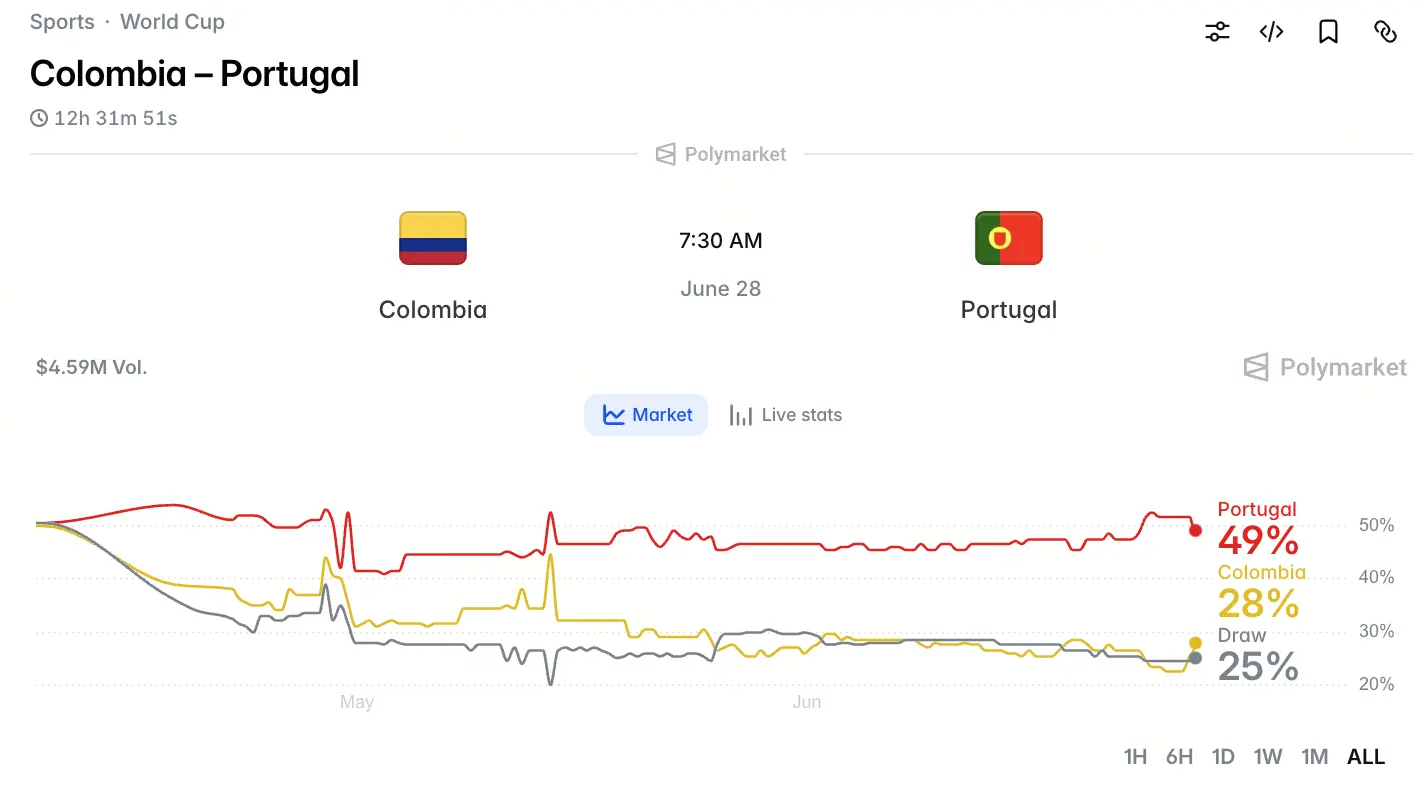
This probability distribution reflects the market's collective judgment of the match's trajectory: Portugal's strength advantage but the imperative to win is fully priced in, while Colombia's undefeated options (win or draw totaling 53%) have attracted higher capital preference. The prediction market's pricing mechanism is based on real-money betting, and its information aggregation efficiency typically outperforms traditional polls or expert forecasts.
From a game theory perspective, Colombia's incentive for a draw (a draw secures the top spot) and Portugal's incentive to win (failure to win means the runner-up spot) form a classic asymmetric game structure. The market assigns a 25% probability to a draw, indicating that a significant portion of funds believe this structural advantage is enough to offset Portugal's superiority on paper.
How do the differences in knockout-stage paths affect both teams' match strategies?
The difference in knockout-stage paths between the group winner and runner-up is the key variable for understanding both teams' strategies.
The Group K winner will face one of the best third-place teams in the Round of 32, with a potential Round of 16 opponent being Group B winner Switzerland. On this path, they will not encounter traditional top-tier teams until at least the quarter-finals.
The Group K runner-up will face the Group L runner-up in the Round of 32 — with England, Ghana, and Croatia competing for qualification from that group. Even if they get past the Round of 32, they could face the Group H winner in the Round of 16, most likely European champions Spain.
For Portugal, the motivation to avoid being in the same half of the bracket as England and Spain is extremely strong. This explains why Portugal must go all out for the win — it's not just about group ranking prestige, but about the entire knockout-stage survival cycle. For Colombia, who have already qualified, the top spot is also preferable, but the psychological expectation that a draw is acceptable will influence their tactical decisions later in the match — whether to continue attacking to extend the lead or to sit back and protect the draw.
Injuries and squad completeness — who has a higher margin for error?
In terms of squad completeness, Colombia has no injury reports, and all 26 players are available. The expected starting lineup includes: goalkeeper Vargas; defenders Munoz, Sanchez, Lucumi, Mojica; midfielders Lerma, Puerta, James Rodriguez; forwards Arias, Diaz, Luis Suarez.
For Portugal, only defender Araujo is listed as doubtful. The expected starting lineup has Ronaldo leading the line, supported by Bruno Fernandes and Felix. The midfield is anchored by Bruno Fernandes and Bernardo Silva, with Vitinha and Neves. In defense, Mendes and Cancelo provide width on both flanks.
Portugal clearly has an advantage in squad depth — the bench also features attackers like Leao, Ramos, and Conceicao. This means if the match becomes a stalemate, Portugal has more options to change the game. Colombia's tactical adjustments rely more on the execution of the starting XI, with relatively limited ability to change things from the bench.
FAQ
Q: What is the kickoff time for Colombia vs. Portugal?
7:30 AM Beijing time on June 28, 2026, at Hard Rock Stadium in Miami.
Q: What are the current Group K standings and qualification scenarios for both teams?
Colombia has 6 points from two wins and has already qualified. Portugal has 4 points from one win and one draw. Colombia only needs a draw to finish first, while Portugal must win to overtake them.
Q: How is Cristiano Ronaldo performing in this World Cup?
Ronaldo had zero shots on target from 3 attempts in the first match against DR Congo, extending his international tournament goal drought. In the second round against Uzbekistan, he scored a brace, becoming the first player to score in six different World Cups.
Q: Have Colombia and Portugal ever faced each other?
The two teams have never met in an official international match. This will be the first official encounter between them.
Q: How do the knockout-stage paths differ for the Group K winner and runner-up?
The winner faces a third-place team in the Round of 32 and possibly Switzerland in the Round of 16; the runner-up faces the Group L runner-up (possibly England) in the Round of 32 and possibly Spain in the Round of 16.
Q: How does the Gate prediction market price the probabilities for this match?
According to Gate prediction market data, Portugal's winning probability is 49%, a draw is 25%, and Colombia's winning probability is 28%.