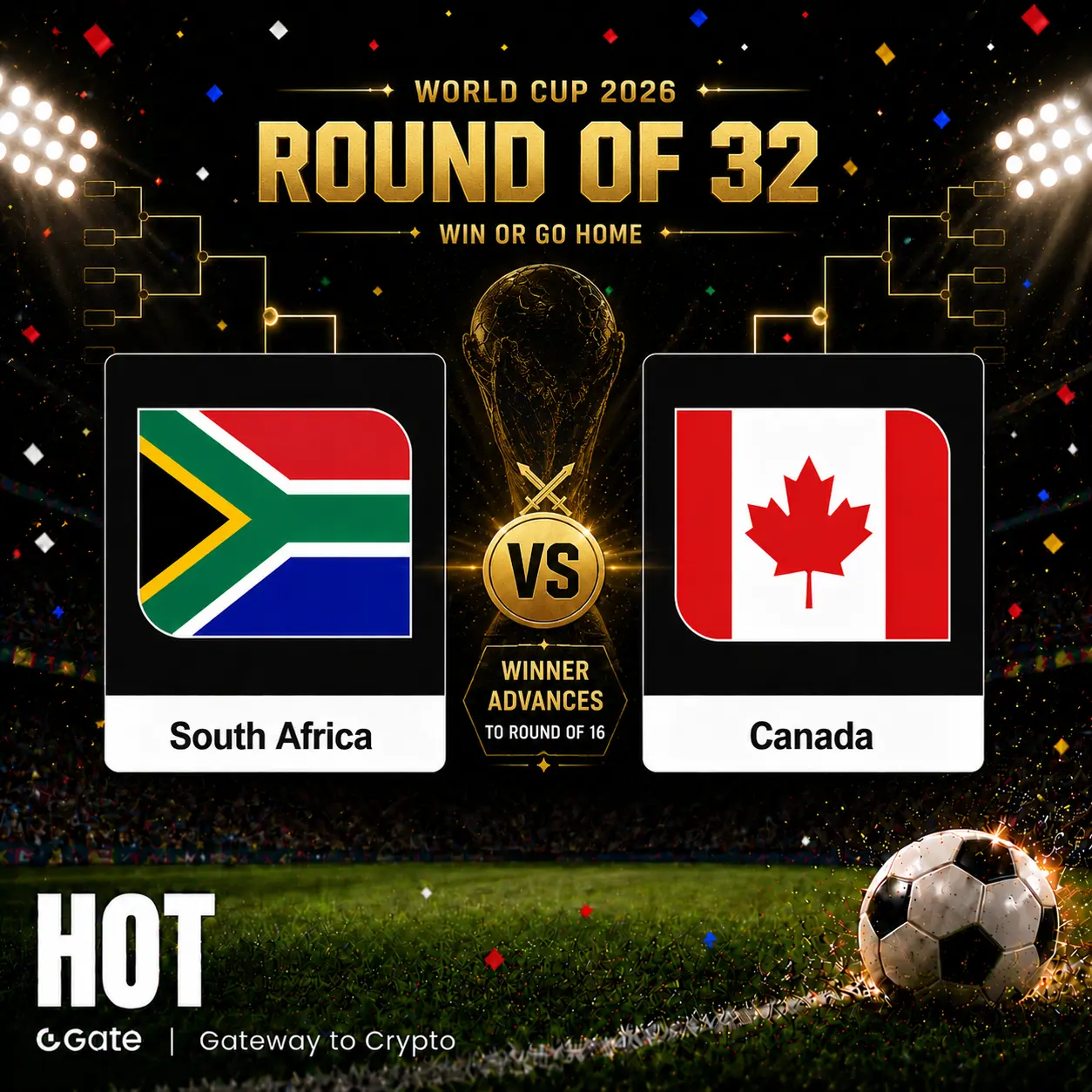
Both teams are in the knockout stage for the first time in their history, what does this match mean?
The qualification journeys of South Africa and Canada are themselves one of the storylines of this World Cup. In the first round of the group stage, South Africa lost 0-2 to Mexico and received two red cards, temporarily bottom of the group. In the second round, they drew 1-1 with Czech Republic thanks to a penalty by Mokoena in the 87th minute. In the final round against South Korea, South Africa had to win — in the 63rd minute, Moremi, who had just come off the bench a minute earlier, provided an assist, and 22-year-old Maseko scored the only goal of the game with a low shot from inside the box. Eventually, South Africa finished second in Group A with 1 win, 1 draw, and 1 loss, accumulating 4 points, advancing to the World Cup knockout stage for the first time in their history.
Canada also made history. In their first match, they drew 1-1 with Bosnia and Herzegovina, earning their first ever World Cup point; in the second round, they thrashed Qatar 6-0, with Jonathan David scoring a hat-trick. Although they lost 1-2 to Switzerland in the final round, Canada still finished second in Group B with 1 win, 1 draw, and 1 loss, accumulating 4 points, advancing to the knockout stage for the first time in their history.
The meeting of two 'newcomers' in the knockout stage means that no matter who wins, it will create a new chapter in their respective countries' football history. This 'historic' nature itself is an emotional variable that cannot be ignored in prediction market pricing.
What do the group stage performances reveal about the true strength of both teams?
Looking at group stage data, the two teams' qualification paths are completely different. South Africa scored only 2 goals in the group stage, one of the lowest scoring teams among the 32 teams to advance, but conceded only 3 goals. They completed only 35 touches in the opponent's penalty area throughout the group stage, the lowest in their group; they created only 2 big chances, also the lowest in the group. 64% of South Africa's shots came from outside the box, with long-range shots being an important scoring method. This is a team based on defense, relying on discipline and counter-attacking efficiency to survive.
Canada, on the other hand, showed a completely different profile. In the three group matches, they had 21 shots on target and accumulated an expected goals (xG) of 7.55, even higher than Brazil (6.64) and the United States (5.69). Canada averaged 35 crosses per game in the group stage and dominated corners against opponents. Their attack is formidable, but there are also concerns in defense — conceding 2 goals against Switzerland in the final round exposed their defensive vulnerabilities against high-intensity attacks.
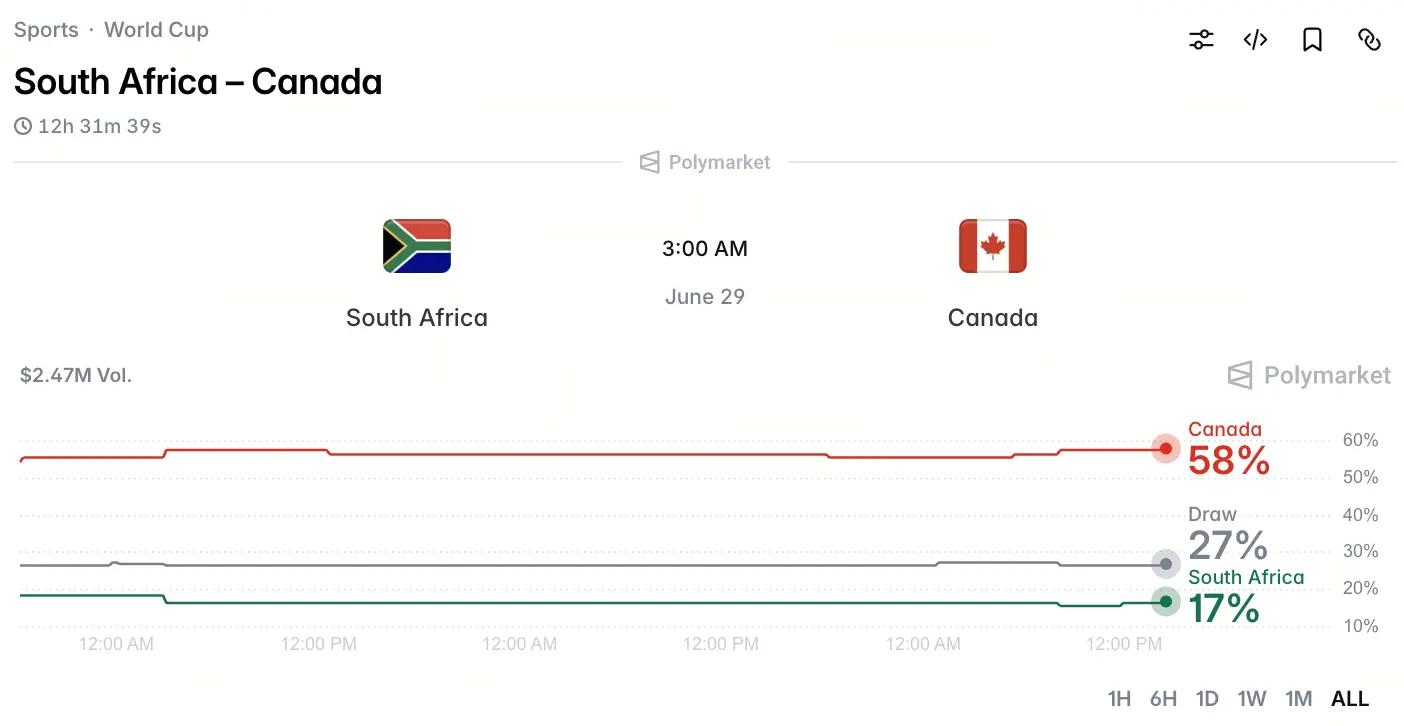
The difference in strength between the two teams is directly reflected in the probability distribution of the prediction market. Canada's 58% win probability support is essentially the market's pricing of their offensive firepower and squad depth.
How does squad depth and injuries to key players affect market pricing?
Canada's biggest advantage lies in the accumulation of experience from Europe's top leagues. Bayern Munich star Alphonso Davies is an iconic figure in Canadian football, Juventus striker Jonathan David has scored 3 goals in the group stage and is in hot form. Southampton's Cyle Larin and Villarreal's Tajon Buchanan also have the individual ability to change the game. This level of player reserve gives Canada a clear advantage in individual technique and big-match temperament.
However, injuries cast a shadow over this advantage. Midfielder Kone suffered a serious leg injury in the match against Qatar and has been confirmed to miss the rest of the World Cup. A bigger concern is Alphonso Davies — due to recurring hamstring issues, he did not play a single minute in the group stage. Head coach Marsch confirmed that Davies is fit to come off the bench, but whether he can play a key role in the knockout stage remains unknown.
For South Africa, midfield core Mokoena returns from suspension after missing the final round due to accumulated yellow cards. Apart from scoring 1 goal against Czech Republic, this midfielder averages 66 accurate passes per game, and contributes 2 interceptions and 6 ball recoveries per game on the defensive end. His return will greatly enhance South Africa's midfield defensive resilience and counter-attack creativity.
Tactical style clash: defensive counter-attack vs possession pressure, who is more suited to the knockout stage?
The essence of this match is a clash of styles. South Africa will likely adopt a disciplined defensive strategy, trying to frustrate Canada's attack and launch counter-attacks. Their ability to stay organized without the ball and quickly transition to attack has troubled stronger opponents in the group stage. In the match against South Korea, South Korea had 68% possession but couldn't score — a typical example of South Africa's defensive resilience.
Canada tends to dominate possession, creating chances through quick passes and attacking runs, using the home crowd momentum to force South Africa into a defensive stance. However, Canada's aggressive attacking style has structural risks — once the front press is broken, the space left behind could be exploited by South Africa's counter-attacks.
Knockout matches have zero margin for error. In this format, defensive stability often matters more than offensive firepower. South Africa's defensive organization has been proven in the group stage, while Canada has yet to demonstrate the reliability of their offensive-defensive balance under knockout pressure. This tactical uncertainty is an important logical basis for the draw probability reaching 27%.
Prediction market 58% vs 17%: What are the deep logics behind the fund distribution?
Gate prediction market data shows Canada win probability at 58%, South Africa at 17%, and draw at 27%. This distribution is not simply a 'strong vs weak' judgment, but the result of multiple factors overlapping.
- Premium for home advantage. As a co-host, playing in front of passionate home fans provides a significant psychological advantage. Although this match is held at SoFi Stadium in Los Angeles, not on Canadian soil, the geographical proximity in North America and fan base still constitute an advantage.
- Discount of squad strength. Canada has multiple players from Europe's top leagues, and this gap in individual ability is quantified as a higher win probability in the prediction market. South Africa's total squad value is only about 41.15 million euros, at the bottom tier among the 32 World Cup teams.
- Discount for knockout uncertainty. South Africa's comeback in the group stage has proven they have the ability to 'defeat higher-ranked opponents'. The market giving 17% win probability is both an objective assessment of South Africa's strength and a risk pricing for the possibility of an 'upset'.
- Anomaly in draw probability. The 27% draw probability is close to half of Canada's win probability, a proportion not common in a seemingly one-sided matchup. It reflects the market's consensus on the following judgment: South Africa's defensive resilience is enough to drag the game into a stalemate, but they lack sufficient attacking firepower to win in regular time.
How has the market pricing logic shifted from the group stage to the knockout stage?
After the World Cup group stage entered its later phase, the prediction market's pricing logic underwent an important shift: the market focus moved from 'who wins or loses' to 'path judgment' — that is, the difficulty structure of a team's path through the knockout stage.
For the South Africa vs Canada matchup, the market needs to evaluate variables on two levels: first, the probability of winning or losing in a single match; second, the subsequent path after the winner advances to the Round of 16. If South Africa pulls off an upset, they will face the winner between the Netherlands and Morocco; if Canada advances smoothly, they will also face that same opponent. However, the impact of 'path judgment' on current market pricing is more reflected in the risk appetite of funds — funds betting on Canada are not only optimistic about them winning this match but also implicitly include an assessment of their competitiveness in the subsequent stage.
Another notable shift is: during the group stage, prediction market trading volume was highly concentrated on top events like the championship winner. After entering the knockout stage, trading density and liquidity for individual match markets significantly increased. The result of a single match directly determines a team's survival, and every goal could rewrite the fate of advancement. This characteristic attracts more short-term funds to participate in single-match predictions.
Variables in the knockout stage: Which unknown factors could change market expectations?
Although the prediction market provides a clear probability distribution, the inherently high variance of knockout matches means that multiple variables could change market expectations before or during the match.
- The first variable is Davies' health condition. As Canada's most decisive player, if Davies starts and maintains form, Canada's win probability could rise further; if he cannot play or is not in good form, market pricing will face recalibration.
- The second variable is South Africa's defensive continuity. Whether South Africa's defensive performance in the group stage is sustainable is the biggest unknown in market pricing. The clean sheet against South Korea showed very high defensive discipline, but Canada's attacking firepower is far beyond that of South Korea.
- The third variable is set pieces. Knockout matches often produce evenly matched contests, and one flash of brilliance or defensive error can change everything. Set pieces, goalkeeper performance, and finishing efficiency can be decisive. South Africa goalkeeper Williams is the pillar of the defense, while Canada's threat from set-piece attacks is also not to be overlooked.
- The fourth variable is match tempo. If South Africa successfully drags the game into the later stages, pressure may gradually shift to the hosts. Canada already exposed issues in dealing with trailing situations in the final group match against Switzerland.
Signal value of prediction markets: Can fund distribution accurately reflect match results?
The core mechanism of prediction markets is 'money voting' — each participant uses their own funds to express judgment on a certain outcome. Price dynamics reflect participants' consensus judgment on event results. In this sense, the 58% win probability for Canada is not a 'prediction' but the collective pricing of market participants.
However, the signal value of prediction markets has boundaries. First, market prices reflect fund distribution, not true probability. The win probability of a favorite team may be overestimated due to excessive fund concentration. Second, prediction markets are affected by liquidity — markets with higher liquidity have greater pricing efficiency; markets with insufficient liquidity may have pricing deviations. Third, the composition of market participants can affect pricing — if supporters of one side are more active or have more funds, prices may deviate from fundamentals.
Therefore, the probability distribution given by Gate prediction market should be understood as an 'instant snapshot of market consensus', not a deterministic judgment of the match outcome. It provides a window to observe collective expectations, but the final result still depends on the actual performance on the pitch over 90 minutes (or more).
FAQ
Q: Gate prediction market shows Canada's win probability at 58%. What does this data mean?
A: The 58% win probability represents the collective pricing of market participants on Canada's victory, reflecting fund distribution rather than absolute probability. This data combines discounts for multiple factors such as Canada's home advantage, squad depth, and attacking firepower.
Q: Does South Africa's 17% win probability mean they have no chance at all?
A: A 17% win probability means the market believes the probability of South Africa pulling off an upset is about one in six. South Africa has proven in the group stage that their defensive resilience and tactical discipline can defeat higher-ranked opponents. The high variance nature of knockout matches means that low-probability events often occur more frequently than market expectations.
Q: Why is the draw probability as high as 27%?
A: The 27% draw probability is close to half of Canada's win probability. This proportion reflects the market's consensus on the following judgment: South Africa's defensive resilience is enough to drag the game into a stalemate, but they lack sufficient attacking firepower to win in regular time.
Q: How does Alphonso Davies' injury affect the prediction market?
A: Davies is Canada's most decisive player, and his health condition is the biggest unknown variable in market pricing. If confirmed to start and maintain form, Canada's win probability could rise further; if he cannot play, market pricing will face recalibration.
Q: How does the 'zero margin for error' in knockout matches affect the result?
A: Knockout matches are decided in a single game, and one mistake can end a team's World Cup journey. In this format, defensive stability is often more decisive than offensive firepower, which is why South Africa's defensive system is given some weight in the prediction market.
Q: How can I participate in Gate's World Cup prediction event?
A: After registering for the event, users who participate in the daily focus match predictions and have a trading volume not less than 50 USDT will qualify for rewards. The prediction result does not affect reward eligibility, and only the first 100 users each day are eligible. New users who participate for the first time with a trading volume not less than 20 USDT can receive exclusive rewards.
LAYOUT REFERENCE (previous): total_lines=105, non_empty_lines=54, blank_lines=51