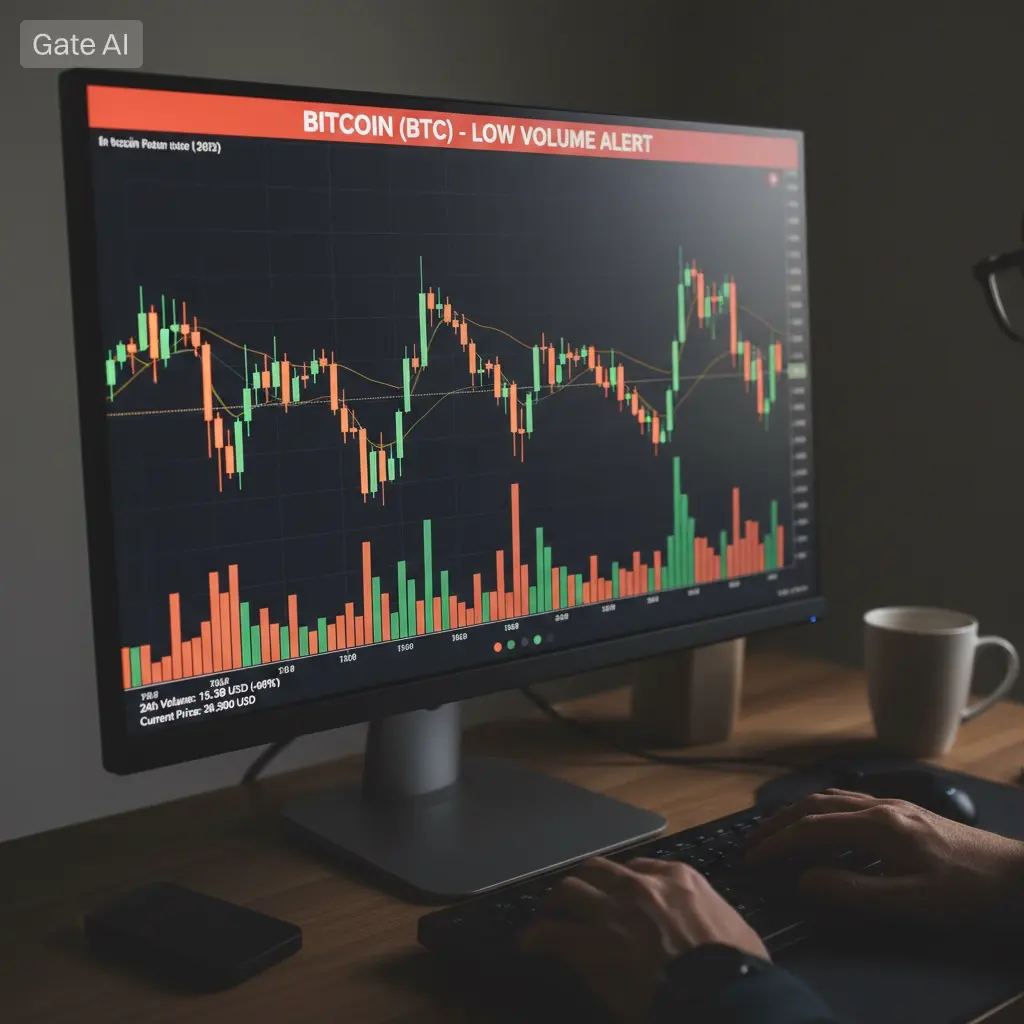


# BitcoinSpotVolumeNewLow

162.66M

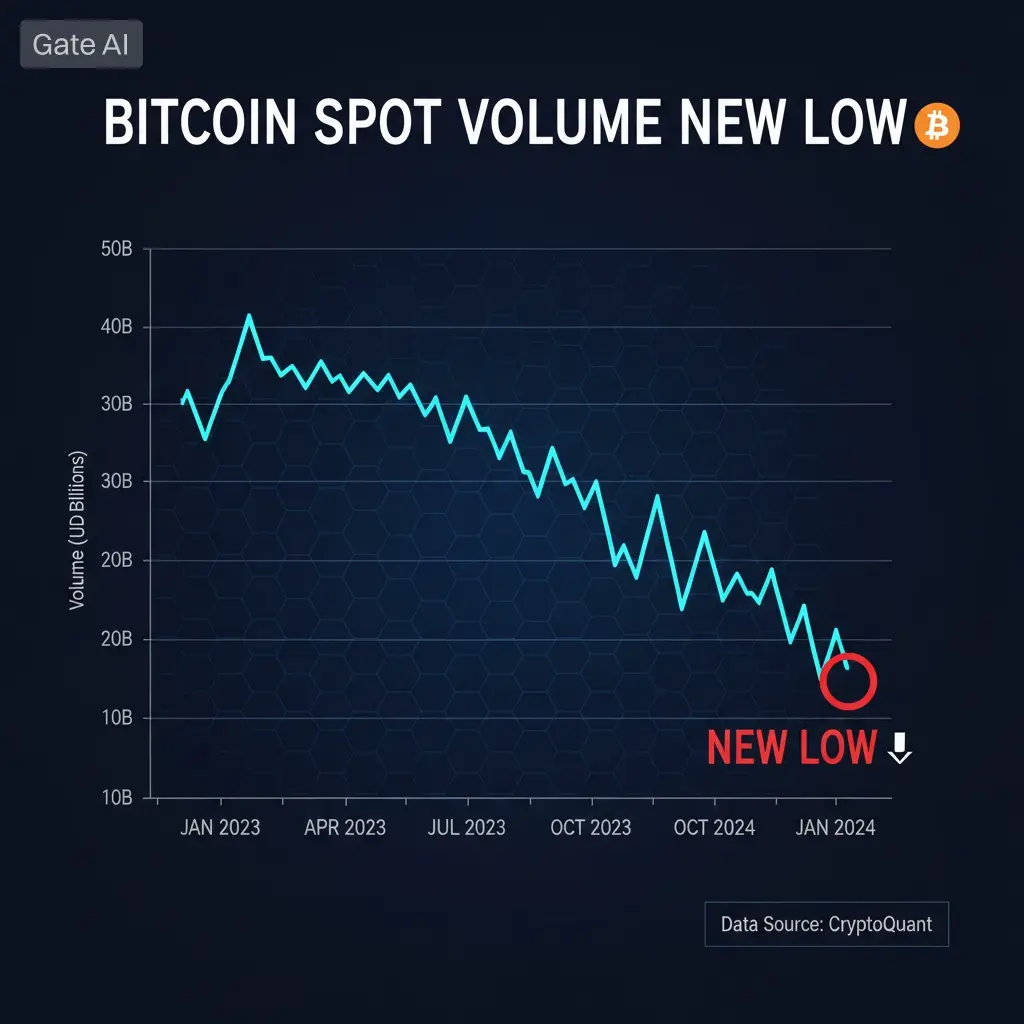
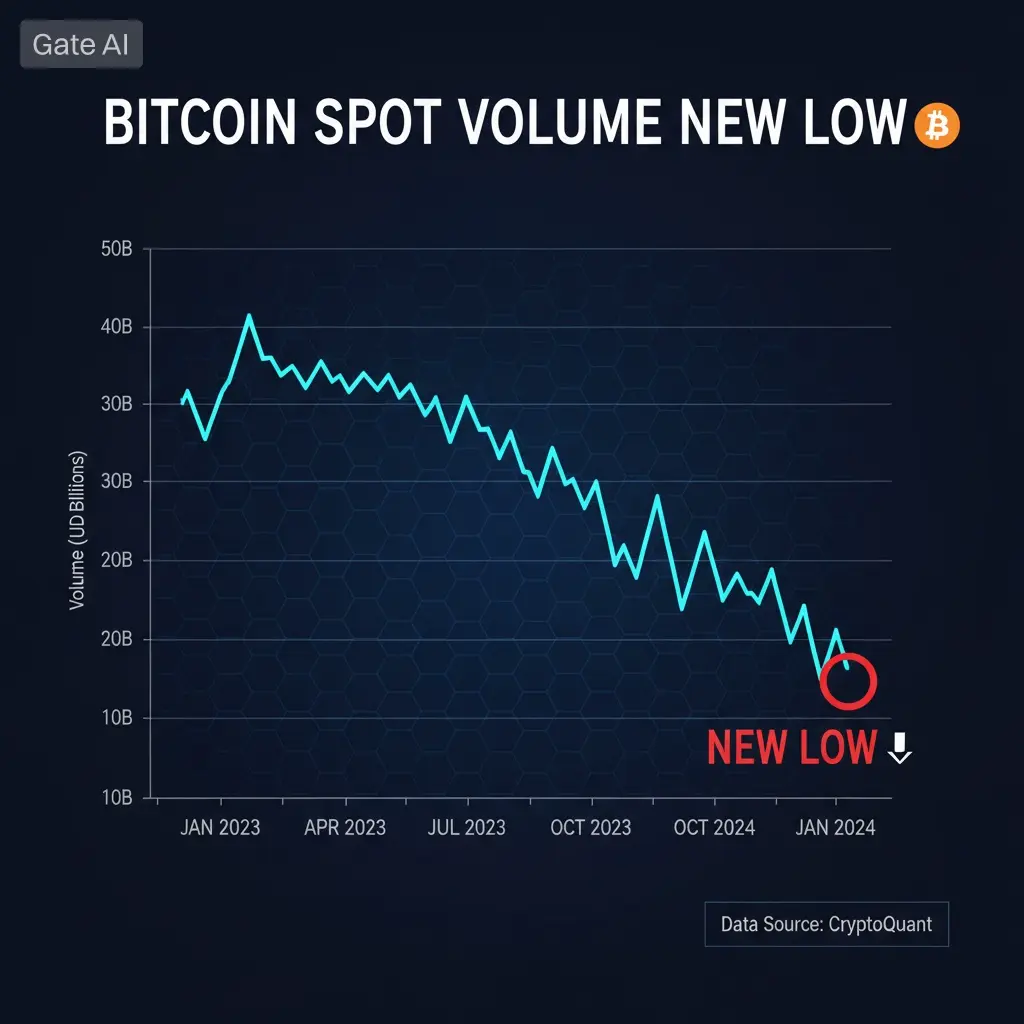
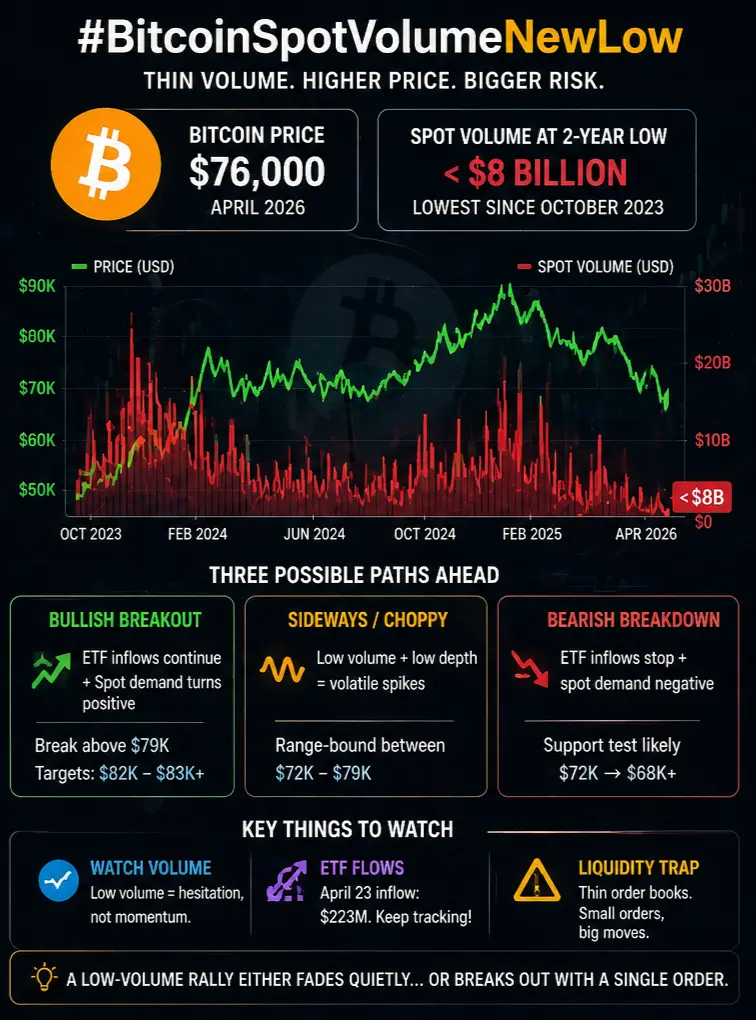
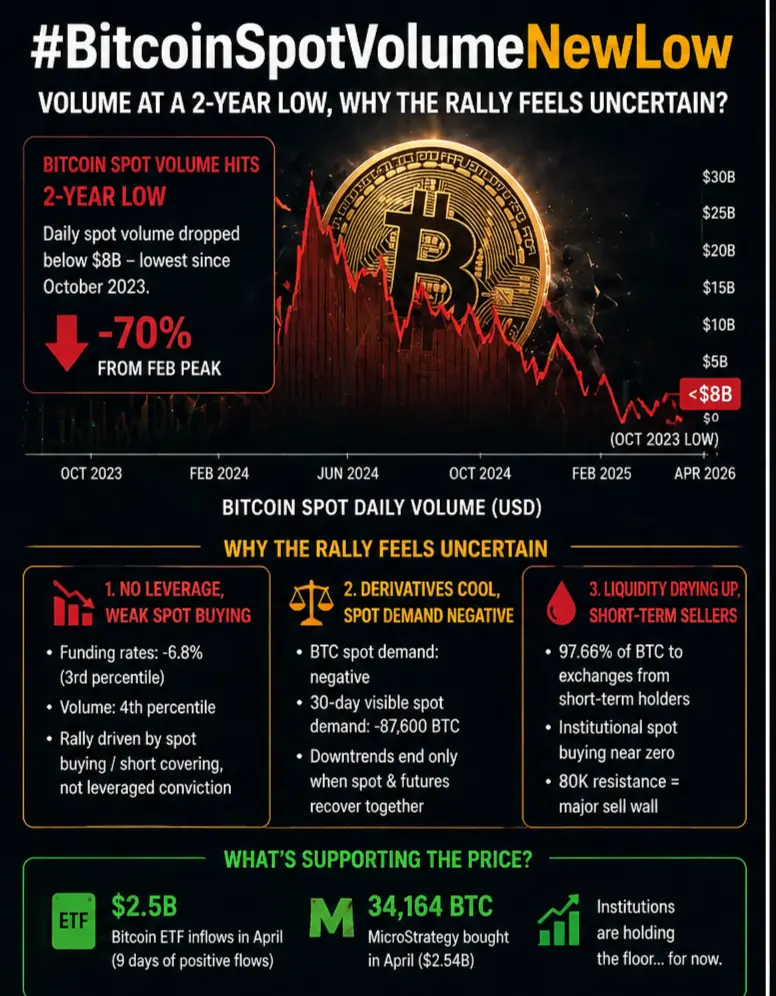
Daily spot trading volume has fallen below 8 B , h i t t i n g i t s l o w e s t l e v e l s i n c e O c t o b e r 2023 a n d d o w n n e a r l y 70 8B,hittingitslowestlevelsinceOctober2023anddownnearly7080K. Calm before the storm — or a quiet buildup for the next leg up?

#BitcoinSpotVolumeNewLow
#BitcoinLowVolume
🚨 Bitcoin Quiet Phase — The Market Is Not Weak, It’s Waiting 🚨
Bitcoin’s drop in spot volume is not a sign of failure—it’s a sign of pause.
Right now, the market is entering a low-participation phase, where activity slows down, conviction fades, and price begins to move less aggressively. This is not where trends end—this is where the next move is prepared.
---
🧭 Market Condition — Silence After Movement
After strong price action, markets don’t continue with the same energy. They slow down.
Bitcoin recently:
Pushed toward $79K
Faced selling pressu
BTC-1.6%
post-image
  • Reward
  • 3
  • Repost
  • Share
Dubai_Prince:
2026 GOGOGO 👊
View More
#BitcoinSpotVolumeNewLow
🌐 Declining Spot Volume — What It Signals About Market
Participation and Cycle Behavior
By DragonKing143
In digital asset markets, volume is
often a more revealing indicator than price itself. The emergence of #BitcoinSpotVolumeNewLow
reflects a period where trading participation in spot markets appears to be
contracting, even as broader interest in the asset class remains structurally
intact.
Within the ecosystem of Bitcoin,
such volume shifts are not unusual. They typically represent changes in
participant behavior, liquidity distribution, and short-term engagemen
BTC-1.6%
post-image
  • Reward
  • Comment
  • Repost
  • Share
#BitcoinSpotVolumeNewLow #比特币现货交易量新低 Bitcoin BTC/ETH consolidating with decreasing volume, approaching a turning point
1. Macro key signals (impacting today’s market)
1. The Federal Reserve maintaining interest rates + Wosh’s nomination advancing: Short-term liquidity expectations are neutral to slightly warm, but the rate cut window is delayed until after June, institutions are reluctant to chase high, favoring “buy on pullback.”
2. Tensions between the US and Iran + increased geopolitical risk aversion: Gold and US Treasuries slightly strengthen, crypto market risk sentiment rises, high-pos
BTC-1.6%
ETH-3.31%
post-image
post-image
  • Reward
  • 2
  • Repost
  • Share
AylaShinex:
LFG 🔥
View More
#BitcoinSpotVolumeNewLow #比特币现货交易量新低 Bitcoin BTC/ETH consolidating with decreasing volume, approaching a turning point
1. Macro key signals (impacting today’s market)
1. The Federal Reserve maintaining interest rates + Wosh’s nomination advancing: Short-term liquidity expectations are neutral to slightly warm, but the rate cut window is delayed until after June, institutions are reluctant to chase high, favoring “buy on pullback.”
2. Tensions between the US and Iran + increased geopolitical risk aversion: Gold and US Treasuries slightly strengthen, crypto market risk sentiment rises, high-pos
BTC-1.6%
ETH-3.31%
AngelEye
#BitcoinSpotVolumeNewLow #比特币现货交易量新低 Bitcoin BTC/ETH consolidating with decreasing volume, approaching a turning point
1. Macro key signals (impacting today’s market)
1. The Federal Reserve maintaining interest rates + Wosh’s nomination advancing: Short-term liquidity expectations are neutral to slightly warm, but the rate cut window is delayed until after June, institutions are reluctant to chase high, favoring “buy on pullback.”
2. Tensions between the US and Iran + increased geopolitical risk aversion: Gold and US Treasuries slightly strengthen, crypto market risk sentiment rises, high-position funds are more willing to take profits.
3. Key milestone on May 5th: Trump’s “Bitcoin Strategic Reserve” executive order approaches: Market anticipates pre-emptive betting, large fluctuations may occur in early May.
4. Spot BTC ETF net inflow in April hits a new high since October last year: Institutional long-term buying logic remains unchanged, pullbacks are buying opportunities (consensus among big influencers).
2. BTC Market Analysis (mainstream opinion from influencers: oscillating bottoming, waiting for a breakout)
Core support: $75,500 (20/100-day moving averages + historically dense buy zone, about 298k BTC accumulated here), as long as it holds, the bullish structure remains intact.
Strong resistance: $77,150, a daily close above can see a rebound to $77,500; $79,500 is April’s high, a breakout opens the door to $80k range.
Consensus among influencers: narrow oscillation between $75,500–$77,000, a breakout could happen within the next two days; a break below $75,500 targets $74,000, losing $73,000 would break the uptrend.
Trading suggestion: Hold spot, buy on dips in batches; wait-and-see on futures, add longs after breaking $77,150, stop-loss and exit if below $75,500.
3. ETH Market Analysis (mainstream influencer view: weak, rebound is shorting opportunity)
Core support: $2,220, if broken look to $2,180, strong support at $2,120.
Strong resistance: $2,330–$2,350 (21-day moving average + EMA50 resistance), only a volume breakout above $2,400 targets $2,500–$2,550.
Influencer consensus: ETH is clearly weaker than BTC, MACD on hourly chart shows strong bearish momentum, rebounds are opportunities to short; do not hold longs below $2,350.
Trading suggestion: Hold spot for now, no bottom-fishing; on futures, short lightly on rebounds between $2,330–$2,350, stop-loss above $2,400.
4. Gold Market Analysis
News interpretation:
The Fed is hawkish, delaying rate cuts, US Treasury yields strengthen, dollar strengthens; oil prices push inflation persistence, suppressing rate cuts; short-term funds take profits, ETF slightly outflows.
In the short term, high interest rate expectations suppress gold, but medium to long-term geopolitical tensions + central bank gold purchases still support prices.
Technical analysis: Daily chart continues downward, yesterday closed with a bearish candle with a lower shadow, emphasizing that around 4520 is a good level for northbound moves, and this dense zone is still relevant. Despite negative news, buy orders in this area are strong, and there is a bullish divergence on the hourly chart, indicating momentum is gradually digesting. The rebound strength appears weak on the market; focus on the 4480–4520 zone today. Use this zone for a medium-term bullish outlook, and after news shocks, the market will gradually calm down. The subsequent process may involve sideways correction, with upward movement requiring time. Wait patiently, with strategy to buy north of 4520, with support at 4460, and targets at 4600–4700–4800–5000 (can hold positions).

Disclaimer: The above information is for reference only, not trading advice. Cryptocurrency markets are high risk; participation should be cautious.

repost-content-media
  • Reward
  • Comment
  • Repost
  • Share
#BitcoinSpotVolumeNewLow
🚨 Bitcoin Market Structure Signal — Spot Volume at New Low 🚨
The emergence of a “Bitcoin spot volume new low” condition is a significant microstructure signal that speaks less about price direction in isolation and more about the underlying participation quality of the market. In liquid markets like Bitcoin, price is only one dimension of behavior; volume, participation breadth, and execution intensity often provide a deeper reading of the system’s internal state.
When spot volume declines to new lows, it typically indicates a reduction in genuine directional convi
BTC-1.6%
EagleEye
#BitcoinSpotVolumeNewLow
🚨 Bitcoin Market Structure Signal — Spot Volume at New Low 🚨
The emergence of a “Bitcoin spot volume new low” condition is a significant microstructure signal that speaks less about price direction in isolation and more about the underlying participation quality of the market. In liquid markets like Bitcoin, price is only one dimension of behavior; volume, participation breadth, and execution intensity often provide a deeper reading of the system’s internal state.
When spot volume declines to new lows, it typically indicates a reduction in genuine directional conviction from cash-driven participants. Spot volume represents real buying and selling activity without leverage amplification, meaning it is closely tied to organic demand rather than derivative-driven speculation. A drop in this metric suggests that fewer participants are engaging in outright accumulation or distribution at current price levels.
This type of environment often reflects a transition into a low-conviction equilibrium phase. In such phases, the market is not strongly trending in either direction because neither buyers nor sellers are aggressively willing to transact at prevailing prices. Instead, activity becomes dominated by passive flows, internal position adjustments, and derivative hedging rather than strong spot-driven accumulation.
One important implication of declining spot volume is the potential weakening of price discovery efficiency. In healthy trending markets, rising or sustained volume confirms directionality and supports continuation. When volume contracts, price movements become more sensitive to relatively small orders, which can increase short-term volatility but reduce structural momentum.
This condition is often associated with what can be described as a “liquidity air pocket” at the spot layer. In such environments, the visible order flow on exchanges thins out, and marginal price movements are increasingly driven by derivatives positioning rather than cash market demand. This does not necessarily imply bearishness, but it does indicate fragility in trend continuation unless new demand enters the system.
From a behavioral perspective, low spot volume often corresponds with a phase of uncertainty or wait-and-see positioning among market participants. Traders may be reluctant to commit capital due to lack of clear macro catalysts, mixed sentiment signals, or anticipation of higher-impact events. This leads to reduced turnover and lower engagement in directional spot trades.
At the same time, it is important to distinguish between distribution-driven low volume and accumulation-driven low volume environments. In distribution phases, declining volume is accompanied by sustained selling pressure and weakening support levels. In accumulation phases, low volume may occur while long-term holders quietly absorb supply without aggressive trading activity. The key difference lies in whether price structure remains stable or begins to deteriorate.
In the current context, the presence of low spot volume combined with broader macro sensitivity suggests a transitional structure rather than a clear directional regime. Markets in this state often consolidate, forming ranges where volatility compresses and participants await external catalysts to define the next impulse move.
Another critical layer is the interaction with derivatives markets. When spot volume declines, futures and perpetual markets often become more dominant in price formation. This can lead to a situation where price is driven more by leverage dynamics, funding rates, and liquidation cascades than by underlying cash demand. In such cases, short-term price action may appear more volatile or disconnected from spot flow, even though the underlying driver is structural liquidity imbalance.
Low spot volume conditions also tend to precede periods of volatility expansion. When participation compresses for an extended period, the market becomes increasingly sensitive to external shocks. A relatively small catalyst—macro data, ETF flows, regulatory news, or large order execution—can trigger outsized price movement because there is limited depth of active participation to absorb the flow.
From a cycle perspective, these phases often occur after either strong upward or downward moves, when the market is digesting prior volatility. Participants who were active during the previous trend may have reduced engagement, while new participants have not yet entered at scale. This creates a temporary participation gap.
Importantly, low spot volume does not inherently imply bearish structure. Instead, it reflects a state of indecision or equilibrium where conviction is absent on both sides. The eventual resolution depends on which side—buyers or sellers—re-enters the market with sufficient strength to break the equilibrium.
If new demand emerges, low-volume environments can act as springboards for rapid upward repricing due to thin resistance. Conversely, if latent supply dominates, the same conditions can lead to accelerated downside once support levels fail.
In summary, Bitcoin spot volume reaching a new low is a structural signal of reduced organic participation, increased reliance on derivatives for price discovery, and a transitional market state characterized by low conviction and compressed liquidity. While not inherently directional, it often marks a preparatory phase for larger volatility expansion once external catalysts reintroduce strong participation into the system.
repost-content-media
  • Reward
  • 5
  • Repost
  • Share
HighAmbition:
good information 👍👍👍
View More
#BitcoinSpotVolumeNewLow
🚨 Bitcoin Market Structure Signal — Spot Volume at New Low 🚨
The emergence of a “Bitcoin spot volume new low” condition is a significant microstructure signal that speaks less about price direction in isolation and more about the underlying participation quality of the market. In liquid markets like Bitcoin, price is only one dimension of behavior; volume, participation breadth, and execution intensity often provide a deeper reading of the system’s internal state.
When spot volume declines to new lows, it typically indicates a reduction in genuine directional convi
BTC-1.6%
post-image
  • Reward
  • 8
  • Repost
  • Share
Miss_1903:
2026 GOGOGO 👊
View More
#BitcoinSpotVolumeNewLow
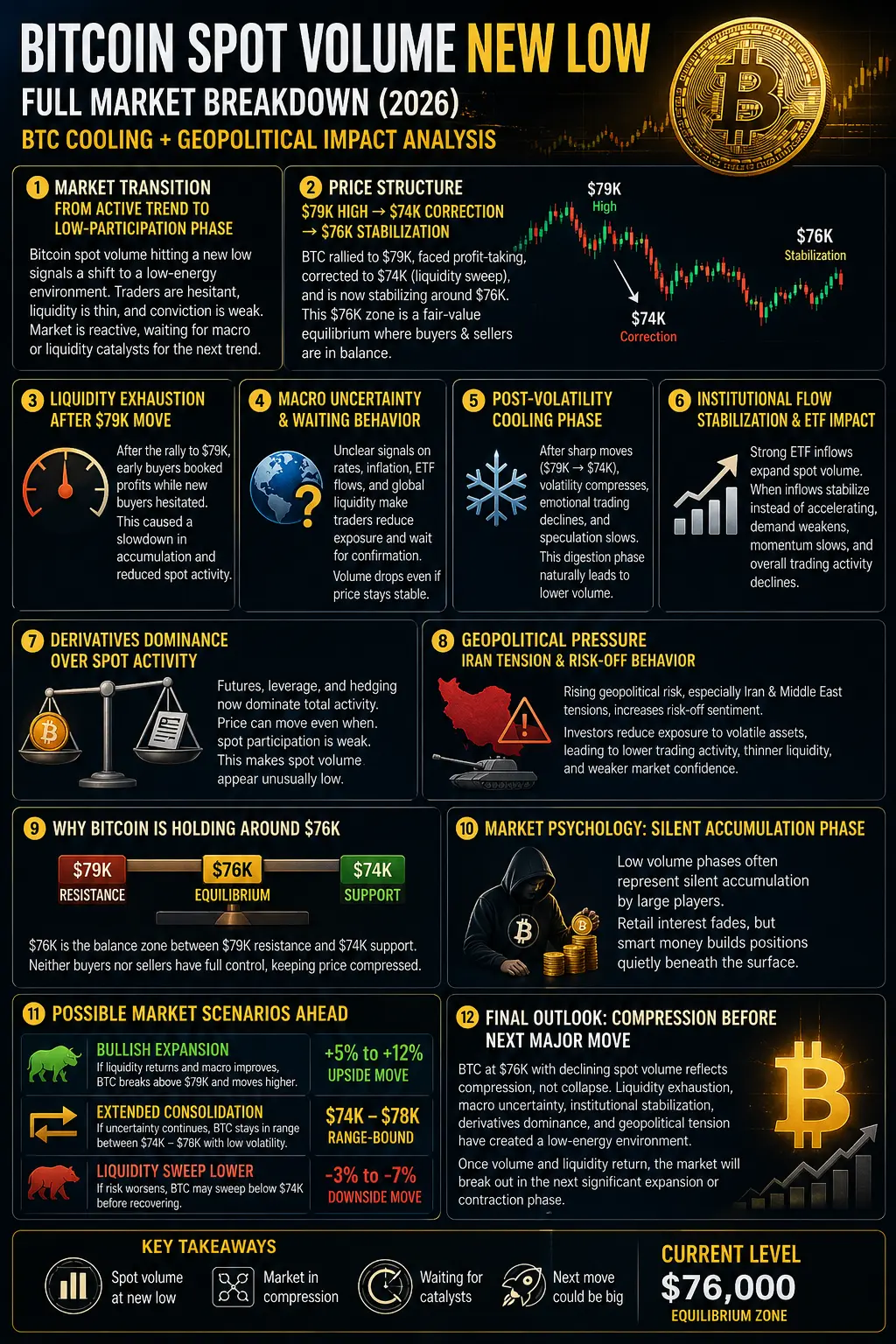
Market Transition: From Active Trend to Low-Participation Phase
Bitcoin spot volume reaching a new low reflects a major shift in market structure where real buying and selling activity has significantly slowed down. This does not indicate a collapse in price action, but rather a transition into a low-energy environment where traders are hesitant, liquidity is thin, and conviction is weak. In such phases, the market is not strongly directional; instead, it becomes reactive, waiting for new macro or liquidity catalysts before committing to a clear trend.
Price Structure
BTC-1.6%
HighAmbition
#BitcoinSpotVolumeNewLow
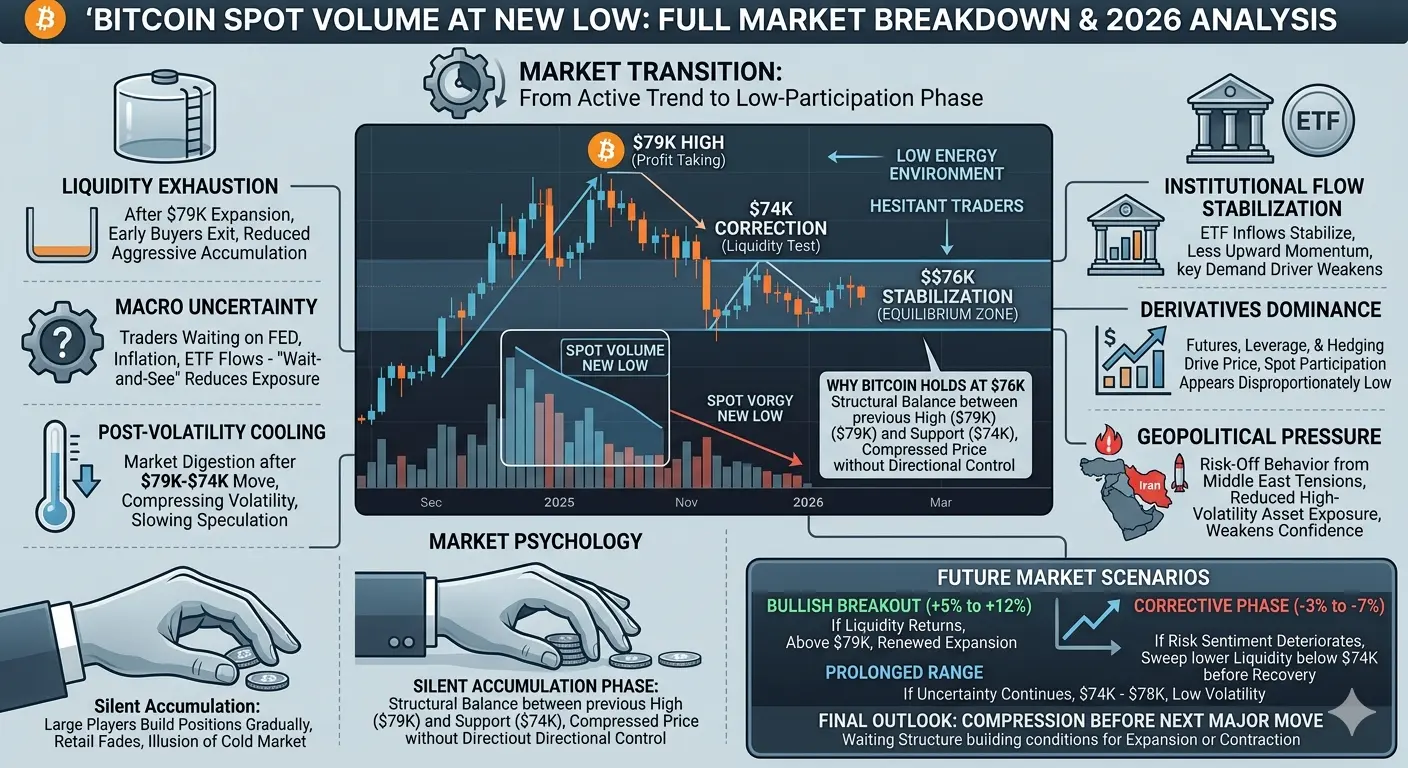
Market Transition: From Active Trend to Low-Participation Phase
Bitcoin spot volume reaching a new low reflects a major shift in market structure where real buying and selling activity has significantly slowed down. This does not indicate a collapse in price action, but rather a transition into a low-energy environment where traders are hesitant, liquidity is thin, and conviction is weak. In such phases, the market is not strongly directional; instead, it becomes reactive, waiting for new macro or liquidity catalysts before committing to a clear trend.
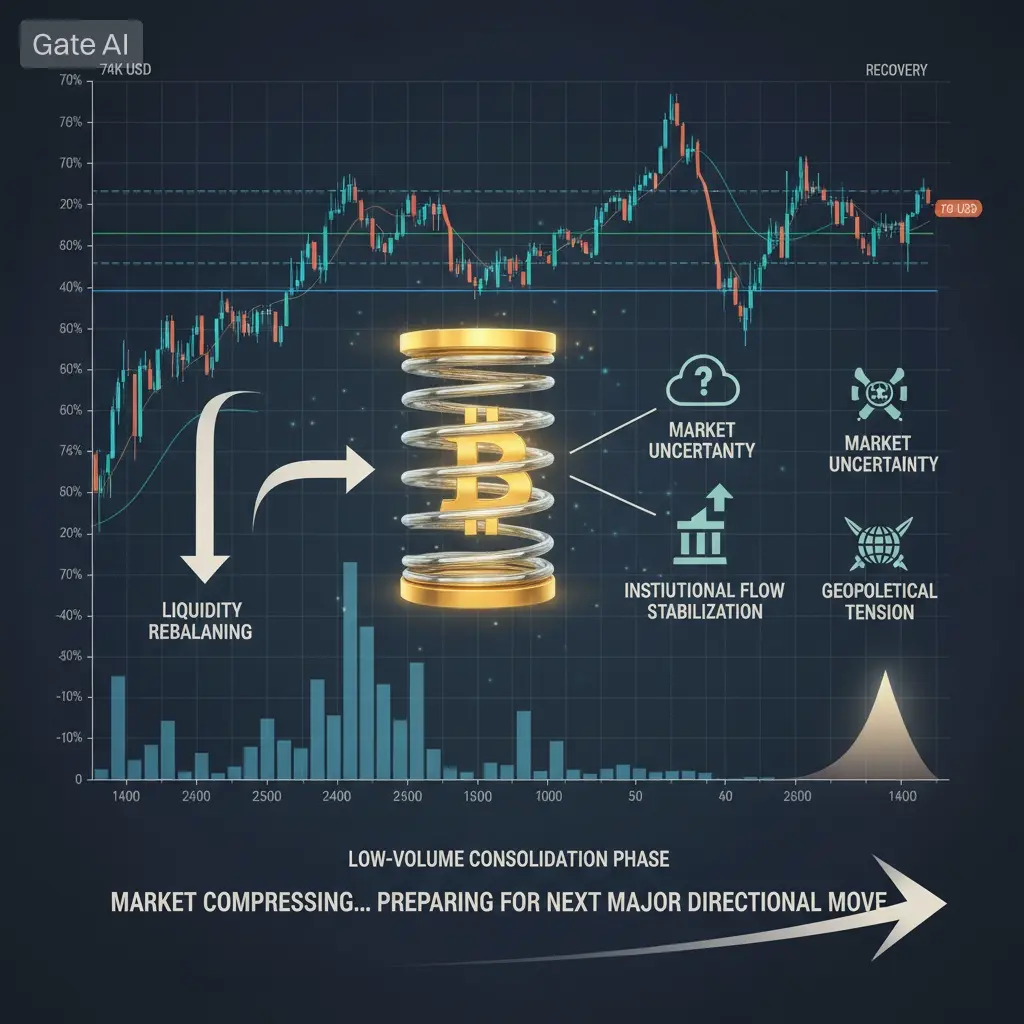
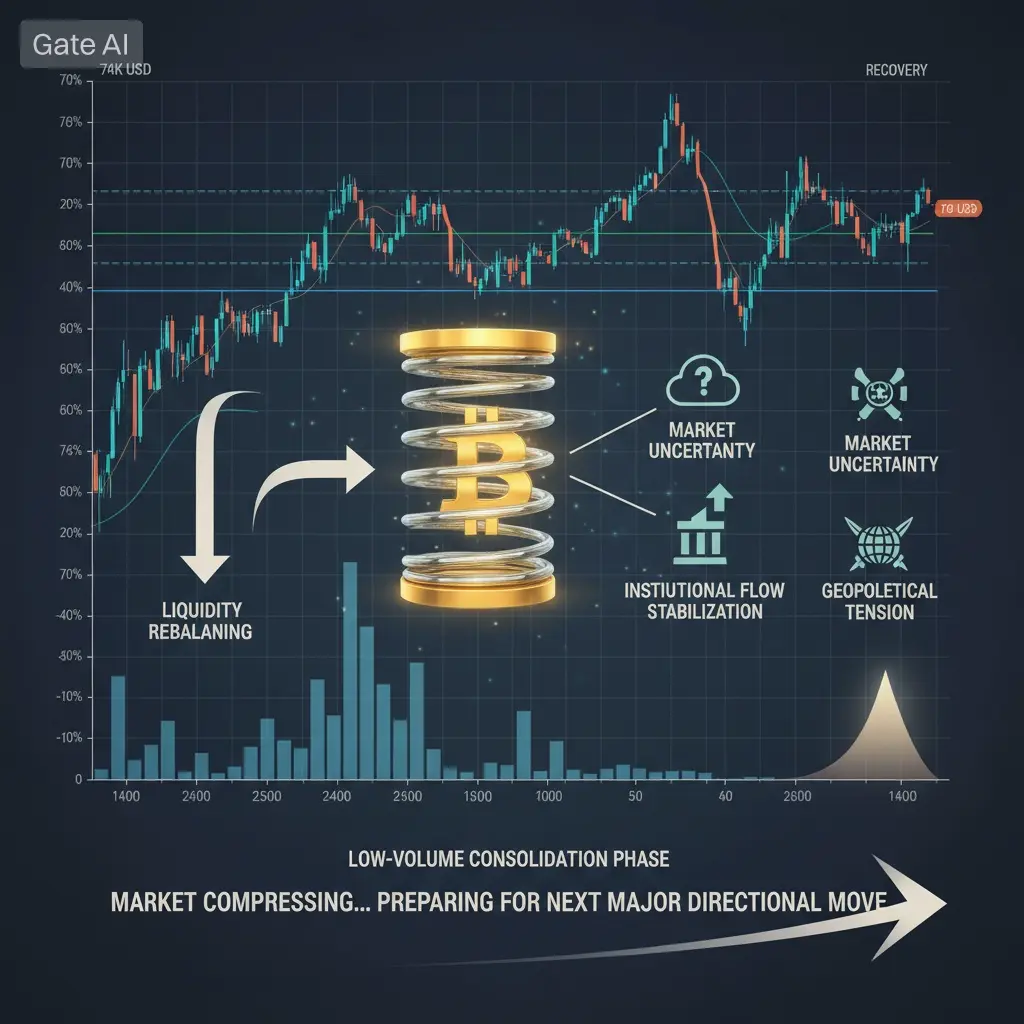
Price Structure: $79K High → $74K Correction → $76K Stabilization
Bitcoin recently formed a clear liquidity sequence where price expanded toward the $79,000 zone, faced strong profit-taking pressure, and then corrected toward $74,000 before stabilizing around $76,000. This movement reflects a typical market cycle where liquidity is first consumed at higher levels, then tested at lower support zones, and finally balanced at an equilibrium point. The current $76K level is acting as a temporary fair-value zone where buyers and sellers are in relative balance, but without strong participation from either side.
Liquidity Exhaustion After the $79K Move
One of the key reasons behind declining spot volume is liquidity exhaustion after the $79K expansion. At that level, early buyers began taking profits, while new participants showed hesitation due to elevated pricing. This created a natural slowdown in aggressive accumulation, leading to reduced spot activity. When liquidity is exhausted at higher levels, markets often enter a cooling phase where both demand and supply weaken simultaneously.
Macro Uncertainty and Waiting Behavior
Bitcoin is highly sensitive to macroeconomic conditions, including interest rate expectations, inflation data, ETF flows, and global liquidity cycles. When these signals become unclear or mixed, traders tend to reduce exposure and wait for confirmation. This “wait-and-see” behavior directly reduces spot trading activity because market participants avoid aggressive positioning in uncertain environments. As a result, volume declines even if price remains relatively stable.
Post-Volatility Cooling and Market Digestion
After the move from $79K to $74K and the stabilization near $76K, the market naturally enters a cooling phase. Volatility compresses, emotional trading declines, and short-term speculation slows down. This is a structural digestion phase where the market processes previous volatility before forming the next major directional move. Low volume during this stage is a normal outcome of reduced trading energy.
Institutional Flow Stabilization and ETF Impact
Institutional participation, especially through ETF-related flows, plays a crucial role in Bitcoin’s liquidity structure. When inflows are strong, spot volume expands alongside price. However, when inflows stabilize instead of accelerating, the market loses a key driver of demand. This stabilization reduces upward momentum and contributes to lower trading activity, reinforcing the current low-volume environment.
Derivatives Dominance Over Spot Market Activity
A major structural shift in modern crypto markets is the increasing dominance of derivatives over spot trading. Futures, leverage, and hedging instruments now account for a large portion of total activity. This means that price can remain active even when spot participation is weak. In such conditions, spot volume appears unusually low because price movement is increasingly driven by leveraged positioning rather than direct asset accumulation.
Geopolitical Pressure: Iran Tension and Risk-Off Behavior
Geopolitical instability, particularly involving Iran and broader Middle East tensions, has added another layer of pressure on market participation. During periods of rising geopolitical risk, investors typically reduce exposure to high-volatility assets like Bitcoin. This risk-off behavior leads to lower trading activity, reduced liquidity, and weaker market confidence. Even if price does not crash, uncertainty alone is enough to suppress volume and delay aggressive positioning.
Why Bitcoin is Holding Around $76K
The $76,000 level currently represents a structural equilibrium zone between the previous high at $79K and the support at $74K. It is not a random price level but a balance point where the market is temporarily stabilizing. At this stage, neither buyers nor sellers have full control, which is why price remains compressed without strong directional breakout.
Market Psychology: Silent Accumulation Phase
Despite low volume and weak participation, the market is not inactive underneath the surface. Historically, low-volume phases often represent silent accumulation periods where larger players build positions gradually without creating visible momentum. Retail participation typically fades during such phases, creating the illusion of a “cold” market, even though structural positioning is developing quietly.
Possible Market Scenarios Ahead
If liquidity returns and macro conditions improve, Bitcoin could break above $79K again and enter a renewed expansion phase, potentially delivering a +5% to +12% upside move. If uncertainty continues, the market may remain in a prolonged range between $74K and $78K with low volatility. Alternatively, if risk sentiment deteriorates further due to macro or geopolitical shocks, Bitcoin may briefly sweep lower liquidity below $74K before recovering, resulting in a short corrective phase of approximately -3% to -7%.
Final Outlook: Compression Before Next Major Move
Bitcoin at $76,000 with declining spot volume reflects a market in compression rather than collapse. The combination of liquidity exhaustion, macro uncertainty, institutional stabilization, derivatives dominance, and geopolitical tension has created a low-energy environment where participation is reduced and conviction is absent. However, such phases are often transitional and precede larger directional moves once volume and liquidity return. The market is currently in a waiting structure, building conditions for its next significant expansion or contraction phase.
repost-content-media
  • Reward
  • 3
  • Repost
  • Share
MasterChuTheOldDemonMasterChu:
Steadfast HODL💎
View More
#BitcoinSpotVolumeNewLow
Market Transition: From Active Trend to Low-Participation Phase
Bitcoin spot volume reaching a new low reflects a major shift in market structure where real buying and selling activity has significantly slowed down. This does not indicate a collapse in price action, but rather a transition into a low-energy environment where traders are hesitant, liquidity is thin, and conviction is weak. In such phases, the market is not strongly directional; instead, it becomes reactive, waiting for new macro or liquidity catalysts before committing to a clear trend.
Price Structure
BTC-1.6%
post-image
post-image
post-image
post-image
  • Reward
  • 24
  • Repost
  • Share
GateUser-68291371:
Hold tight 💪
View More
#BitcoinSpotVolumeNewLow #BitcoinSpotVolumeNewLow
The current state of the crypto market presents a paradox that seasoned traders recognize immediately but newer participants often overlook: price can rise while conviction quietly disappears. The hashtag #BitcoinSpotVolumeNewLow captures this exact moment in the market cycle—a phase where Bitcoin is holding strong near the $76,000–$79,000 range, yet the underlying participation tells a completely different story. On the surface, stability looks reassuring. Beneath it, the structure feels fragile, almost like a rally balancing on invisible supp
BTC-1.6%
post-image
post-image
  • Reward
  • 5
  • Repost
  • Share
ybaser:
Just charge forward 👊
View More
#BitcoinSpotVolumeNewLow
Volume at a 2-Year Low, Why the Rally Feels Uncertain?
Bitcoin is consolidating around 76,000 dollars in April 2026, but the headlines are not about price. They are about volume. Spot trading volume fell to its lowest level since October 2023. Price is up, participation is down. So what does that actually mean?
Looking at the numbers, the drop is clear. Glassnode data shows daily Bitcoin spot volume slipped below 8 billion dollars, the lowest since October 2023. That is down 70 percent from the 25 billion dollar plus peak seen in early February. According to 10x Rese
BTC-1.6%
ETH-3.31%
post-image
post-image
  • Reward
  • 22
  • Repost
  • Share
Sakura_3434:
Just charge forward 👊
View More
Load More

Join 40 M users in our growing community

⚡️ Join 40 M users in the crypto craze discussion
💬 Engage with your favorite top creators
👍 See what interests you