
Futures
Access hundreds of perpetual contracts
TradFi
Gold
One platform for global traditional assets
Options
Hot
Trade European-style vanilla options
Unified Account
Maximize your capital efficiency
Demo Trading
Introduction to Futures Trading
Learn the basics of futures trading
Futures Events
Join events to earn rewards
Demo Trading
Use virtual funds to practice risk-free trading
Launch
CandyDrop
Collect candies to earn airdrops
Launchpool
Quick staking, earn potential new tokens
HODLer Airdrop
Hold GT and get massive airdrops for free
Launchpad
Be early to the next big token project
Alpha Points
Trade on-chain assets and earn airdrops
Futures Points
Earn futures points and claim airdrop rewards


More



Water Utilities Market "Scarce Resources, Many Competitors" E20 Xue Tao: The era of water utilities development dominated by "fighting for territory" has ended
The Beijing Bureau of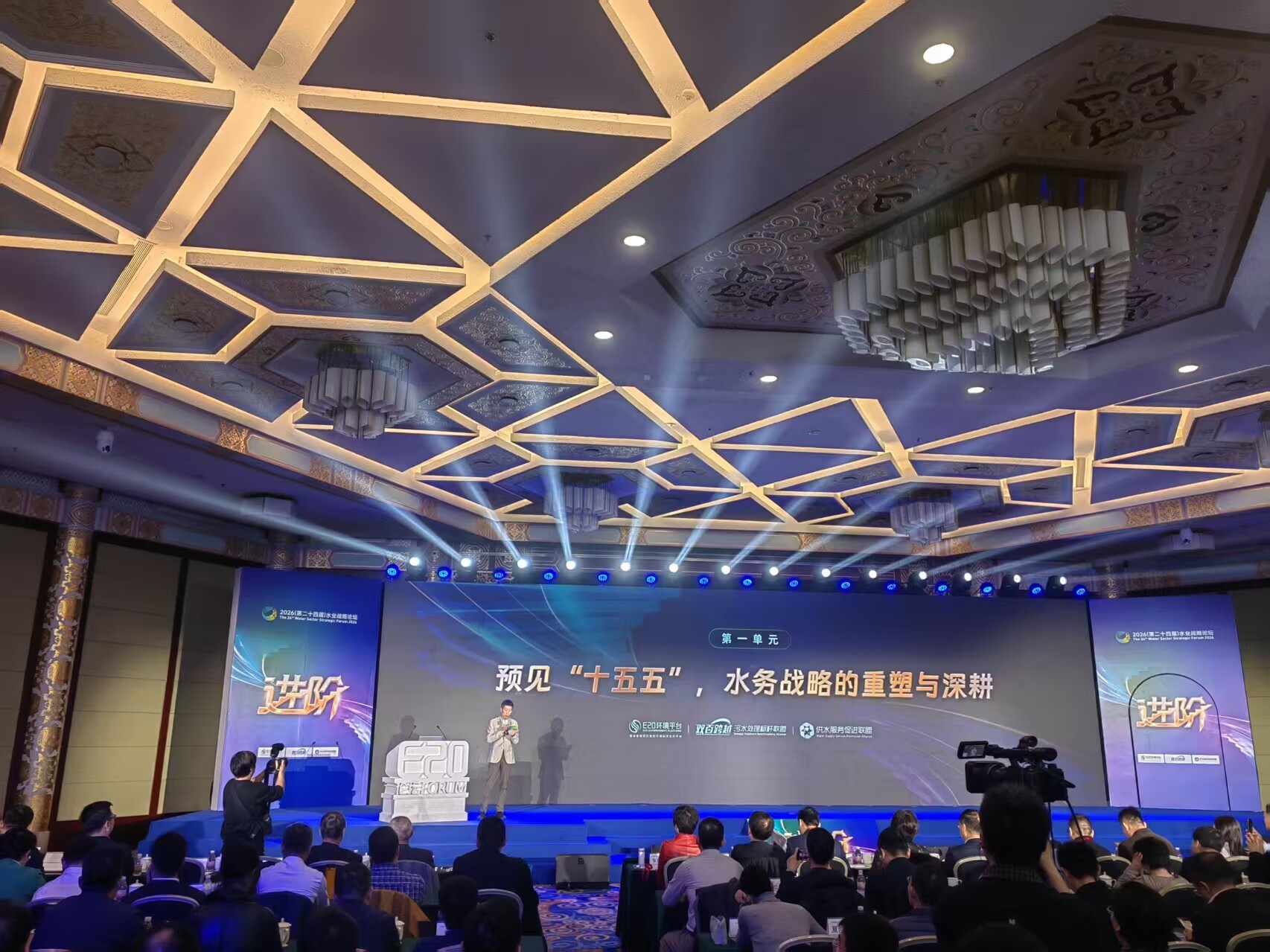 March 26, (Reporter Li Biao) On March 26, at the “2026 (24th) Water Industry Strategic Forum,” hosted by the E20 Environmental Platform, discussions on the evolution of the water services industry and future growth pathways were underway within the industry. The “scale expansion” development model appears to be collectively being abandoned by water utilities.
Zhang Lizhen, deputy director of the National Engineering Research Center for Environmental Protection Technology Management and Evaluation, introduced that 2026 is a year with special significance. We are at a historical intersection between the conclusion of the “14th Five-Year Plan” and the start of the “15th Five-Year Plan,” and we are also in a critical period when China’s water services industry is being profoundly reshaped. Complex and ever-changing external conditions, and deep adjustments to internal structures, are driving the industry to shift from past scale expansion toward value-focused development centered on “intelligent industry empowerment.” Low-carbon transformation, improving quality and efficiency, systems-based governance, and the integration of digital and intelligence are redefining the underlying logic and development path of the water services industry.
In response, Ma Yuntong, senior vice president of Beijing Enterprises Water Group Co., Ltd., said that the entire industry has entered a deep-water zone of existing inventory. Specifically, the speed of releasing incremental scale has dropped sharply. Compared with the period of the “13th Five-Year Plan,” during the “14th Five-Year Plan” period, whether it is municipal pipeline networks for wastewater or sludge, the proportion by which the incremental release speed falls across various business segments may exceed 50%. Therefore, the traditional model of heavy-asset scale expansion, it should be said, can hardly continue.
Meanwhile, at the forum site, Xue Tao, executive partner of the E20 Environmental Platform and executive dean of its research institute, pointed out that an era of water services development led by large-scale construction or “conquering and claiming territory” has ended. In recent years, the marketization rate of municipal wastewater has generally remained stable overall, but there may be differences in perception across different regions.
Xue Tao further said that local governments in first- and second-tier cities are gradually reclaiming concession rights, while in third- and fourth-tier cities, concession rights are still being released due to fiscal pressure. Some other cities are in a middle state: although their fiscal conditions are still relatively acceptable, they choose to extend concession rights for reasons related to debt reduction. Therefore, the current marketization rate of municipal wastewater is essentially the result of multiple interwoven forces balancing each other, and the marketization rate of municipal wastewater basically remains within a stable range of normalization.
“Over the past few years, the number of concession projects that have been newly released in the water services market has indeed decreased, and companies competing for projects in the market have correspondingly also decreased. Overall, the water services market still shows a ‘porridge is scarce and monks are many’ situation—that is the situation reflected in our data. More worrying is that in recent years, most of the localities willing to release concession projects have poorer location conditions, and even if they are taken out, it is not necessarily that someone will take over them.” Xue Tao said.
So, where is the way out for the industry? In response, Xue Tao told reporters from the Economic Daily News: For scale expansion, most water utilities have been showing a relatively cautious approach. Now, within the water services industry, companies are exploring certain development paths, and there are some cases of transformation and development, but it is still difficult to compare them with the prior conventional models.
Site of the 2026 (24th) Water Industry Strategic Forum Photo by Li Biao, Economic Daily News reporter