
Futures
Access hundreds of perpetual contracts
TradFi
Gold
One platform for global traditional assets
Options
Hot
Trade European-style vanilla options
Unified Account
Maximize your capital efficiency
Demo Trading
Introduction to Futures Trading
Learn the basics of futures trading
Futures Events
Join events to earn rewards
Demo Trading
Use virtual funds to practice risk-free trading
Launch
CandyDrop
Collect candies to earn airdrops
Launchpool
Quick staking, earn potential new tokens
HODLer Airdrop
Hold GT and get massive airdrops for free
Launchpad
Be early to the next big token project
Alpha Points
Trade on-chain assets and earn airdrops
Futures Points
Earn futures points and claim airdrop rewards


More






Wen Chengkai: 3.30 Safe-haven assets lose their shine, gold surges then pulls back, falling back into volatility
In the early trading session in Asia today, global financial markets once again saw sharp volatility. The U.S. Dollar Index extended its strong uptrend, rising 0.17% during the session to break above the 100.33 level, marking the highest since March 16—this is the fifth consecutive trading day of gains. At the same time, spot gold put on a roller-coaster move: it surged as high as $4,514 at the open, then quickly fell back to around $4,420, with the intraday decline nearly 1.3%.
Market analysis shows that gold’s current price action displays a typical tug-of-war between bulls and bears. On the one hand, safe-haven buying supported the price of gold as tensions in the Middle East escalated; on the other hand, a sharp jump in international oil prices intensified inflation concerns. WTI crude surged 3% intraday to break above $103 per barrel, setting a three-week high. This strengthens expectations that the Federal Reserve will keep interest rates high, driving the dollar higher and thereby weighing on gold’s performance.
From the standpoint of market sentiment and structure, gold’s performance shows clear divergence: On the spot side, price fluctuations have somewhat narrowed, with the daily chart maintaining range-bound movement—indicating that near-term direction for bulls versus bears is not yet clear. On the volatility side, gold’s volatility index remains at a relatively high level, suggesting that the potential impact of geopolitical risks has not been fully released and the market still faces the possibility of extreme volatility. This divergence precisely confirms the market’s shift: it is gradually moving away from emotion-driven chasing and back to a rational pricing logic based on interest rates and macroeconomic fundamentals, and the near-term consolidation is merely a transition.
Gold range-bound consolidation—pullbacks are your chance to get on board
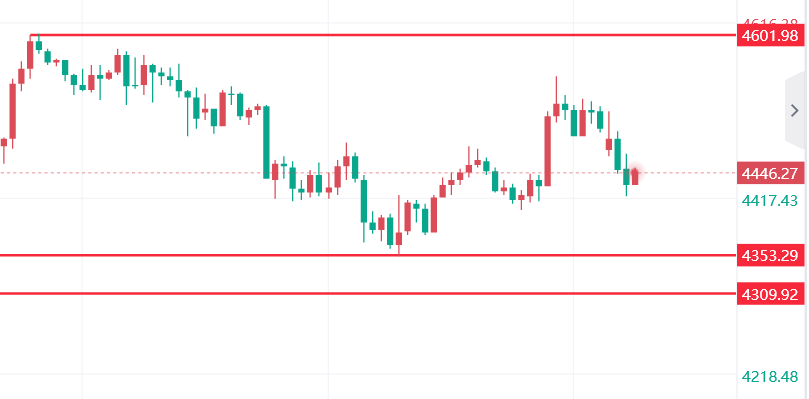
Gold maintains a range-bound pattern of $4,300–$4,700: Short-term resistance: $4,550–$4,600; Short-term support: $4,400–$4,350; Breakout logic: a valid break above $4,600 could open up upside room for a rebound; if it breaks below $4,300, it may further test the medium-term lows. Overall, the technical picture is mainly about repair—trend opportunities require coordination with fundamental data.
Based on the current market conditions and the core logic, Wen Chengkai provides a clear conclusion:
(I) Near-term view: A high probability of stabilization around $4,350. With gold currently pulling back to around $4,350, I believe the downside room in the short term is essentially limited, so it is not advisable to chase shorts on the short-term. This round of action is more likely a second pullback to test the lows rather than a direct break through the $4,100 medium-term low. In the short term, the likelihood of $4,100 being broken through again is extremely low.
(II) Core opportunity: a second pullback—position for the main upswing. A second pullback is by no means a bad thing; in fact, it is your chance to get on board. In the rebound phase that started from $4,100, short-term consolidation is only a buildup of energy. The real main upswing for this cycle is still ahead, and the view that the medium-term targets are $4,900–$5,000 has never changed. Key point for execution: the stabilization signals in the $4,350 area—once stabilization is confirmed, that will be the critical opportunity for longs to get on board. Too-low price levels most likely will not be offered.
(III) The annual operational iron rule: In a range-bound market, prioritize timing and don’t be greedy for too much; This year’s gold market is mainly characterized by range-bound movements, not a one-way trend. Trading must stick to the rhythm. For accumulative gold and silver: for investors holding positions at high levels, you must exit around the $5,000 area in this rebound, then wait for the next pullback before selecting an entry opportunity; For short-term investors: give up chasing highs and selling lows, and focus on buying low and selling high within the range.
Overall outlook: pressured in the short term, but still has upside potential in the long term
The current gold market is in a typical phase of “short-term pressure, long-term support.” Short term: geopolitical developments are not directly driving gold prices; the suppressions from macroeconomics and monetary policy remain, so gold most likely will stay in range-bound consolidation, mainly building a base through volatility. Medium to long term: the global economic slowdown trend is clear, policy expectations may shift, and together with the long-term impact of geopolitical risks, gold still has upside potential to break above $5,000.