In practice, when a developer or user submits an AI request, they don’t receive an unverifiable result directly. Instead, the process enters a multi-stage workflow—computation, verification, and recording—designed to ensure trustworthy outcomes. This structure is especially vital for automated decision-making and data processing.
This workflow typically includes request entry, inference execution, result verification, and on-chain confirmation. The way these modules work together forms the foundation of OpenGradient’s operational logic.
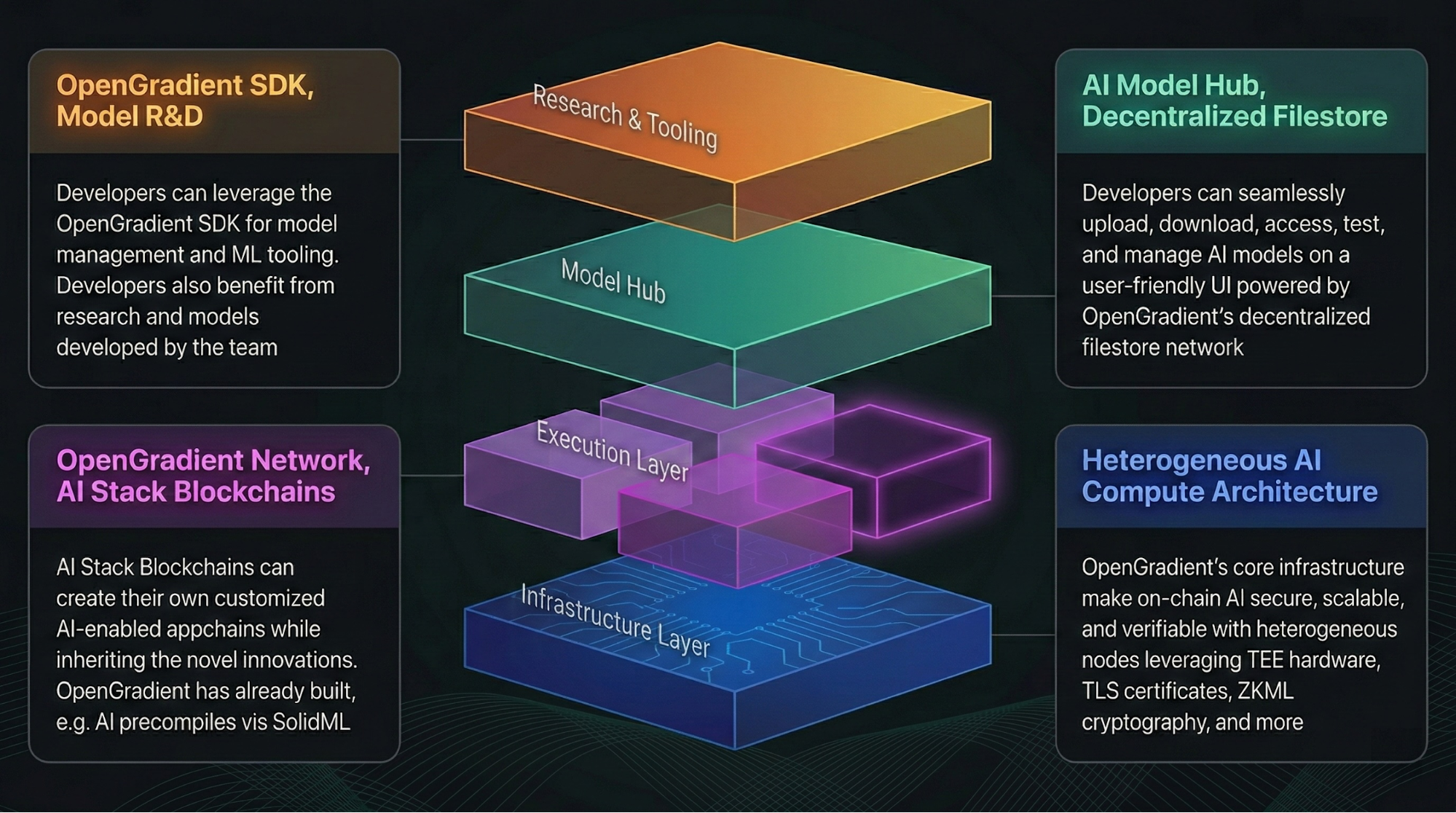
How Users Connect to the OpenGradient Network
User access initiates the entire workflow.
Technically, developers connect their applications to the OpenGradient network through an API or SDK, submitting inference requests that include model parameters and input data. After receiving a request, the system formats it and prepares it for assignment.
Structurally, the access layer sits at the network’s edge, converting user requests into executable internal tasks and forwarding them to the scheduling system. This layer typically includes interface services and request management modules.
This design abstracts complex distributed computing behind a unified interface, so users can leverage the network without needing to understand its underlying architecture.
How AI Requests Are Submitted in OpenGradient
The request submission stage determines how tasks enter the execution pipeline.
Once a request is received, the system assigns it to the appropriate inference node based on task type, complexity, and node status. Scheduling algorithms optimize resource utilization during this process.
The request management module logs task details and generates a unique identifier for tracking and verification. The task then enters the execution queue, awaiting inference node processing.
This mechanism enables unified scheduling for efficient resource allocation while preventing node congestion.
Inference nodes are responsible for executing the computations.
Upon receiving a task, an inference node runs the AI model locally, processes the input data, and generates output results. To ensure verifiability, the node also produces related proof data.
Inference nodes comprise the model execution environment and a results generation module, typically running in a controlled environment to guarantee stability and reproducibility.
This stage ensures that computation and proof generation happen together, laying the groundwork for subsequent verification.
How Verification Nodes Validate Inference Results
Verification nodes confirm the integrity and trustworthiness of results.
They receive output and proof data from inference nodes and independently verify correctness using computation or validation algorithms. If validation fails, the result is rejected or recalculated.
The verification layer operates independently from the execution layer, so verification doesn’t rely on original computation nodes—boosting overall system security.
This mechanism shifts trust from a single node to the network as a whole, providing tamper resistance.
How On-Chain Recording Achieves Final Confirmation
On-chain recording permanently anchors the final result.
After verification, results are submitted to the blockchain (or a related data layer), creating an immutable proof of execution. This usually involves data packaging and confirmation steps.
The on-chain layer sits at the end of the process, recording results on the distributed ledger for long-term traceability.
This design ensures that computational results are persistent and auditable for future queries and reviews.
How Modules Collaborate to Complete Execution
Collaboration among modules determines the system’s overall efficiency.
The request, execution, verification, and recording layers are connected via message passing and task scheduling, with each phase passing results to the next.
Modules are arranged in a pipeline, enabling continuous task processing without bottlenecks.
| Module |
Function |
Position |
| Access Layer |
Receives Requests |
Entry Point |
| Scheduling Layer |
Allocates Tasks |
Middle |
| Inference Node |
Executes Computation |
Core |
| Verification Node |
Validates Results |
Security Layer |
| On-Chain Layer |
Records Results |
End Point |
This collaborative approach boosts throughput and ensures clear responsibilities at every stage.
Structural Breakdown of the OpenGradient Inference Workflow
The entire workflow can be broken down into sequential steps.
A typical task follows the sequence: request submission → task allocation → model execution → result generation → verification → on-chain recording. These steps form a closed loop.
Each phase is managed by a distinct module, enabling clear responsibility and system scalability.
Breaking the process into standardized steps enhances maintainability and expands system capabilities.
Summary
OpenGradient enables verifiable computation by decomposing AI inference, result verification, and on-chain recording into collaborative modules. This structure allows decentralized AI networks to achieve both efficiency and trust.
FAQ
How does OpenGradient handle AI requests?
Once a user submits a request, the system assigns it to inference nodes for execution, then initiates the verification process.
Why are verification nodes necessary?
They independently validate inference results, eliminating reliance on any single node.
What is the role of on-chain recording?
It preserves the final result, ensuring immutability and auditability.
What’s the difference between inference nodes and verification nodes?
Inference nodes perform computations; verification nodes confirm the correctness of results.
Why does OpenGradient use a multi-stage workflow?
A staged process increases efficiency and strengthens security by allowing each module to focus on specialized tasks.







