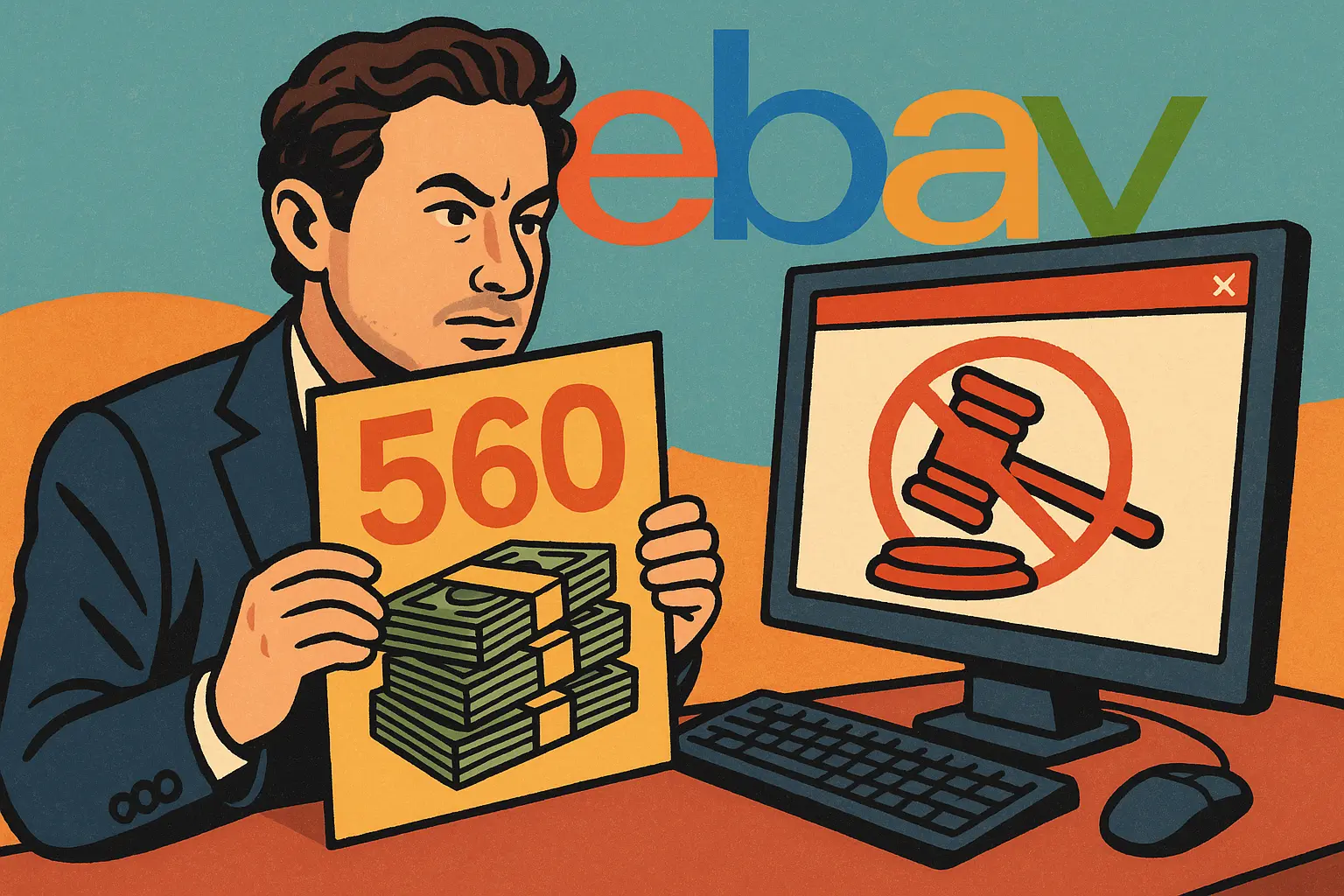
According to a screenshot posted by GameStop CEO Ryan Cohen on social media on May 7, Cohen’s eBay personal account was permanently disabled just two days after it submitted an offer to buy eBay for $125 per share, for a total of about $56 billion. The notification from eBay cited the reason as: “Some of the user’s activities are creating risk for the eBay community.”
eBay Account Ban: Background and Details
Based on the screenshot Cohen posted and related reporting, Cohen previously auctioned personal items on his eBay account (including video games, sports memorabilia, and GameStop merchandise) and publicly stated that this was “selling things on eBay to pay for the costs of acquiring eBay.” He also published comments criticizing the eBay board on the platform. On the day the account was disabled, Cohen had also reached eBay’s platform-set monthly maximum listing amount limit. eBay did not publicly comment on the account suspension.
$5.6 Billion Acquisition Proposal: Structure and Financing Constraints
According to GameStop’s official proposal documents, GameStop proposed to acquire all of eBay’s shares with a 50/50 mix of cash and stock at $125 per share. As of January 31, 2026, GameStop held about $9.4 billion in cash and liquid assets, and also had a $20 billion financing letter from TD Securities, with wording described as “highly confident.”
Two people familiar with the matter told The New York Times that the financing letter is not legally binding, and that the level of confidence is partly based on the assumption that the combined company would achieve an investment-grade credit rating. Moody’s said on Tuesday that the proposed transaction would have a “negative impact” on the credit rating, and noted that it would cause eBay’s debt to jump from $7 billion to $31 billion.
Reactions From All Sides: Burry Dumps His Holdings, Analysts and the Stock Price
Well-known investor Michael Burry said in a Substack post on Monday that he had sold all of his GameStop holdings, citing concerns about the size of the debt involved in the acquisition deal. Burry wrote in the post: “Don’t confuse debt with creativity.”
Don Bilson, head of event-driven research at Gordon Haskett, said: “Cohen’s first attempt to pitch this transaction didn’t go smoothly.” In a CNBC interview on May 4, 2026, Cohen was unable to clearly explain how GameStop would fund the cost of acquiring eBay, repeatedly asked the host to consult GameStop’s official website, and did not directly answer questions.
In a May 7, 2026 report by The New York Times, GameStop’s stock price was down about 6% since the acquisition news was disclosed; eBay’s stock price was about 14% below the $125 per share offer price proposed by Cohen.
FAQ
Why was Ryan Cohen’s eBay account permanently disabled?
According to a screenshot of an eBay official notice posted by Cohen on social media, the ban reason was “Some of the user’s activities are creating risk for the eBay community.” Cohen previously auctioned personal items on the account and posted comments criticizing the eBay board, and on the day the account was disabled, he had already hit the platform’s monthly maximum listing amount limit.
What disclosed constraints are there in GameStop’s financing plan to acquire eBay?
According to two people familiar with the matter told The New York Times, the $20 billion financing letter issued by TD Securities is not legally binding, and the confidence level is partly based on the assumption that the combined company would achieve an investment-grade credit rating. Moody’s also said the transaction would cause eBay’s debt to surge from $7 billion to $31 billion, creating a “negative impact” on the credit rating.
Why did Michael Burry sell all his GameStop holdings?
According to Burry’s Substack disclosure in May 2026, the main reason he sold all his GameStop holdings was his concern about the magnitude of the debt involved in the acquisition proposal.
Disclaimer: The information on this page may come from third parties and does not represent the views or opinions of Gate. The content displayed on this page is for reference only and does not constitute any financial, investment, or legal advice. Gate does not guarantee the accuracy or completeness of the information and shall not be liable for any losses arising from the use of this information. Virtual asset investments carry high risks and are subject to significant price volatility. You may lose all of your invested principal. Please fully understand the relevant risks and make prudent decisions based on your own financial situation and risk tolerance. For details, please refer to
Disclaimer.
Related Articles
Grab Q1 2026: Analysts Bullish Despite Indonesia Regulatory Cap
Analysts remain broadly optimistic about Grab following its first-quarter 2026 results, despite emerging regulatory headwinds in Indonesia. The company reported a 466.7% jump in earnings to US$136 million in Q1 2026 from US$24 million in Q1 2025, with brokerage firms presenting mixed outlooks on
CryptoFrontier21m ago
Morgan Stanley to Launch Crypto Asset Product Within Weeks, Enables ETF Conversion Without Tax Trigger
According to Foresight News, Morgan Stanley's wealth management head Jed Finn announced at Consensus 2026 that the firm will launch a new product within weeks. The product allows clients to transfer crypto assets held on external platforms to Morgan Stanley and convert them into corresponding
GateNews41m ago
Nasdaq President Says SEC's Friendlier Crypto Stance Lets Markets Build Again
Nasdaq president Tal Cohen recently said a more favorable SEC stance is giving crypto firms and exchanges room to experiment with tokenization and digital market infrastructure.
GateNews1h ago
Grant Cardone Adds More BTC to Treasury, Says Bitcoin-Real Estate Strategy Could Outperform REITs
Real estate mogul Grant Cardone recently said a hybrid bitcoin-real estate strategy could outperform traditional REITs and added more Bitcoin to his treasury. According to Cardone, the model brings new users into crypto while challenging conventional real estate
GateNews1h ago
Duan Yongping Swaps All China Shenhua Holdings for Pop Mart Latest
Duan Yongping, a prominent investor, announced on social media that he has swapped all his China Shenhua shares for Pop Mart (09992.HK), a collectibles company. Duan noted that China Shenhua is a strong company and his investment generated solid returns, but he plans to explore new opportunities
GateNews1h ago
Major CEX Adds SpaceX, OpenAI, and Anthropic Pre-IPO Trading
According to reports, a leading centralized exchange launched SPACEX/USDT, OPENAI/USDT, and ANTHROPIC/USDT Pre-IPO trading pairs today (May 7). The platform supports leverage trading on these instruments.
GateNews1h ago


