I. Paradigm Shift: From Model Capability to Execution Capability
Historically, the AI industry’s core competitiveness centered on model capability—specifically, which players could generate more accurate and natural content. Yet, at this stage, AI essentially remained a "passive response system." The advent of Agents has introduced a closed-loop from understanding to action, fundamentally transforming AI in three main ways:
- Moving from "answering questions" to "completing tasks"
- Shifting from "single interactions" to "continuous execution"
- Evolving from "tool attributes" to "system attributes"
This transformation is not defined by a single technological breakthrough, but by the convergence of multiple capabilities at a single point in time, enabling AI to exhibit operating system-like execution characteristics for the first time.
II. Technical Structure: How Agents Achieve a Systematic Closed Loop
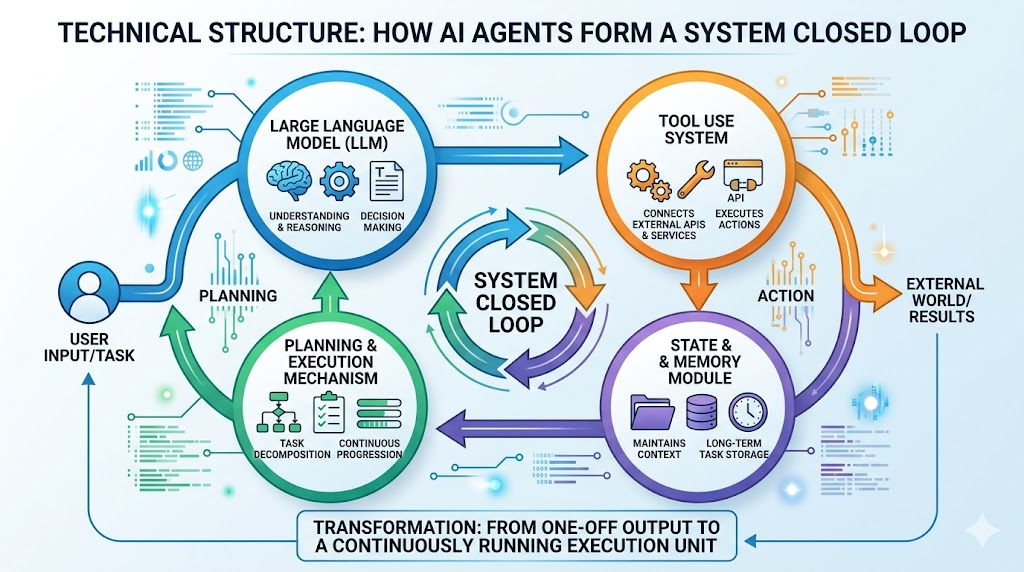
From a structural perspective, an Agent is not a single model but the result of multiple modules working in concert. Its core components include:
- Large language model: Handles understanding, reasoning, and decision-making
- Tool invocation system: Connects to external APIs and services
- State and memory module: Maintains context and manages long-term tasks
- Loop execution mechanism: Supports task decomposition and continuous advancement
Once these four modules form a closed loop, AI evolves from a one-time output interface to a continuously operating execution unit. This marks the essential distinction between Agents and traditional AI tools.
III. Software Rewrite: Shifting Interaction Methods and Value Logic
The rise of Agents is reshaping software’s fundamental structure. Traditional software is built around the UI, with users completing tasks via clicks and inputs. In the Agent paradigm, users simply set objectives, and the system automatically plans and executes the necessary steps. This shift has two immediate impacts: UI importance declines while APIs and system interfaces become more critical; simultaneously, software shifts from "human-oriented operation" to "machine-oriented invocation." At the value level, competition moves from interface design and feature packaging to execution efficiency and resource orchestration.
IV. Business Impact: The Erosion Path of SaaS Moats
Within the Agent framework, the traditional SaaS moat is being systematically eroded—not all at once, but along a clear trajectory:
- Agents start by invoking individual software functions, replacing some manual tasks
- Agents orchestrate workflows across multiple software platforms, weakening product boundaries
- Users shift dependency from software products to execution systems
Ultimately, software is abstracted into capability modules rather than complete products, refocusing future competition on:
- Data quality and exclusivity
- Openness of system interfaces
- Execution efficiency and stability
Real-World Constraints: Key Challenges for Agent Adoption
Despite a clear narrative, Agent deployment faces several critical constraints that determine their integration into real-world economic systems. The most pivotal include:
- Security: Enhanced execution amplifies error and attack risks
- Identity: Differentiating human and Agent behavioral boundaries
- Payments: Agents require financial capability to execute tasks
- Permissions: Defining operational scope and responsibility
These are not peripheral issues—they are foundational to the scalable adoption of Agents.
Value Distribution: Why the Execution Layer Is Becoming Central
In terms of industry structure, value in the Agent era is being redistributed across three main layers:
- Hashrate layer: GPU and cloud infrastructure—capital-intensive and highly concentrated
- Model layer: Foundational models and inference—high technical barriers but intense competition
- Execution layer: Agent runtime, task orchestration, and state systems
The execution layer’s prominence is rising rapidly because it directly determines task completion and offers ecosystem lock-in similar to an operating system—making it the most underestimated value segment today.
VII. Crypto Intersection: Infrastructure for the Agent Economy
As Agents become the primary execution entities, their participation in economic activities centers on three core needs:
- Payments: Automated settlement and cross-system transactions
- Identity: Verifying humans and Agents to establish trust
- Rule enforcement: Programmatic behavior constraints
Here, Crypto delivers well-aligned solutions: Stablecoins for payments, decentralized identity for verification, and Smart Contracts for rule enforcement. This provides Crypto with a practical foundation for adoption in the Agent era, moving beyond mere narrative.
VIII. Path Projection and Risk
Agent evolution is likely to be gradual: short-term, they embed in existing software to optimize processes; mid-term, Agent-first platforms emerge; long-term, progress hinges on regulatory and security maturity. Notably, current market pricing for Agents is anticipatory, reflecting long-term potential before demand is fully validated. Additionally, enterprise adoption pace, user behavior inertia, and regulatory factors may still constrain development. Thus, Agents should be viewed as a medium- to long-term structural shift, with their impact unfolding progressively rather than being realized in the short term.