What is Crypto Arbitrage
In the complex ecosystem of the cryptocurrency market, Crypto Arbitrage is becoming an increasingly attractive trading strategy for many investors. It exploits small price differences of the same cryptocurrency across different markets to make a profit through strategic buying and selling. Compared to traditional financial markets, the 24/7 uninterrupted trading, high decentralization, and greater price volatility in the cryptocurrency market provide abundant opportunities for arbitrage trading. Understanding and mastering crypto arbitrage not only opens new profit avenues for investors but also helps in gaining a deeper insight into how the cryptocurrency market operates.
Crypto Arbitrage is a trading strategy that profits from the price differences of the same cryptocurrency across different markets by buying low and selling high. Similar arbitrage behavior also exists in traditional financial markets, such as in stock markets where the same company’s stock might have different prices due to factors like market supply and demand in different regions. In the cryptocurrency market, these price differences are more frequent and noticeable due to its unique characteristics.
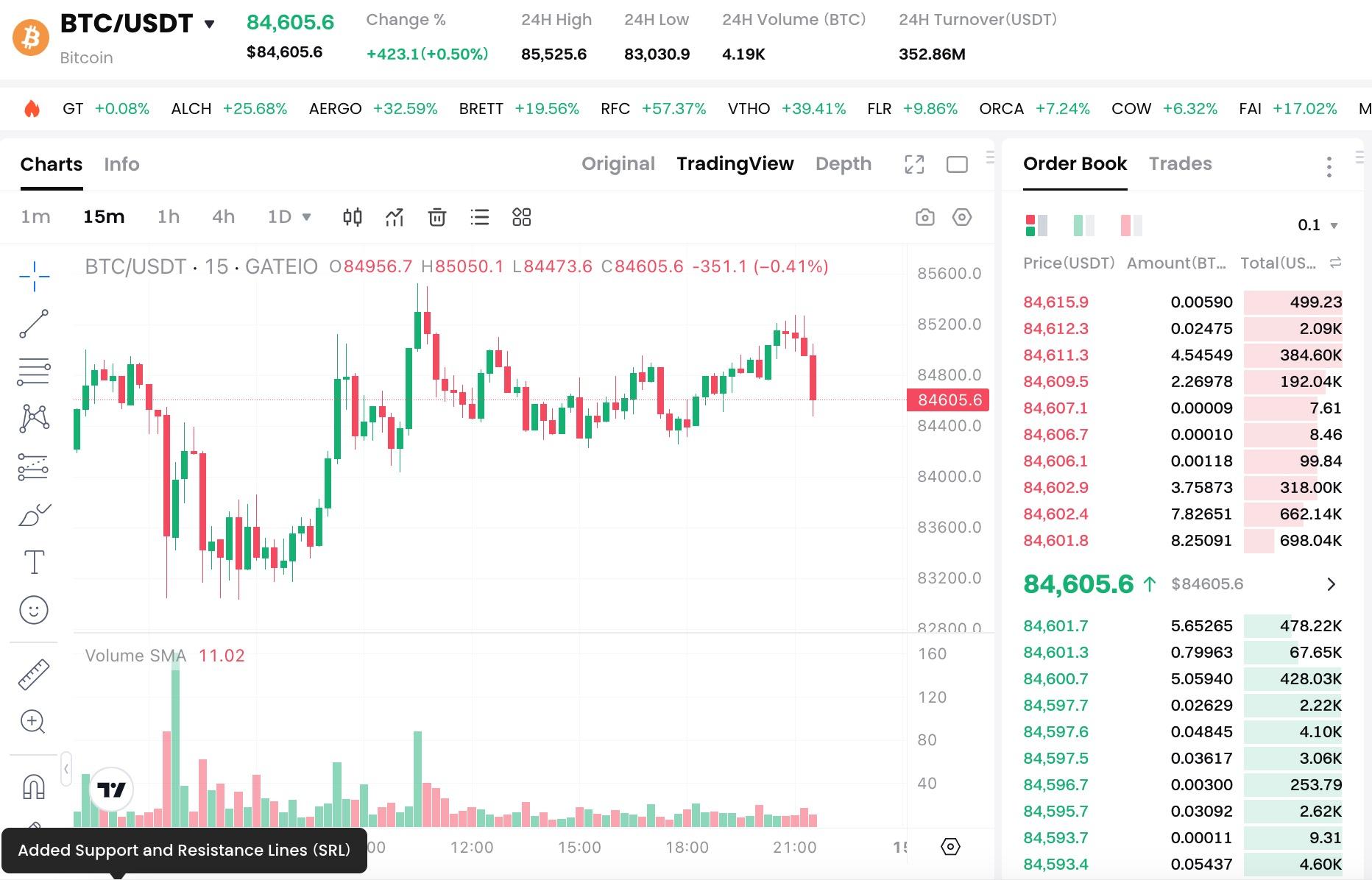
Image Source:https://www.Gate.com/trade/BTC_USDT
The cryptocurrency market consists of many trading platforms, each differing in trading rules, user demographics, liquidity, and more. These differences result in inconsistent pricing for the same cryptocurrency across different platforms. For example, the price of Bitcoin on Exchange A might be $50,000, while on Exchange B, it could be $50,200. In this case, an arbitrageur can buy Bitcoin on Exchange A and quickly sell it on Exchange B, profiting from the $200 price difference (excluding transaction fees and other costs). The price discrepancies mainly arise from market inefficiencies, including delayed information dissemination, varying transaction costs, and regional demand differences for cryptocurrencies, which create opportunities for arbitrage.
Reasons for Crypto Arbitrage
(1) Liquidity Differences: Different exchanges have varying user bases and trading activity, leading to differences in liquidity. Exchanges with high liquidity are less likely to experience large price changes from big trades, and their prices update more quickly. In contrast, exchanges with lower liquidity might see significant price fluctuations from smaller buy or sell orders, creating price differences compared to high liquidity exchanges. For example, smaller cryptocurrency exchanges with fewer users may see significant price swings when large orders are placed, creating a price gap between them and major exchanges.

Image source:https://www.Gate.com/price
(2) Regional Demand Differences: Investors in different regions have varying levels of acceptance and demand for cryptocurrencies. In certain areas, factors such as policy environment, economic conditions, or investor preferences can lead to higher demand for specific cryptocurrencies, pushing their prices up. In contrast, in other regions, the price of the same cryptocurrency might be relatively lower. For instance, regions with a more active interest in blockchain technology might see higher demand and prices for innovative cryptocurrencies compared to areas where the technology is less prominent.
(3) Transaction Cost Differences: Exchanges charge varying fees for transactions, withdrawals, and other services. These costs directly impact the net profit for investors and influence cryptocurrency pricing. On exchanges with lower transaction fees, investors are more inclined to trade, which could push the cryptocurrency price higher (since lower fees encourage buying at slightly higher prices). Conversely, exchanges with higher fees may have lower prices due to the increased costs associated with trading.
Types of Crypto Arbitrage
1. Cross-Exchange Arbitrage
This is the most common form of cryptocurrency arbitrage, involving trading between different cryptocurrency exchanges to take advantage of price differences for the same cryptocurrency. For example, if the price of Ethereum on Exchange A is $1,800, while on Exchange B it is $1,820, an arbitrageur can buy Ethereum on Exchange A and sell it on Exchange B, earning a $20 price difference per Ethereum. The key to this arbitrage strategy is quickly identifying price discrepancies and executing trades in a timely manner, as these price differences often shrink rapidly as market participants react to the changes.
In May 2021, Bitcoin’s price on some exchanges in Asia briefly exceeded the prices on exchanges in the U.S. and Europe. Some sharp arbitrageurs capitalized on this by buying Bitcoin on European or U.S. exchanges at a lower price and quickly transferring it to Asian exchanges to sell at a higher price, earning substantial profits within just a few days. However, such opportunities are often fleeting, requiring arbitrageurs to have efficient trading systems and real-time market monitoring capabilities.
2. Triangular Arbitrage
Triangular arbitrage involves exploiting the price relationships between three different cryptocurrencies within the same exchange. Suppose there are price inconsistencies between Bitcoin (BTC) and Ethereum (ETH), Ethereum and Litecoin (LTC), and Litecoin and Bitcoin on a specific exchange. The arbitrageur can perform a series of trades, such as buying Ethereum with Bitcoin, then buying Litecoin with Ethereum, and finally converting Litecoin back into Bitcoin, profiting from the price differences. This type of arbitrage requires a deep understanding of the exchange rate relationships between different cryptocurrencies in the market and precise calculations, as even small price fluctuations or transaction costs can affect the outcome.
At one point, a specific exchange showed a temporary imbalance between the Bitcoin/Ethereum rate, the Ethereum/Litecoin rate, and the Litecoin/Bitcoin rate. An experienced arbitrageur spotted the opportunity and, through careful calculations and swift execution of triangular arbitrage, successfully completed several rounds of trades within a few hours, achieving a 5% asset increase. However, such opportunities are rare in the market and require high-speed execution and precise calculations.
3. Decentralized Arbitrage
Decentralized arbitrage mainly occurs between decentralized exchanges (DEX) and centralized exchanges (CEX). Decentralized exchanges typically use Automated Market Makers (AMM) mechanisms to determine asset prices, which differ from the order book-based pricing system of centralized exchanges. Due to these differences in pricing mechanisms, the same cryptocurrency can have a price discrepancy between a decentralized exchange and a centralized exchange. Arbitrageurs can buy on the platform with the lower price and then sell on the platform with the higher price. For example, on a decentralized exchange, a certain ERC-20 token may have a relatively low price due to the characteristics of its liquidity pool, while the same token is priced higher on a centralized exchange. Arbitrageurs can exploit this price difference for profit.
During the rapid growth of the DeFi (Decentralized Finance) market, some emerging decentralized exchanges offered low trading fees and unique liquidity incentives to attract users, resulting in price differences for certain cryptocurrencies between these decentralized exchanges and traditional centralized exchanges. Some arbitrageurs took advantage of these price differences by buying popular DeFi tokens at a lower price on decentralized exchanges and then transferring them to centralized exchanges for a higher sale price, earning substantial returns. However, it is important to note that trading on decentralized exchanges carries risks such as smart contract vulnerabilities and impermanent loss, so arbitrageurs must carefully evaluate these risks.
4. Flash Loan Arbitrage
Flash loan arbitrage is a more complex and DeFi-dependent form of arbitrage. Flash loans allow users to borrow large amounts of funds without collateral, as long as the loan is repaid within the same transaction block, with no interest charges (although a small fee may be charged). Arbitrageurs use flash loans to borrow funds and search for price differences between different DeFi protocols or liquidity pools to execute arbitrage. After completing the trade, they immediately repay the loan and pocket the profits.
For example, an arbitrageur might use a flash loan to purchase a cryptocurrency at a low price in one liquidity pool and then sell it at a higher price in another liquidity pool, with the price difference being used to repay the loan and earn a profit.
During the DeFi summer craze of 2020, significant price discrepancies existed between some DeFi protocols on the Ethereum blockchain. Skilled arbitrageurs used flash loans to borrow large amounts of capital from Protocol A, bought a specific cryptocurrency at a low price in Protocol B’s liquidity pool, then sold it at a higher price in Protocol C’s liquidity pool, completing the entire arbitrage process within a single transaction block. These operations could yield thousands of dollars in profits. However, flash loan arbitrage requires highly advanced technical skills and market insight, as mistakes or sudden market changes can lead to significant losses.
How to Profit from Crypto Arbitrage
(1) Seize Speed and Timing
The cryptocurrency market operates 24/7 and is highly volatile, so investors need to use tools like CoinMarketCap, KairosPeak, and others to monitor prices across multiple exchanges in real-time. Once an arbitrage opportunity is identified, automated trading bots can be used to execute trades within milliseconds. Advanced bots can quickly buy on exchanges with lower prices and sell on those with higher prices to lock in profits as soon as price differences appear.
(2) Control Trading Costs
Trading fees can eat into arbitrage profits, and different exchanges have different fee structures. For example, Binance offers fee discounts to BNB holders. When performing cross-exchange arbitrage, transferring funds may incur additional costs. Investors can minimize these costs by pre-funding multiple exchanges and reducing the frequency of fund transfers. It’s also advisable to move funds during times when blockchain networks are less congested to lower fees and reduce transaction times.
(3) Focus on Liquidity
Exchanges with high liquidity ensure that large transactions can be completed smoothly. Popular exchanges like Coinbase, OKX, and others have large user bases and high trading volumes. Investors can assess an exchange’s liquidity by checking its 24-hour trading volume and order book depth, avoiding large arbitrage trades on exchanges with low liquidity to prevent failures in executing trades at the desired price.
Risks of Crypto Arbitrage
(1) Market Risk
Cryptocurrency prices are highly volatile, and during arbitrage, the price difference may shrink or disappear entirely due to rapid market changes before the trade is completed, leading to potential losses. Market trends can also impact arbitrage strategies, as price differences may change if the market shifts from an uptrend to a downtrend. If investors do not adjust their strategies in time, they may incur losses.
(2) Technical Risk
Network delays or failures can prevent trading instructions from being issued and executed on time, causing missed arbitrage opportunities. Trading platforms may also experience server crashes, software bugs, or other issues that prevent trades from being processed or cause data errors, resulting in potential losses for investors.
(3) Regulatory Risk
Global cryptocurrency regulations vary and can change rapidly. New policies in certain countries may restrict or ban trading, affecting market operations and altering price differences. There may also be legal and compliance risks. Investors who are unaware of local regulations and trade recklessly may face lawsuits or penalties.
(4) Security Risks
Cryptocurrency exchanges are prone to hacking, such as the 2018 Coincheck hack in Japan, where $530 million worth of virtual currency was stolen. Private key security is also crucial; if a private key is leaked, hackers can transfer the account’s assets. Investors who access exchanges through insecure networks or devices or store their private keys improperly may risk having their assets stolen.