What is FLUX: A Comprehensive Guide to the Revolutionary AI Image Generation Model


FLUX: Comprehensive Research Report
FLUX's Positioning and Significance
FLUX (FLUX) is a decentralized computing service and blockchain cloud service solution designed to provide users with institutional and private control over cloud infrastructure in a distributed manner. As a core cryptocurrency powering a distributed computing ecosystem, FLUX plays a critical role in enabling decentralized cloud services and enterprise-grade computational resources.
As of December 2025, FLUX ranks among the mid-tier cryptocurrencies with a market capitalization of approximately $42.6 million and a circulating supply of 406.2 million tokens. The project maintains an active community of 65,272 token holders and operates across 29 exchanges, including Gate.com.
This report provides an in-depth analysis of FLUX's technical architecture, market performance, and ecosystem potential.
Origin and Development History
Genesis and Background
FLUX originated from the ZEL token, which was subsequently rebranded to FLUX. The project was created to address the limitations of centralized cloud computing infrastructure, offering a decentralized alternative to traditional cloud service providers such as Alibaba Cloud and AWS.
The core motivation behind FLUX's development was to democratize access to enterprise-grade computing resources by enabling a distributed network of node operators to provide computational power and infrastructure services. This model eliminates the need for centralized intermediaries while maintaining security, transparency, and scalability.
Project Launch and Key Metrics
- Published Date: August 2, 2018
- Initial Price: $0.138
- All-Time High: $3.33 (January 3, 2022)
- All-Time Low: $0.016404 (January 13, 2021)
- Current Market Position: Ranked #554 globally
How FLUX Operates?
Decentralized Computing Network
FLUX operates on a globally distributed network of nodes that validate transactions and provide computational resources without central authority or intermediaries. This peer-to-peer architecture eliminates traditional gatekeepers, granting users direct control over their digital assets and infrastructure access.
The network achieves consensus through distributed validation mechanisms, ensuring system transparency, resistance to attacks, and enhanced resilience through geographic and operational redundancy.
Blockchain Foundation
FLUX's blockchain functions as a transparent, immutable digital ledger recording all transactions and computational resource allocations. Transactions are grouped into blocks connected through cryptographic hashing, creating a secure sequential chain of records.
This design allows any participant to independently verify the transaction history, establishing trust without requiring intermediaries or centralized authorities.
FluxOS Computing Layer
FLUX operates on FluxOS, a computing network layer that runs on Linux-based infrastructure. FluxOS provides verified enterprise-grade computational capabilities verified by the blockchain network, combining traditional computing power with blockchain-based governance and transparency.
The system enables users to:
- Purchase computational resources using FLUX tokens
- Execute distributed computing tasks across the network
- Maintain transparent, auditable operations through blockchain verification
Network Participation and Incentives
FLUX employs a Proof-of-Work (PoW) consensus mechanism combined with node operator incentives. Network participants can select from multiple hardware requirement tiers:
- Cumulus Nodes: Entry-level hardware requirements
- Nimbus Nodes: Mid-tier computational resources
- Stratus Nodes: Enterprise-grade specifications
Node operators are rewarded with FLUX tokens for:
- Validating transactions
- Providing computational power to the network
- Maintaining FluxOS infrastructure
This incentive structure ensures continuous network growth while distributing rewards fairly among participants contributing computing resources.
Security Architecture
FLUX implements cryptographic security protocols protecting transactions and resource allocations:
- Private Key Cryptography: Users maintain exclusive signing authority over their assets
- Public Key Infrastructure: Enables transparent verification of transaction authenticity
- Blockchain Immutability: All transactions become permanent, auditable records
This multi-layered security approach prevents unauthorized access, double-spending, and fraudulent resource allocation while maintaining pseudonymous transaction privacy.
Market Performance and Technical Indicators
Current Market Status (December 18, 2025)
| Metric | Value |
|---|---|
| Current Price | $0.10468 |
| 24-Hour Change | -6.04% |
| 7-Day Change | -6.99% |
| 30-Day Change | -24.97% |
| 1-Year Change | -84.71% |
| Market Capitalization | $42,523,811.74 |
| Fully Diluted Valuation | $42,595,297.40 |
| 24-Hour Volume | $285,087.17 |
| Circulating Supply | 406,226,707.50 FLUX |
| Total Supply | 406,909,604.50 FLUX |
| Maximum Supply | 440,000,000 FLUX |
| Market Dominance | 0.0013% |
Price Trends Analysis
FLUX has experienced significant volatility, particularly reflected in its one-year performance showing an 84.71% decline from previous levels. Recent short-term movements indicate downward pressure, with 24-hour and 7-day declines of -6.04% and -6.99% respectively.
The token's circulating supply represents 92.32% of maximum supply, indicating mature circulations dynamics with limited inflation pressure from future token releases.
Ecosystem and Network Statistics
- Active Holders: 65,272 addresses maintaining FLUX tokens
- Exchange Listings: 29 major cryptocurrency exchanges including Gate.com
- Smart Contract: Deployed on Ethereum (ETH):
0x720CD16b011b987Da3518fbf38c3071d4F0D1495
Community and Resources
Official Channels
- Primary Website: https://runonflux.io
- Wallet Interface: https://zelcore.io
- Block Explorer: https://explorer.runonflux.io/
- Whitepaper: https://fluxwhitepaper.app.runonflux.io/
- GitHub Repository: https://github.com/runonflux
- Twitter: https://twitter.com/runonflux
- Reddit Community: https://www.reddit.com/r/Flux_Official/
Investment Considerations
Risk Factors: FLUX exhibits significant price volatility, with year-to-date losses of 84.71%. Investors should conduct thorough due diligence and understand distributed computing infrastructure technology before participating.
Use Cases: FLUX's primary value proposition centers on enabling decentralized cloud computing services and enterprise computational resource allocation through a tokenized incentive model.
Market Position: As a mid-tier altcoin with modest trading volume relative to its market capitalization, FLUX maintains active development communities but operates in a competitive distributed computing infrastructure landscape.
Conclusion
FLUX represents an innovative approach to decentralizing cloud computing infrastructure by combining blockchain technology with distributed node networks. Through its PoW consensus mechanism, node operator incentives, and FluxOS computing layer, FLUX enables transparent, censorship-resistant access to computational resources.
While current market conditions have pressured FLUX's valuation, the project maintains active development, community participation, and fundamental infrastructure positioning within the distributed computing sector. Prospective participants should carefully evaluate the project's technological merits, market adoption trajectory, and competitive positioning within emerging decentralized infrastructure solutions.
Flux's Market Performance
Circulating Supply Overview
As of December 18, 2025, Flux has a circulating supply of 406,226,707.50 tokens, with a total supply of 406,909,604.50 tokens. The maximum supply is capped at 440,000,000 tokens, representing a fixed supply model. Currently, the circulating supply accounts for approximately 92.32% of the maximum supply, indicating a mature distribution phase with limited new token issuance.
Price Volatility
Flux reached its all-time high of $3.33 on January 3, 2022, during the peak of the 2021-2022 cryptocurrency bull market. Conversely, its lowest price was $0.01640374, recorded on January 13, 2021, reflecting early market volatility and price discovery phase.
As of December 18, 2025, Flux is trading at $0.10468, down 6.04% in the last 24 hours and down 84.71% over the past year. These significant declines reflect broader market corrections and shifting investor sentiment in the distributed computing sector.
Click to view current FLUX market price
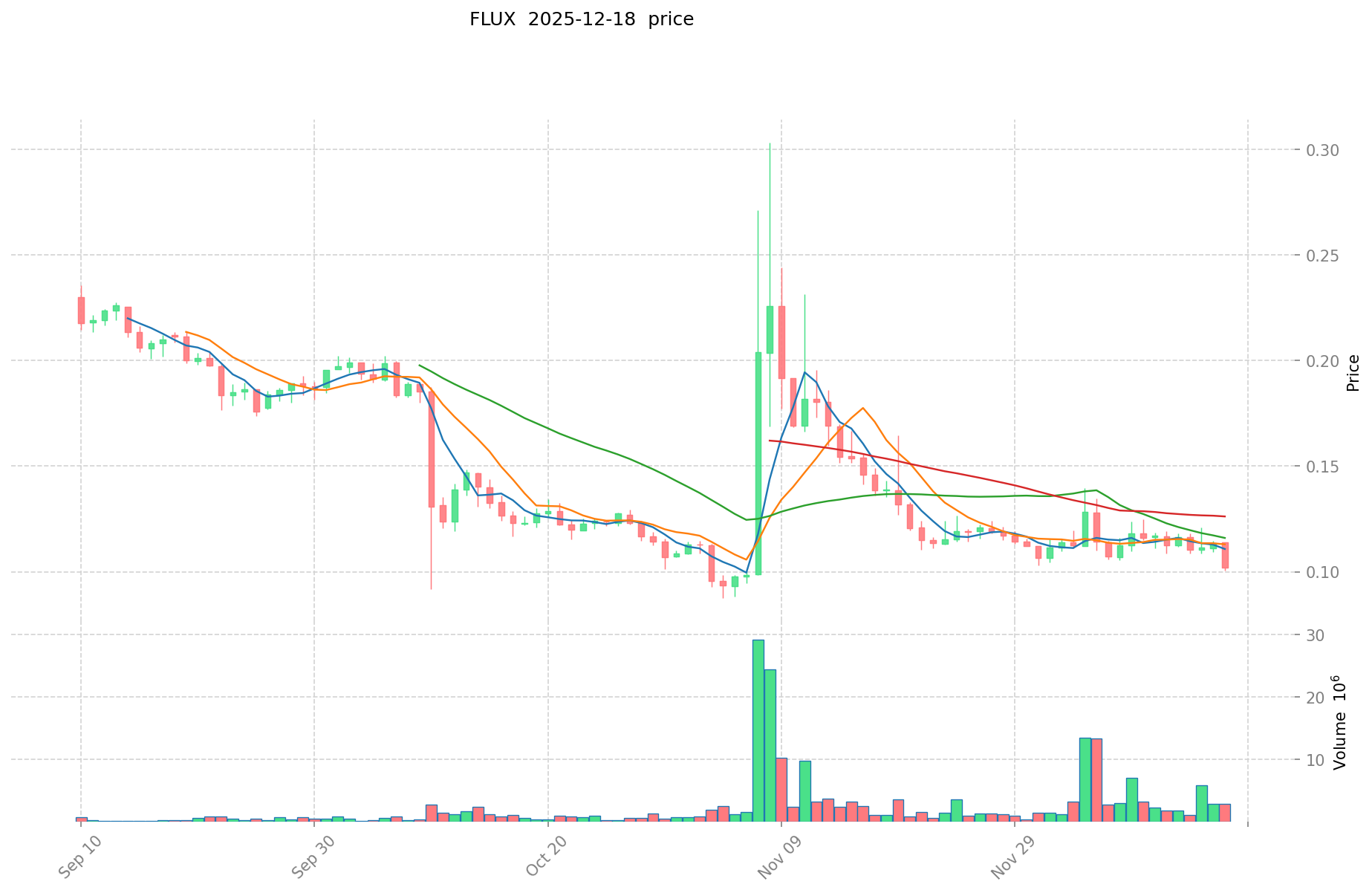
Market Metrics
- Market Capitalization: $42,523,811.74 (circulating supply basis)
- Fully Diluted Valuation: $42,595,297.40
- 24-Hour Trading Volume: $285,087.17
- Market Dominance: 0.0013%
- Number of Holders: 65,272
- Trading Pairs Available: 29 exchanges
Flux (FLUX) Comprehensive Analysis Report
Market Overview
Flux (FLUX) is a decentralized computing and blockchain cloud service solution that evolved from the ZEL token. As of December 18, 2025, Flux maintains a significant position in the cryptocurrency ecosystem with the following metrics:
| Metric | Value |
|---|---|
| Current Price | $0.10468 |
| Market Cap | $42,523,811.74 |
| 24H Volume | $285,087.17 |
| Circulating Supply | 406,226,707.50 FLUX |
| Total Supply | 406,909,604.50 FLUX |
| Max Supply | 440,000,000 FLUX |
| Market Ranking | #554 |
| Circulating Ratio | 92.32% |
Price Performance
Flux has experienced notable volatility across different timeframes:
- 1 Hour: +1.44% ($0.001486 change)
- 24 Hours: -6.04% (-$0.006729)
- 7 Days: -6.99% (-$0.007867)
- 30 Days: -24.97% (-$0.034838)
- 1 Year: -84.71% (-$0.579950)
All-Time High: $3.33 (January 3, 2022) All-Time Low: $0.01640374 (January 13, 2021)
Project Overview
Core Concept
Flux is a cryptocurrency powering a distributed computing network and blockchain cloud infrastructure platform. It provides users with decentralized institutional and private control over cloud infrastructure in a manner comparable to traditional cloud services like Alibaba Cloud and AWS.
Technical Foundation
Key Features:
- Consensus Mechanism: Proof of Work (PoW)
- Operating System: Flux OS, built on Linux, delivers verified enterprise-grade computing power
- Network: Highly scalable Flux network with transparent governance operations secured by blockchain
- Node Architecture: Multiple hardware tier options for node operators to select based on capacity requirements
Value Proposition
Flux serves multiple critical functions within its ecosystem:
- Incentive Mechanism: Provides rewards for miners and FluxNode operators participating in network maintenance
- Transaction Currency: Functions as the medium for purchasing computational resources on the FluxOS network
- Governance: Enables transparent, decentralized decision-making through on-chain governance mechanisms
- Network Security: Utilized to secure and validate enterprise computing operations
Ecosystem Architecture
Distributed Computing Network
Flux operates a decentralized computing infrastructure that democratizes access to computational resources. Node operators can participate at three different hardware requirement levels, creating a multi-tier network architecture that balances accessibility with performance requirements.
FluxOS Computing Platform
The FluxOS layer provides a comprehensive computing environment where:
- Users access distributed computing resources without reliance on centralized cloud providers
- Transactions and resource purchases are conducted using FLUX tokens
- Network transparency is maintained through blockchain-based governance operations
Node Operator Economics
Node operators receive FLUX token rewards for:
- Providing computing power to the network
- Maintaining infrastructure according to tier specifications
- Supporting network security and decentralization
Tokenomics & Distribution
Supply Metrics
- Circulating Supply: 406,226,707.50 FLUX (92.32% of total)
- Total Supply: 406,909,604.50 FLUX
- Maximum Supply: 440,000,000 FLUX
- Fully Diluted Valuation: $42,595,297.40
Token Holders
Flux has accumulated 65,272 token holders across all addresses and platforms.
Historical Context
Flux launched with an initial price of $0.138 on August 3, 2018. The project was previously known as ZEL token before the rebranding to Flux.
Blockchain Integration
Smart Contract Deployment
Flux maintains an Ethereum-based token contract for interoperability:
- Chain: Ethereum (ETH)
- Contract Address:
0x720CD16b011b987Da3518fbf38c3071d4F0D1495 - Verification: Available on Etherscan
This multi-chain presence enables broader ecosystem participation and liquidity access.
Trading & Accessibility
Exchange Presence
Flux is listed on 29 exchange platforms globally, ensuring broad market accessibility and liquidity for traders and investors.
Trading Volume
Daily trading volume stands at approximately $285,087, indicating moderate but consistent market activity.
Community & Resources
Official Channels
- Official Website: https://runonflux.io
- Platform: https://zelcore.io
Technical Resources
- Block Explorer: https://explorer.runonflux.io/
- Smart Contract Explorer: https://etherscan.io/token/0x720CD16b011b987Da3518fbf38c3071d4F0D1495
- Whitepaper: https://fluxwhitepaper.app.runonflux.io/
- GitHub Repository: https://github.com/runonflux
Social Media Presence
- X (Twitter): @runonflux
- Reddit Community: r/Flux_Official
How to Acquire FLUX
Trading Steps
- Access Gate.com: Visit the Gate.com platform, a leading global cryptocurrency exchange
- Create Account: Register and complete identity verification procedures
- Fund Your Account: Deposit fiat currency or transfer cryptocurrency
- Purchase FLUX: Search for FLUX trading pairs and execute buy orders
- Secure Storage: Transfer tokens to a secure self-custody solution for long-term holding
Supported Trading Pairs
FLUX is available for trading against multiple base currencies on Gate.com, providing flexible entry points for different investor preferences.
Investment Considerations
Strengths
- Innovative Infrastructure: Decentralized cloud computing addresses a significant market gap
- Established Network: Operational distributed computing network with active node operators
- Enterprise-Grade: Linux-based OS with verified enterprise computing capabilities
- Clear Utility: Direct token utility for resource purchasing and network operations
- Transparent Governance: Blockchain-based governance ensuring operational transparency
- Multi-Tier Architecture: Flexible participation options catering to different user capabilities
Risk Factors
- Market Volatility: Experienced 84.71% decline over the past year
- Adoption Challenges: Competing against established cloud infrastructure providers
- Technical Complexity: Requires technical knowledge for optimal node operation
- Market Competition: Operating in a competitive decentralized computing space
- Price Pressure: Current price significantly below historical peaks
- Market Position: Ranked #554 by market capitalization indicates smaller market presence relative to major cryptocurrencies
Market Dynamics
The significant 30-day decline of -24.97% reflects broader cryptocurrency market pressures. Long-term investors should monitor:
- Network growth and node operator adoption rates
- Development progress on ecosystem applications
- Competitive landscape evolution in decentralized computing
- Overall market sentiment toward cloud infrastructure tokens
Summary
Flux represents an ambitious approach to democratizing cloud computing infrastructure through blockchain technology. The project offers genuine utility through its FluxOS platform and distributed computing network, distinguishing it from purely speculative cryptocurrency projects.
Key Takeaways:
- Established Project: Operating network with measurable technical achievements
- Clear Use Case: Addresses real demand for decentralized computing resources
- Token Utility: Direct functional requirement within ecosystem operations
- Community: Active development team and engaged community of node operators
- Market Accessibility: Listed on 29 exchanges including Gate.com for broad participation
While Flux faces competitive pressures from both traditional cloud providers and emerging blockchain infrastructure projects, its technical foundation and operational network provide a substantive platform for continued development. The project's ability to attract node operators and developers will be critical indicators of future success.
Potential participants should conduct thorough research, understand the technical requirements of node operation, and consider Flux as a medium-to-long-term investment aligned with broader blockchain infrastructure trends.
Last Updated: December 18, 2025
FAQ
What is a flux for soldering?
Flux for soldering is a chemical substance that cleans metal surfaces and prevents oxidation during the soldering process. It removes impurities, enhances solder flow, and ensures strong joints between electronic components. Essential for successful soldering applications.
What is a flux in physics?
In physics, flux measures the number of electric or magnetic field lines passing through a surface. It quantifies how much of a field penetrates that surface area, applying to both electric and magnetic fields.
What is flux made of?
FLUX is a blockchain-based token built on distributed ledger technology. It comprises cryptographic mechanisms, smart contract protocols, and consensus algorithms that enable decentralized network operations and value transfer across the ecosystem.
What is a flux in welding?
Flux is a protective material used in welding that cleans the weld area and prevents air contamination. It shields the molten metal to create stronger, cleaner, and higher-quality welds by removing oxides and impurities.
Share
Content
FLUX's Positioning and Significance
Origin and Development History
How FLUX Operates?
Market Performance and Technical Indicators
Ecosystem and Network Statistics
Community and Resources
Investment Considerations
Conclusion
Flux's Market Performance
Market Overview
Project Overview
Ecosystem Architecture
Tokenomics & Distribution
Blockchain Integration
Trading & Accessibility
Community & Resources
How to Acquire FLUX
Investment Considerations
Summary
FAQ
How to Buy Cryptocurrency


Trending Cryptocurrencies



What is FLUX: The Next-Generation AI Image Generation Model Revolutionizing Creative Design

What is KAS: Understanding the Key Agreement Scheme in Modern Cryptography

How Active is the Community and Ecosystem of Akash Network (AKT) in 2025?

What is MVL: Understanding the Multi-Value Logic System in Modern Computing

How Active is Pi Network's Community in 2025?
What is GEOD: Understanding the Global Environmental Observation Database and Its Impact on Climate Research
Mastering the Inverse Bart Chart Pattern for Successful Crypto Trading

XRP ETF Inflows Surpass $1 Billion: How Institutional Capital Is Reshaping the XRP Investment Landscape

National Bank of Canada Heavily Invests in MicroStrategy: What Institutional Bitcoin Signals Does It Send?

Discover the Top Wallet for Bitcoin Ordinals and NFTs

How to Use Sui Block Explorer to Analyze Price Trends and Market Dynamics