What is DF: Understanding Data Frames in Python for Efficient Data Analysis

2025-11-20 04:41:28
Blockchain
Crypto Insights
DAO
DeFi
Stablecoin
Article Rating : 3.9
half-star
0 ratings
This article delves into dForce's role in DeFi, providing a comprehensive overview of its technical architecture, market performance, and contributions to decentralized finance. Readers will learn about the evolution of dForce, its operational mechanisms, and significant partnerships that bolster its ecosystem. Addressing technical, regulatory, and competitive challenges, the article explores dForce's community, social media influence, and active engagement within the DeFi sector. Ultimately, dForce's innovative approach positions it as a key player in the decentralized finance landscape, with avenues for participation detailed for interested users.
What is DF: Understanding Data Frames in Python for Efficient Data Analysis

dForce's Positioning and Significance

In 2020, dForce Network launched dForce (DF), aiming to address financial inefficiencies and fragmentation in the decentralized finance (DeFi) space. As a comprehensive open finance protocol, dForce plays a crucial role in DeFi, stablecoin issuance, and liquidity provision.

As of 2025, dForce has become a significant player in the DeFi ecosystem, with an active developer community and a range of financial products. This article will analyze its technical architecture, market performance, and future potential.

Origins and Development History

Birth Background

dForce was created by the dForce Network team in 2020, aiming to solve the fragmentation and inefficiencies in decentralized finance. It was born during the DeFi boom, with the goal of providing a comprehensive suite of DeFi services and products to change the status quo. dForce's launch brought new possibilities for DeFi users and developers.

Important Milestones

  • 2020: Main network launched, achieving a multi-asset single collateral stablecoin protocol.
  • 2021: Major upgrade introducing lending and borrowing markets.
  • 2022: Ecosystem expansion, with the number of DeFi protocols built on dForce surpassing 50.

With the support of its community and foundation, dForce continues to optimize its technology, security, and real-world applications.

How Does dForce Work?

Decentralized Control

dForce operates on a decentralized network of computers (nodes) spread across the globe, free from the control of banks or governments. These nodes collaborate to validate transactions, ensuring system transparency and attack resistance, empowering users with greater autonomy and enhancing network resilience.

Blockchain Core

dForce's blockchain is a public, immutable digital ledger that records every transaction. Transactions are grouped into blocks and linked through cryptographic hashes to form a secure chain. Anyone can view the records, establishing trust without intermediaries. dForce's unique architecture further enhances performance and interoperability within its ecosystem.

Ensuring Fairness

dForce adopts a Proof of Stake (PoS) consensus mechanism to validate transactions and prevent fraudulent activities such as double-spending. Validators maintain network security by staking DF tokens and running nodes, and are rewarded with DF tokens. Its innovations include more energy-efficient consensus and higher scalability.

Secure Transactions

dForce uses public-private key cryptography to secure transactions:

  • Private keys (similar to secret passwords) are used to sign transactions
  • Public keys (similar to account numbers) are used to verify ownership

This mechanism ensures fund security, while transactions remain pseudonymous. Additional security features include smart contract audits and multi-signature wallets.

DF Market Performance

Circulation Overview

As of November 20, 2025, DF's circulating supply is 999,926,146.6275177 tokens, which is equal to its total supply. The maximum supply is also set at 999,926,146.6275177 tokens, indicating a fixed supply model.

Price Fluctuations

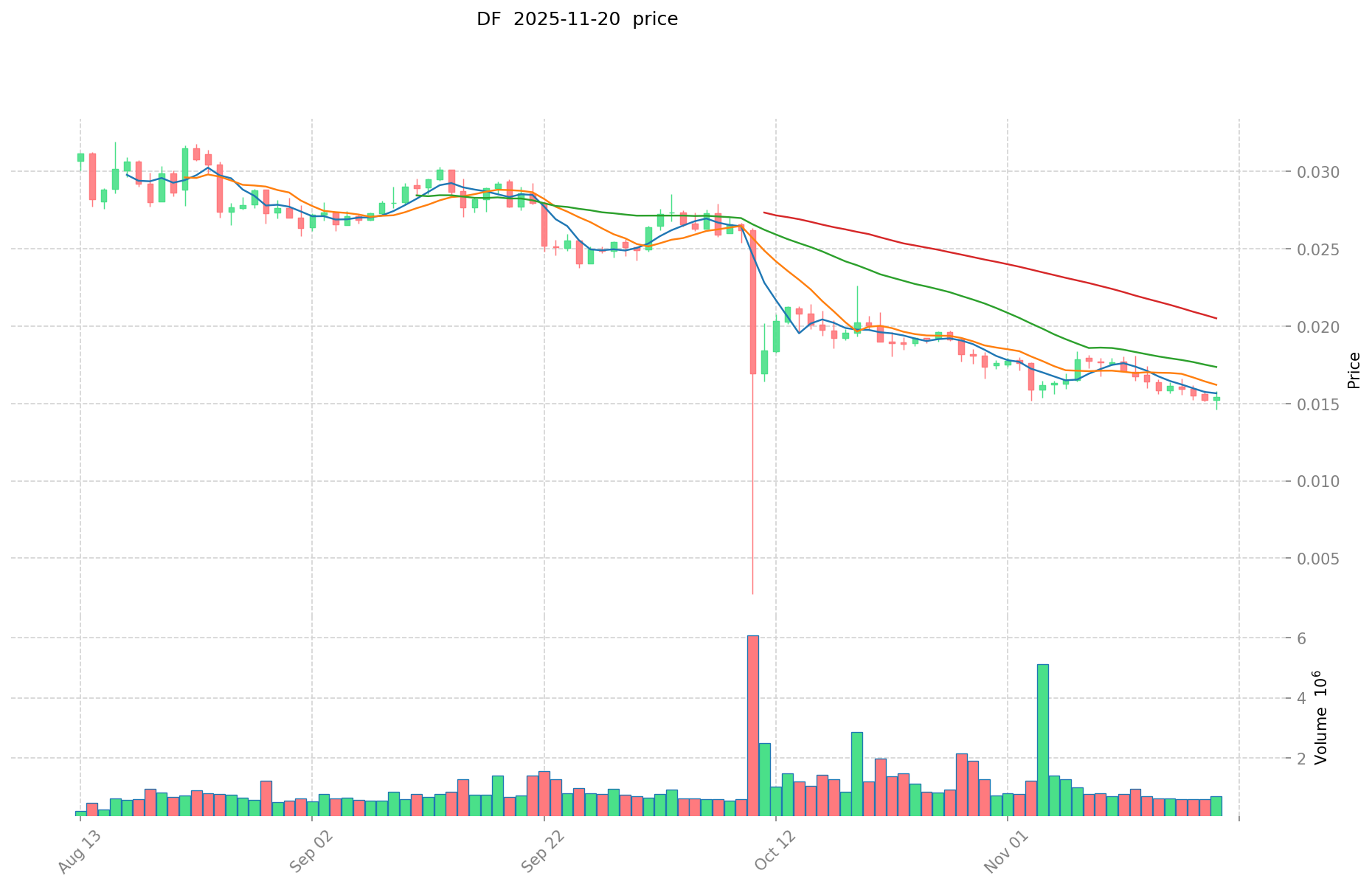
DF reached its all-time high of $1.5 on June 20, 2020, likely driven by positive market sentiment and increased adoption of the dForce ecosystem.

Its lowest price was $0.00935785, recorded on October 11, 2025, possibly due to broader market downturns or specific challenges faced by the project.

These fluctuations reflect market sentiment, adoption trends, and external factors affecting the DeFi sector.

Click to view the current DF market price
price-image

On-Chain Metrics

  • Daily Transaction Volume: $11,284.4950975 (indicating network activity)
  • Active Addresses: 2,607 (reflecting user engagement)

dForce Ecosystem Applications and Partnerships

Core Use Cases

dForce's ecosystem supports multiple applications:

  • DeFi: USDx and GOLDx tokens, providing stablecoin and synthetic asset solutions.
  • Liquidity Protocol: dForce platform offers liquidity mining rewards for users.

Strategic Collaborations

dForce has established partnerships to enhance its technical capabilities and market influence. These partnerships provide a solid foundation for dForce's ecosystem expansion.

Controversies and Challenges

dForce faces the following challenges:

  • Technical Issues: Potential scalability bottlenecks or transaction delays
  • Regulatory Risks: Uncertain regulatory environment for DeFi platforms
  • Competitive Pressure: Rising competition from other DeFi protocols

These issues have sparked discussions within the community and market, also driving continuous innovation for dForce.

dForce Community and Social Media Atmosphere

Fan Enthusiasm

dForce's community shows vitality, with metrics such as daily trading volume and wallet address growth. On X platform, related posts and hashtags (like #dForce) often trend, with high monthly post volumes. Price movements and new feature releases ignite community enthusiasm.

Social Media Sentiment

Sentiment on X presents a polarized view:

  • Supporters praise dForce's DeFi capabilities and governance model, considering it a "future of decentralized finance."
  • Critics focus on potential risks and market volatility.

Recent trends show mixed sentiments depending on market conditions.

Hot Topics

X users actively discuss dForce's regulatory uncertainties, liquidity mining, and protocol governance, showcasing its transformative potential and the challenges in mainstream adoption.

More Information Sources for dForce

  • Official Website: Visit dForce official website for features, use cases, and latest updates.
  • X Updates: On X platform, dForce uses @dforcenet, with posts covering technical upgrades, community events, and partnership news.

dForce Future Roadmap

  • Ecosystem Goals: Support more DeFi applications and attract more users
  • Long-term Vision: Become a comprehensive open finance protocol

How to Participate in dForce?

  1. Purchase Channels: Buy DF on Gate.com
  2. Storage Solutions: Use secure wallets for storage
  3. Participate in Governance: Through the dForce forum to participate in community decisions
  4. Build Ecosystem: Visit developer documentation to develop DApps or contribute code

Summary

dForce redefines decentralized finance through blockchain technology, offering stablecoin solutions, liquidity protocols, and governance mechanisms. Its active community, rich resources, and strong market performance make it stand out in the cryptocurrency field. Despite facing regulatory and technical challenges, dForce's innovative spirit and clear roadmap secure its important position in the future of decentralized technology. Whether you're a novice or an experienced player, dForce is worth paying attention to and participating in.

FAQ

What does df mean?

In crypto, 'DF' often stands for 'DeFi' or 'Decentralized Finance', referring to financial services on blockchain networks.

What does df mean in a text message?

In texting, 'df' typically means 'What the f***' or 'Da f***', expressing surprise, confusion, or disbelief.

Why do we use df?

We use df (degrees of freedom) to ensure accurate statistical calculations, adjusting for sample size and preventing overestimation of parameters.

What is the definition of df?

DF stands for 'Disk Free' in Unix systems, a command to report available disk space. In crypto context, it may refer to 'Decentralized Finance', a blockchain-based financial system.

* The information is not intended to be and does not constitute financial advice or any other recommendation of any sort offered or endorsed by Gate.
Related Articles
What is WNXM: Understanding the Wrapped Nexus Mutual Token and Its Role in DeFi Insurance

What is WNXM: Understanding the Wrapped Nexus Mutual Token and Its Role in DeFi Insurance

This article provides a comprehensive analysis of WNXM, the Wrapped Nexus Mutual Token, explaining its significance in the DeFi insurance sector. Launched in 2020, WNXM enhances liquidity for Nexus Mutual's native token, playing a pivotal role in decentralized risk-sharing. It explores the token's origin, technical architecture, market performance, and its dynamic ecosystem. The article also addresses challenges such as scalability and regulatory risks, while highlighting community engagement and strategic partnerships. Readers will understand WNXM's impact on decentralized insurance, opportunities for participation, and its ongoing evolution within the crypto space.
2025-09-30 07:40:41
How Does the Token Economic Model of YB Work in Filecoin's Network?

How Does the Token Economic Model of YB Work in Filecoin's Network?

The article explores how the YB token economic model functions within Filecoin's network, highlighting its role in large-scale decentralized storage. It details the massive Yottabyte unit's contribution to meeting storage demands in sectors like AI and big data. The piece also examines the YB token's distribution mechanism, which ties to network storage growth, fostering sustainable expansion. Additionally, the governance utility of YB tokens empowers holders in decision-making processes, supporting decentralized governance within Filecoin. This article is valuable for blockchain enthusiasts and investors interested in decentralized storage networks and token governance.
2025-10-24 09:50:13
How Did Venus Protocol Lose Over $100 Million in Security Incidents?

How Did Venus Protocol Lose Over $100 Million in Security Incidents?

This article investigates how Venus Protocol lost over $100 million due to security incidents, highlighting significant vulnerabilities in DeFi platforms. It explores the XVS token manipulation and a $27 million phishing attack, underscoring the risks of oracle price manipulation and social engineering. Readers will gain insight into the defensive measures Venus Protocol has implemented, including automated risk controls and real-time monitoring. Key topics include market manipulation tactics, phishing, and security enhancements, providing valuable knowledge for DeFi enthusiasts and investors focused on security optimization and risk prevention.
2025-11-02 10:06:11
What is YFDAI: Exploring the Decentralized Finance Platform Revolutionizing Yield Farming

What is YFDAI: Exploring the Decentralized Finance Platform Revolutionizing Yield Farming

What is YFDAI: Exploring the Decentralized Finance Platform Revolutionizing Yield Farming provides an in-depth analysis of YFDAI's role in DeFi. It details its technical architecture, historic milestones, and market performance, addressing the needs of investors and DeFi enthusiasts seeking innovative, community-driven solutions. Key sections cover the origins, operation mechanisms, market performance, applications, controversies, and community engagement surrounding YFDAI. The article highlights the ecosystem's strategic collaborations and roadmap, offering insights into the challenges it faces and the opportunities it presents. Purchase YFDAI on Gate to participate and contribute to its growth.
2025-10-31 17:43:40
How Does a Token Economic Model Balance Inflation, Burning, and Governance?

How Does a Token Economic Model Balance Inflation, Burning, and Governance?

This article delves into the intricacies of the token economic model, examining how it balances inflation, burning, and governance. It highlights Sui's strategic token distribution, allocating 40% to the community, 30% to the team, and 30% to investors, fostering decentralization and sustainability. The article further explores the dual mechanism of a 2% annual token supply increase alongside periodic burns to maintain economic equilibrium. It discusses the quarterly token burning mechanism and the impact on supply dynamics, enhancing long-term value. Additionally, it explains how tying voting power to token staking duration refines governance utility. Keywords: token economic model, inflation, burning, governance, token distribution, Sui, deflation, staking.
2025-11-22 10:04:54
How Does On-Chain Data Reveal WLFI's True Circulating Supply?

How Does On-Chain Data Reveal WLFI's True Circulating Supply?

The article explores the transparency of WLFI's token distribution, highlighting how on-chain data reveals 27.3 billion tokens in circulation, exceeding initial projections. It discusses the strategic initial allocation of WLFI across multiple blockchain networks including Ethereum, Solana, and BNB Chain, fostering liquidity and investor confidence. The piece addresses tokenomics, market impact, and price volatility, focusing on WLFI's role in governance and USD-based stablecoins. Suitable for investors and analysts, this text outlines the project's commitment to distributed governance and robust market participation.
2025-12-04 05:39:10
Recommended for You
Guide to eCash Token Integration and Contract Address on BSC

Guide to eCash Token Integration and Contract Address on BSC

This article guides readers on the integration and contract address of eCash Token (XEC) on BSC. It explores the successful issuance of XEC as a BEP-20 token across smart chain networks, enhancing accessibility and operation in the DeFi ecosystem. The article also details the conversion process from BCHA to XEC, ensuring a seamless transition. Additionally, it provides FAQs addressing the blockchain, contract address location, and eCash's growth potential. Ideal for token holders and developers, this resource optimizes token usage and network interaction.
2025-12-24 14:09:05
Efficient Protocol for Stable Coin Exchange

Efficient Protocol for Stable Coin Exchange

The article delves into the advanced protocol of Stableswap 2.0, highlighting Wombat Exchange's innovative solutions on the BNB Chain. It addresses key challenges such as slippage, stability, and scalability in stablecoin exchanges through a single-sided liquidity pool model, enhancing capital efficiency and pool health. The introduction of precise swap cost calculations further bolsters usability, making the protocol a significant milestone in DeFi evolution. Targeted at DeFi users seeking reliable stablecoin trading, the article outlines Wombat's progress in reducing risks and barriers in the ecosystem.
2025-12-24 14:08:00
Revealing the Winners of the BNB Chain Zero2Hero Hackathon

Revealing the Winners of the BNB Chain Zero2Hero Hackathon

Explore the winners of the BNB Chain Zero2Hero Hackathon, a pivotal event in blockchain innovation, featuring 19 winning projects across varied tracks like DeFi, SocialFi, and NFT. Participants from the ecosystem developed innovative solutions to meet challenges in decentralized storage, financial inclusion, and cross-chain interoperability. With a $200,000 prize pool and additional partner bounties, the hackathon boosts engagement and development within the BNB Chain community. Top performers gain incubator access, driving forward blockchain ecosystem growth and technological advancement.
2025-12-24 14:06:22
Understanding Blockchain Tokenization: A Comprehensive Guide

Understanding Blockchain Tokenization: A Comprehensive Guide

Understanding Blockchain Tokenization: A Comprehensive Guide explores the transformative power of tokenization in blockchain technology, revealing how assets are converted into digital tokens for enhanced trading, efficiency, and accessibility. The article delves into various applications across sectors like finance, sports, healthcare, and enterprises, offering insights on asset management, trading mechanisms, and its benefits such as liquidity and operational efficiency. Readers will gain knowledge on how blockchain tokenization resolves industry challenges, democratizes access, and broadens market reach, positioning itself as a crucial component in the evolving digital economy.
2025-12-24 14:03:45
Understanding the Benefits of Rollup-as-a-Service Solutions

Understanding the Benefits of Rollup-as-a-Service Solutions

The article explores the concept and benefits of Rollup-as-a-Service (RaaS), offering an efficient solution for deploying scalable blockchain networks. RaaS enhances transaction throughput and scalability on Layer 2 networks, while maintaining security via the main blockchain. Targeting developers in sectors like DeFi and gaming, it simplifies infrastructure management. With partnerships through providers like AltLayer and Movement Labs, RaaS democratises blockchain scalability and innovation. Topics covered include definitions, specialized solutions, ecosystem integration, and the future impact of RaaS. The article is structured to guide readers through the advantages, specialized tools, and broader industry implications of RaaS.
2025-12-24 14:01:53
Understanding Front Running in Crypto

Understanding Front Running in Crypto

Find out how blockchain operators leverage front running to front-run large transactions and secure unfair profits. Learn how to safeguard your assets on Gate and within DeFi using effective strategies and tools.
2025-12-24 13:56:53

