Is PayPal USD (PYUSD) a good investment?: A Comprehensive Analysis of the Stablecoin's Potential Returns and Risk Factors

Introduction: PayPal USD (PYUSD) Investment Position and Market Prospects
PayPal USD (PYUSD) is an important asset in the cryptocurrency field. As of December 15, 2025, PYUSD has achieved a market capitalization of $3.86 billion, with a circulating supply of approximately 3.87 billion tokens and a current price hovering around $0.9992. Issued by Paxos Trust Company and designed to contribute to the opportunities stablecoins offer for payments, PYUSD is 100% backed by U.S. dollar deposits, short-term U.S Treasuries and similar cash equivalents, maintaining a 1:1 redemption ratio with U.S. dollars. With its status as a regulated, asset-backed stablecoin, PYUSD has gradually become a focal point when investors discuss whether PayPal USD represents a sound investment opportunity. This article provides a comprehensive analysis of PYUSD's investment value, historical price performance, future price forecasts, and investment risks to serve as a reference for investors.
PayPal USD (PYUSD) Comprehensive Market Research Report
I. Price History Review and Current Investment Value Assessment
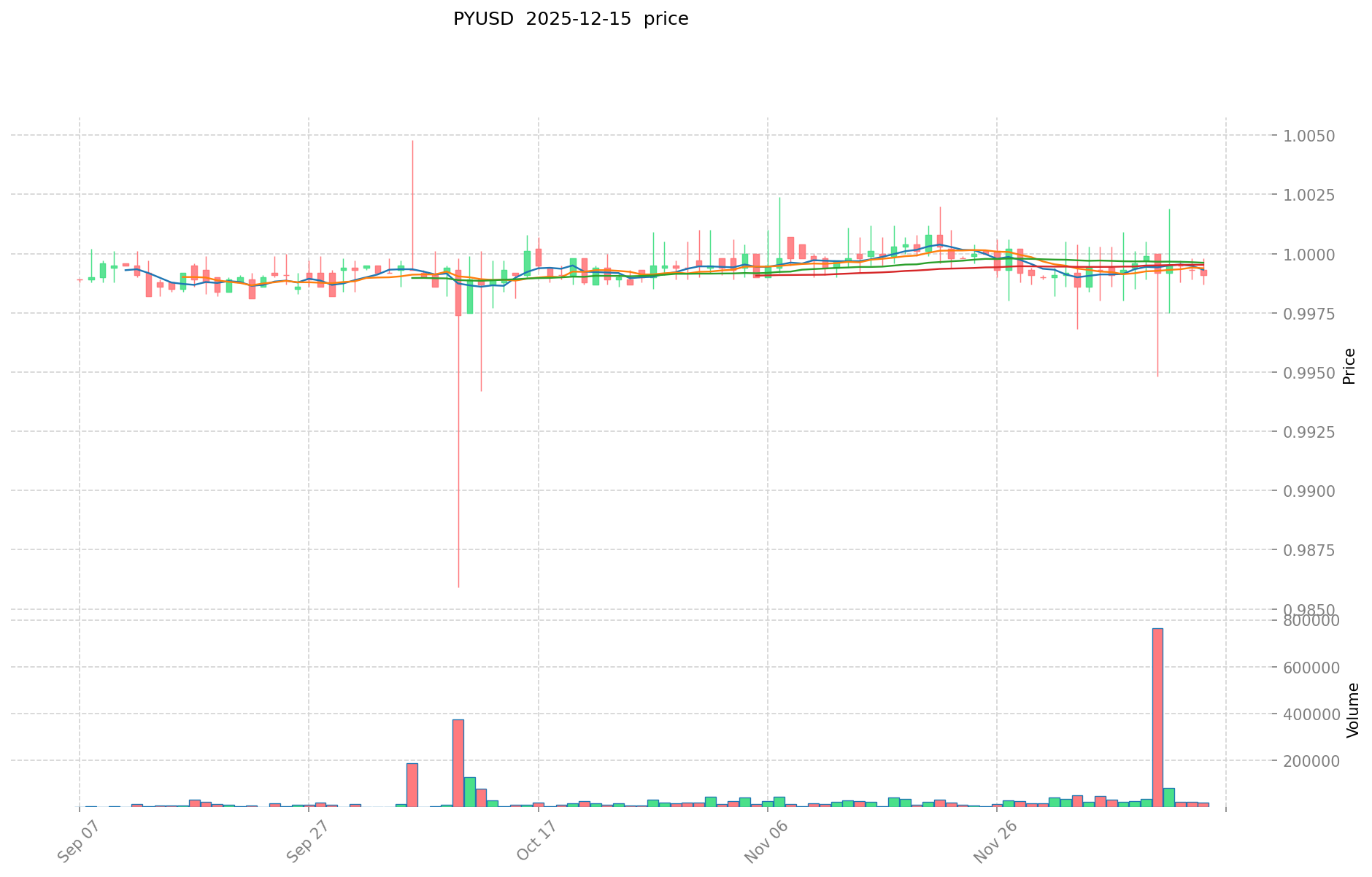
PYUSD Historical Price Performance
- August 2023: PYUSD reached its all-time low of $0.833 on August 22, 2023, marking the beginning of market stabilization following its launch period.
- September 2023: PYUSD achieved its all-time high of $1.20 on September 12, 2023, representing peak market enthusiasm during the initial trading phase.
- 2023-2025: Over the past year through December 2025, PYUSD demonstrated minimal price volatility with a modest annual gain of 0.11%, underscoring its fundamental design as a stablecoin.
Current Market Status (December 15, 2025)
| Metric | Value |
|---|---|
| Current Price | $0.9992 |
| 24-Hour Price Change | -0.04% |
| 7-Day Price Change | -0.06% |
| 30-Day Price Change | -0.10% |
| 1-Year Price Change | +0.11% |
| Market Capitalization | $3,862,630,314.93 |
| Fully Diluted Valuation | $966,840,773.11 |
| 24-Hour Trading Volume | $21,524.55 |
| Market Dominance | 0.029% |
| Token Holders | 46,904 |
| Market Ranking | #34 |
For real-time PYUSD market pricing and detailed charts, visit the official price tracking page
II. Project Overview and Technical Architecture
Core Concept and Design
PayPal USD (PYUSD) is engineered to facilitate payment opportunities through stablecoin technology. The asset is 100% backed by U.S. dollar deposits, short-term U.S. Treasuries, and equivalent cash instruments, ensuring direct redemption value.
Key Characteristics:
- Issuer: Paxos Trust Company (regulated financial institution)
- Redemption Mechanism: 1:1 redeemable for U.S. dollars
- Blockchain Network: Solana (SPL token standard)
- Contract Address:
2b1kV6DkPAnxd5ixfnxCpjxmKwqjjaYmCZfHsFu24GXo - Maximum Supply: Unlimited (∞)
- Circulating Supply: 3,865,722,893.24 PYUSD
- Listed Exchanges: 14 major trading platforms
Strategic Significance in the Stablecoin Ecosystem
PayPal's entry into the stablecoin market in August 2023 represented a watershed moment for crypto asset adoption. As a mainstream, publicly-traded, and strictly-regulated U.S. fintech giant, PayPal's formal adoption of stablecoin infrastructure signifies the industry's transition into a new phase dominated by traditional finance (TradFi) and fintech players pursuing mass-market mainstream adoption.
This milestone distinguishes PYUSD from earlier stablecoin experiments by anchoring it within established institutional finance frameworks rather than crypto-native infrastructure.
III. Market Dynamics and Competitive Positioning
Current Market Landscape
The stablecoin market, valued at over $283 billion as of reference data analysis, has undergone significant consolidation following a decade of market evolution. The competitive structure demonstrates:
- Market Concentration: USDT and USDC dominate approximately 90% of total stablecoin market share
- Regulatory Compliance Model: The market has converged on fiat-collateralized stablecoin architectures as the dominant paradigm following the failure of algorithmic models
- PYUSD's Position: Occupies a specialized niche as a payment-focused stablecoin backed by institutional fintech credibility
Price Stability Analysis
PYUSD's performance metrics reveal characteristic stablecoin behavior:
| Time Period | Price Change |
|---|---|
| 1-Hour | -0.05% |
| 24-Hour | -0.04% |
| 7-Day | -0.06% |
| 30-Day | -0.10% |
| 1-Year | +0.11% |
The minimal deviations from the $1.00 peg across all timeframes demonstrate effective collateralization management and redemption mechanisms.
IV. Network Infrastructure
Blockchain Deployment
PYUSD operates on the Solana blockchain utilizing the SPL (Solana Program Library) token standard, offering:
- Transaction Speed: Solana's high-throughput architecture enabling rapid payment settlement
- Cost Efficiency: Reduced transaction fees compared to legacy blockchain networks
- Interoperability: Integration with Solana's DeFi ecosystem and payment applications
V. Market Sentiment and Adoption Indicators
- Market Emotion Index: Neutral (score: 1)
- Active Token Holders: 46,904 addresses
- Distribution Breadth: Indicates growing but moderate adoption among crypto market participants
Conclusion
PayPal USD represents a strategic convergence of institutional finance credibility with blockchain payment infrastructure. Its stable pricing, regulatory backing through Paxos Trust Company, and 1:1 USD redemption guarantee position it as a bridge asset facilitating institutional entry into digital payment systems. While maintaining minimal market share relative to USDT and USDC, PYUSD's significance lies in validating mainstream fintech adoption of stablecoin technology rather than capturing dominant market position.
The project's continuation of price stability within a narrow band surrounding $1.00 validates its core technical and operational design, even as broader market conditions fluctuate.
PayPal USD (PYUSD) Investment Analysis Report
Report Date: December 15, 2025
I. Executive Summary
PayPal USD (PYUSD) is a stablecoin designed to facilitate payments, backed 100% by U.S. dollar deposits, short-term U.S. Treasuries, and similar cash equivalents. Issued by Paxos Trust Company, PYUSD maintains a 1:1 redemption ratio with U.S. dollars. As of the report date, PYUSD is ranked 34th by market capitalization with a current price of $0.9992, representing minimal price volatility typical of stablecoin instruments.
II. Core Factors Influencing PYUSD Investment Considerations
Backing Mechanism and Stability
PYUSD is distinguished by its comprehensive reserve backing structure:
- Reserve Composition: 100% backed by U.S. dollar deposits, short-term U.S. Treasuries, and cash equivalents
- Redemption Structure: Maintains 1:1 convertibility with U.S. dollars
- Issuer Credibility: Issued by Paxos Trust Company, a regulated trust company
This backing mechanism ensures that PYUSD functions as a stable store of value rather than a speculative asset. The price stability is evidenced by the 24-hour price range of $0.9987 to $0.9998, demonstrating minimal deviation from its $1.00 peg.
Market Position and Adoption
- Market Ranking: 34th by market capitalization
- Market Capitalization: $3.86 billion (circulating)
- Circulating Supply: 3.87 billion tokens
- Number of Holders: 46,904 addresses
- Listed Exchanges: 14 major cryptocurrency exchanges
- Network: Deployed on Solana blockchain (SPL token standard)
The presence on multiple exchange platforms and diverse holder base indicates meaningful ecosystem adoption within the cryptocurrency infrastructure.
Supply Dynamics
- Circulating Supply: 3.87 billion PYUSD
- Maximum Supply: Unlimited (∞)
- Circulation Ratio: 399.51%
The unlimited maximum supply reflects the stablecoin model where supply expands or contracts based on demand for the underlying U.S. dollar reserves. This contrasts with fixed-supply cryptoassets and aligns with traditional reserve-backed currency mechanisms.
Historical Performance and Price Trends
Price Movement Analysis:
- 1-Hour Change: -0.05%
- 24-Hour Change: -0.04%
- 7-Day Change: -0.06%
- 30-Day Change: -0.10%
- 1-Year Change: +0.11%
Historical Price Range:
- All-Time High: $1.20 (September 12, 2023)
- All-Time Low: $0.833 (August 22, 2023)
- Current Price: $0.9992
The minor deviations from the $1.00 peg reflect normal stablecoin market mechanics, where arbitrage mechanisms typically restore price equilibrium.
24-Hour Trading Activity
- Trading Volume (24h): $21,524.55
- 24-Hour High: $0.9998
- 24-Hour Low: $0.9987
III. Market Sentiment and Outlook
Market sentiment indicators suggest cautious positioning around PYUSD within the investment community. Key considerations include:
- Stability Advantage: PYUSD offers stability and potential for adoption within the PayPal ecosystem
- Competitive Environment: Faces competition from established stablecoins and regulatory challenges
- Ecosystem Integration: Potential for integration into PayPal's payment infrastructure supports utility-driven adoption
IV. Risk Considerations
- Regulatory Environment: Stablecoins operate within evolving regulatory frameworks that may impact operational scope
- Competition: Multiple competing stablecoin offerings in the market
- Operational Dependencies: Value preservation depends on issuer's maintenance of reserve backing and regulatory compliance
V. Investment Context
As a stablecoin, PYUSD functions primarily as a medium of exchange and store of value rather than a growth-oriented investment. Its value proposition derives from:
- Payment Functionality: Integration with PayPal's payment ecosystem
- Capital Preservation: Reserve backing ensures value stability
- Redemption Certainty: 1:1 convertibility with U.S. dollars
- Multi-Chain Availability: Accessibility across blockchain networks
VI. Conclusion
PYUSD represents a reserve-backed stablecoin designed for payment utility rather than capital appreciation. Its investment profile is characterized by price stability, liquidity across multiple exchanges, and integration with PayPal's ecosystem. Investment considerations should focus on utility, reserve security, and regulatory compliance rather than price appreciation expectations, given the stablecoin's design parameters and historical price stability around the $1.00 target.
III. PYUSD Future Investment Prediction and Price Outlook (Is PayPal USD(PYUSD) worth investing in 2025-2030)
Short-term Investment Prediction (2025, short-term PYUSD investment outlook)
- Conservative forecast: $0.9991 - $1.0000
- Neutral forecast: $0.9991 - $1.0491
- Optimistic forecast: $1.0000 - $1.0491
Mid-term Investment Outlook (2026-2028, mid-term PayPal USD(PYUSD) investment forecast)
-
Market phase expectation: PYUSD is entering a gradual expansion phase as stablecoin adoption accelerates. The asset is expected to maintain its core 1:1 USD backing while gaining increased adoption in cross-border payments and decentralized finance applications.
-
Investment return forecast:
- 2026: $0.5735 - $1.3108 (projected range with 2% potential increase)
- 2027: $0.9807 - $1.2608 (predicted range with 16% potential upside)
- 2028: $1.0684 - $1.6148 (forecasted range with 21% potential growth)
-
Key catalysts: Expansion of PayPal's stablecoin ecosystem, increased institutional adoption of PYUSD in payment protocols, regulatory clarity for stablecoins in major jurisdictions, and growth in Solana network applications.
Long-term Investment Outlook (Is PayPal USD(PYUSD) a good long-term investment?)
- Base scenario: $1.0214 - $1.4145 USD (corresponding to steady adoption rates and stable regulatory environment)
- Optimistic scenario: $1.7611 - $2.3598 USD (corresponding to massive mainstream adoption and favorable market conditions through 2030)
- Risk scenario: $0.8770 - $1.0214 USD (corresponding to regulatory headwinds or competitive pressures from alternative stablecoins)
Check PYUSD long-term investment and price prediction: Price Prediction
2025-12-15 - 2030 Long-term Outlook
- Base scenario: $1.0240 - $1.7611 USD (corresponding to steady adoption and mainstream application growth)
- Optimistic scenario: $1.7611 - $2.3598 USD (corresponding to large-scale adoption and favorable market environment)
- Transformative scenario: $2.3598 USD and above (if ecosystem breakthrough progress and mainstream adoption are achieved)
- 2030-12-31 Predicted High: $2.3598 USD (based on optimistic development assumptions)
Disclaimer: This analysis is based on available market data and historical trends. Past performance does not guarantee future results. Stablecoins carry inherent risks including regulatory changes, counterparty risks, and market dynamics. This content is for informational purposes only and should not be construed as investment advice.
| 年份 | 预测最高价 | 预测平均价格 | 预测最低价 | 涨跌幅 |
|---|---|---|---|---|
| 2025 | 1.049055 | 0.9991 | 0.519532 | 0 |
| 2026 | 1.3108192 | 1.0240775 | 0.5734834 | 2 |
| 2027 | 1.260844218 | 1.16744835 | 0.980656614 | 16 |
| 2028 | 1.61481455772 | 1.214146284 | 1.06844872992 | 21 |
| 2029 | 2.1075758270814 | 1.41448042086 | 0.8769778609332 | 41 |
| 2030 | 2.359777686120738 | 1.7610281239707 | 1.021396311903006 | 76 |
PayPal USD (PYUSD) Investment Analysis Report
Report Date: December 15, 2025
I. Executive Summary
PayPal USD (PYUSD) is a stablecoin designed to facilitate payment opportunities through blockchain technology. It is 100% backed by U.S. dollar deposits, short-term U.S. Treasuries, and similar cash equivalents, with a 1:1 redemption rate for U.S. dollars. The token is issued by Paxos Trust Company and currently ranks 34th in market capitalization.
Key Metrics (as of December 15, 2025):
- Current Price: $0.9992
- Market Capitalization: $3,862,630,314.93
- Fully Diluted Valuation: $966,840,773.11
- Circulating Supply: 3,865,722,893.24 PYUSD
- 24-Hour Trading Volume: $21,524.55
II. Market Performance Analysis
Price Movement Trends
| Time Period | Price Change | Change Amount |
|---|---|---|
| 1 Hour | -0.05% | -$0.0005 |
| 24 Hours | -0.04% | -$0.0004 |
| 7 Days | -0.06% | -$0.0006 |
| 30 Days | -0.10% | -$0.0010 |
| 1 Year | +0.11% | +$0.0011 |
Historical Price Range
- All-Time High: $1.2 (September 12, 2023)
- All-Time Low: $0.833 (August 22, 2023)
- 24-Hour High: $0.9998
- 24-Hour Low: $0.9987
Market Position
- Global Rank: 34th
- Market Share: 0.029%
- Number of Holders: 46,904
- Supported Exchanges: 14
III. Technical & Operational Specifications
Blockchain Infrastructure
- Primary Blockchain: Solana (SPL standard)
- Contract Address: 2b1kV6DkPAnxd5ixfnxCpjxmKwqjjaYmCZfHsFu24GXo
- Issuer: Paxos Trust Company
Supply Characteristics
- Circulating Supply: 3,865,722,893.24 PYUSD
- Total Supply: 967,614,865 PYUSD
- Maximum Supply: Unlimited
- Supply Circulating Ratio: 399.51%
IV. Investment Strategy and Risk Management
Investment Methodology
For Conservative Investors:
- HODL Strategy: Long-term holding aligned with PYUSD's stablecoin nature, suitable for portfolio stabilization
- Primary Use Case: Reserve asset, payment settlement, or USD exposure on blockchain
For Active Traders:
- Limited applicability: As a stablecoin, PYUSD experiences minimal price volatility, offering few trading opportunities compared to volatile cryptocurrencies
- Arbitrage Opportunities: May arise from price discrepancies across different exchanges (current 24-hour range: $0.9987-$0.9998)
Risk Management
Asset Allocation Recommendations:
- Conservative Investors: PYUSD allocation as 5-10% of crypto portfolio for portfolio stabilization
- Aggressive Investors: Limited utility; primarily as liquidity reserve rather than growth asset
- Institutional Investors: Operational use for settlement and liquidity management
Portfolio Diversification:
- PYUSD functions as a hedge against cryptocurrency volatility rather than a growth investment
- Effective pairing with volatile cryptocurrencies to reduce overall portfolio risk
- Alternative stable value stores: other major stablecoins (USDC, USDT, DAI) for diversification
Secure Storage:
- Hot Wallets: For regular transactions and exchange operations
- Cold Storage: For long-term holding and institutional reserves
- Hardware Wallets: Ledger or Trezor for enhanced security
- Custodial Solutions: Institutional-grade custodians for large holdings
V. Investment Risks and Challenges
Market Risks
- Minimal Price Volatility: While reducing speculative trading opportunities, stablecoins may experience slight depeg events
- Liquidity Concentration: 24-hour trading volume of $21,524 suggests lower liquidity compared to major cryptocurrencies
- Exchange Dependency: Limited to 14 exchanges, potentially restricting accessibility
Regulatory Risks
- Stablecoin Regulation: Evolving regulatory frameworks globally may impact PYUSD's operational status
- Issuer Oversight: Paxos Trust Company is subject to regulatory scrutiny; regulatory changes affecting the issuer could impact PYUSD
- Jurisdictional Restrictions: Different countries maintain varying policies toward stablecoin adoption and use
Technical and Operational Risks
- Blockchain Dependency: Reliance on Solana network; network congestion or technical issues could affect transaction speed
- Reserve Verification: Dependency on Paxos Trust Company's reserve backing and compliance
- Integration Risk: Changes to blockchain infrastructure or network upgrades could necessitate token migration
Counterparty Risks
- Issuer Risk: Paxos Trust Company's operational continuity and regulatory compliance are critical
- Redemption Risk: While guaranteed 1:1 redemption, external factors could theoretically impact this promise
VI. Conclusion: Is PayPal USD a Good Investment?
Investment Value Summary
PayPal USD is not primarily an investment vehicle but rather a utility asset designed for payments and settlement. As a stablecoin:
- ✅ Strengths: Full USD backing, regulatory oversight by Paxos, accessible payment utility, 1:1 redemption guarantee
- ⚠️ Limitations: Minimal capital appreciation potential, low trading volume, limited exchange availability
Investor Recommendations
✅ For New Investors:
- Use PYUSD as a stable reserve in cryptocurrency portfolios rather than seeking returns
- Maintain holdings in secure wallets for transaction readiness
- Dollar-cost averaging irrelevant; purchase only amounts needed for operational use
✅ For Experienced Investors:
- Incorporate as portfolio stabilizer and liquidity reserve
- Leverage for arbitrage opportunities across exchanges if price discrepancies emerge
- Combine with growth-oriented cryptocurrencies for comprehensive portfolio balancing
✅ For Institutional Investors:
- Strategic use for settlement operations and operational liquidity
- Potential integration into treasury management systems
- Monitoring regulatory developments affecting stablecoin approvals
Critical Disclaimer
⚠️ Important Notice: PayPal USD is a stablecoin designed for payments and settlement, not capital appreciation. Cryptocurrency investments carry substantial risks including market volatility, regulatory uncertainty, and technical vulnerabilities. This report is provided for informational purposes only and does not constitute investment advice, financial recommendation, or solicitation to purchase or sell any asset. Investors must conduct independent research and consult qualified financial advisors before making investment decisions. All investments involve risk, including potential loss of principal.
Report Generated: December 15, 2025
PayPal USD (PYUSD) Frequently Asked Questions (FAQ)
I. What is PayPal USD (PYUSD) and how does it work?
Q: What is PayPal USD (PYUSD) and how does it work?
A: PayPal USD (PYUSD) is a stablecoin issued by Paxos Trust Company, designed to facilitate payment opportunities through blockchain technology. It is 100% backed by U.S. dollar deposits, short-term U.S. Treasuries, and similar cash equivalents, maintaining a 1:1 redemption ratio with U.S. dollars. PYUSD operates on the Solana blockchain using the SPL token standard, enabling fast and low-cost transactions. The token's core function is to serve as a bridge between traditional finance and blockchain-based payment systems rather than as a speculative investment asset.
II. What backing and collateral supports PYUSD?
Q: What backing and collateral supports PYUSD?
A: PYUSD is fully collateralized with 100% backing comprising U.S. dollar deposits, short-term U.S. Treasuries, and equivalent cash instruments. This reserve structure is managed by Paxos Trust Company, a regulated financial institution, ensuring that each PYUSD token can be redeemed 1:1 for U.S. dollars. The comprehensive backing mechanism distinguishes PYUSD from algorithmic stablecoins and provides capital preservation guarantees to token holders.
III. Is PYUSD a good investment for capital appreciation?
Q: Is PYUSD a good investment for capital appreciation?
A: No, PYUSD is not designed for capital appreciation. As a stablecoin, its primary function is to maintain a stable value around $1.00 rather than generate investment returns. Historical data shows PYUSD has delivered only 0.11% return over the past year, with minimal price volatility across all timeframes. PYUSD functions as a utility asset for payments and portfolio stabilization rather than a growth investment vehicle. Investors seeking capital gains should consider alternative cryptocurrency assets with growth potential.
IV. What are the primary risks associated with holding PYUSD?
Q: What are the primary risks associated with holding PYUSD?
A: Key risks include regulatory uncertainty regarding stablecoin oversight in various jurisdictions, operational dependency on Paxos Trust Company's compliance and financial stability, low trading volume ($21,524 in 24-hour volume) which may limit liquidity during market stress, blockchain dependency on Solana network performance, and potential depeg events where PYUSD temporarily deviates from its $1.00 target. Additionally, evolving regulatory frameworks could impact PYUSD's operational scope or restrict its use in certain regions.
V. How does PYUSD compare to other major stablecoins like USDT and USDC?
Q: How does PYUSD compare to other major stablecoins like USDT and USDC?
A: PYUSD occupies a specialized niche within the stablecoin market dominated by USDT and USDC, which together control approximately 90% of total stablecoin market share. PYUSD's competitive advantages include PayPal's mainstream fintech credibility, regulatory backing through Paxos Trust Company, and integration potential with PayPal's global payment ecosystem. However, PYUSD has significantly lower market capitalization ($3.86 billion versus USDT's market dominance), lower trading volume, and availability on only 14 exchanges compared to major competitors' broader distribution. PYUSD's significance derives from validating mainstream fintech adoption rather than capturing dominant market position.
VI. What is the price forecast for PYUSD through 2030?
Q: What is the price forecast for PYUSD through 2030?
A: Price forecasts for PYUSD through 2030 depend on adoption scenarios. Short-term (2025): conservative estimate $0.9991-$1.0000, optimistic estimate $1.0000-$1.0491. Mid-term (2026-2028): projections range from $0.5735-$1.6148 with potential gains of 2-21% driven by stablecoin adoption expansion. Long-term (2030): base scenario $1.0214-$1.4145; optimistic scenario $1.7611-$2.3598; risk scenario $0.8770-$1.0214. These forecasts assume steady regulatory environment and mainstream adoption acceleration. Important disclaimer: Past performance does not guarantee future results, and these projections carry substantial uncertainty.
VII. How should investors incorporate PYUSD into their portfolio strategy?
Q: How should investors incorporate PYUSD into their portfolio strategy?
A: PYUSD functions as a stabilizer and utility asset rather than a growth investment. Conservative investors should allocate 5-10% of crypto portfolios to PYUSD for portfolio stabilization and USD exposure on blockchain. Active traders will find limited opportunities given minimal volatility. Institutional investors should utilize PYUSD for settlement operations and liquidity management. Optimal strategy involves pairing PYUSD with volatile cryptocurrencies to reduce overall portfolio risk. For secure storage, utilize hardware wallets for long-term holding or custodial solutions for institutional-scale reserves. Dollar-cost averaging is unnecessary; purchase only amounts needed for operational use.
VIII. What regulatory developments could affect PYUSD's future?
Q: What regulatory developments could affect PYUSD's future?
A: Potential regulatory impacts include evolving stablecoin oversight frameworks in major jurisdictions (particularly the United States, European Union, and Asia), enhanced issuer oversight affecting Paxos Trust Company's operations, possible restrictions on stablecoin use in specific regions, and requirements for additional reserve transparency or redemption procedures. Favorable developments could include regulatory clarity affirming stablecoin legitimacy, integration approvals for payment systems, and cross-border settlement frameworks. Adverse developments might include operational restrictions, reserve requirement increases, or jurisdictional bans. Investors should monitor regulatory announcements from financial authorities and stablecoin regulatory bodies to assess impact on PYUSD's operational viability and utility.
Disclaimer: This FAQ is provided for informational purposes only and does not constitute investment advice, financial recommendation, or solicitation to purchase or sell assets. Cryptocurrency investments carry substantial risks including regulatory uncertainty, technical vulnerabilities, and market volatility. Investors must conduct independent research and consult qualified financial advisors before making investment decisions.
Share
How to Buy Cryptocurrency


Trending Cryptocurrencies



XZXX: A Comprehensive Guide to the BRC-20 Meme Token in 2025

Bitcoin Fear and Greed Index: Market Sentiment Analysis for 2025

Top Crypto ETFs to Watch in 2025: Navigating the Digital Asset Boom
5 ways to get Bitcoin for free in 2025: Newbie Guide
Bitcoin Market Cap in 2025: Analysis and Trends for Investors

2025 Bitcoin Price Prediction: Trump's Tariffs' Impact on BTC

Is Falcon Finance (FF) a good investment?: A Comprehensive Analysis of Returns, Risks, and Market Potential
Is Zebec Protocol (ZBCN) a good investment?: A Comprehensive Analysis of Tokenomics, Use Cases, and Market Potential in 2024

Is Audiera (BEAT) a good investment?: A Comprehensive Analysis of Tokenomics, Market Potential, and Risk Factors

Is zkSync (ZK) a good investment?: A Comprehensive Analysis of Layer 2 Scaling Solutions and Future Prospects

TBC vs MANA: A Comprehensive Comparison of Two Leading Blockchain Governance Tokens