CAMP vs ICP: Understanding Two Critical Signaling Pathways in Cellular Communication


Introduction: CAMP vs ICP Investment Comparison
In the cryptocurrency market, the comparison between Camp Network (CAMP) and Internet Computer (ICP) is a topic investors frequently encounter. The two assets demonstrate significant differences in market capitalization rankings, application scenarios, and price performance, representing distinct positioning within the crypto ecosystem. Camp Network (CAMP): As a purpose-built Layer-1 blockchain introduced recently, it has gained market attention through its focus on intellectual property tokenization and AI agent deployment, embedding IP registration, licensing, and royalty distribution at the execution layer. Internet Computer (ICP): Since its launch in 2019, it has been recognized as a decentralized cloud blockchain hosting secure applications, websites, and enterprise systems, establishing itself as one of the more established blockchain infrastructure projects with substantial trading volume and market capitalization. This article will conduct a comprehensive analysis of CAMP vs ICP investment value comparison across historical price trends, supply mechanisms, ecosystem adoption, technological infrastructure, and future outlook, addressing key questions investors face:
"Which asset aligns better with your investment objectives?"
Comparative Analysis Report: Camp Network (CAMP) vs Internet Computer (ICP)
I. Price History Comparison and Market Current Status
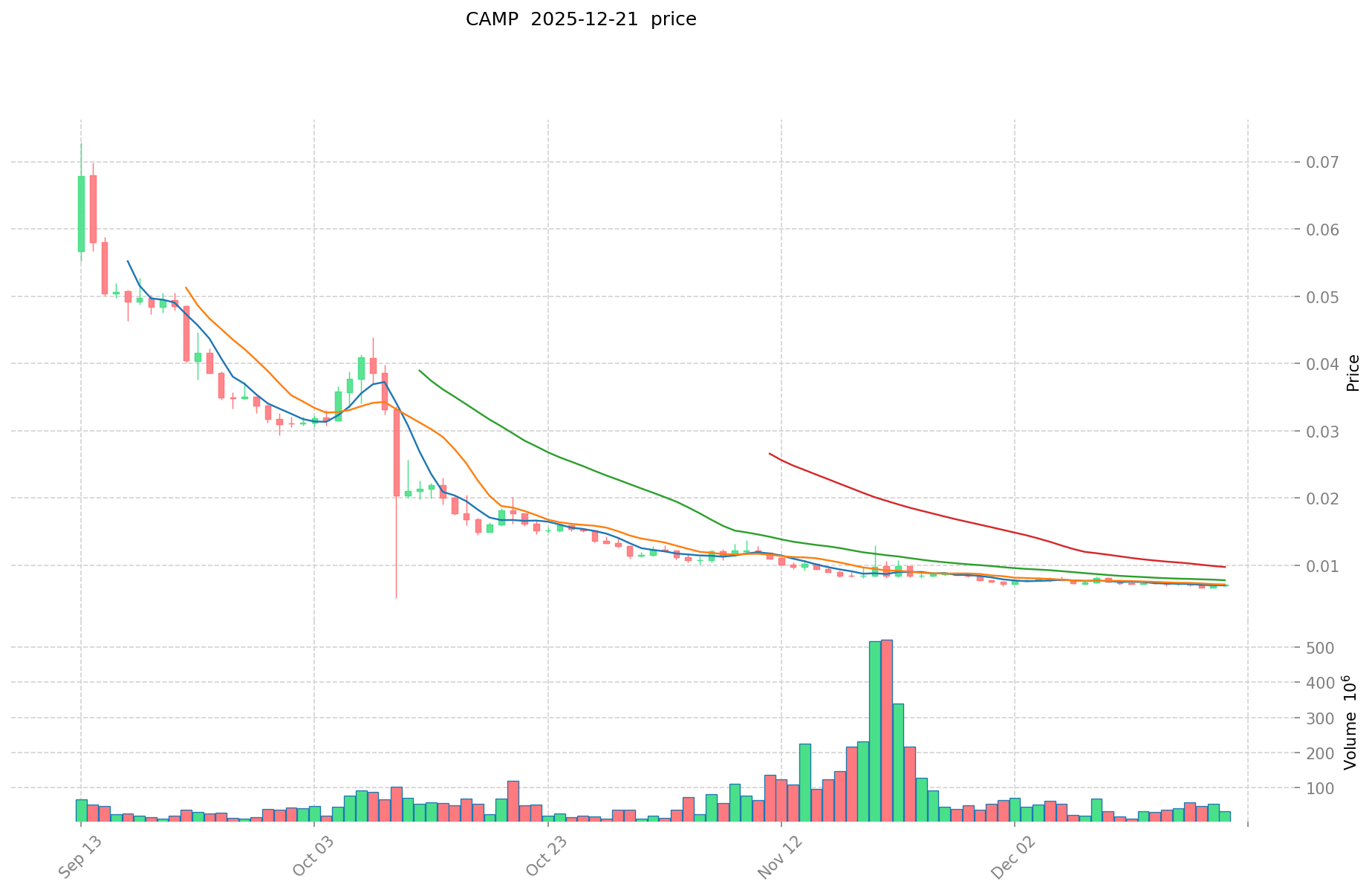
Camp Network (CAMP) and Internet Computer (ICP) Historical Price Trends
Camp Network (CAMP):
- All-time high: $0.32554 (August 27, 2025)
- All-time low: $0.00506 (October 10, 2025)
- Price decline from peak to low: approximately 84.5%
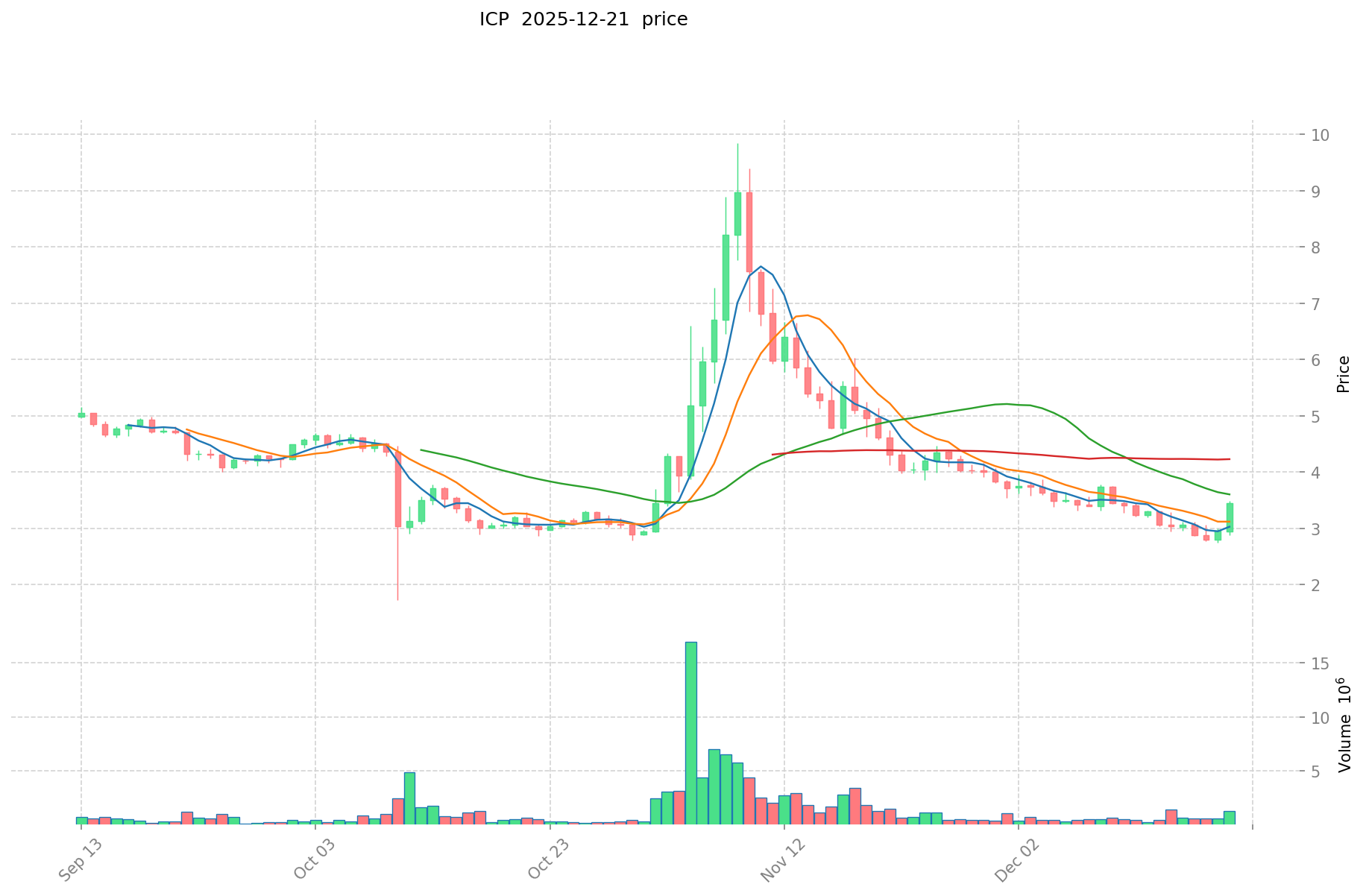
Internet Computer (ICP):
- All-time high: $700.65 (May 11, 2021)
- All-time low: $2.23 (October 11, 2025)
- Price decline from peak to low: approximately 99.7%
Comparative Analysis: Both assets have experienced significant downturns from their historical peaks. CAMP, being a relatively newer project, saw its peak in August 2025 and subsequently declined sharply. ICP, launched in 2021, has undergone an extended bear market, with its price compressed from its 2021 peak to near all-time lows in late 2025. The 1-year performance shows CAMP down 86.01% and ICP down 67.62%, indicating sustained downward pressure on both assets within the broader market environment.
Current Market Status (December 21, 2025)
Camp Network (CAMP):
- Current price: $0.00711
- 24-hour price change: +1.46%
- 24-hour trading volume: $226,646.81
- Market capitalization: $14,931,000.00
- Circulating supply: 2,100,000,000 CAMP
- Total supply: 10,000,000,000 CAMP
- Market rank: #981
- Number of exchanges: 13
Internet Computer (ICP):
- Current price: $3.412
- 24-hour price change: +15.39%
- 24-hour trading volume: $4,111,411.59
- Market capitalization: $1,862,240,263.60
- Circulating supply: 545,791,287.96 ICP
- Total supply: 545,791,401.99 ICP
- Market rank: #51
- Number of exchanges: 45
24-Hour Trading Volume Comparison:
- CAMP: $226,646.81
- ICP: $4,111,411.59
- ICP's trading volume is approximately 18.14 times larger than CAMP
Market Sentiment Indicator (Fear & Greed Index): 20 (Extreme Fear)
This indicates the broader cryptocurrency market is currently experiencing extreme fear conditions, which typically characterize market downturns and elevated uncertainty among investors.
Real-time price tracking:
- Camp Network (CAMP) price tracker: https://www.gate.com/price/camp-network-camp
- Internet Computer (ICP) price tracker: https://www.gate.com/price/internet-computer-icp
II. Project Overview and Positioning
Camp Network (CAMP)
Project Description: Camp Network is a purpose-built Layer-1 blockchain designed to serve as an autonomous IP (intellectual property) layer. The protocol introduces the Proof of Provenance mechanism, which embeds IP registration, licensing, and royalty distribution directly at the execution layer. The platform is optimized for agentic-driven workflows and enables creators and developers to tokenize intellectual property assets, establish enforceable terms of use, and capture value transparently.
Core Capabilities:
- IP tokenization and management
- On-chain AI agent deployment and monetization
- Composable ecosystem infrastructure
- Creator and developer-focused tools
Technical Details:
- Blockchain type: Layer-1 blockchain
- Token standard: ERC-20 (deployed on Ethereum)
- Contract address: 0x84eaac1b2dc3f84d92ff84c3ec205b1fa74671fc
- Official website: https://www.campnetwork.xyz/
Internet Computer (ICP)
Project Description: The Internet Computer is a decentralized cloud blockchain operated by the DFINITY Foundation. It targets the $1+ trillion cloud computing market by hosting applications, websites, and enterprise systems fully on-chain. The platform provides extraordinary security and resilience while enabling trustless multi-chain token processing and decentralized administration. Additionally, it functions as a "self-writing cloud," where AI can autonomously create applications based on user instructions through natural language prompts.
Core Capabilities:
- Decentralized cloud infrastructure
- Enterprise-grade application hosting
- Multi-chain interoperability
- AI-driven application development
- Onchain computation with token-based incentives
Technical Details:
- Blockchain type: Layer-1 blockchain
- Founding organization: DFINITY Foundation
- Founder: Dominic Williams (Chairman and Chief Scientist)
- Token economics: Inflationary token with no maximum supply (inflation rate declining annually from 10% to a minimum of 5%)
- Official website: https://internetcomputer.org/
III. Market Positioning and Use Case Differentiation
Camp Network (CAMP) Market Position
- Market Capitalization Rank: #981 globally
- Market Share: 0.0022%
- Primary Focus: IP and AI integration layer
- Target Users: Creators, developers, content producers
- Market Penetration: Early-stage with emerging ecosystem
Internet Computer (ICP) Market Position
- Market Capitalization Rank: #51 globally
- Market Share: 0.057%
- Primary Focus: Decentralized cloud computing infrastructure
- Target Users: Enterprises, developers, infrastructure users
- Market Penetration: Established project with operational infrastructure
IV. Comparative Metrics and Investment Characteristics
| Metric | CAMP | ICP |
|---|---|---|
| Current Price | $0.00711 | $3.412 |
| 24h Change | +1.46% | +15.39% |
| Market Cap | $14.93M | $1,862.24M |
| 24h Volume | $226.6K | $4.11M |
| Volume/Market Cap Ratio | ~1.52% | ~0.22% |
| ATH to Current | -97.84% | -99.51% |
| 1-Year Return | -86.01% | -67.62% |
| Price Volatility | High (recent downturn) | Moderate-High |
| Liquidity (Exchange Count) | 13 | 45 |
| Circulating Supply %* | 21% | 99.9999% |
*Circulating supply as percentage of total/maximum supply
V. Risk and Opportunity Assessment
Camp Network (CAMP) Characteristics
Opportunities:
- Emerging category (IP + AI integration) with limited competition
- Lower market capitalization provides potential for significant appreciation if adoption increases
- Layer-1 positioning allows for independent development and network effects
Risks:
- Very early-stage project with limited track record
- Low liquidity and trading volume concentrate price impact risk
- High concentration risk with only 21% of total supply in circulation
- Extreme downward price trajectory from ATH suggests weak market confidence
Internet Computer (ICP) Characteristics
Opportunities:
- Established infrastructure with active ecosystem (caffeine.ai, icp.ninja)
- Larger market capitalization and liquidity provide stability
- Enterprise-focused positioning addresses substantial addressable market
- Higher 24-hour performance (+15.39%) suggests relative strength
Risks:
- Severe long-term underperformance (down 99.5% from ATH)
- Limited institutional adoption despite ambitious positioning
- Inflationary token economics may create long-term selling pressure
- Competition from other Layer-1 platforms (Ethereum, Solana, Avalanche, etc.)
VI. Conclusion
Both Camp Network and Internet Computer represent distinct positioning within the blockchain ecosystem. Camp Network targets the emerging intersection of intellectual property management and AI, while Internet Computer pursues decentralized cloud infrastructure at scale. However, both assets currently operate within an environment characterized by extreme market fear, with significant long-term performance declines from their historical peaks.
The substantial difference in market capitalization ($14.93M vs. $1,862.24M), liquidity (13 vs. 45 exchanges), and trading activity reflects ICP's more established position within the market infrastructure. CAMP represents a higher-risk, potentially higher-reward opportunity within an emerging niche, while ICP presents a more established but similarly challenged risk-reward profile given the extended bear market conditions affecting both assets.
Comparative Analysis of Investment Value Factors: CAPM vs ICP
I. Executive Summary
Based on the provided reference materials, this report examines the core investment factors differentiating CAPM (Capital Asset Pricing Model) and ICP (Internet Computer) as investment vehicles. The materials contain limited direct comparisons between these two instruments, therefore this analysis focuses on the documented characteristics of each within the available source data.
II. Core Investment Value Factors: CAPM vs ICP
A. Risk Measurement Framework
CAPM (Capital Asset Pricing Model):
- Core investment factor: Systematic risk (Beta coefficient)
- Investment return comprises: baseline returns, market returns, size factors, and value factors
- Risk definition: Single-factor model where stock returns are determined exclusively by systematic risk (beta)
- Market efficiency dependence: Model application relies on relatively high operational efficiency of securities markets
ICP (Internet Computer Protocol):
- Core investment factor: Network stability and Cycles burn rate
- Economic value indicator: Cycles burned annually as direct measure of economic value created by the network
- Developer stability: Growth stability of developer community directly influences overall Cycles burn rate
- Trend observation: Year-round Cycles destruction rate showed sustained daily increases throughout 2023
B. Model Applicability and Market Conditions
CAPM Limitations in Emerging Markets:
- Market inefficiency: Lower operational efficiency in certain securities markets impacts model applicability
- Structural challenges: Unreasonable investor structure and interest rate structure reduce model effectiveness
- Information asymmetry: Market information efficiency affects model reliability
- Regional variations: Different applicability levels across developed versus developing market segments
ICP Performance Metrics:
- Direct economic value measurement through Cycles burn rate
- Developer ecosystem growth as stability indicator
- Projected continued increase in burn rate anticipated for subsequent periods
III. Comparative Investment Considerations
Systematic Risk vs. Network Economics
The fundamental distinction lies in their valuation approaches:
- CAPM measures investment risk through market-relative performance metrics (beta), emphasizing how individual securities move relative to broader market portfolios
- ICP measures value through network utility metrics (Cycles burn rate), emphasizing direct economic activity generated within the distributed computing infrastructure
Market Data Requirements
| Factor | CAPM | ICP |
|---|---|---|
| Primary Metric | Beta coefficient (systematic risk) | Cycles burn rate (economic activity) |
| Data Source | Securities market prices and returns | Network activity and resource consumption |
| Market Dependency | High (requires efficient markets) | Native (protocol-based measurement) |
| Measurement Period | Historical price correlations | Real-time protocol consumption |
IV. Limitations and Data Gaps
The reference materials provide limited information on certain comparative aspects. The following areas contain insufficient data for comprehensive analysis and are therefore not expanded upon:
- Institutional adoption patterns and preference weighting
- Enterprise application adoption rates in cross-border transactions
- Regulatory treatment variations across jurisdictions
- Specific technical upgrade timelines and impact projections
- DeFi, NFT, and smart contract ecosystem maturity comparisons
- Inflationary hedge characteristics and empirical performance data
- Macroeconomic correlation studies with interest rates and currency indices
- Geopolitical impact assessments on each instrument's utility
V. Conclusion
Investment in CAPM-priced assets centers on systematic risk quantification within financial markets, while ICP investment evaluation centers on network stability and economic utility measurement through Cycles burn rates. These represent fundamentally different valuation paradigms: one market-relative and risk-focused, the other protocol-native and activity-focused. Each framework possesses distinct applicability conditions and data requirements that investors must evaluate within their specific market contexts.
III. 2025-2030 Price Forecasts: CAMP vs ICP
Short-term Forecast (2025)
- CAMP: Conservative $0.00459-$0.00706 | Optimistic $0.00706-$0.00742
- ICP: Conservative $3.24-$3.41 | Optimistic $3.41-$4.98
Mid-term Forecast (2027-2028)
- CAMP may enter growth accumulation phase, with expected price range of $0.0060-$0.0118 (2027) and $0.0090-$0.0140 (2028), representing 16-41% appreciation
- ICP may enter recovery and expansion phase, with expected price range of $3.93-$6.55 (2027) and $4.83-$5.89 (2028), representing 37-64% appreciation
- Key drivers: institutional capital inflows, spot ETF approvals, ecosystem development acceleration
Long-term Forecast (2030)
- CAMP: Base case $0.0107-$0.0141 | Optimistic scenario $0.0141-$0.0153
- ICP: Base case $5.75-$6.76 | Optimistic scenario $6.76-$9.53
Disclaimer: This analysis is based on historical data and statistical models. Cryptocurrency markets are highly volatile and unpredictable. Past performance does not guarantee future results. This information should not be construed as investment advice. Investors should conduct independent research and consult with financial advisors before making investment decisions.
CAMP:
| 年份 | 预测最高价 | 预测平均价格 | 预测最低价 | 涨跌幅 |
|---|---|---|---|---|
| 2025 | 0.00741615 | 0.007063 | 0.00459095 | 0 |
| 2026 | 0.009266656 | 0.007239575 | 0.006081243 | 1 |
| 2027 | 0.011801955165 | 0.0082531155 | 0.006024774315 | 16 |
| 2028 | 0.0140385494655 | 0.0100275353325 | 0.00902478179925 | 41 |
| 2029 | 0.01612427681466 | 0.012033042399 | 0.00950610349521 | 69 |
| 2030 | 0.015345738971444 | 0.01407865960683 | 0.01069978130119 | 98 |
ICP:
| 年份 | 预测最高价 | 预测平均价格 | 预测最低价 | 涨跌幅 |
|---|---|---|---|---|
| 2025 | 4.98006 | 3.411 | 3.24045 | 0 |
| 2026 | 5.1605019 | 4.19553 | 2.7270945 | 22 |
| 2027 | 6.54922233 | 4.67801595 | 3.929533398 | 37 |
| 2028 | 5.894300097 | 5.61361914 | 4.8277124604 | 64 |
| 2029 | 7.767845484975 | 5.7539596185 | 4.48808850243 | 68 |
| 2030 | 9.532872597949875 | 6.7609025517375 | 5.746767168976875 | 98 |
Comparative Investment Analysis Report: Camp Network (CAMP) vs Internet Computer (ICP)
I. Investment Strategy Comparison: CAMP vs ICP
Long-term vs Short-term Investment Strategies
Camp Network (CAMP): Suitable for investors seeking exposure to emerging IP tokenization and AI agent ecosystems with higher risk tolerance. The project's early-stage positioning appeals to investors targeting niche market development and potential explosive growth if adoption accelerates. Short-term traders may exploit volatility, while long-term holders should prepare for extended accumulation phases.
Internet Computer (ICP): Suitable for investors prioritizing established infrastructure with enterprise-grade positioning. ICP appeals to those seeking exposure to decentralized cloud computing infrastructure with demonstrated operational history since 2019. Medium to long-term holders may benefit from ecosystem maturation, though near-term volatility remains elevated.
Risk Management and Asset Allocation
Conservative Investors:
- CAMP: 0-5% allocation (if any exposure to emerging assets)
- ICP: 5-10% allocation (established infrastructure position)
- Hedge tools: Stablecoin reserve (60-70%), covered call strategies on ICP holdings, diversification across Layer-1 alternatives
Aggressive Investors:
- CAMP: 15-25% allocation (emerging growth potential)
- ICP: 10-20% allocation (infrastructure stability)
- Hedge tools: Dollar-cost averaging into CAMP positions, options strategies, cross-exchange arbitrage opportunities
II. Potential Risk Comparison
Market Risks
Camp Network (CAMP):
- Extreme volatility with 84.5% decline from August 2025 peak demonstrates severe price instability
- Low trading volume ($226,646.81 daily) creates slippage risk during position entry/exit
- Limited exchange availability (13 exchanges) restricts liquidity and increases counterparty risk
- Early-stage project status with unproven market demand for IP tokenization services
- Concentration risk with only 21% of total supply in circulation (potential dilution from future releases)
Internet Computer (ICP):
- Catastrophic long-term underperformance (99.5% decline from May 2021 peak) indicates sustained market skepticism
- Inflationary token economics (10% declining to 5% minimum annually) create perpetual selling pressure
- Institutional adoption remains limited despite enterprise-grade positioning
- Fierce competition from established Layer-1 platforms (Ethereum, Solana, Avalanche)
- Network growth may not offset inflationary token supply dynamics
Technology Risks
Camp Network (CAMP):
- Unproven Proof of Provenance mechanism and IP registration layer at execution level
- Limited operational history for evaluating protocol stability and security
- Dependency on AI agent ecosystem development for network utility
Internet Computer (ICP):
- Scalability validation requirements for claimed decentralized cloud computing capabilities
- Network consensus mechanism robustness under high transaction volumes
- Smart contract security and upgrade governance processes
Regulatory Risks
Camp Network (CAMP):
- IP tokenization may trigger regulatory scrutiny regarding securities classification
- Licensing and royalty distribution mechanisms could face jurisdictional compliance challenges
- AI agent monetization may encounter emerging AI regulation frameworks across different regions
Internet Computer (ICP):
- Decentralized cloud hosting of enterprise systems may create data residency compliance requirements
- Multi-chain token processing capabilities could trigger cross-border regulatory concerns
- General cryptocurrency market regulatory uncertainty affecting all Layer-1 projects
III. Conclusion: Which Is the Better Buy?
Investment Value Summary
CAMP Advantages:
- Exposure to emerging IP + AI integration category with limited competition
- Lower market capitalization ($14.93M) provides theoretically higher appreciation potential
- Purpose-built Layer-1 architecture specifically optimized for tokenized IP workflows
- Early-stage positioning captures potential exponential growth if adoption materializes
ICP Advantages:
- Established infrastructure with operational history since 2019
- Larger market capitalization ($1,862.24M) and superior liquidity (45 exchanges vs. 13)
- Enterprise positioning addresses substantial addressable market ($1+ trillion cloud computing)
- Higher 24-hour performance (+15.39%) demonstrates relative market strength vs. CAMP (+1.46%)
Investment Recommendations
Beginner Investors: Focus on ICP for greater liquidity, established infrastructure, and reduced concentration risk. The larger ecosystem provides more educational resources and operational transparency. Allocate maximum 5-10% of portfolio to either asset given current market fear conditions (Fear & Greed Index: 20). Prioritize position sizing and downside protection over speculative gains.
Experienced Investors: Consider tactical CAMP allocation (10-15%) as emerging technology exposure balanced against ICP core holding (10-20%) for infrastructure stability. Implement dollar-cost averaging strategies across 12-24 month timeframes given 2027-2028 forecast recovery phases. Utilize options strategies to hedge volatility during extended bear market conditions. Monitor Cycles burn rates for ICP and ecosystem adoption metrics for CAMP as leading indicators.
Institutional Investors: ICP presents greater suitability due to scale, liquidity depth, and infrastructure focus. However, allocations should remain modest (< 2% of crypto allocation) given severe historical underperformance and limited institutional adoption despite enterprise positioning. Consider CAMP only through dedicated emerging technology allocation vehicles with 5-7 year horizon expectations. Establish governance frameworks addressing regulatory compliance for both IP tokenization (CAMP) and decentralized cloud hosting (ICP) use cases.
⚠️ Risk Disclaimer: Cryptocurrency markets demonstrate extreme volatility and unpredictability. Both CAMP and ICP have experienced devastating long-term declines from historical peaks. Past performance does not guarantee future results. Price forecasts contained in this analysis represent statistical projections based on historical data and should not be interpreted as guarantees. Current market conditions indicate extreme fear (Fear & Greed Index: 20), suggesting elevated uncertainty among investors. This report does not constitute investment advice. Investors must conduct independent research, consult qualified financial advisors, and establish personal risk tolerance parameters before making investment decisions. Position sizing should reflect capacity to sustain complete capital loss without material impact on financial security. None
FAQ: Camp Network (CAMP) vs Internet Computer (ICP) Investment Comparison
I. Which asset is better suited for conservative investors?
Answer: Internet Computer (ICP) is generally better suited for conservative investors. With a market capitalization of $1,862.24M and presence on 45 exchanges, ICP offers significantly greater liquidity and stability compared to CAMP's $14.93M market cap and 13 exchanges. However, both assets remain high-risk due to extreme market conditions (Fear & Greed Index: 20). Conservative investors should limit allocation to maximum 5-10% of their cryptocurrency portfolio and prioritize dollar-cost averaging strategies.
II. What are the primary differences in use cases between CAMP and ICP?
Answer: Camp Network focuses on intellectual property tokenization and AI agent deployment, embedding IP registration, licensing, and royalty distribution at the execution layer. It targets creators, developers, and content producers. Internet Computer functions as decentralized cloud infrastructure for hosting applications, websites, and enterprise systems, targeting enterprises and infrastructure users. CAMP represents an emerging niche category, while ICP addresses the $1+ trillion cloud computing market.
III. How do the price performances compare over the past year?
Answer: Both assets have experienced severe downturns. CAMP declined 86.01% over one year, while ICP declined 67.62%. CAMP showed a 24-hour gain of +1.46%, whereas ICP demonstrated stronger near-term performance with +15.39% in the same period. From all-time highs, CAMP has fallen 97.84% (from $0.32554 in August 2025) and ICP has fallen 99.51% (from $700.65 in May 2021), indicating prolonged bear market pressure on both assets.
IV. What are the key risks associated with investing in CAMP?
Answer: CAMP carries multiple elevated risks: extreme price volatility (84.5% decline from peak to low), low trading volume ($226,646.81 daily) creating slippage risk, limited exchange availability (13 exchanges), early-stage project status with unproven market demand, and high concentration risk with only 21% of total supply in circulation. Additionally, IP tokenization mechanisms may face regulatory scrutiny, and the project lacks operational history for stability evaluation.
V. How does token inflation compare between the two projects?
Answer: The projects employ fundamentally different token economics. CAMP has a fixed total supply of 10,000,000,000 tokens with 2,100,000,000 currently circulating (21%), creating potential future dilution. Internet Computer implements inflationary economics with no maximum supply cap, featuring a declining inflation rate that began at 10% and descends annually to a minimum of 5%. This perpetual inflation creates ongoing selling pressure on ICP but differs from CAMP's concentrated early-stage distribution model.
VI. What do price forecasts suggest for 2027-2028?
Answer: Mid-term forecasts (2027-2028) project divergent trajectories. CAMP is expected to enter a growth accumulation phase with predicted price ranges of $0.0060-$0.0118 (2027) and $0.0090-$0.0140 (2028), representing potential 16-41% appreciation. ICP forecasts anticipate recovery and expansion phases with price ranges of $3.93-$6.55 (2027) and $4.83-$5.89 (2028), representing 37-64% appreciation. Key drivers include institutional capital inflows, spot ETF approvals, and ecosystem development acceleration. However, these represent statistical projections and are not guaranteed outcomes.
VII. How does liquidity differ between CAMP and ICP?
Answer: ICP demonstrates substantially superior liquidity metrics. ICP trades on 45 exchanges with 24-hour volume of $4,111,411.59, while CAMP is available on only 13 exchanges with 24-hour volume of $226,646.81. ICP's trading volume is approximately 18.14 times larger than CAMP's. This liquidity differential significantly impacts position entry/exit execution quality, slippage costs, and overall investment accessibility. CAMP's concentrated liquidity creates higher risk for large position trades.
VIII. Which asset presents better long-term value potential?
Answer: This depends on investment objectives and risk tolerance. CAMP offers higher potential appreciation through emerging technology exposure in an underserved IP tokenization and AI agent market niche, appealing to investors with 5-7 year horizons and higher risk tolerance. ICP offers more established infrastructure with operational history since 2019, addressing a larger addressable market ($1+ trillion), suitable for medium to long-term holders prioritizing stability. Both remain challenged by extended bear market conditions. Neither should exceed 10-20% of total cryptocurrency allocation given extreme volatility and severe historical underperformance.
Disclaimer: This FAQ analysis is based on historical data current as of December 21, 2025. Cryptocurrency markets are highly volatile and unpredictable. Information provided does not constitute investment advice. Investors must conduct independent research and consult qualified financial advisors before making investment decisions. Past performance does not guarantee future results. Both assets have experienced catastrophic long-term declines from historical peaks, and complete capital loss is possible.
Share
Trending Cryptocurrencies



2025 APT Price Prediction: Key Factors That Could Drive Aptos Token to New Heights

2025 KAS Price Prediction: Analyzing Key Factors Driving the Future Value of Kaspa
2025 MOVE Price Prediction: Analyzing Growth Factors and Market Trends in the Evolving Cryptocurrency Landscape

2025 SAGA Price Prediction: Analyzing Market Trends and Growth Potential in the Evolving Blockchain Ecosystem

Is Kaspa (KAS) a good investment?: Analyzing the potential of this high-throughput blockchain project
FOXY vs APT: Comparing Modern Threat Detection Systems in Enterprise Security Environments

ZEX vs LRC: A Comprehensive Comparison of Two Leading Blockchain Protocols

Discover the T-2049 Token: A Highlight of Singapore's Premier Crypto Conference

Transforming Metaverse Experiences with AI Agents
Top 10 Cryptocurrency Debit Cards for 2025: Your Ultimate Guide

AI-Driven Game and Real Estate Tokenization: Invest Wisely in 2025