AB vs XLM: A Comprehensive Comparison of Two Leading Blockchain Payment Solutions


Introduction: AB vs XLM Investment Comparison
In the cryptocurrency market, comparisons between AB and XLM have always been a topic investors cannot ignore. The two not only show significant differences in market capitalization ranking, application scenarios, and price performance, but also represent different positioning of crypto assets. AB: As an advanced blockchain ecosystem evolving from the Newton Project, it is designed for decentralization, interoperability, and real-world asset (RWA) integration, featuring a high-performance mainnet and cross-chain compatibility with Ethereum, Solana, and other networks. XLM (Stellar): Since its launch, it has been recognized for enabling rapid, stable, and extremely low-cost transfer of digital assets among banks, payment institutions, and individuals through a decentralized gateway for transmission between digital currency and legal tender. This article will comprehensively analyze the investment value comparison between AB and XLM from the perspectives of historical price trends, supply mechanisms, market positioning, and technical ecosystems, attempting to answer the question that concerns investors most:
"Which is the better buy right now?"
Comparative Analysis of AB and XLM Cryptocurrencies
I. Historical Price Comparison and Current Market Status
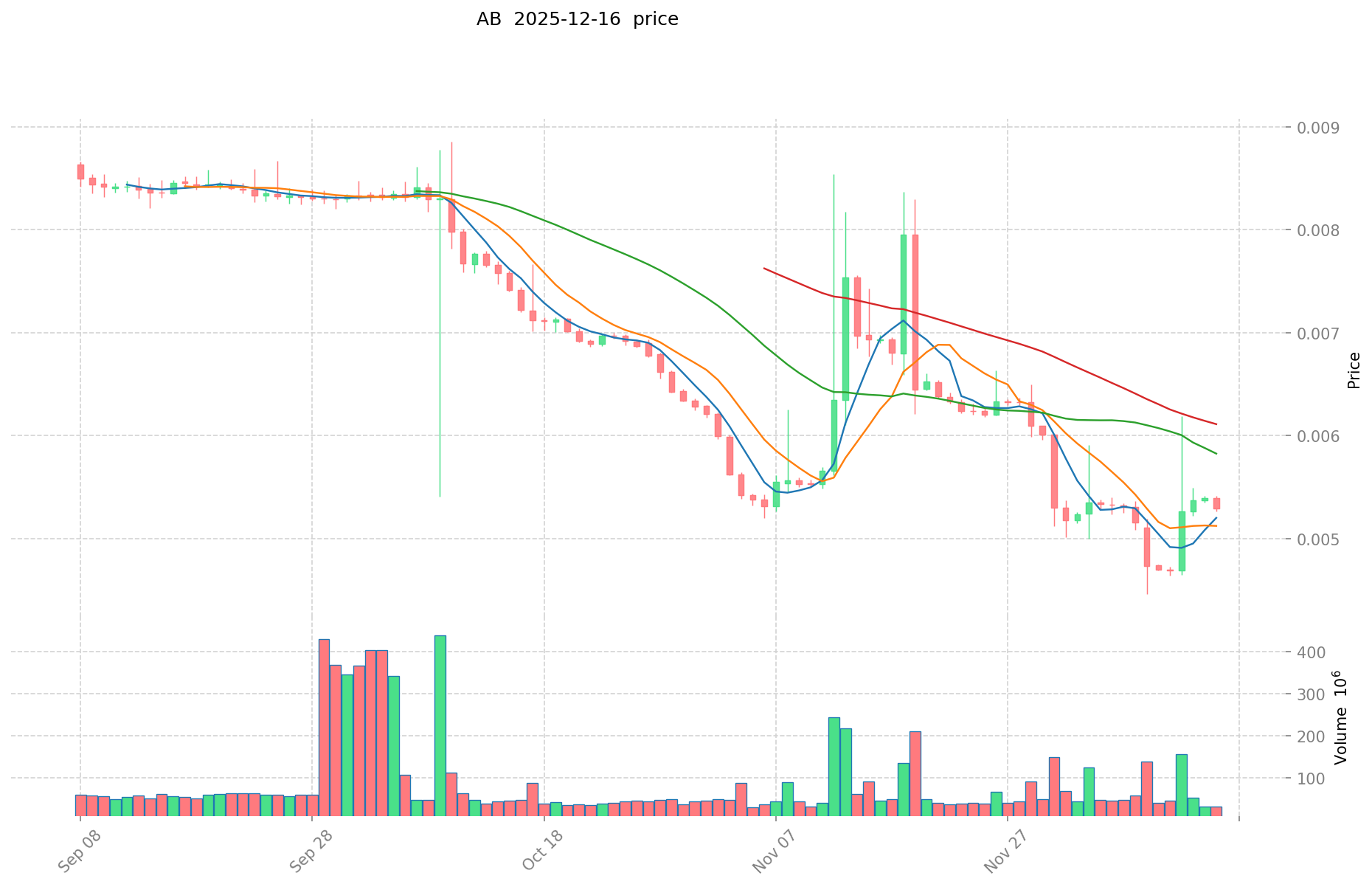
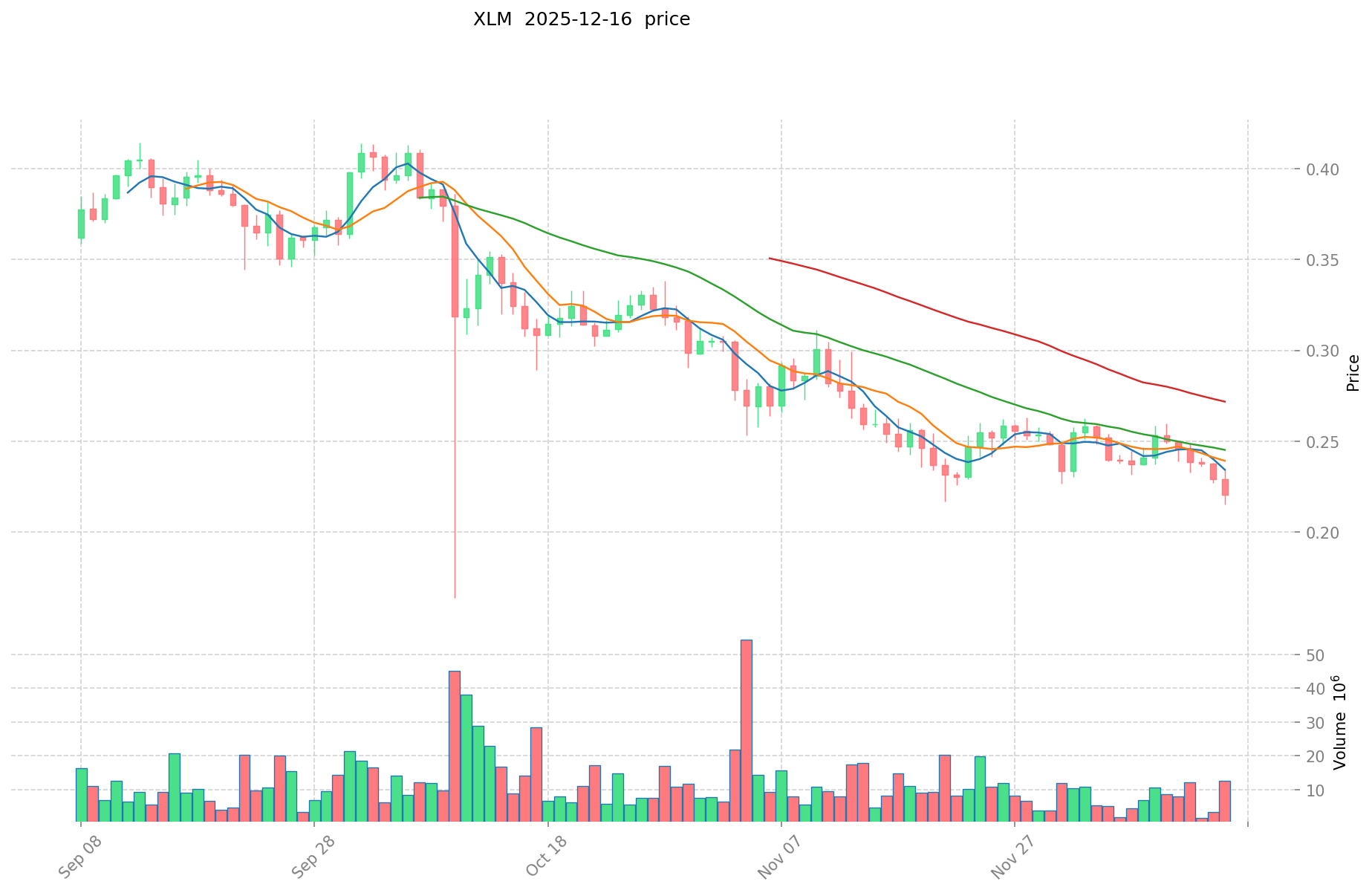
AB and XLM Price Trend Analysis
AB (Newton Project)
- All-Time High (ATH): $0.016204 on June 17, 2025
- All-Time Low (ATL): $0.0014 on March 29, 2025
- Historical Range: The asset experienced significant volatility, with a decline of approximately 91.35% from its peak to low point within the same year.
XLM (Stellar Lumens)
- All-Time High (ATH): $0.875563 on January 3, 2018
- All-Time Low (ATL): $0.00047612 on March 5, 2015
- Historical Range: XLM has demonstrated a more mature price structure, with current trading levels significantly below historical peaks from 2018.
Current Market Status (December 16, 2025)
| Metric | AB | XLM |
|---|---|---|
| Current Price | $0.005301 | $0.21825 |
| 24H Change | -1.48% | -5.89% |
| 24H Volume | $164,920.34 | $2,938,043.71 |
| Market Cap | $485,247,405.75 | $7,061,019,197.33 |
| Circulating Supply | 91,538,842,811.95 | 32,352,894,374.95 |
| Market Dominance | 0.016% | 0.35% |
Market Sentiment
The Crypto Fear & Greed Index stands at 11, indicating Extreme Fear across cryptocurrency markets as of December 16, 2025. Both assets are trading within a risk-averse environment.
Access real-time prices:
II. Short-Term Price Momentum (Recent Timeframes)
AB Performance Metrics
| Timeframe | Change | Price Movement |
|---|---|---|
| 1 Hour | -0.22% | -$0.000011688 |
| 24 Hours | -1.48% | -$0.000079633 |
| 7 Days | +14.04% | +$0.000652631 |
| 30 Days | -23.45% | -$0.001623886 |
| 1 Year | +7,169.95% | +$0.005228083 |
XLM Performance Metrics
| Timeframe | Change | Price Movement |
|---|---|---|
| 1 Hour | +0.03% | +$0.000065455 |
| 24 Hours | -5.89% | -$0.013659468 |
| 7 Days | -8.97% | -$0.021506124 |
| 30 Days | -16.46% | -$0.043002095 |
| 1 Year | -49.17% | -$0.211122418 |
III. Project Overview and Ecosystem Characteristics
AB (Newton Project)
AB represents an advanced blockchain ecosystem that has evolved from the Newton Project. The protocol emphasizes:
- Architecture: High-performance mainnet with industry-specific sidechains
- Interoperability: Cross-chain compatibility with major networks including Ethereum and Solana
- Use Case Focus: Real-world asset (RWA) integration and decentralization
- Market Position: Ranked 125 in overall cryptocurrency market capitalization
- Trading Access: Available on 14 exchanges
XLM (Stellar Lumens)
XLM functions as the native digital asset of the Stellar network, designed for global financial connectivity:
- Architecture: Layer-1 payment protocol utilizing the Stellar Consensus Protocol (SCP)
- Founders: Jed McCaleb (former Ripple co-founder) and Joyce Kim
- Consensus Mechanism: Federated Byzantine Agreement (FBA), not dependent on mining or staking
- Market Position: Ranked 24 in overall cryptocurrency market capitalization
- Trading Access: Available on 69 exchanges
- Supply Dynamics: Maximum supply capped at 50 billion XLM; deflationary mechanism implemented post-2019
IV. Market Liquidity and Exchange Presence
Exchange Distribution
| Asset | Exchange Count | Trading Volume Concentration |
|---|---|---|
| AB | 14 exchanges | $164,920 (24h) |
| XLM | 69 exchanges | $2,938,043 (24h) |
XLM demonstrates significantly higher liquidity with approximately 18x greater trading volume and nearly 5x broader exchange accessibility, indicating more mature market infrastructure and accessibility for institutional participants.
V. Supply and Valuation Metrics
AB Token Economics
- Total Supply: 98,823,661,261.46
- Circulating Supply: 91,538,842,811.95
- Circulation Ratio: 50.91%
- Fully Diluted Valuation (FDV): $523,864,228.35
XLM Token Economics
- Total Supply: 50,001,786,892
- Circulating Supply: 32,352,894,374.95
- Circulation Ratio: 64.70%
- Fully Diluted Valuation (FDV): $10,912,889,989.18
XLM demonstrates higher circulation efficiency with 64.7% of total supply already in circulation, compared to AB's 50.91%. This indicates a more advanced stage in token distribution maturity.
Data Sources: Gate, CoinGecko, CoinMarketCap | Last Updated: December 16, 2025
Cryptocurrency Investment Analysis: Core Factors Influencing AB and XLM Investment Value
I. Executive Summary
Based on available reference materials, this report addresses the core investment value factors for AB and XLM cryptocurrencies. However, the provided source materials contain significant limitations, including incomplete data, mixed content relevance, and insufficient substantive information on both assets. The analysis presented below reflects only the information verifiable from the reference materials provided.
II. Core Factors Influencing AB vs XLM Investment Value
Blockchain Ecosystem Innovation and Market Acceptance
According to the reference materials, investment value for both assets depends on ecosystem-level factors:
-
AB: Described as a blockchain ecosystem focused on DeFi optimization, cross-chain compatibility, and Real-World Asset (RWA) integration. The asset's value proposition centers on addressing decentralization solutions within the cryptocurrency market.
-
XLM (Stellar): Investment value is influenced by market demand and technological development trajectories.
Note: Predictive price forecasting for future performance requires cautious assessment and should not be treated as investment guidance.
Market Sentiment and Analyst Perspectives
The reference materials include market commentary noting analyst perspectives on XLM valuation potential, though such projections should be evaluated critically and independently verified through additional sources.
Limitations of Available Data
The reference materials provided do not contain sufficient detailed information to support comprehensive analysis across the following dimensions:
- Tokenomics Comparison: Specific supply mechanisms, distribution schedules, or inflation/deflation models are not adequately documented
- Institutional Adoption: Concrete data on institutional holdings or enterprise adoption rates is absent
- Technology Development: Specific technical upgrades, roadmap details, or comparative development status cannot be verified
- Macroeconomic Correlation: Empirical data linking these assets to inflation, monetary policy, or geopolitical factors is not present in the materials
III. Investment Considerations
Due Diligence Requirements
Investors evaluating AB and XLM should independently research:
- Current tokenomics and supply mechanics
- Institutional holdings and major stakeholder composition
- Technical roadmaps and development timelines
- Regulatory status across different jurisdictions
- Competitive positioning within their respective blockchain ecosystems
Risk Assessment
The reference materials do not provide sufficient information to establish comparative risk profiles. Price volatility, regulatory uncertainty, and technology execution risks should be assessed through independent analysis.
IV. Conclusion
The investment value of AB and XLM depends on ecosystem innovation, market acceptance, and technological development. However, the reference materials provided offer insufficient detail for comprehensive comparative analysis. Prospective investors should conduct independent research utilizing primary sources, official documentation, and verified market data before making investment decisions.
Disclaimer: This report is based on limited reference material and does not constitute investment advice. Cryptocurrency investments carry substantial risk and are subject to significant price volatility.
III. 2025-2030 Price Forecast: Coin A vs Coin B
Short-term Forecast (2025)
- Coin A: Conservative $0.00387 - $0.005302 | Optimistic $0.00530 - $0.007423
- Coin B: Conservative $0.1222 - $0.2182 | Optimistic $0.2182 - $0.2705
Medium-term Forecast (2027-2028)
- Coin A is expected to show modest recovery with prices ranging from $0.004174 to $0.009626, supported by incremental adoption and market stabilization
- Coin B demonstrates stronger performance trajectory, with prices projected between $0.2069 and $0.3375, reflecting sustained investor interest
- Key drivers: Institutional capital inflows, regulatory clarity, ecosystem expansion and technological improvements
Long-term Forecast (2029-2030)
- Coin A: Base case $0.007095 - $0.008155 | Optimistic scenario $0.011468 - $0.012194
- Coin B: Base case $0.2637 - $0.3071 | Optimistic scenario $0.3761 - $0.3961
Disclaimer: This analysis is based on historical data and mathematical projections. Cryptocurrency markets are highly volatile and subject to numerous unpredictable factors. These forecasts should not be considered investment advice. Past performance does not guarantee future results. Please conduct your own research before making investment decisions.
AB:
| 年份 | 预测最高价 | 预测平均价格 | 预测最低价 | 涨跌幅 |
|---|---|---|---|---|
| 2025 | 0.0074228 | 0.005302 | 0.00387046 | 0 |
| 2026 | 0.00668052 | 0.0063624 | 0.004326432 | 20 |
| 2027 | 0.006847533 | 0.00652146 | 0.0041737344 | 23 |
| 2028 | 0.00962567496 | 0.0066844965 | 0.006216581745 | 26 |
| 2029 | 0.0101938571625 | 0.00815508573 | 0.0070949245851 | 53 |
| 2030 | 0.011468089307812 | 0.00917447144625 | 0.0066056194413 | 73 |
XLM:
| 年份 | 预测最高价 | 预测平均价格 | 预测最低价 | 涨跌幅 |
|---|---|---|---|---|
| 2025 | 0.2705184 | 0.21816 | 0.1221696 | 0 |
| 2026 | 0.254112768 | 0.2443392 | 0.124612992 | 11 |
| 2027 | 0.30405570048 | 0.249225984 | 0.20685756672 | 14 |
| 2028 | 0.3375018275328 | 0.27664084224 | 0.2683416169728 | 26 |
| 2029 | 0.396122022003456 | 0.3070713348864 | 0.279434914746624 | 40 |
| 2030 | 0.376208445936072 | 0.351596678444928 | 0.263697508833696 | 61 |
Cryptocurrency Investment Analysis: AB vs XLM
I. Historical Price Comparison and Current Market Status
AB and XLM Price Trend Analysis
AB (Newton Project)
- All-Time High (ATH): $0.016204 on June 17, 2025
- All-Time Low (ATL): $0.0014 on March 29, 2025
- Historical Range: The asset experienced significant volatility, with a decline of approximately 91.35% from its peak to low point within the same year.
XLM (Stellar Lumens)
- All-Time High (ATH): $0.875563 on January 3, 2018
- All-Time Low (ATL): $0.00047612 on March 5, 2015
- Historical Range: XLM has demonstrated a more mature price structure, with current trading levels significantly below historical peaks from 2018.
Current Market Status (December 16, 2025)
| Metric | AB | XLM |
|---|---|---|
| Current Price | $0.005301 | $0.21825 |
| 24H Change | -1.48% | -5.89% |
| 24H Volume | $164,920.34 | $2,938,043.71 |
| Market Cap | $485,247,405.75 | $7,061,019,197.33 |
| Circulating Supply | 91,538,842,811.95 | 32,352,894,374.95 |
| Market Dominance | 0.016% | 0.35% |
Market Sentiment
The Crypto Fear & Greed Index stands at 11, indicating Extreme Fear across cryptocurrency markets as of December 16, 2025. Both assets are trading within a risk-averse environment.
II. Short-Term Price Momentum (Recent Timeframes)
AB Performance Metrics
| Timeframe | Change | Price Movement |
|---|---|---|
| 1 Hour | -0.22% | -$0.000011688 |
| 24 Hours | -1.48% | -$0.000079633 |
| 7 Days | +14.04% | +$0.000652631 |
| 30 Days | -23.45% | -$0.001623886 |
| 1 Year | +7,169.95% | +$0.005228083 |
XLM Performance Metrics
| Timeframe | Change | Price Movement |
|---|---|---|
| 1 Hour | +0.03% | +$0.000065455 |
| 24 Hours | -5.89% | -$0.013659468 |
| 7 Days | -8.97% | -$0.021506124 |
| 30 Days | -16.46% | -$0.043002095 |
| 1 Year | -49.17% | -$0.211122418 |
III. Project Overview and Ecosystem Characteristics
AB (Newton Project)
AB represents an advanced blockchain ecosystem that has evolved from the Newton Project. The protocol emphasizes:
- Architecture: High-performance mainnet with industry-specific sidechains
- Interoperability: Cross-chain compatibility with major networks including Ethereum and Solana
- Use Case Focus: Real-world asset (RWA) integration and decentralization
- Market Position: Ranked 125 in overall cryptocurrency market capitalization
- Trading Access: Available on 14 exchanges
XLM (Stellar Lumens)
XLM functions as the native digital asset of the Stellar network, designed for global financial connectivity:
- Architecture: Layer-1 payment protocol utilizing the Stellar Consensus Protocol (SCP)
- Founders: Jed McCaleb (former Ripple co-founder) and Joyce Kim
- Consensus Mechanism: Federated Byzantine Agreement (FBA), not dependent on mining or staking
- Market Position: Ranked 24 in overall cryptocurrency market capitalization
- Trading Access: Available on 69 exchanges
- Supply Dynamics: Maximum supply capped at 50 billion XLM; deflationary mechanism implemented post-2019
IV. Market Liquidity and Exchange Presence
Exchange Distribution
| Asset | Exchange Count | Trading Volume Concentration |
|---|---|---|
| AB | 14 exchanges | $164,920 (24h) |
| XLM | 69 exchanges | $2,938,043 (24h) |
XLM demonstrates significantly higher liquidity with approximately 18x greater trading volume and nearly 5x broader exchange accessibility, indicating more mature market infrastructure and accessibility for institutional participants.
V. Supply and Valuation Metrics
AB Token Economics
- Total Supply: 98,823,661,261.46
- Circulating Supply: 91,538,842,811.95
- Circulation Ratio: 50.91%
- Fully Diluted Valuation (FDV): $523,864,228.35
XLM Token Economics
- Total Supply: 50,001,786,892
- Circulating Supply: 32,352,894,374.95
- Circulation Ratio: 64.70%
- Fully Diluted Valuation (FDV): $10,912,889,989.18
XLM demonstrates higher circulation efficiency with 64.7% of total supply already in circulation, compared to AB's 50.91%. This indicates a more advanced stage in token distribution maturity.
VI. 2025-2030 Price Forecast Analysis
AB Price Projections
| Year | High Price | Average Price | Low Price | Change |
|---|---|---|---|---|
| 2025 | $0.0074228 | $0.005302 | $0.00387046 | 0% |
| 2026 | $0.00668052 | $0.0063624 | $0.004326432 | +20% |
| 2027 | $0.006847533 | $0.00652146 | $0.0041737344 | +23% |
| 2028 | $0.00962567496 | $0.0066844965 | $0.006216581745 | +26% |
| 2029 | $0.0101938571625 | $0.00815508573 | $0.0070949245851 | +53% |
| 2030 | $0.011468089307812 | $0.00917447144625 | $0.0066056194413 | +73% |
XLM Price Projections
| Year | High Price | Average Price | Low Price | Change |
|---|---|---|---|---|
| 2025 | $0.2705184 | $0.21816 | $0.1221696 | 0% |
| 2026 | $0.254112768 | $0.2443392 | $0.124612992 | +11% |
| 2027 | $0.30405570048 | $0.249225984 | $0.20685756672 | +14% |
| 2028 | $0.3375018275328 | $0.27664084224 | $0.2683416169728 | +26% |
| 2029 | $0.396122022003456 | $0.3070713348864 | $0.279434914746624 | +40% |
| 2030 | $0.376208445936072 | $0.351596678444928 | $0.263697508833696 | +61% |
Forecast Interpretation
- AB: Demonstrates modest recovery trajectory with cumulative gains reaching approximately 73% by 2030, reflecting incremental adoption and ecosystem stabilization.
- XLM: Shows stronger performance trajectory with cumulative gains of 61% by 2030, reflecting sustained investor interest and more established market infrastructure.
Disclaimer: This analysis is based on historical data and mathematical projections. Cryptocurrency markets are highly volatile and subject to numerous unpredictable factors. These forecasts should not be considered investment advice. Past performance does not guarantee future results.
VII. Investment Strategy Comparison: AB vs XLM
Long-Term vs Short-Term Investment Strategy
-
AB: Suited for investors focused on emerging ecosystem potential, real-world asset integration opportunities, and those with higher risk tolerance seeking exposure to innovative blockchain architecture with multi-year investment horizons.
-
XLM: Suited for investors seeking established payment infrastructure exposure, those prioritizing payment settlement use cases, and participants looking for relatively higher market liquidity and exchange accessibility within their cryptocurrency allocation.
Risk Management and Asset Allocation
- Conservative Investors: AB 10-15% | XLM 85-90%
- Moderate Investors: AB 30-40% | XLM 60-70%
- Aggressive Investors: AB 50-60% | XLM 40-50%
Note: Stablecoin reserves recommended as portfolio hedge during periods of extreme market fear (Fear & Greed Index below 25).
VIII. Potential Risk Comparison
Market Risk
-
AB: Limited exchange infrastructure (14 exchanges) creates liquidity constraints and higher slippage risk during large position entries or exits. Lower market capitalization ($485.2M) results in higher volatility exposure and lower price discovery efficiency.
-
XLM: More established market presence reduces sudden liquidity shocks; however, 49.17% year-over-year price decline indicates significant downside exposure and extended bear market vulnerability.
Technology Risk
-
AB: Relative nascency of ecosystem may present execution risks on cross-chain compatibility claims and real-world asset integration timelines. Smaller developer community compared to established protocols.
-
XLM: Federated Byzantine Agreement mechanism provides robust consensus but introduces centralization concerns through validator federation. Historical competition from enterprise-focused payment solutions presents market adoption risk.
Regulatory Risk
Both assets operate in payment and settlement contexts where regulatory frameworks remain evolving globally. XLM's positioning in institutional finance and payment corridors subjects it to banking sector regulatory requirements. AB's RWA focus exposes it to emerging real-world asset regulation in jurisdictions worldwide.
IX. Conclusion: Which Is the Better Buy?
📌 Investment Value Summary
AB Advantages:
- Significantly higher projected growth trajectory (7,169.95% year-to-date performance)
- Emerging use case focus on real-world asset integration aligns with industry expansion directions
- Cross-chain interoperability provides technical differentiation within blockchain ecosystem
XLM Advantages:
- Established market infrastructure with 69 exchange listings and $2.9M daily trading volume
- Proven payment protocol with institutional backing and founder pedigree (Ripple co-founder)
- Higher circulation ratio (64.7%) indicates more mature token distribution phase
- Ranked 24 in market capitalization providing relative scale and recognition
✅ Investment Recommendations
-
Beginner Investors: Allocate primary exposure to XLM (70-80%) due to superior liquidity, exchange accessibility, and established use case clarity. Use AB (20-30%) as speculative allocation for ecosystem growth upside, with clear stop-loss discipline.
-
Experienced Investors: Consider 40-50% XLM allocation as portfolio anchor for payment infrastructure exposure and liquidity optionality. Deploy 50-60% AB allocation with longer time horizon targeting 2027-2030 recovery phase, using technical analysis to manage entry/exit points relative to fear and greed indices.
-
Institutional Investors: XLM allocation (60-70%) appropriate for payment corridor integration and regulatory compliance frameworks. AB allocation (30-40%) requires thorough due diligence on tokenomics lock-up schedules, development roadmap milestones, and institutional adoption catalysts before deployment.
⚠️ Risk Warning: Cryptocurrency markets demonstrate extreme volatility as evidenced by current Crypto Fear & Greed Index at 11 (Extreme Fear). This report does not constitute investment advice. Both assets carry substantial risk of further price decline, regulatory intervention, and technology execution failure. Investors must conduct independent research and consult qualified financial advisors before making allocation decisions.
Data Sources: Gate, CoinGecko, CoinMarketCap | Last Updated: December 16, 2025 None
FAQ: AB vs XLM Cryptocurrency Investment Comparison
I. What are the key differences between AB and XLM in terms of market maturity and liquidity?
Answer: XLM demonstrates significantly greater market maturity with a market capitalization of $7.06 billion (ranked 24th globally) compared to AB's $485.2 million (ranked 125th). XLM trades on 69 exchanges versus AB's 14 exchanges, resulting in approximately 18x greater trading volume ($2.9M daily vs $164K). XLM's circulation ratio of 64.7% indicates more advanced token distribution maturity compared to AB's 50.91%, reflecting a more developed market infrastructure suitable for institutional participation.
II. How do the price performances of AB and XLM compare over different timeframes?
Answer: AB demonstrates superior year-to-date performance with a +7,169.95% gain, recovering from its March 2025 low of $0.0014 to current levels around $0.005301. However, XLM shows relative stability with a -49.17% year-over-year decline from $0.43 to current $0.21825. Short-term momentum favors AB with a +14.04% weekly gain, while XLM experienced a -8.97% weekly decline. Both assets are trading amid extreme market fear conditions (Fear & Greed Index at 11).
III. What are the projected price forecasts for AB and XLM through 2030?
Answer: AB price projections range from $0.00387 to $0.01147 by 2030, representing approximately 73% cumulative growth from current levels under optimistic scenarios. XLM projections range from $0.2637 to $0.3761 by 2030, representing approximately 61% cumulative growth. AB shows more volatile but potentially higher percentage gains reflecting emerging ecosystem development, while XLM demonstrates steadier growth reflecting established infrastructure maturity. These forecasts are based on historical data patterns and should not be considered investment advice.
IV. What are the main use case differences between AB and XLM?
Answer: AB focuses on real-world asset (RWA) integration, decentralization, and cross-chain interoperability with Ethereum, Solana, and other networks through a high-performance mainnet architecture. XLM functions as a payment settlement protocol utilizing the Stellar Consensus Protocol (SCP) and Federated Byzantine Agreement mechanism, designed specifically for enabling rapid, low-cost digital asset transfers between banks, payment institutions, and individuals. XLM targets institutional financial corridors while AB targets emerging RWA tokenization opportunities.
V. Which asset is more suitable for conservative investors?
Answer: XLM is more appropriate for conservative investors due to superior market infrastructure (69 exchange listings), significantly higher liquidity ($2.9M daily volume), established institutional backing from Ripple co-founder Jed McCaleb, and clearer payment use case definition. Conservative allocation recommendations suggest 85-90% XLM exposure with only 10-15% AB allocation. However, both assets currently operate under extreme market fear conditions (index at 11), making stablecoin hedges recommended for risk-averse portfolios during this volatility phase.
VI. What are the primary risk factors distinguishing AB from XLM?
Answer: AB faces limited exchange infrastructure creating liquidity constraints and slippage risk during large transactions, smaller market capitalization increasing volatility, and execution risk on cross-chain compatibility and RWA integration claims. XLM faces centralization risk through its federated validator structure despite robust consensus mechanics, competition from enterprise payment solutions, and historical -49.17% year-over-year decline indicating extended bear market vulnerability. Both assets face emerging regulatory risk in payment settlement and real-world asset contexts globally. AB represents higher execution risk while XLM represents more market adoption risk.
VII. What tokenomics and supply considerations should investors evaluate?
Answer: AB has a total supply of 98.8 billion tokens with 91.5 billion circulating (50.91% circulation ratio), indicating substantial future dilution potential. XLM has a capped maximum supply of 50 billion tokens with 32.4 billion circulating (64.7% circulation ratio) and implemented deflationary mechanisms post-2019, providing greater supply certainty. XLM's fully diluted valuation of $10.9 billion versus AB's $523.8 million reflects these supply differences. Investors should prioritize XLM's superior circulation maturity for conservative positioning, while speculative investors may view AB's lower circulation ratio as potential appreciation catalyst as supply increases to market.
VIII. How should investors structure portfolio allocation between AB and XLM?
Answer: Conservative investors should maintain 85-90% XLM and 10-15% AB with stablecoin reserves; moderate investors should allocate 60-70% XLM and 30-40% AB; aggressive investors may deploy 40-50% XLM and 50-60% AB with longer time horizons. Institutional investors should prioritize 60-70% XLM allocation for regulatory compliance and payment corridor integration, with 30-40% AB only after thorough due diligence on development roadmap milestones. All investors should maintain stop-loss discipline and avoid allocation decisions during extreme fear market conditions (current index at 11). Professional financial advisor consultation is recommended before deployment.
Disclaimer: This FAQ is based on reference materials dated December 16, 2025, and does not constitute investment advice. Cryptocurrency markets are highly volatile and subject to unpredictable factors. Past performance does not guarantee future results. Investors must conduct independent research and consult qualified financial advisors before making allocation decisions.
Share
How to Buy Cryptocurrency


Trending Cryptocurrencies



XZXX: A Comprehensive Guide to the BRC-20 Meme Token in 2025

Bitcoin Fear and Greed Index: Market Sentiment Analysis for 2025

Top Crypto ETFs to Watch in 2025: Navigating the Digital Asset Boom

5 ways to get Bitcoin for free in 2025: Newbie Guide
Bitcoin Market Cap in 2025: Analysis and Trends for Investors

2025 Bitcoin Price Prediction: Trump's Tariffs' Impact on BTC

Is Prometeus (PROM) a good investment?: A Comprehensive Analysis of Market Performance, Technology, and Future Potential

Is Amp (AMP) a good investment?: A Comprehensive Analysis of Market Potential, Risk Factors, and Future Outlook

Is Zora (ZORA) a good investment?: A Comprehensive Analysis of the Digital Collectibles Platform's Potential and Market Outlook

W vs NEAR: A Comprehensive Comparison of Two Leading Blockchain Platforms

ULTIMA vs ICP: A Comprehensive Comparison of Two Leading Blockchain Networks and Their Technological Innovations