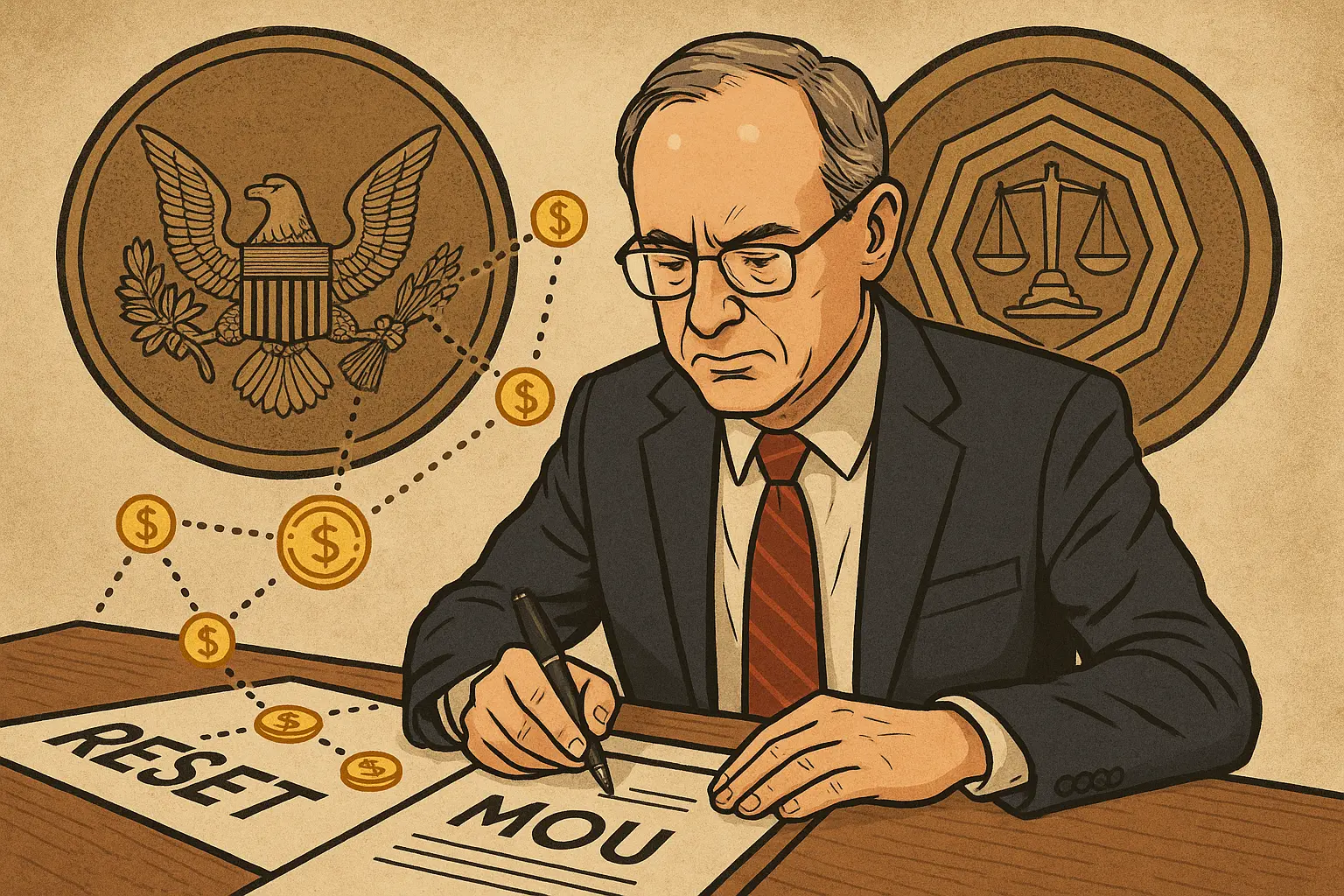
On April 21, Paul Atkins, Chair of the U.S. Securities and Exchange Commission (SEC), announced a “reset” plan for the digital-asset oversight of its “A-C-T” strategy (advance, clarify, transform) in a keynote address at the Economic Club of Washington, marking the one-year anniversary since he took office. The core elements include an “innovation exemption” mechanism, a five-category token classification framework, and a memorandum of understanding (MoU) signed with the U.S. Commodity Futures Trading Commission (CFTC).
Five-category token framework: Narrowing the SEC’s jurisdiction
(Source: SEC)
According to Atkins’ speech, the SEC’s five-category token framework explicitly places four of the five token types outside the scope of securities laws, leaving only a small portion of crypto assets subject to regulation under existing securities laws—thereby narrowing the SEC’s direct jurisdiction. In his speech, Atkins said, “Our goal is to help market participants categorize crypto assets clearly, rather than making them guess after the fact whether the SEC will determine that certain assets are securities.”
Atkins also emphasized the principle of “form not changing the substance,” noting that whether stocks exist in traditional paper form, are registered through the DTCC, or take the form of blockchain tokens, their nature remains that of stocks, but not all tokens used for financing should be viewed as securities forever.
Innovation exemption: 12 to 36 months of relief
Based on Atkins’ speech and the SEC’s prior guidance in “Project Crypto,” the “innovation exemption” allows eligible issuers and trading venues, during a 12- to 36-month relief period, to issue and trade tokenized securities on-chain under comparatively more lenient regulatory conditions, without having to comply with all immediate registration requirements. After the relief period ends, the relevant parties must demonstrate that they have achieved “sufficient decentralization,” or transition to a standard securities regulatory regime.
Atkins said this exemption is intended to keep the tokenization of stocks, bonds, and other real-world assets within the U.S. market, and he said the new roadmap is meant to “restore regulatory clarity, strengthen competitiveness, and accelerate innovation.”
SEC and CFTC memorandum of understanding
According to the SEC’s public statement, the SEC has signed an MoU with the CFTC, committing to jointly interpret crypto assets, coordinate rulemaking, and establish a regulatory framework tailored to the needs of on-chain markets. The expansion work of Project Crypto also focuses in parallel on modernizing on-chain clearing, margin, and collateral rules, with the goal of formally bringing the tokenized market within an expanded regulatory framework of U.S. capital markets.
Frequently asked questions
What are the key terms of the SEC’s “innovation exemption”?
According to the SEC Chair Atkins’ speech and the Project Crypto guidance, the “innovation exemption” allows eligible issuers and trading venues to trade tokenized securities on-chain on more lenient terms during a 12- to 36-month relief period. After the relief period, they must demonstrate “sufficient decentralization” or transition to a standard securities regulatory regime.
How does the SEC’s five-category token framework affect the scope of crypto-asset regulation?
According to Atkins’ speech, the five-category token framework places four of the five token types outside the scope of securities law regulation, leaving only a small portion of crypto assets regulated under existing securities laws. The aim is to provide clear categorization for market participants, rather than relying on after-the-fact enforcement determinations.
What core issues are covered in the SEC-CFTC memorandum of understanding?
According to the SEC’s public statement, the SEC and CFTC’s memorandum of understanding commits them to jointly interpret crypto assets, coordinate rulemaking, and establish a regulatory framework suited to the needs of on-chain tools, covering the modernization of clearing, margin, and collateral rules.
Disclaimer: The information on this page may come from third parties and does not represent the views or opinions of Gate. The content displayed on this page is for reference only and does not constitute any financial, investment, or legal advice. Gate does not guarantee the accuracy or completeness of the information and shall not be liable for any losses arising from the use of this information. Virtual asset investments carry high risks and are subject to significant price volatility. You may lose all of your invested principal. Please fully understand the relevant risks and make prudent decisions based on your own financial situation and risk tolerance. For details, please refer to
Disclaimer.
Related Articles
PACE Act Targets Faster Payments With Fed Access for Fintechs
PACE Act introduces optional federal licensing for fintechs, requiring compliance, reserves, and oversight by the OCC.
Direct access to Fed systems like FedNow and Fedwire aims to cut delays, lower costs, and reduce reliance on banks.
Industry groups support the bill, citing improved comp
CryptoFrontNews42m ago
CLARITY Act Faces May Delay Amid Bank Pressure Push
Senate timing pressures and hearings narrow the window, risking delay of the CLARITY Act markup decision into May.
Banking groups intensify lobbying against stablecoin yield provisions, expanding outreach to multiple committee members.
Ongoing disputes over yields, ethics, and DeFi
CryptoFrontNews42m ago
Russia's State Duma Passes Cryptocurrency Regulation Bill on First Reading, Allows Cross-Border Crypto Settlement to Bypass Sanctions
Gate News message, April 22 — Russia's State Duma passed a cryptocurrency regulation bill on first reading, classifying cryptocurrencies as "property" and designating the Central Bank of Russia to oversee market participants' licensing and supervision. The bill introduces a tiered access mechanism f
GateNews47m ago
Fed Chair Nominee Kevin Warsh Backs Crypto Integration, Opposes CBDC
Abstract: Trump's Fed chair nominee Kevin Warsh argues digital assets are already part of U.S. finance, rejects a central bank digital currency, and favors market-led crypto innovation. He disclosed more than $100 million in crypto holdings, inviting questions about independence.
Summary: Warsh, Trump's Fed nominee, says digital assets are integral to U.S. finance, rejects a CBDC, and favors market-driven crypto innovation; he disclosed more than $100 million in crypto holdings, raising independence concerns.
GateNews2h ago
35% of European Investors Would Switch Banks for Better Crypto Services, MiCA Adoption Accelerates
Gate News message, April 22 — A survey by Boerse Stuttgart Digital found that 35% of European investors would consider switching banks for better cryptocurrency services, highlighting how digital assets are beginning to influence banking relationships across the continent.
The survey covered
GateNews3h ago
Hong Kong Chief Executive Cites Virtual Currency Risks in Halting Basketball Betting Tax
Gate News message, April 22 — Hong Kong Chief Executive John Lee stated today that the suspension of the basketball betting tax policy requires careful risk management, citing concerns related to virtual currencies and illegal prediction markets. Lee emphasized that the halt is not solely about
GateNews3h ago


