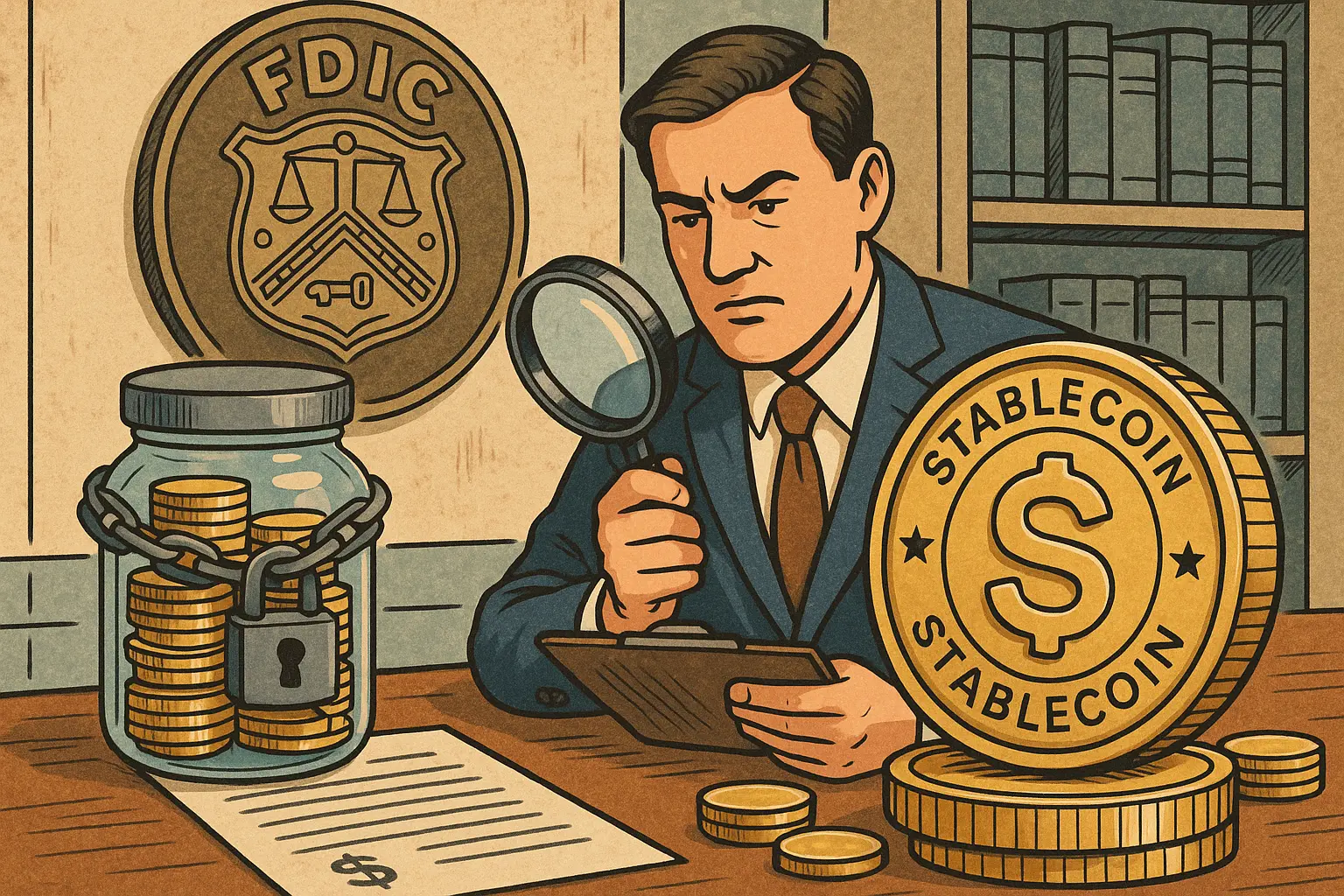
The Federal Deposit Insurance Corporation (FDIC) voted on April 7 to approve a proposal to establish a federal regulatory framework for stablecoin issuers, to implement key provisions of the GENIUS Act that the President has already signed. The proposed rule, which runs to 191 pages, applies to subsidiaries of insured depository institutions, as well as stablecoin issuers authorized by federal or state regulators. They must meet standards including reserves, redemption, capital, and risk management, and the public comment period will be 60 days.
FDIC Proposal Core: Detailed Breakdown of Four Key Compliance Requirements
The new requirements bring stablecoin issuers to a compliance standard highly aligned with traditional bank products, primarily across four dimensions:
Four New Compliance Obligations for Stablecoin Issuers
Reserve Asset Standards: Must hold cash or highly liquid, safe assets such as U.S. Treasury securities to support the full face value of the stablecoin
1:1 Redemption Protection: Must demonstrate the ability to reliably redeem tokens on a one-to-one basis, ensuring that holders can redeem at face value at any time
Capital Adequacy Requirements: Must meet minimum capital adequacy ratio standards to guard against potential systemic risk
Risk Management Mechanisms: Must establish a bank-level risk identification and control framework
FDIC attorney Chantal Hernandez explained during the meeting that the rule is also intended to “clarify the scope of deposit insurance applicable to deposits held as reserve assets.” However, FDIC official Eugene Frenkel also confirmed that, pursuant to the explicit provisions of the GENIUS Act, payments of stablecoins are not backed by the U.S. government’s full faith and credit guarantee, nor do they fall within the direct coverage of federal deposit insurance.
Bringing Stablecoins into the Banking Ecosystem: The Structural Role of Reserves and Custody
This proposal formally grants banks a compliance role within the stablecoin ecosystem—FDIC-regulated banks will be permitted to hold stablecoin issuers’ reserves and provide related custodial services. This means stablecoin funds no longer remain in a closed-loop circulation limited to a purely crypto ecosystem, but are directly connected to the infrastructure of traditional finance.
FDIC Chair Travis Hill said, “Over the past two years, we have made tremendous progress in this area, including the rapid shift in the federal government’s stance, the enactment of the GENIUS Act, and significant technological developments by both banks and non-bank institutions. Use cases for stablecoin and tokenized deposit products continue to grow as well.” The formal involvement of banks provides traditional financial trust mechanisms to back the stablecoin ecosystem.
Regulatory Coordination: OCC, the Treasury, and the FDIC Building a Stablecoin Regulatory Framework in Sync
The FDIC proposal is part of broader cross-agency regulatory coordination. Under the GENIUS Act framework, the Office of the Comptroller of the Currency (OCC) has already issued its rule set; last week, the Treasury also released an advance notice of proposed rulemaking (ANPRM) aimed at strengthening state oversight of small stablecoin issuers.
Three major regulatory bodies coordinating their efforts signals that the U.S. government is constructing a comprehensive federal stablecoin regulatory framework in a systematic way. U.S. stablecoins will no longer be viewed as standalone crypto products, but instead will operate under rules similar to those governing banks.
Frequently Asked Questions
What specific new requirements does the FDIC impose on stablecoins?
The FDIC proposal requires stablecoin issuers to hold cash or U.S. Treasury securities to fully support the token’s face value, ensure 1:1 redemption, meet capital adequacy ratio requirements, and establish a risk management mechanism. Banks regulated by the FDIC will also be permitted to hold reserves and provide custodial services.
Are stablecoins protected by U.S. federal deposit insurance?
Based on confirmations by FDIC officials and the explicit provisions of the GENIUS Act, stablecoin payments are not backed by the U.S. government’s full faith and credit guarantee, nor are they directly covered by federal deposit insurance. However, if the deposit funds supporting the stablecoin meet the legal definition of deposits, they may be eligible for corresponding deposit insurance protection.
When will the FDIC’s new stablecoin rules be officially implemented?
The FDIC has approved the proposal to enter the public comment period, which lasts 60 days. The rules have not yet been finalized. After collecting comments and completing any necessary amendments, the final rule will be issued.
Disclaimer: The information on this page may come from third parties and does not represent the views or opinions of Gate. The content displayed on this page is for reference only and does not constitute any financial, investment, or legal advice. Gate does not guarantee the accuracy or completeness of the information and shall not be liable for any losses arising from the use of this information. Virtual asset investments carry high risks and are subject to significant price volatility. You may lose all of your invested principal. Please fully understand the relevant risks and make prudent decisions based on your own financial situation and risk tolerance. For details, please refer to
Disclaimer.
Related Articles
White House Mediates Clarity Act Stablecoin Dispute, Witt Reveals Legislative Timeline
Patrick Witt announced at the Solana Policy Institute summit that the White House mediated a stablecoin dispute to advance the Clarity Act. The compromise allows banks and crypto firms to together address regulatory concerns, with future focus on crypto taxation and blockchain integration strategies among financial institutions.
GateNews2h ago
Hong Kong SFC Investment Committee Warns Prediction Market Trading May Constitute Illegal Gambling
The Hong Kong SFC warns that prediction markets are speculative and not investment products, lacking regulatory protection. They involve gambling elements, potentially making them illegal. The committee urges the public to differentiate between investment and gambling.
GateNews4h ago
Economist Proposes National USD Stablecoin to Eliminate Currency Controls in Venezuela
Alejandro Grisanti, head of Ecoanalitica, proposed issuing a national USD stablecoin as part of a series of measures to lift currency controls in Venezuela. This system would complement the current auction system, allowing the excluded sector to receive dollars via blockchain rails.
Key
Coinpedia6h ago
Elizabeth Warren Accuses SEC Chair Paul Atkins of Misleading Congress Over Enforcement Decline
Senator Elizabeth Warren accused SEC Chair Paul Atkins of misleading Congress about enforcement actions' decline. With only 456 new cases in 2025, concerns arise regarding the SEC's effectiveness and the regulatory landscape for cryptocurrency and market oversight.
GateNews7h ago
CLARITY Act Delay Continues as Senator Thom Tillis Signals Ongoing Talks
Lawmakers are delaying the CLARITY Act due to ongoing negotiations on stablecoin provisions, with timing uncertain and potential markup pushed to late April or early May. Kevin Warsh’s financial disclosures add complexity to regulatory discussions.
CryptoFrontNews10h ago
Democratic Senators Question Lax AML Oversight of Major CEX Over $1.7B Iran-Linked Crypto Flows
Democratic senators are scrutinizing the Trump administration's oversight of a cryptocurrency exchange linked to $1.7 billion in Iranian transactions, questioning its AML controls and a lenient bank settlement on sanctions evasion.
GateNews13h ago


