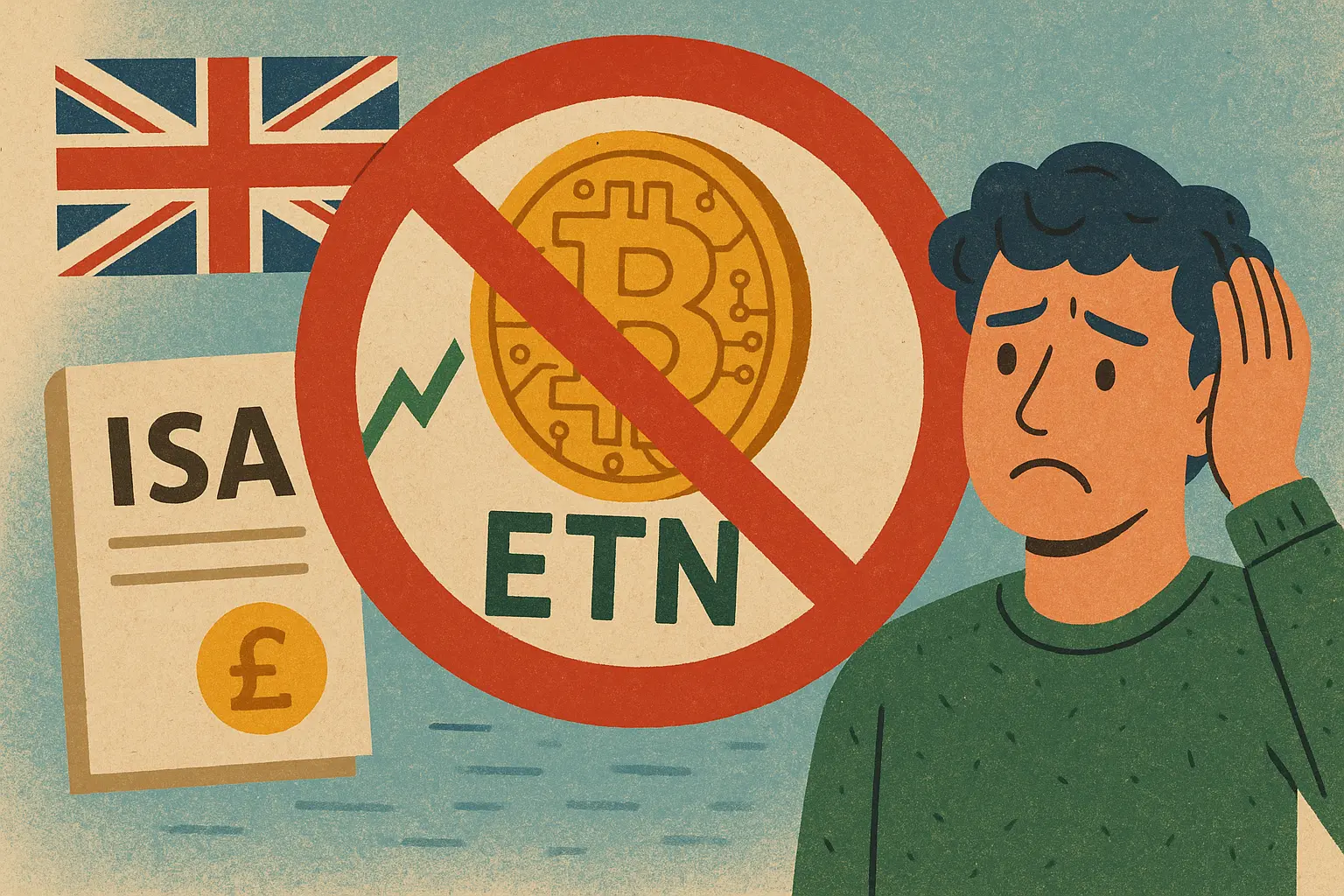
The UK Individual Savings Account (ISA) cryptocurrency investment channel will officially close in April 2026. HMRC’s regulatory policy adjustments have reclassified cryptocurrency exchange-traded notes (ETNs) as securities that do not qualify as ISA accounts, resulting in major investment platforms no longer legally offering such products within ISA accounts.
HMRC Reclassification: The Core Mechanism of Policy Shift
Individual Savings Accounts (ISAs) are the core tax-advantaged investment vehicles in the UK, allowing investors to exempt their capital gains and gains from taxation. For many years, eligible stocks, funds and certain exchange-traded products have been held within the ISA.
Crypto ETNs are exchange-traded notes that track the price of digital assets such as Bitcoin or Ethereum, and investors can buy them through traditional brokerage accounts without directly holding digital tokens, combining compliance convenience with crypto exposure. However, HMRC’s reclassification shattered the assumption that some investors expected ISA tax benefits for such products.
The key implications of this regulatory adjustment are as follows:
Disqualification: Crypto ETNs are classified as a category of securities that do not comply with the current ISA rules, and platforms cannot legally provide such services within the framework of the ISA
Tax implications: Investors who purchase crypto ETNs outside of ISAs are subject to tax declaration and tax at the standard rate
Alternative gap: There are currently no alternative packaging structures on the market that can restore crypto ETN ISA qualifications
Platform compliance obligations: Investment platforms that originally provided crypto ETNs in ISA accounts must stop such services by April
Real-World Implications for UK Retail Investors: From Financial Planning to Market Participation
For long-term investors, ISAs’ tax benefits have a compounding effect, and the tax-free framework can significantly enhance capital accumulation efficiency. The removal of crypto ETNs from ISAs changes the basis for risk-return assessment for investors who originally planned to deploy digital assets in a structured manner.
Of particular note is the young investor group. There is a growing interest in digital assets among younger generations in the UK, and many are turning to ISAs as their primary investment vehicle. This ban limits their path to incorporating crypto investments into long-term financial planning, which may indirectly prompt some investment activities to shift to overseas platforms or direct token purchases, thereby entering areas with more limited regulatory coverage.
Traditional assets (stocks, funds, bonds) remain eligible for ISA, allowing investors to adjust their existing asset allocation while closely monitoring policy directions.
Policy controversy: protecting retail investors or weakening competitiveness
The ban reflects the long-standing divergence in direction of UK regulators on digital asset policy.
Supporting HMRC’s reclassification argues that the cryptocurrency market remains volatile and regulated tax-exempt accounts should not provide tax subsidies for high-risk assets, a move that can reduce the systemic risk of retail investors over-allocating without adequate risk awareness.
Critics point out that crypto ETNs are regulated exchange-traded products, and their transparency and risk management standards are much higher than those of direct token purchases. Excluding such regulated products from ISAs may instead divert investment activity to less regulated channels, which is counterintuitive to protect investors.
The broader competitiveness concern lies in the UK’s crypto ETN ISA ban against the backdrop of the approval of spot Bitcoin ETFs in the United States and the continued opening of institutional crypto investment channels in several major markets, and the UK’s crypto ETN ISA ban is seen by some observers as a signal of regulatory conservatism that could weaken the attractiveness of the UK financial market in the global digital asset ecosystem.
Frequently Asked Questions
What options do UK investors still have for holding crypto ETNs after the ISA ban goes into effect in April?
Investors can still hold crypto ETNs through a standard taxable brokerage account, but they must report the corresponding gains in accordance with UK capital gains tax rules and maintain complete transaction records for tax filing. Some investors can also choose to hold Bitcoin or Ethereum directly on regulated exchanges, or wait for future adjustments to the regulatory framework.
What crypto-related investments for ISA accounts are still compliant?
Currently, crypto ETNs in ISAs are not eligible, but obtaining indirect crypto asset exposure by holding shares in relevant listed companies is still within the scope of permission from many ISA managers. Investors are advised to seek confirmation from their platform service providers or financial advisors on a specific basis.
Is it possible that this ban will be revoked or adjusted?
There is currently no official signal of revision of regulatory policies, but industry discussions on relevant policies continue. If the cryptocurrency regulatory environment becomes clearer globally and is accompanied by local political or market pressures, the possibility of future policy framework adjustments cannot be ruled out. Investors should pay close attention to relevant announcements from HMRC and the Financial Conduct Authority (FCA).
Disclaimer: The information on this page may come from third parties and does not represent the views or opinions of Gate. The content displayed on this page is for reference only and does not constitute any financial, investment, or legal advice. Gate does not guarantee the accuracy or completeness of the information and shall not be liable for any losses arising from the use of this information. Virtual asset investments carry high risks and are subject to significant price volatility. You may lose all of your invested principal. Please fully understand the relevant risks and make prudent decisions based on your own financial situation and risk tolerance. For details, please refer to
Disclaimer.
Related Articles
Iran fires back at Trump’s speech: “No credibility in his remarks—stocks plunge”; Nomura warns that no clear message has been seen, and Asian central banks may raise rates to defend against it
Trump recently said he would launch a fierce attack on Iran within the next few weeks. The market reacted strongly: the dollar rose while Asian stock markets fell. Nomura Securities warned that Asian currencies could weaken and that the risk of central bank intervention was increasing. Iran also countered Trump’s remarks, but they failed to ease tensions, and there has been no concrete commitment on the proposal to reopen the Strait of Hormuz. The United Kingdom plans to hold a diplomatic meeting to further negotiate.
動區BlockTempo3h ago
A CEX chief legal officer: The U.S. stablecoin regulatory bill is nearing an agreement on the issue of returns
On April 2, Paul Grewal, the Chief Legal Officer of a certain CEX, said in an interview that the debate over stablecoin yield in the United States’ soon-to-be released “CLEAR Act” is nearing an agreement. He emphasized that although there are disagreements, all parties recognize that other elements of the bill are just as important, and he is optimistic about the bill’s prospects. Grewal opposed conflating the issue of stablecoin yield with challenges facing the banking industry. The CEX and its CEO previously opposed a proposal to limit stablecoin rewards, saying it would harm innovation and consumers’ interests.
GateNews4h ago
An EDX application for a trust bank license, supported by Citadel
EDX Markets has recently applied to the U.S. Office of the Comptroller of the Currency to establish a national trust bank, aiming to integrate into the traditional financial system and provide asset custody and management services. Influenced by the Trump administration, crypto industry regulation has been moving toward openness, and many companies such as Circle and Ripple have already obtained similar licenses. With its unique positioning, EDX focuses on serving traditional financial participants, and hopes to improve its compliance and strengthen its competitiveness by obtaining that license.
ChainNewsAbmedia6h ago
Markets Down 25%, Sentiment Up 80%: 5 Macro Catalysts—From Trade Easing to Fed Printing that Could Ignite the Next Explosive Surge.
Market sentiment is rising despite a 25% decline, signaling early accumulation behavior.
Macro factors like easing policy and weaker dollar support altcoin recovery potential.
Infrastructure and narrative-driven tokens may lead the next market phase.
The crypto market has plunged into a
CryptoNewsLand10h ago
Crypto Policy Enters 'New Phase,' According to Solana Policy Institute - Coinspeaker
The Solana Policy Institute, a Washington-focused nonprofit launched in late 2025 to advance blockchain-specific legislative and regulatory strategy, has characterized the current U.S. crypto policy environment as entering a materially new phase – one defined by implementation rather than
Coinspeaker17h ago
U.S. Labor Department Moves to Clarify How Crypto and Private Equity Could Enter 401(k) Plans
The U.S. Department of Labor proposed a rule allowing fiduciaries to include alternative assets like crypto in 401(k) plans, providing legal protections if they follow defined evaluation processes. This marks a shift toward integrating digital assets cautiously into retirement investing.
CryptoNewsFlash17h ago


