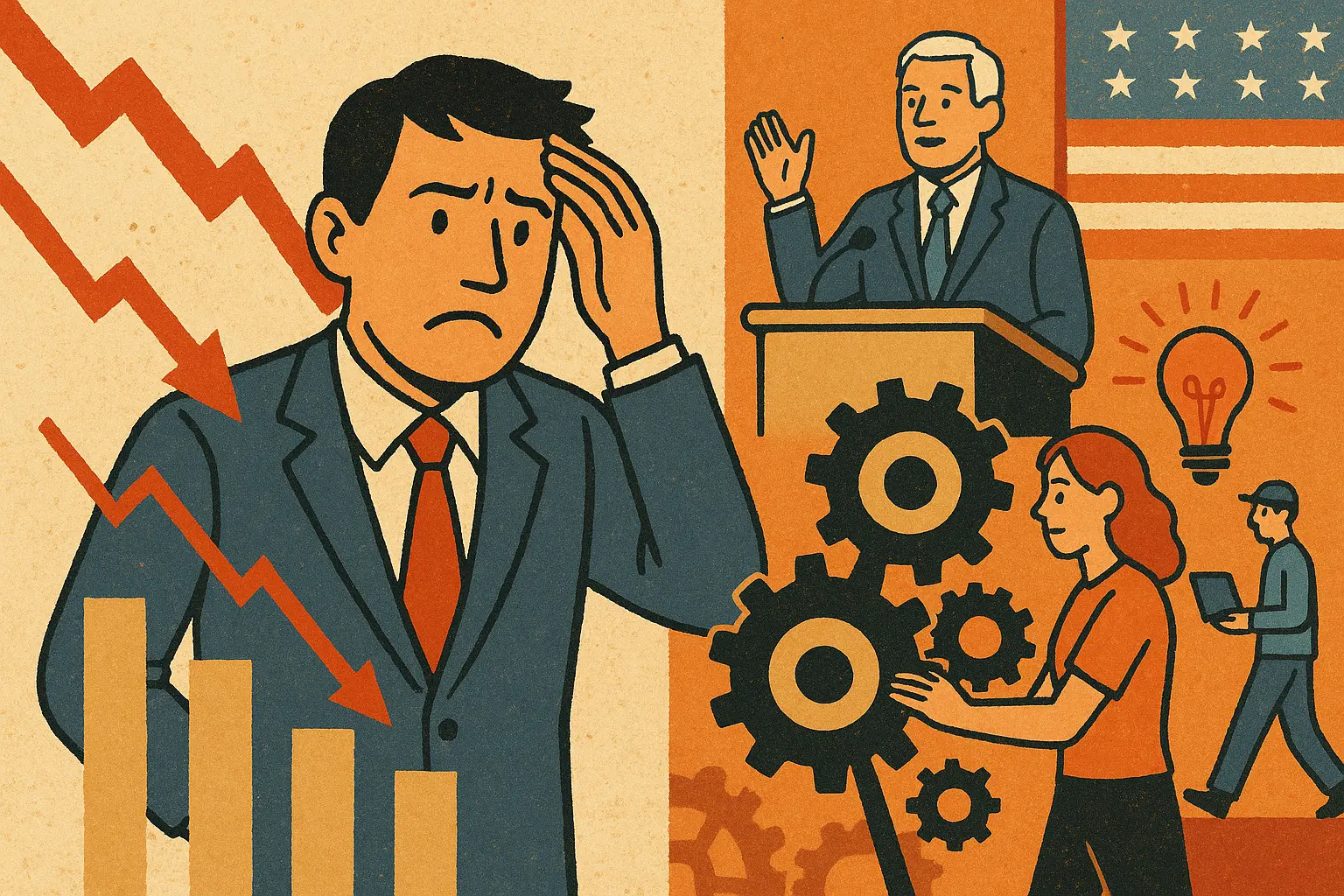
White House Chief Kevin Hassett states that future employment may decline due to slower labor force growth and increased productivity. From November to December, the average monthly non-farm payroll increase was 53,000, far below the pre-pandemic average of 183,000. He emphasizes that the economy is not weak, and tighter immigration policies combined with rising productivity allow growth even with limited labor force. The January forecast is an increase of 70,000. Powell says demand and supply are declining simultaneously, making current interpretation very difficult.
Data Shock: From 180,000 to 50,000
Data shows that in November and December, the US added an average of about 53,000 non-farm jobs per month, significantly below the pre-pandemic ten-year average of approximately 183,000 per month, and well below the rapid employment growth seen in the later stages of the Biden administration. This sharp drop from 180,000 to 50,000 would normally be seen as a sign of serious economic recession, but the White House attempts to offer an alternative explanation.
Non-farm employment data is one of the most important indicators of US economic health. An increase of 180,000 per month is considered the baseline needed to maintain full employment, as it absorbs new entrants into the labor market (graduates, immigrants, etc.). When job growth remains below this level for an extended period, unemployment tends to rise, and the economy may enter recession. During the 2008 financial crisis and the COVID-19 pandemic, non-farm employment saw significant declines, triggering economic collapse.
However, Hassett emphasizes that recent employment slowdown does not necessarily mean economic weakness. First, part of the recent employment growth has been driven by a rapid expansion of labor supply; second, since Trump tightened immigration policies, labor supply has become more complex, making it harder for economists to determine whether the “cooling” in the labor market is due to weakening demand or shrinking supply.
Three Possible Explanations for the Employment Slowdown
Weak demand: Companies are reluctant to hire, signaling recession (traditional interpretation)
Supply contraction: Reduced immigration causes labor shortages, non-economic issue (White House explanation)
Productivity surge: Technologies like AI increase efficiency, requiring fewer workers (new argument)
Second, Hassett proposes a third explanation: rising productivity is increasing output per worker, allowing the economy to grow despite limited labor supply and low monthly job gains. In an interview, he said that strong GDP growth coexists with declining labor force size (attributed to the departure of undocumented immigrants), which could make future employment data appear “lower.” He also notes that “population growth is declining, while productivity is surging,” and in this unusual combination, markets should not panic solely based on a string of lower-than-usual employment figures.
The Fed’s Dilemma: Demand vs. Supply
Hassett’s statement echoes what Fed Chair Powell said two weeks ago after the latest monetary policy meeting. Powell pointed out that US policymakers are facing a “very challenging and unusual situation,” where labor demand and supply may both decline simultaneously. Powell indicated that this could correspond to below-normal job gains while unemployment remains relatively stable.
He also admitted that “this is a very difficult period to interpret the labor market,” because the Fed’s policy response will depend on whether the main factors limiting job growth are demand- or supply-driven. This dilemma puts the Fed in a bind: misjudging weak demand as supply contraction and not cutting rates could miss the opportunity to support the economy; misjudging supply constraints as demand weakness and cutting rates could reignite inflation.
If labor supply is constrained (e.g., due to deportations reducing potential workforce), the labor market may face hiring bottlenecks and rising wages, often a sign of inflationary pressure, which would make the Fed more cautious about cutting rates. If Trump’s immigration policies significantly reduce labor supply, certain industries (agriculture, construction, services) could face severe labor shortages, forcing companies to raise wages to attract workers, increasing costs that are ultimately passed on to consumers, pushing inflation higher.
If employment growth slows due to demand weakness, then rate cuts would be needed to support economic growth and recruitment. Trump has repeatedly criticized Powell and the Fed for not cutting rates enough to stimulate the economy. He favors low interest rates to bolster his economic policies and stock market performance, but Powell insists on data-driven, independent decisions. This divergence could intensify in the coming months.
Similar to Hassett, Kevin Warsh—nominated by Trump, planning to succeed Powell as Fed Chair in May pending Senate confirmation—also suggests that higher productivity could suppress inflation and alter the central bank’s policy outlook. Warsh is a hawk, and his nomination has already caused market concern; if he takes office and insists on high interest rates, it would be very unfavorable for risk assets.
Three Market Reactions to Non-Farm Payroll Data
The US Labor Department will release the delayed January employment report on Wednesday. Market expectations are around 70,000 new jobs in January, compared to 50,000 in December; the unemployment rate in December was 4.4%, with a roughly similar forecast for January. The 70,000 figure is already very low, but how will markets react if actual data is worse (e.g., only 30-40,000 new jobs or negative growth)?
Dario Perkins, Chief Global Macro Strategist at TS Lombard, notes: “The demand vs. supply debate is crucial for monetary policy. If it’s demand-driven, the Fed needs to act; if supply-driven, inflation will be more sticky, and the Fed should stick to its stance.” He also warns that ample demand stimulation exists in the near future, and if supply is impaired, it could lead to more complicated consequences.
If non-farm payrolls meet expectations (around 70,000), markets may remain range-bound, as the data is within expectations, not prompting rate cuts or recession fears. If data exceeds expectations (e.g., over 150,000), risk assets may sell off, as this reduces the likelihood of rate cuts. If data is far below expectations (e.g., only 2-3,000 new jobs), market reactions will depend on the interpretation: if seen as demand weakness, markets may first fall (fear of recession) then rise (expectation of rate cuts); if seen as supply constraints, markets may continue to decline (inflation worries).
For cryptocurrencies like Bitcoin, the impact of non-farm payroll data is indirect but significant. Weak data that triggers rate cut expectations favors Bitcoin, which benefits from low interest rates and no yield. Strong data maintaining high rates puts downward pressure on Bitcoin. Data indicating supply constraints and inflation fears could renew narratives of Bitcoin as an inflation hedge. Currently, markets are highly uncertain, and Wednesday’s payroll report could be a key turning point for short-term trends.


