From digital asset trading to cross-border payments and fund management in DeFi ecosystems, stablecoins are taking on an increasingly important role as “on-chain dollars.” Compared with crypto assets that experience greater price volatility, stablecoins can preserve the efficiency of blockchain settlement while reducing uncertainty caused by value fluctuations. As a result, they are being adopted by more institutions and payment platforms.
For Ripple, the launch of RLUSD not only means its ecosystem is expanding beyond a single XRP asset framework into the stablecoin sector, but also reflects growing institutional demand for compliant, transparent, and low-volatility digital assets in the payments market. As Ripple Payments, the XRPL ecosystem, and on-chain finance applications continue to expand, RLUSD is seen as an important addition to Ripple’s payment infrastructure.
What Is RLUSD?
As a dollar-backed stablecoin issued by Ripple, Ripple USD is pegged to the U.S. dollar at a 1:1 ratio and backed by cash and short-term dollar-equivalent assets. RLUSD is deployed on XRP Ledger (XRPL) and Ethereum, and is mainly used for cross-border payments, on-chain fund settlement, and stable value transfer in digital finance scenarios.
RLUSD is currently deployed on both XRP Ledger and Ethereum. XRPL offers lower fees and faster on-chain settlement, while Ethereum has a more mature DeFi and smart contract ecosystem. Through multichain issuance, RLUSD can support a wider range of payment and financial application scenarios.
Within the Ripple ecosystem, RLUSD is not a replacement for XRP. Instead, it serves as a stable settlement asset that works alongside XRP as part of the broader payments and liquidity system.
Why Did Ripple Launch RLUSD?
Ripple has long focused on cross-border payments and institutional financial infrastructure. As stablecoins gradually become an important part of digital payments, relying only on volatile digital assets is no longer enough to meet some institutions’ need for stable settlement assets.
The launch of RLUSD allows Ripple to introduce a more stable dollar-denominated asset into its existing payment network, covering more institutional payment and on-chain finance scenarios. For example, stablecoins are often better suited as a medium of value in enterprise cross-border settlement, digital asset trading, on-chain dollar transfers, and DeFi liquidity management.
At the same time, the global regulatory environment is pushing the stablecoin market toward greater transparency and compliance. Through RLUSD, Ripple aims to build a more institutional-grade stablecoin system and strengthen its competitiveness in payments and financial infrastructure.
How Does RLUSD Work?
RLUSD mainly operates through three parts: issuance, circulation, and redemption.
When a user or institution deposits an equivalent amount of U.S. dollar assets, the system mints RLUSD at a 1:1 ratio. The newly issued RLUSD then enters on-chain circulation and can be used for payments, transfers, or on-chain financial applications.
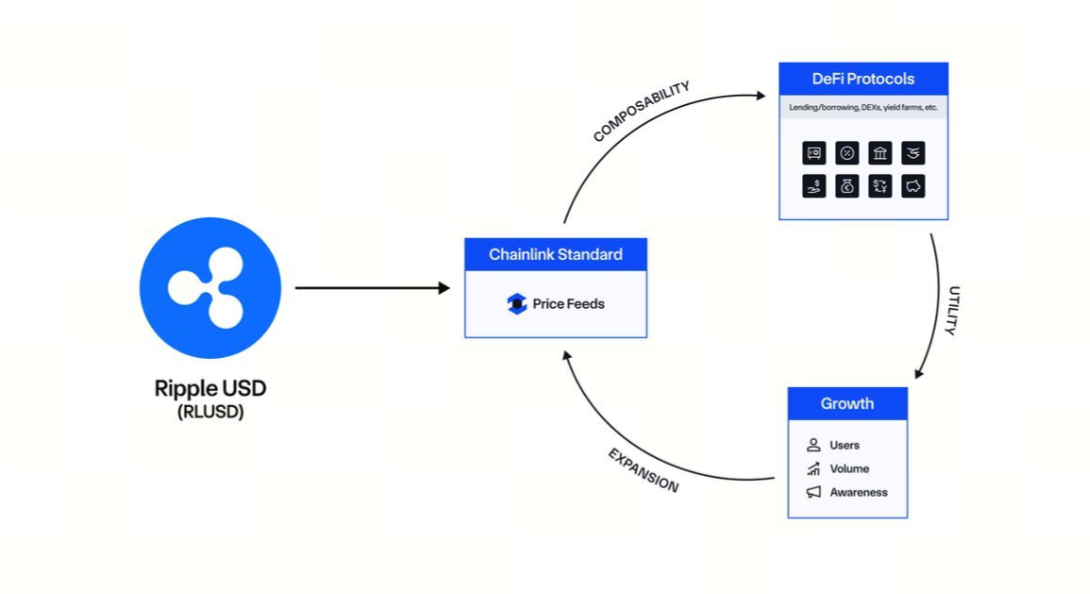
When users want to redeem RLUSD back into dollars, the corresponding amount of RLUSD is burned, while the reserve assets are used to complete redemption. Through this mechanism, the amount of RLUSD circulating on-chain remains matched with real-world dollar reserves.
To maintain stability, RLUSD reserves are usually composed of cash, short-term U.S. Treasuries, and highly liquid assets. This structure is similar to that of mainstream fiat-backed stablecoins, with the core goal of ensuring sufficient liquidity and redemption capacity.
At the technical level, RLUSD runs on both XRPL and Ethereum. On XRP Ledger, RLUSD can use low fees and fast confirmation to complete payment settlement. On Ethereum, RLUSD can access a more mature DeFi ecosystem and smart contract applications.
How Is RLUSD Different From XRP?
RLUSD and XRP are both important digital assets within the Ripple ecosystem, but their design goals and use cases differ clearly.
XRP is a digital asset whose price fluctuates with the market. Its main uses include liquidity bridging, cross-currency conversion, and acting as an intermediary asset in some payment scenarios. RLUSD, by contrast, is a stablecoin. Its core goal is to maintain price stability, making it more suitable for payments, settlement, and fund storage.
Put simply, XRP emphasizes liquidity efficiency, while RLUSD emphasizes value stability.
In Ripple’s cross-border payment system, XRP can be used for liquidity conversion between different fiat currencies, while RLUSD can participate in payment settlement as a stable dollar asset. This means the two are more complementary than directly competitive.
Their risk structures are also different. XRP’s price is affected by changes in market supply and demand, while RLUSD’s value mainly depends on the stability of its reserve assets and issuance mechanism.
What Can RLUSD Be Used For?
As stablecoin adoption continues to grow, RLUSD’s use cases are gradually expanding from payments into a wider range of digital finance scenarios.
In cross-border payments, RLUSD can be used for on-chain dollar settlement between companies or institutions. Compared with traditional bank transfers, blockchain payments can usually shorten settlement times and reduce intermediaries.
In digital asset trading markets, stablecoins are also important pricing and trading media. RLUSD can serve as a dollar settlement tool in digital asset trading, helping improve capital flow efficiency.
As the DeFi ecosystem develops, RLUSD can also be used as an on-chain liquidity asset, collateral asset, and trading pair asset across financial protocols. Because it supports both XRPL and Ethereum, RLUSD also has broader ecosystem compatibility.
Potential Risks and Limitations of RLUSD
Although stablecoins can reduce price volatility risk, RLUSD still has certain limitations.
First, RLUSD is a centralized stablecoin, and its stability depends on the issuer’s reserve management and compliance framework. If reserve transparency, liquidity management, or the regulatory environment changes, the stablecoin system may be affected.
Second, compared with USDT and USDC, which already have large-scale liquidity, RLUSD is still in the ecosystem expansion stage, and its market coverage and trading depth still need to improve.
In addition, the stablecoin industry itself faces issues such as regulatory changes, cross-chain security, and on-chain compliance. For this reason, RLUSD’s long-term development depends not only on technical capability, but also on the global regulatory environment for stablecoins.
Conclusion
Ripple USD (RLUSD), the dollar-backed stablecoin issued by Ripple, is designed to provide a more stable value carrier for cross-border payments, on-chain settlement, and digital finance scenarios. Unlike XRP, RLUSD maintains price stability through dollar reserves, making it more suitable as a payment and settlement tool.
As stablecoins gradually become an important part of blockchain financial infrastructure, the emergence of RLUSD also shows that Ripple is expanding from a payment network into a more complete digital asset ecosystem. By combining XRPL’s efficient settlement capabilities with Ethereum’s DeFi ecosystem, RLUSD is attempting to build a new connection between institutional payments and on-chain finance.
FAQs
Are RLUSD and XRP the Same Asset?
No. XRP is a price-volatile digital asset, while RLUSD is a stablecoin. They serve different functions within the Ripple ecosystem.
Which Blockchains Is RLUSD Deployed On?
RLUSD is currently deployed on XRP Ledger (XRPL) and Ethereum.
Can RLUSD Be Used for Cross-Border Payments?
Yes. One of RLUSD’s design goals is to support more efficient on-chain cross-border payments and institutional settlement.
Is RLUSD Fully Decentralized?
RLUSD is a centralized stablecoin, and its issuance and reserve management are handled by Ripple-related entities.
How Is RLUSD Different From USDT and USDC?
RLUSD is also a fiat-backed stablecoin, but its focus is more closely tied to Ripple’s payments ecosystem, institutional settlement, and XRPL network scenarios.







