As the Web3 ecosystem expands, user activity is now spread across DeFi, NFTs, GameFi, DAOs, and on-chain social platforms. While all of these actions are recorded on the blockchain, the data tends to exist as isolated events, making it difficult to build a cohesive user understanding model.
With the rapid rise of AI Agents, digital identities, and personalized services, relying solely on wallet addresses no longer meets the needs of intelligent applications for user comprehension. Identity Embedding creates a unified digital identity representation that allows AI to understand the patterns and traits behind user behavior, making it a core component of the Bluwhale AI Web3 Intelligence Layer.
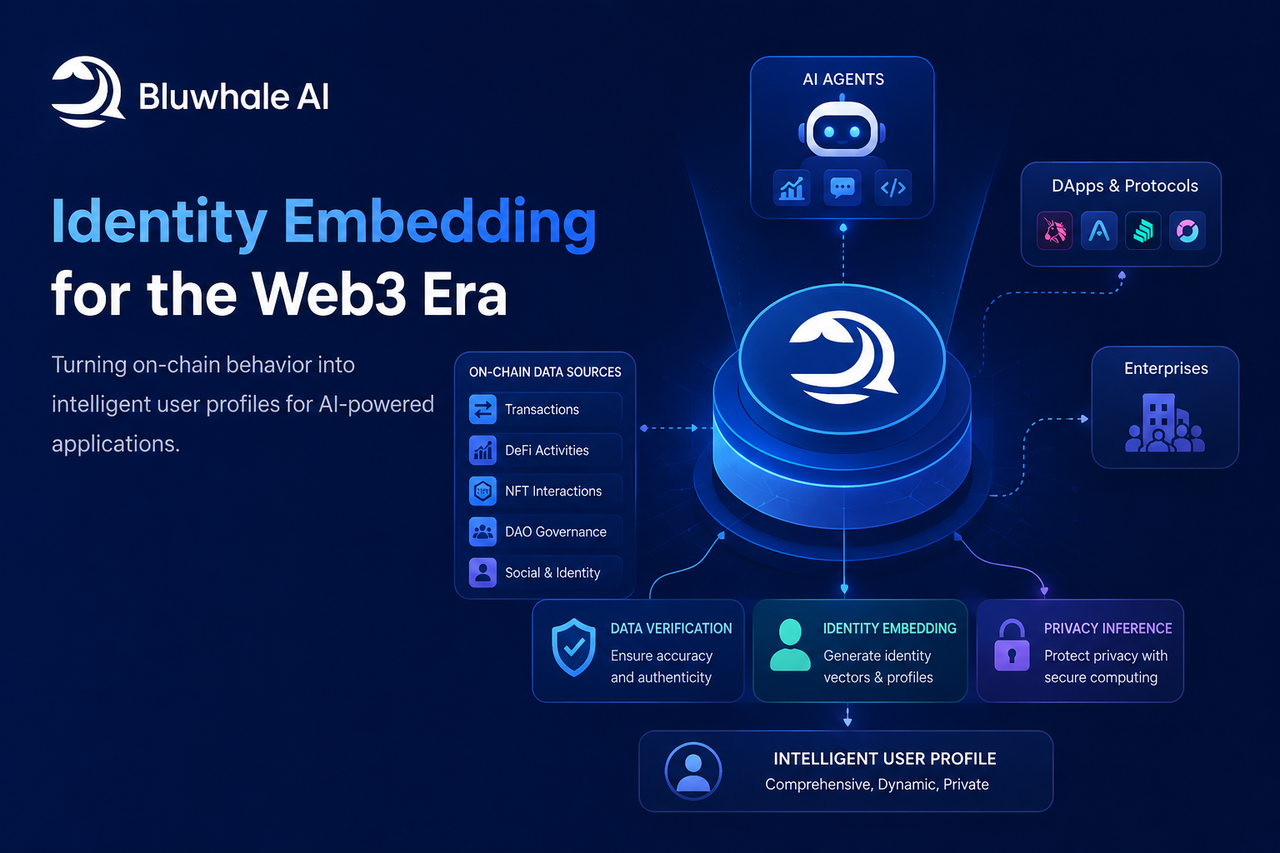
What Is Identity Embedding?
Identity Embedding is a method that transforms user behavior and identity attributes into vectorized representations.
In AI, embeddings are commonly used to convert complex information into numerical vectors that machines can process. For instance, large language models turn words into semantic vectors to grasp relationships between different terms.
Bluwhale AI applies this concept to Web3 identity. By analyzing a user's on-chain footprint—including asset holdings, trading habits, protocol interactions, and community engagement—the system converts these signals into a unified identity vector.
This vector-based identity enables AI to quickly identify user traits without having to reprocess all raw data each time.
Why Wallet Addresses Fall Short in Expressing User Identity
Wallet addresses are the most fundamental identifier in the blockchain world.
However, a wallet address alone only records asset flows and transaction history—it cannot directly reveal a user's intent.
For example, two users may hold identical asset amounts, but one actively participates in governance voting while the other frequently trades. From wallet balances alone, it's nearly impossible to tell them apart.
Moreover, a single user often manages multiple wallets, and activity across different chains remains siloed. This fragmentation makes identity understanding even more complex.
Identity Embedding's value lies in overcoming the limitations of individual addresses and understanding users through the lens of their overall behavior.
What On-Chain Data Does Bluwhale AI Analyze?
The accuracy of Identity Embedding depends on the richness of its data sources.
Bluwhale AI collects user behavior data from several key dimensions:
Asset Holding Behavior
Asset types, holding periods, and allocation structures reveal a user's investment preferences and risk appetite.
Long-term holders and high-frequency traders exhibit markedly different patterns.
Protocol Interaction Records
The DeFi protocols, liquidity pools, or lending platforms a user engages with are critical inputs for building a profile.
Which protocols a user interacts with shows their activity level and areas of interest within the ecosystem.
Governance and Community Participation
Governance voting, DAO contributions, and on-chain community interactions reflect a user's long-term commitment and governance tendencies.
Social and Identity Data
With user consent, select on-chain social connections and identity data can further enrich the profile.
How Is Identity Embedding Generated?
Generating user profiles is not a one-time aggregation of data—it's an ongoing process of learning and updating.
Data Collection
The system first pulls user behavior data from multiple blockchain networks and protocols.
After cleaning and normalization, the data enters the analysis pipeline.
Feature Extraction
Machine learning models identify representative behavioral features, such as:
- Trading frequency
- Changes in asset composition
- Protocol preferences
- Depth of engagement
Vector Encoding
Extracted features are converted into vectorized representations.
This step is similar to compressing complex identity information into a digital coordinate system that AI can quickly recognize.
Profile Generation
Multiple vectors are combined to form a unified identity model.
The system then generates corresponding user tags and behavioral profiles.
How Does Identity Embedding Continuously Update?
User identity is not static.
As assets shift, protocol usage evolves, and new behaviors emerge, the profile must adapt.
Bluwhale AI continuously monitors fresh on-chain activity and incorporates it into the analysis.
When a user starts using a new protocol, joins a DAO, or changes their investment strategy, the identity vector adjusts in real time.
This dynamic update mechanism ensures the profile reflects the user's current state, not just historical data.
How Does Identity Embedding Help AI Agents Understand Users?
An AI Agent's intelligence largely depends on how well it understands the user.
If the Agent only sees a wallet address, the information it can access is extremely limited.
With Identity Embedding, the Agent can quickly identify a user's cohort, behavioral preferences, and participation patterns.
For example:
- Determine if the user is a long-term holder
- Identify whether the user is active in DeFi
- Analyze the user's governance involvement
- Understand the user's risk tolerance
These insights allow the Agent to deliver a more personalized experience.
How Is Identity Embedding Different from Traditional User Profiles?
Traditional internet platforms also rely on user profiling. However, the source of data and who controls it are fundamentally different.
| Aspect |
Identity Embedding |
Web2 User Profile |
| Data Source |
On-chain behavioral data |
Platform internal data |
| Data Ownership |
User-controlled |
Platform-controlled |
| Verifiability |
Verifiable on-chain |
Verified internally by the platform |
| Identity Form |
Decentralized identity |
Platform account system |
| Data Flow |
Authorized access |
Controlled by the platform |
Identity Embedding prioritizes user data sovereignty and open-ecosystem compatibility.
As such, it is considered one of the key directions for the future of Web3 digital identity.
What Challenges Does Identity Embedding Face?
Despite its great potential, Identity Embedding still encounters several hurdles:
Data Fragmentation
User behavior is scattered across multiple blockchains and protocols, making data aggregation difficult.
Identity Linking
A single user may control many wallet addresses, and accurately connecting them is not always possible.
AI Inference Bias
User profiles are probabilistic. Model output may be affected by data quality or training methodology.
Privacy Protection
Balancing profile accuracy with user privacy is a challenge the industry must keep solving.
Summary
As a core technology of Bluwhale AI's Web3 Intelligence Layer, Identity Embedding analyzes on-chain behavior, protocol interactions, asset allocation, and identity traits to convert complex data into a unified vector-based identity. Unlike a simple wallet address, Identity Embedding enables AI systems to gain a more comprehensive understanding of user behavior and preferences, supporting use cases such as personalized recommendations, intelligent advisory, on-chain credit assessment, and AI Agent services.
FAQs
What's the difference between Identity Embedding and a wallet address?
A wallet address primarily records asset and transaction data. Identity Embedding goes further by analyzing behavioral patterns, protocol preferences, and participation habits to build a more complete user identity model.
Why does Bluwhale AI need Identity Embedding?
Bluwhale AI aims to help AI Agents better understand on-chain users. Identity Embedding converts complex behavioral data into a unified identity representation, enhancing the AI's ability to know the user.
Does Identity Embedding compromise user privacy?
One of its core design goals is balancing data utility with privacy. Users can provide the necessary identity information and authorization results without exposing all their raw data.
How do AI Agents use Identity Embedding?
AI Agents can access identity profiles through an authorization mechanism, allowing them to identify user preferences, risk characteristics, and behavior patterns to deliver more personalized services.
Is Identity Embedding the same as on-chain credit scoring?
No. Identity Embedding describes user behavioral traits, while credit scoring is just one potential application that can be built on top of identity data.