Unlike traditional brokers, wallets, or card products that operate independently, Based aims to unify “tradable assets” and “spendable purchasing power” under a single balance framework, minimizing friction between on-chain returns and real-world spending. For the industry, this model consolidates Builder income (such as Hyperliquid builder code), payment interchange, cross-border FX, and trading fees into a scalable revenue structure—closely resembling a “trading platform + neobank” hybrid.
Hyperliquid delivers a high-performance on-chain Central Limit Order Book (CLOB) and a composable market expansion framework (like the builder-deployed perpetual market ecosystem enabled by HIP-3). As a leading application, Based translates on-chain liquidity, risk control parameters, and settlement advantages into a one-stop app experience that’s accessible to mainstream users. At the same time, $BASED serves as a long-term alignment mechanism, redistributing growth dividends to real users and ecosystem participants.
What Is Based (BASED)? Project Background and Development
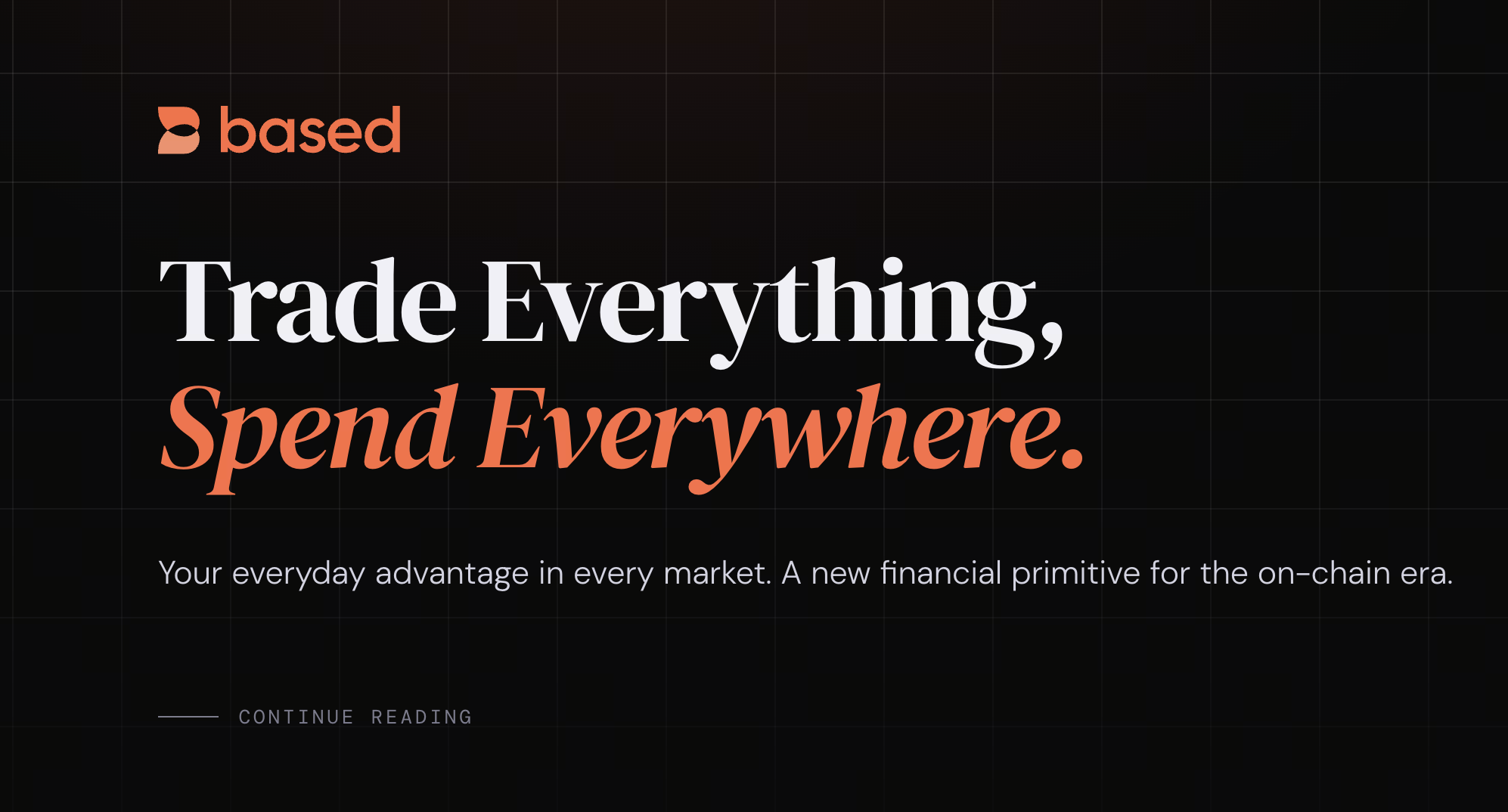
Based (often styled as Based or BasedApp) is an on-chain financial super app built for global users, centered on the motto “Trade Everything, Spend Everywhere.” It enables multi-market trading, capital retention, and Visa-powered spending—all within a single account system. According to its public litepaper (2026), key metrics include: over 100,000 active users, approximately $20 million in ARR, more than $4.1 billion in cumulative trading volume, and over $15 million in revenue across all product lines over the past nine months (data is updated regularly per official disclosures). On the funding front, Based announced an $11.5 million Series A led by Pantera in February 2026 to accelerate on-chain financial infrastructure and ecosystem growth.
$BASED is the ecosystem’s native utility token, featuring a fixed total supply of 1 billion and a “user benefit” incentive model, with issuance and ecosystem budgeting managed by the Based Foundation. Note: Based as a product and distribution channel is distinct from the Hyperliquid protocol itself; however, Hyperliquid serves as a core execution and market access layer.
BASED Tokenomics and Ecosystem Incentives
BASED’s primary objective is to link platform growth, user retention, and builder ecosystem expansion into a unified incentive flywheel: more traders drive higher revenue, which in turn funds card Cashback, AI credits, platform rewards, and Launchpool resources. Stronger distribution attracts more projects to launch on Based, and when projects use BASED as a utility token, it creates sustained demand for the token.
Token allocation is fixed at 1 billion, with approximate breakdowns: about 36% for Genesis distribution (with detailed tables and vesting schedules for community, partner communities, and Season participants), about 23.64% for ecosystem and rewards (managed by the Foundation), about 20.36% for investors, and about 20% for core contributors—typically with lock-up and linear vesting to reduce short-term selling pressure and align long-term interests. Final terms are subject to Based Foundation and official contracts/disclosures.
Utility benefits include reduced trading and prediction market fees, up to 8% $BASED Cashback on Visa cards (depending on tier), higher card limits, lower deposit/withdrawal friction, future Launchpool/airdrop eligibility, and Agentic AI spending limits. For users, it’s crucial to see these rights as “product usage and risk buffer”—not as guaranteed returns.
How Based Builds a “Trade Everything, Spend Everywhere” Super App
“Trade Everything” focuses on a unified gateway: integrating crypto spot and perpetuals, stock indices, precious metals, energy, and more within a single interface, reducing the cognitive load of switching between multiple brokers and wallets.
“Spend Everywhere” aims to eliminate the “withdraw before spending” gap: users leverage their Based balance to transact with any merchant on the Visa network, seamlessly bridging on-chain assets and real-world purchasing power.
What Is the Relationship Between Based and Hyperliquid?
Hyperliquid is a decentralized trading infrastructure specializing in on-chain perpetuals and order book performance. Based is a large-scale application layer built on Hyperliquid, participating in trading flows and generating recurring revenue via builder code and related mechanisms.
The Based team also contributes to builder-type products in the HIP-3 ecosystem, exemplifying a “product team + protocol expansion framework” synergy: Hyperliquid delivers a deployable, composable market layer, while Based drives user growth, branding, compliant payment integration, and productization.
How Based’s Trading, Prediction Market, and Visa Card Ecosystems Work
Trading: Users place orders within Based, with matching and risk engines powered by on-chain infrastructure like Hyperliquid. Based adds value through account management, risk alerts, cross-device experience, and fee privileges.
Prediction markets: Official materials frequently highlight the integration or aggregation of leading prediction markets (e.g., Polymarket), enabling “event-driven trading” within a unified app environment.
Visa card: Based Visa Platinum is globally accepted, converting trading profits and crypto balances into fiat payments at the point of sale, with $BASED Cashback and other rewards. Card products also involve issuing banks, KYC, regional availability, and fee structures—users should always refer to the application page and terms for details.
Based’s AI Agent and Web 4.0 Vision
Based’s AI strategy is twofold: first, “assisting trading” via smarter routing, risk monitoring, and automated strategies; second, a more ambitious vision of “agents owning wallets and operating alongside humans,” enabled by concepts like x402 for machine payments and settlements—allowing agents to purchase services, pay fees, and trade autonomously. The litepaper describes “Web 4.0” as providing AI Agents with domains, hosting, payments, identity, and financial services, empowering them to generate recurring cash flow like long-term economic actors.
For evaluators, the key questions are not about slogans, but about privacy and inference controls (with official support for private inference), clear on-chain authorization boundaries, and how product design mitigates agent fund risks.
Versus traditional internet brokers, Based stands out for its on-chain composability, 24/7 trading, and direct support for crypto-native assets. Compared to typical “DEX front ends,” Based uniquely integrates payment networks, user growth systems, and builder revenue models—delivering a true super app experience.
Relative to other Perp DEXs, Hyperliquid’s main advantage is its on-chain CLOB and performance; Based differentiates by offering not just trading, but also integrated spending and project discovery (Launchpool) within a unified growth engine, with $BASED powering the rights system.
Key Risks to Consider When Investing in BASED
- Price and liquidity risk: Crypto assets are highly volatile; unlocking schedules, market sentiment, and macro liquidity can amplify swings.
- Regulatory and compliance risk: Cards, deposits/withdrawals, prediction markets, and some assets may face regional restrictions.
- Smart contract and integration risk: Cross-app, cross-chain, and third-party protocol integrations introduce attack surfaces and parameter risks.
- Narrative execution risk: The scale and revenue impact of AI Agent, Web 4.0, and Launchpool will require time to validate.
- Information risk: Always consult Based Foundation, the official litepaper, contract audits, and disclosures. Be wary of secondhand summaries and marketing exaggeration.
Future Directions and Market Potential for the Based Ecosystem
The “What’s Next” narrative is about evolving from app to ecosystem: enabling high-value trader distribution for builders, protocols, and agents; expanding Launchpool post-TGE; and establishing Based AI as a long-term product pillar. Market potential should be assessed using verifiable metrics (users, trading volume, revenue mix, retention, ARPU)—not just by comparing to traditional broker market cap multiples, which are best used as rough benchmarks, not pricing conclusions.
Summary
Based leverages Hyperliquid’s high-performance on-chain infrastructure, the Visa payment network, and the AI Agent narrative to create a super app that unites trading, spending, and distribution. $BASED acts as the core utility and incentive alignment hub. For readers, the most valuable takeaway is to first assess whether the product addresses real-world friction, then whether token unlocks and rights match your risk profile, and only then consider “potential” and “upside.”
FAQs
-
Q1: Is Based the official Hyperliquid team?
No. Based is an application built on the Hyperliquid ecosystem; the relationship is protocol-to-application, with deep collaboration on trading infrastructure and market expansion frameworks.
-
Q2: Is $BASED a security?
This depends on jurisdiction and specific sales arrangements; there’s no universal answer. Always consult local laws and official compliance disclosures.
-
Q3: How can I check the TGE/unlock schedule?
Refer to Based Foundation, the official litepaper, and announcement channels. Different allocation categories may have different cliff and linear release terms.
-
Q4: Is the Visa card available to everyone?
Card products are subject to regional, KYC, and issuing partner rules. Always refer to the application page for specifics.
-
Q5: Are prediction markets compliant?
Regulation of prediction markets and binary event contracts varies significantly by country. Users should review local laws and platform terms.
-
Q6: Will the AI Agent move my funds?
If you enable autonomous trading or proxy wallet features, pay close attention to approval scope, limits, revocation mechanisms, and Private Key/session security. Do not assume “fully automated” means risk-free by default.







