Within the blockchain ecosystem, most storage solutions still operate on a “pay-as-you-go” model, where the continued existence of data depends on ongoing payments. Arweave seeks to solve this challenge with its “permanent storage” mechanism, enabling data to remain available long-term without repeated renewals, thereby enhancing data reliability and accessibility.
From the perspective of digital assets and the data economy, Arweave is more than just a storage network—it acts as foundational infrastructure for data assetization. By turning data into a verifiable, accessible long-term resource, Arweave empowers blockchains not only to record trades but to support a robust, persistent data layer.
Source: arweave.com
What Is Arweave (AR)
Arweave is a blockchain network dedicated to permanent data storage, with the core mission of making data “upload once, store forever.” Unlike traditional blockchains focused primarily on recording trades, Arweave treats data itself as the central object of storage, giving blockchains a more comprehensive information-carrying capability.
Technically, Arweave forgoes the traditional blockchain structure in favor of a unique data organization method, allowing the network to store massive amounts of data securely. This design makes it suitable not only for financial use cases but also for content storage and data archiving.
To understand Arweave, start with the “blockchain storage network” concept. It is both a chain and a decentralized data layer, providing foundational support for Web3 applications. Further exploration includes the “Arweave permanent storage mechanism” and how it differs from other “blockchain data storage models.”
In essence, Arweave expands the blockchain’s role from a “record-keeping tool” to “data infrastructure,” broadening the functional boundaries for decentralized applications.
Arweave’s Core Positioning: Permanent Storage Network and the Permaweb Concept
Arweave’s core vision is to build a “permanent storage network,” aiming not only to preserve data but to establish an open, data-driven network structure known as the Permaweb. The Permaweb is a decentralized internet built on Arweave, where all content remains accessible long-term.
On the traditional internet, website content relies on servers and centralized platforms—if a server is shut down or data is deleted, the content is lost forever. On the Permaweb, once data is uploaded, it persists indefinitely, creating a truly “immutable content network.”
This architecture establishes a new foundational layer for Web3, allowing applications to be built on a stable, persistent data environment. Examples include decentralized websites and on-chain archival systems, all leveraging Arweave’s storage capabilities. Related concepts include “Permaweb architecture” and “Web3 storage infrastructure.”
As a result, Arweave’s value goes beyond storage itself—it redefines the lifecycle of data on the internet, making “long-term accessibility” the default.
Arweave’s Technical Architecture: Blockweave and Storage Mechanism
Arweave’s technical foundation is its Blockweave architecture—a structure distinct from traditional blockchains. In Blockweave, each new block links to the previous block and randomly references historical blocks, strengthening the dependence on historical data.
This approach requires network nodes to access and verify portions of historical data, increasing the likelihood that data remains persistently stored. This is known as “Proof of Access,” where miners must prove they possess certain historical data to be eligible for block production.
Compared to traditional chain structures, Blockweave prioritizes data availability over mere trade consistency. This enables secure, large-scale data storage. Related mechanisms include the “Blockweave structure principle” and the “Proof of Access working method.”
Overall, this architecture embeds “storage behavior” directly into the consensus mechanism, making data storage a core aspect of network operation rather than an auxiliary function.
Arweave’s Operating Mechanism: Data Upload, Storage, and Retrieval
On Arweave, data processing follows three steps: upload, storage, and retrieval. Users pay a one-time fee when uploading data, covering both immediate and long-term preservation.
Once uploaded, data is distributed across network nodes and maintained long-term through the Blockweave structure and consensus mechanism. Nodes earn rewards for storage and validation, creating continuous incentives to maintain data.
For retrieval, users access stored content through network interfaces. This process resembles traditional web access, but data is sourced from decentralized nodes rather than a single server. Related processes include the “Arweave data upload process” and the “data retrieval mechanism.”
This operational model allows Arweave to deliver an internet-like data access experience without reliance on centralized servers.
The Role of the AR Token: Storage Payment and Incentive Mechanism
AR is the native token of the Arweave network, used for storage payments and incentivizing node participation. Users pay a one-time AR fee for long-term data storage.
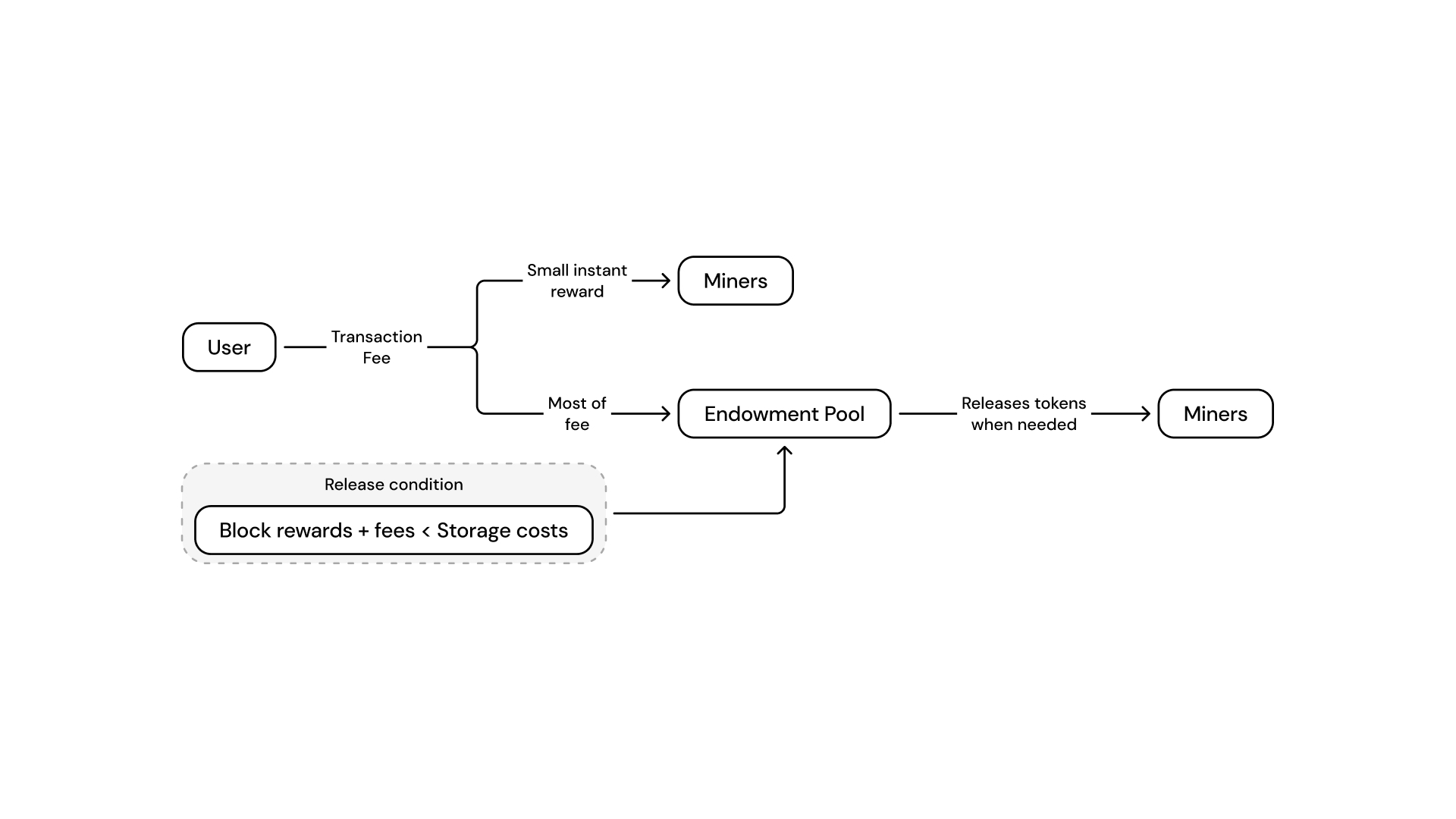
Miners earn rewards for providing storage and validation services. These rewards come from both block rewards and network economic mechanisms, such as reserve fund releases.
A key innovation is Arweave’s Endowment mechanism. Most user payments do not go directly to miners but are placed in a reserve pool to subsidize future storage costs, supporting “permanent storage.”
In summary, AR is not just a payment tool—it is the cornerstone of Arweave’s long-term storage economic model. Further reading includes “Arweave Tokenomics” and the “Endowment Model.”
Arweave Use Cases: Data Storage, NFTs, and Decentralized Websites
Arweave’s use cases center on scenarios demanding long-term data preservation. In the NFT space, for example, metadata must remain accessible over time—Arweave offers stable storage support.
For content storage, users can upload articles, images, or files to the network, ensuring immutable, long-term preservation. This is ideal for archives, academic records, and public information.
Arweave also enables decentralized websites—Permaweb applications—that do not depend on traditional servers and can operate indefinitely with unaltered content. Related topics include “NFT storage solutions” and “decentralized website architecture.”
Thus, Arweave acts as a “data layer” in Web3, rather than a single-purpose application platform.
Comparing Arweave with Other Storage Protocols: IPFS / Filecoin
In decentralized storage, Arweave, IPFS, and Filecoin each have distinct philosophies. Arweave is centered on “permanent storage,” IPFS functions as a data distribution protocol, and Filecoin focuses on the storage marketplace.
Arweave uses a one-time payment model, while Filecoin requires ongoing payments. This makes Arweave ideal for long-term storage, whereas Filecoin offers flexibility but demands continuous maintenance fees.
Arweave’s reserve pool mechanism smooths long-term costs, while other protocols typically pay nodes directly. Related topics include “Arweave vs IPFS” and “Filecoin storage model comparison.”
Collectively, these solutions represent different approaches: permanence, distribution, and market-driven storage.
Arweave’s Advantages, Limitations, and Common Misconceptions
Arweave’s primary advantage is its permanent storage capability, allowing data to persist long-term with no ongoing maintenance fees—critical for high-reliability applications.
However, the system has limitations. Permanent storage means data is difficult to delete, which can be problematic in certain scenarios. Its economic model also assumes declining long-term costs, raising questions about sustainability.
A common misconception is that Arweave is just another storage network. In reality, it is “data infrastructure,” combining storage and validation mechanisms, not merely simple data hosting.
To fully understand Arweave, consider both its technical architecture and economic model—not just one dimension.
Summary
With its Blockweave architecture and Endowment economic model, Arweave has created a blockchain network focused on “permanent storage.” Its core value is transforming data from a “short-term resource” into a “long-term asset,” providing robust data infrastructure for Web3.
While challenges remain around cost and sustainability, Arweave offers a unique approach in decentralized storage—enabling long-term data availability through one-time payments. This model opens new possibilities for blockchain applications.
FAQ
What is Arweave (AR)?
Arweave is a blockchain network for permanent data storage, enabling long-term data preservation with a one-time payment.
What is the Permaweb?
The Permaweb is a decentralized network built on Arweave, where all content is permanently accessible and tamper-proof.
How does Arweave achieve permanent storage?
It leverages the Blockweave architecture and Proof of Access mechanism, together with the Endowment economic model for long-term incentives.
What is the difference between Arweave and IPFS?
Arweave focuses on permanent storage, while IPFS is designed for data distribution and does not guarantee long-term preservation.
How are Arweave storage fees calculated?
Users pay a one-time fee, part of which goes into a reserve pool to support future storage costs.







