On most blockchain networks, users must pay a Gas Fee when transferring assets, calling smart contracts, or performing any on-chain action. For example, Ethereum users need to hold ETH, while Solana users need to hold SOL. Although this mechanism is an important part of how blockchains operate, it also raises the barrier for ordinary users encountering Web3 for the first time.
As the blockchain industry gradually expands into payments, social networking, blockchain games, and super app ecosystems, reducing the complexity of Gas for users has become an important area of competition for Web3 infrastructure. Kaia’s Gas Fee Delegation was introduced in this context. Its core goal is to let users complete certain on-chain actions without having to hold KAIA tokens in advance, improving both accessibility and user experience in Web3.
What Is Gas Fee Delegation?
As a fee payment mechanism on the Kaia network, Gas Fee Delegation allows a third party to pay the Gas Fee required for an on-chain transaction on behalf of the user.
In traditional blockchain networks, users usually need to pay transaction fees themselves. This means users must not only create a wallet, but also buy and hold the native token before they can perform on-chain actions.
Kaia introduces the concept of a “Fee Payer.” Developers, application platforms, or service providers can act as the Fee Payer and cover Gas costs for users.
As a result, users can complete certain on-chain transactions even if their account does not hold KAIA. This experience is also known as a “Gasless Transaction.”
Why Does Gas Fee Affect the Web3 User Experience?
Gas Fee is an important mechanism for blockchain networks. It helps prevent spam transactions and incentivizes validators to maintain network security.
For ordinary internet users, however, having to buy a token before using an application does not match the habits formed by traditional internet products.
For example, a user who has never used Web3 may only want to claim an NFT, try a blockchain game, or make a small payment. If they first have to learn how wallets work, buy a Gas Token, and complete a transfer process, the experience becomes much harder. For this reason, more blockchain projects are trying to reduce how much users need to think about Gas.
Kaia’s Gas Fee Delegation is essentially a Web3 user experience improvement. Its goal is not to eliminate transaction fees, but to move the complexity of Gas management away from the user and into the application service layer.
How Does Kaia’s Gas Fee Delegation Work?
Kaia’s Gas Fee Delegation mechanism usually involves three main roles:
-
User(Transaction Sender)
-
Fee Payer
-
Kaia network validators
When a user performs an action in a Mini DApp or on-chain application, the system first generates a transaction.
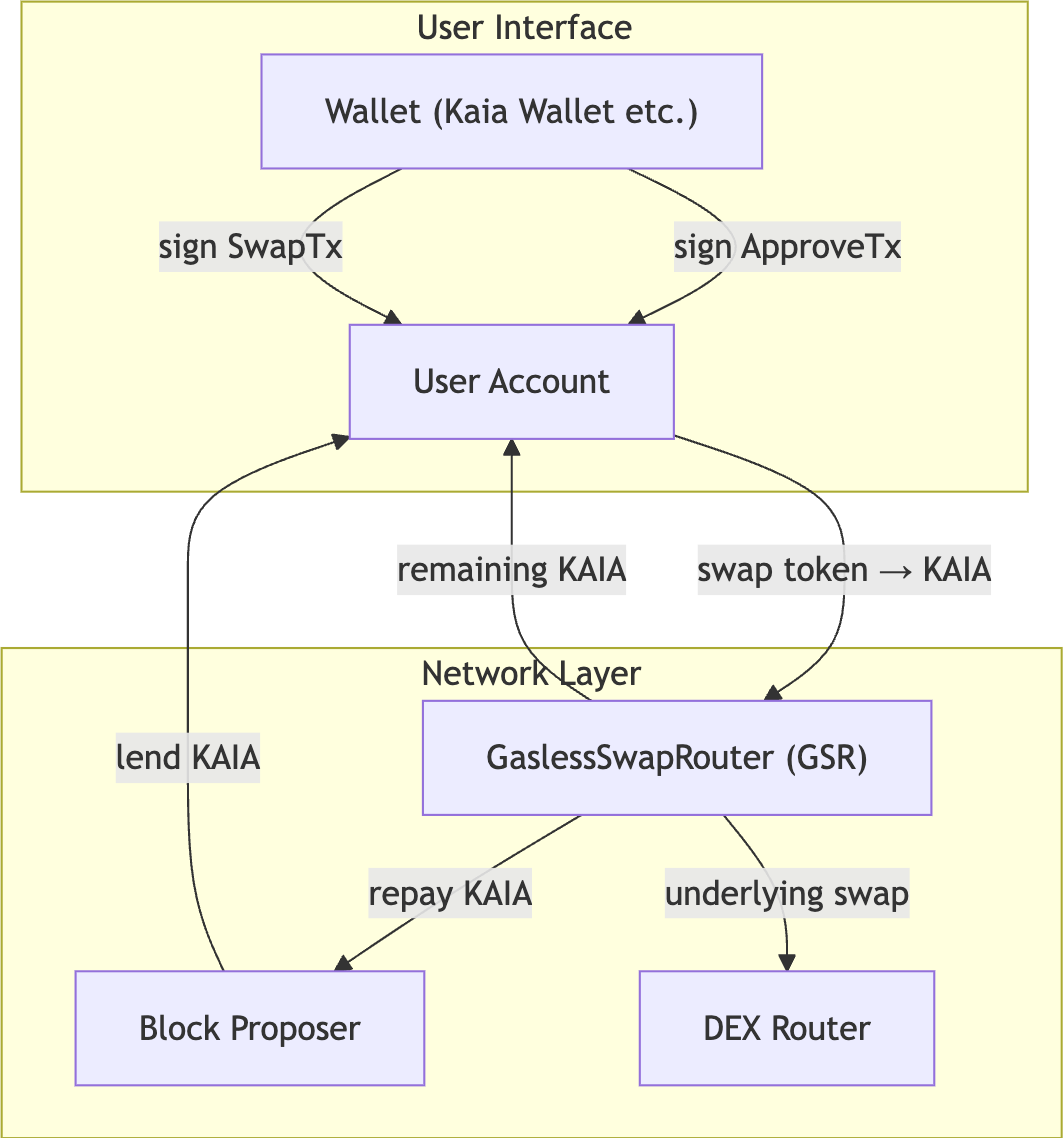
The user then signs the transaction content to confirm authorization for the action. However, the Gas Fee for this transaction does not necessarily have to be paid by the user.
The application platform or service provider can act as the Fee Payer, sign the transaction again, and cover the corresponding fee.
Finally, the transaction is broadcast to the Kaia network, where validators confirm it and record it on the blockchain.
This mechanism means users can complete certain on-chain interactions without holding KAIA.
How Is a Gasless Transaction Completed?
In Kaia’s gasless transaction flow, users usually do not directly notice the complex on-chain steps behind the scenes.
For example, after a user clicks “Claim NFT” in a Mini DApp:
-
The application generates an on-chain transaction request
-
The user confirms the action and signs the transaction
-
The Fee Payer signs the transaction for fee payment
-
The transaction is broadcast to the Kaia network
-
Validators confirm the transaction
-
The NFT or asset is updated in the user’s account
From the user’s perspective, this process feels closer to clicking “confirm” in an ordinary internet application than to the complex wallet interactions usually associated with Web3. This improved experience is one of the key reasons Kaia Mini DApps can more easily reach ordinary internet users.
What Role Does the Fee Payer Play in the Kaia Network?
The Fee Payer is a core part of Gas Fee Delegation.
A Fee Payer can be a Mini DApp developer, an on-chain gaming platform, a payment service platform, a Web3 social application, or an enterprise blockchain service. These platforms prepare KAIA tokens in advance and use them to pay Gas on behalf of users.
From a business model perspective, platforms may treat transaction fees as part of user acquisition costs, operating expenses, or ecosystem incentives.
For example, a Web3 gaming platform may want to lower the barrier for first-time users, so it may be willing to cover the fees for a user’s first few on-chain actions.
This model is somewhat similar to “free trials” or “platform subsidies” in traditional internet services.
What Scenarios Are Suitable for Kaia’s Gasless Mechanism?
Gas Fee Delegation is better suited to Web3 scenarios that require large-scale user onboarding, such as Mini DApps, blockchain games, NFT platforms, social applications, stablecoin payments, membership points systems, and digital content platforms. These scenarios usually target ordinary internet users rather than crypto-native users.
If users must first learn about wallets and Gas mechanisms, application growth may be affected. Gasless transactions can therefore help platforms reduce user drop-off.
For payment scenarios, Gas Fee Delegation can also make on-chain payments feel closer to traditional mobile payment flows.
How Is Kaia’s Gas Fee Delegation Different From Ethereum?
Ethereum currently does not provide a native Gas Fee Delegation mechanism by default in the same way Kaia does.
On Ethereum, users usually need to hold ETH themselves to pay Gas Fees.
Although the Ethereum ecosystem has also developed solutions such as Account Abstraction and Meta Transactions to reduce how much users need to think about Gas, the overall user experience remains relatively complex.
Kaia, by contrast, treats Fee Delegation as an important network-layer feature and focuses it on super app and Mini DApp ecosystems.
This difference also reflects the different ecosystem directions of the two networks:
Does Gas Fee Delegation Carry Risks?
Although gasless transactions can improve the user experience, the design also comes with certain challenges.
First, fee delegation means platforms need to absorb operating costs. If the user base grows quickly, platforms may face significant Gas spending pressure.
Second, some custodial-style experiences may reduce users’ understanding of how blockchain mechanisms actually work.
In addition, if a Fee Payer system is abused, spam transactions or resource consumption problems may occur. For this reason, platforms usually set transaction limits, whitelist mechanisms, or risk control rules.
In the long run, whether the gasless mechanism is sustainable is closely tied to the platform’s business model, the quality of user growth, and ecosystem activity.
Conclusion
Gas Fee Delegation is an important user experience improvement mechanism on the Kaia network. Its core goal is to lower the barrier for ordinary users entering Web3.
By allowing applications to pay transaction fees on behalf of users, Kaia can offer a “gasless” interaction experience that feels closer to traditional internet products. This mechanism is especially suitable for Mini DApps, blockchain games, payments, and super app ecosystems.
Compared with traditional blockchains, which require users to actively learn wallet operations and Gas management, Kaia focuses more on hiding complex on-chain logic and promoting large-scale adoption of Web3 services through low-barrier interactions.
FAQs
Can Users Trade Without Holding KAIA Tokens?
In applications that support Gas Fee Delegation, users can complete certain on-chain actions even without holding KAIA.
What Is a Gasless Transaction?
A Gasless Transaction refers to an interaction model where users can complete on-chain transactions without paying transaction fees themselves.
What Is a Fee Payer?
A Fee Payer is the party that covers transaction fees on behalf of users. This role is usually handled by an application platform or service provider.
What Are the Use Cases for Kaia’s Gas Fee Delegation?
Use cases include Mini DApps, blockchain games, NFTs, stablecoin payments, social applications, and digital content platforms.
How Is Kaia’s Gasless Mechanism Different From Ethereum?
Ethereum usually requires users to pay ETH Gas themselves, while Kaia natively supports a Fee Delegation mechanism.
Is Gas Fee Delegation Completely Free?
Users may not need to pay transaction fees directly, but the platform still has to cover the corresponding Gas costs.







