In traditional digital advertising, ad budgets are typically allocated by centralized advertising platforms. After advertisers pay, the platform manages ad placement and traffic distribution, but most returns are captured by the platform itself, leaving users and content creators—those who contribute real attention value—without appropriate compensation. This return structure creates persistent inequity in value distribution across the advertising ecosystem.
Beyond return allocation issues, traditional advertising faces excessive user data collection, ad fraud, and inefficiencies in ad delivery. As demand grows for privacy protection and fair return mechanisms, the digital advertising industry is moving toward more transparent and efficient value distribution models. The BAT rewards mechanism is a leading example of this evolution.
What is the basic principle behind the BAT rewards mechanism?
Within the Brave browser ecosystem, the BAT rewards mechanism is central to advertising value circulation. Advertisers purchase ad services to capture user attention, and BAT serves as the settlement token, distributing ad budgets to users and content creators, establishing a complete incentive loop.
The core logic is straightforward: advertisers pay for ads, users earn rewards for viewing ads, and content creators receive returns from user engagement. BAT acts as the value exchange medium, enabling ad revenue to flow transparently among all participants.
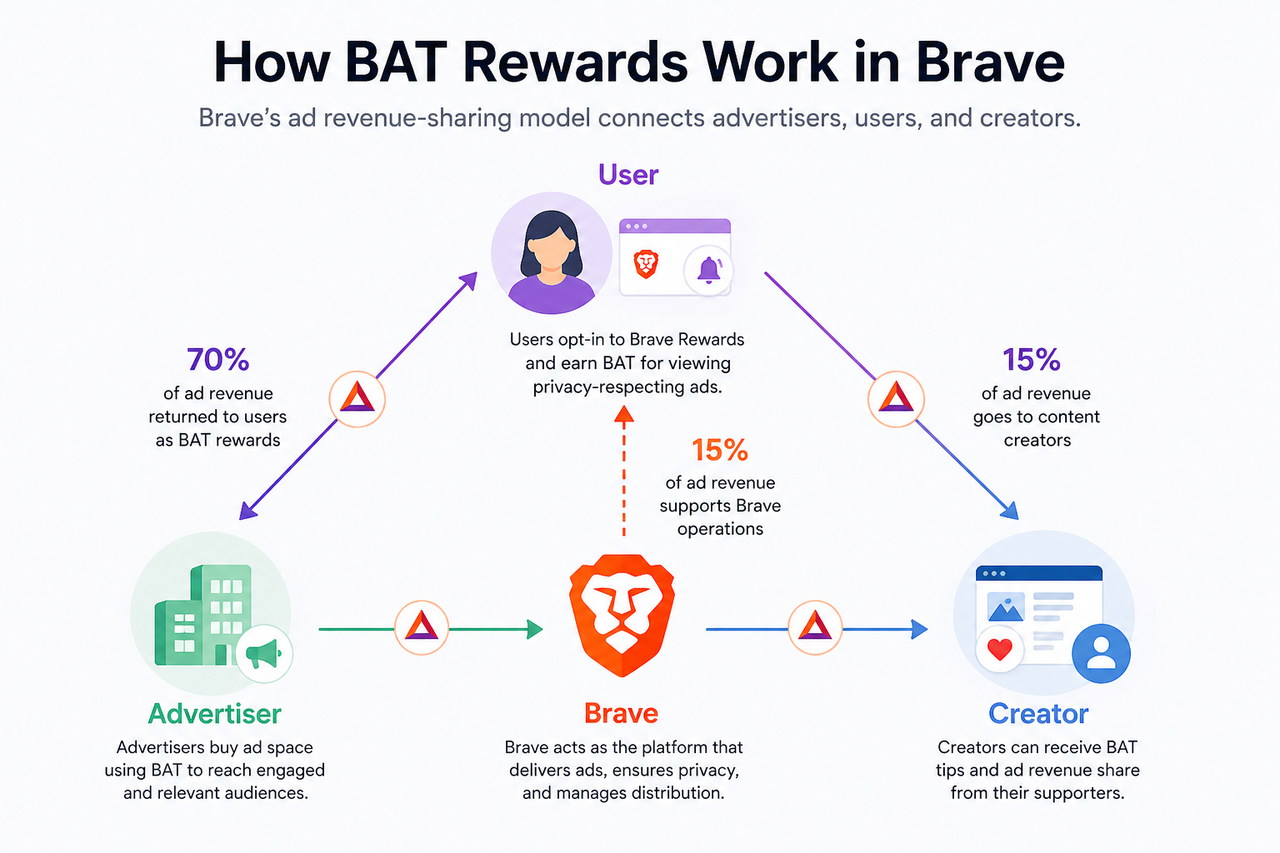
Brave browser uses a local ad matching system to display ads, and users can choose whether to receive them. When users view ads, part of the BAT paid by advertisers is allocated to users, while another portion rewards content creators and helps support platform operations. This model ensures ad value reaches all participants in the ecosystem.
How do advertisers participate in the BAT rewards mechanism?
Advertisers are the value input in the BAT rewards mechanism. When businesses purchase ad services on Brave, they allocate BAT as their ad budget. Advertisers can set targeting strategies, and Brave matches ads based on users’ local browsing behavior.
Unlike traditional platforms, Brave does not rely on large-scale centralized data collection. Instead, it uses local algorithms for ad matching, enhancing privacy protection. BAT paid by advertisers is distributed based on ad display and engagement, ensuring budgets reach real users and creators.
How do users earn BAT through Brave ads?
Users can participate in the BAT rewards mechanism by enabling Brave Rewards. Once activated, the browser delivers ad notifications tailored to users’ interests; after viewing, users receive BAT rewards. Ads appear as notifications or new tab ads, without disrupting the browsing experience.
This approach quantifies user attention as tangible value. Unlike traditional models where users’ browsing behavior is uncompensated, Brave allows users to directly share in ad returns, making “users earning returns for viewing ads” an integral part of the digital advertising ecosystem.
How do content creators earn BAT returns?
Beyond user rewards, the BAT rewards mechanism extends to content creators. Website authors, video creators, and others can sign up as Brave Verified Creators to receive BAT tips or ad revenue shares. Users may allocate their BAT rewards to creators they support.
This model diversifies content creators’ sources of return, reducing reliance on platform-driven ad revenue sharing. Creators receive BAT directly from user support, decreasing dependence on centralized platform income.
How does the BAT rewards mechanism optimize ad return distribution?
BAT rewards reallocate ad returns among advertisers, users, and creators via token distribution. Ad budgets are no longer concentrated on the platform; instead, they are distributed based on user attention and content value. This transparent allocation increases engagement throughout the ecosystem.
For advertisers, this reduces budget loss through intermediaries. For users and creators, it enables direct participation in ad activities and a fairer value exchange.
What are the advantages of the BAT rewards mechanism?
The BAT rewards mechanism’s primary advantage is transparent return distribution. Ad budget flows are clear, and users and creators receive direct returns, reducing value concentration typical in traditional models.
A second advantage is privacy protection. Brave browser’s local ad matching limits user data uploads and avoids centralized collection of behavioral data. The mechanism also improves ad efficiency, allowing budgets to reach users more precisely.
What are the limitations of the BAT rewards mechanism?
Although BAT rewards optimize ad return distribution, their effectiveness depends heavily on the scale of the Brave ecosystem. If user numbers are low, advertiser demand and BAT circulation efficiency may suffer, affecting reward levels.
Additionally, compared to traditional ad platforms, Brave’s ad network has a smaller market footprint. The BAT rewards mechanism’s growth depends on Brave’s user base expansion and advertisers’ willingness to adopt Web3 advertising models.
Summary
The BAT rewards mechanism redistributes ad returns among advertisers, users, and content creators, creating a more transparent and equitable digital advertising value flow. Users earn BAT by viewing ads, creators receive returns through user support, and advertisers reach their target audience more efficiently.
This mechanism not only improves return distribution efficiency but also demonstrates Web3’s potential in digital advertising. Although BAT rewards are limited by Brave’s ecosystem scale, the “attention as value” model signals new directions for industry innovation.
FAQs
What is the core function of the BAT rewards mechanism?
The BAT rewards mechanism’s core function is to redistribute ad returns, allowing advertisers’ budgets to be allocated to users and content creators.
How do users earn BAT rewards?
After enabling Brave Rewards, users earn BAT rewards by viewing ads in Brave browser.
Why do advertisers use BAT for ad placement?
Advertisers use BAT to increase budget transparency and deliver targeted ads while protecting user privacy.
How do content creators participate in BAT return distribution?
Content creators can sign up as Brave Verified Creators and receive BAT through user tips and ad revenue sharing.
How does the BAT rewards mechanism differ from traditional ad return models?
Traditional ad returns are concentrated on the platform, while BAT rewards distribute returns among users, creators, and the platform, achieving a fairer value flow.