Amazon is one of the most widely followed U.S. listed companies, and many users compare different ways to access Amazon Stock (AMZN). Some users already hold USDT and want a crypto-native route to U.S. stock exposure, while others may prefer the familiar structure of a traditional securities account.
The key point is not whether one route is universally preferable. Buying Amazon Stock on Gate and buying Amazon Stock through a traditional broker involve different account structures, settlement methods, rights arrangements, transfer assumptions, and operational checks. Users should understand those differences before choosing an access method.
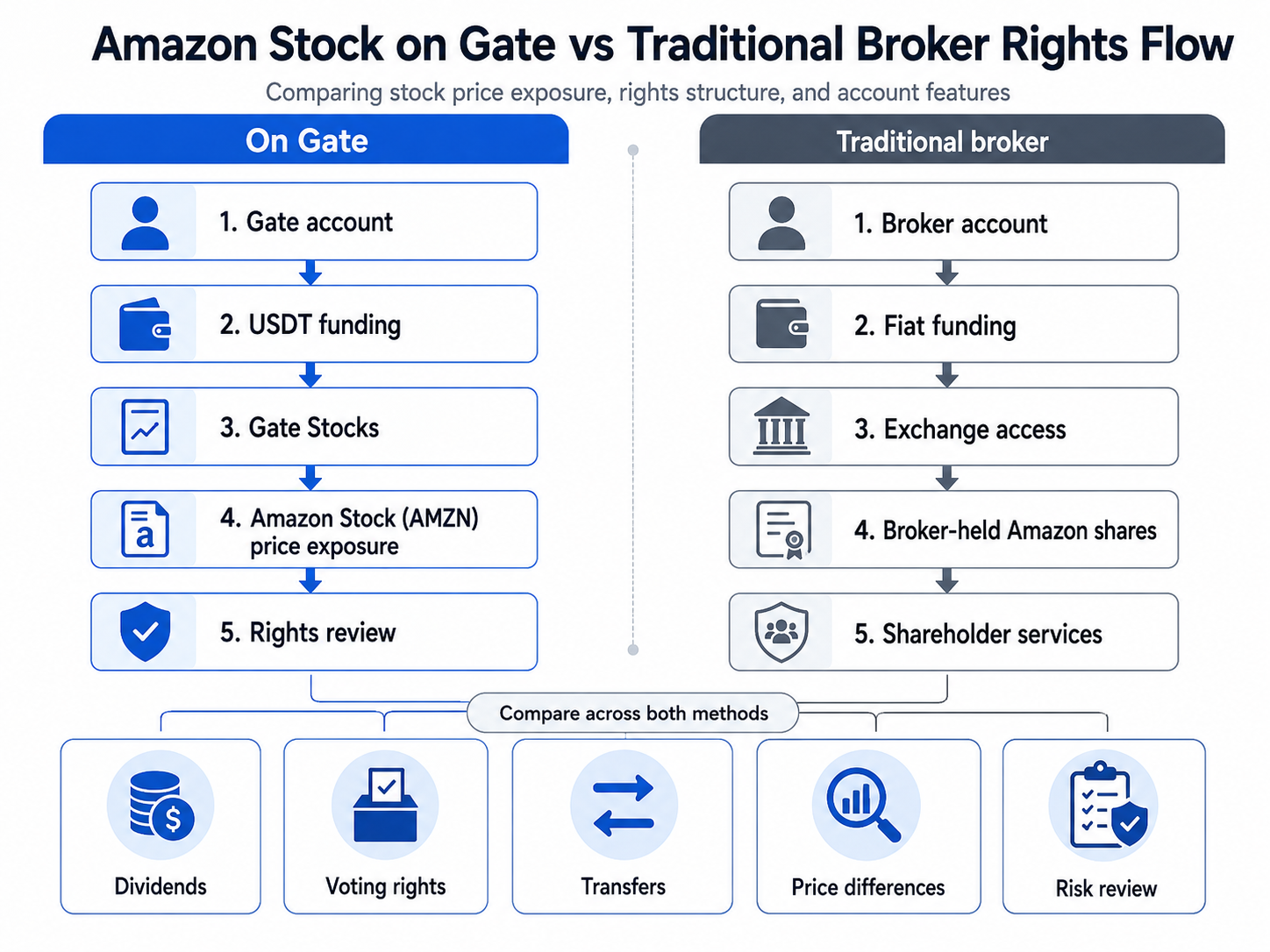
What Is the Key Difference Between Buying Amazon Stock on Gate and Buying It Through a Traditional Broker?
The key difference between buying Amazon Stock on Gate and buying it through a traditional broker is the access structure. Gate Stocks gives eligible users a way to access Amazon Stock (AMZN) through a Gate account and USDT-based stock trading flow. A traditional broker usually requires a separate brokerage account, fiat funding, securities settlement, and broker-specific reporting.
Through Gate Stocks, the user experience is designed around a crypto-native account environment. Users may transfer USDT into a stock account, search for Amazon Stock (AMZN), review order details, and place an order through Gate Stocks, subject to eligibility, supported assets, product rules, and the latest information shown in the Gate interface as of June 2026. The related buy Amazon Stock with USDT on Gate tutorial covers the operational flow, including account preparation, USDT funding, asset search, order review, and risk checks.
A traditional broker follows a different model. Users usually open a securities account, deposit fiat currency or settle in U.S. dollars, and buy Amazon Stock through broker access to securities markets. Brokers may also provide formal securities statements, tax forms, corporate action notices, transfer services, voting services, and other account-level tools depending on jurisdiction and broker rules.
Before comparing the two routes, users should prepare the basic checks below.
| Preparation Point |
What to Check for Amazon Stock (AMZN) |
Why It Matters |
| Stock name and ticker |
Amazon Stock (AMZN) |
Confirms the correct U.S. stock product |
| Product type |
Gate Stocks price exposure |
Clarifies the product structure before trading |
| Settlement asset |
USDT, if using the Gate Stocks flow |
Shows how funding and settlement may differ from fiat brokerage |
| Dividend rule verification |
Check current Gate Stocks rules as of June 2026 |
Dividend treatment may differ from direct broker-held shares |
| Voting rights verification |
Check current Gate Stocks rights rules as of June 2026 |
Voting participation may not match traditional shareholding |
| Transfer rule verification |
Check whether external broker transfer is supported as of June 2026 |
Positions should not be assumed transferable |
| Regional eligibility |
Confirm account and location eligibility |
Product access may vary by jurisdiction |
| Risk review |
Market, liquidity, USDT, product, and platform risks |
Helps users review exposure before order confirmation |
These preparation points matter because the practical differences are not limited to the buy button. Account eligibility, settlement currency, rights treatment, dividend handling, order execution, and transfer rules may all affect how a user experiences Amazon Stock (AMZN) exposure through Gate Stocks.
How Are Dividends Handled for Users Holding Amazon Stock on Gate?
Dividend handling for Amazon Stock on Gate should be verified from Gate’s latest official product rules before trading as of June 2026. In a traditional brokerage account, dividend handling usually depends on direct or nominee-held share arrangements, broker procedures, tax withholding rules, and corporate action processing. In Gate Stocks, dividend treatment may follow the product structure and current Gate Stocks rules rather than the exact process used by a traditional broker.
This distinction is important because dividend rights and shareholder-related benefits are not always identical across stock access models. Some stock access structures may provide economic benefits related to holdings, while others may not provide the same corporate action experience that users expect from a direct brokerage account. Users should not assume that dividend treatment, timing, currency, withholding process, display method, or reinvestment options will match a broker unless the latest product rules clearly state so.
For Amazon Stock (AMZN), the dividend issue is also practical because users need to understand what happens if a corporate action occurs. Even if the user’s main purpose is price exposure, rights-related details still matter for recordkeeping, long-term holding decisions, and comparison with traditional shareholding. The broader distinction between economic rights and shareholder rights is useful here because stock exposure can include price participation while still having rights conditions that require separate review.
As of June 2026, the safe approach is to check dividend-related rules inside the current Gate Stocks documentation and order interface before buying Amazon Stock on Gate. Users should review whether dividends are supported, how any supported dividend event may be handled, whether any deductions or tax treatment may apply, and whether the treatment differs from broker-held Amazon shares.
Do Users Holding Amazon Stock on Gate Have Shareholder Voting Rights?
Users holding Amazon Stock on Gate should not assume that voting rights are the same as holding Amazon shares directly through a traditional broker. Voting rights may depend on Gate Stocks product rules, custody arrangements, service provider structure, eligibility, corporate action support, and the latest rights framework as of June 2026. The correct approach is to verify the current product rules before trading.
Traditional brokers may offer voting access when users hold eligible shares through a brokerage account, although the exact process can still vary. Some brokers send proxy materials, allow online voting, or provide corporate action instructions through their account system. Even in the brokerage world, voting access can depend on account type, shareholding structure, location, record date, and broker support.
Gate Stocks should be assessed through its own rights structure. If the current rules do not clearly grant direct shareholder voting participation, users should treat voting as different from traditional broker-held shares. This is especially relevant for users who care about shareholder governance, annual meeting participation, proxy voting, or formal investor rights beyond price exposure.
The difference does not mean users cannot access Amazon Stock (AMZN) price movements through Gate Stocks. It means the user should separate price exposure from shareholder governance. Buying Amazon Stock on Gate may be suitable for users focused on price exposure through a crypto-native account flow, while traditional brokers may be more suitable for users who specifically require voting participation, formal corporate action control, or direct securities account services.
Why May Gate’s Amazon Stock Price Differ from the Exchange Price?
Gate’s Amazon Stock price may differ from the exchange price because the user is interacting with a product flow, order book conditions, reference pricing, liquidity, execution timing, spreads, and market access rules that may not match the visible price on a traditional exchange screen at every moment. A difference in displayed or executed price should not automatically be interpreted as manipulation or arbitrage. It can arise from how pricing, routing, timing, liquidity, and order confirmation work.
In a traditional broker workflow, the user may see exchange quotes, broker quotes, delayed quotes, real-time quotes, or venue-specific prices depending on the account and data subscription. On Gate Stocks, users should review the order page, estimated cost, available liquidity, price display, trading session, order type, and confirmation details before submitting an order. Final execution can differ from a preview, especially if the order type, market movement, or liquidity conditions change.
Spreads also matter. The buy price and sell price may not be identical, and wider spreads can affect the final result, especially during fast market conditions or periods of lower liquidity. Trading hours and reference pricing may also matter because U.S. stock markets follow their own sessions, while crypto users may be accustomed to 24-hour markets. As of June 2026, users should check the current Gate Stocks trading rules and Amazon Stock (AMZN) order page before placing any order.
The difference between Gate Stocks, traditional brokers, and stock CFDs also matters because each structure may handle pricing, leverage, rights, and settlement differently. Gate Stocks should be evaluated as Gate Stocks, not as a CFD, not as a tokenized stock, and not as a fully identical traditional brokerage account.
Can Users Transfer Amazon Stock from Gate to Another Broker?
Users should not assume that Amazon Stock positions held through Gate Stocks can be transferred to an external brokerage account unless Gate’s official product rules clearly support such transfers as of June 2026. Transferability is one of the most important differences between buying Amazon Stock on Gate and buying Amazon Stock through a traditional broker.
In a traditional brokerage account, users may sometimes transfer eligible securities from one broker to another through supported transfer systems, although the exact availability depends on broker rules, account type, jurisdiction, asset eligibility, fees, and transfer procedures. This is part of the broader securities account infrastructure that many long-term stock investors expect when using conventional broker services.
Gate Stocks may not operate in the same way from the user’s perspective. Even when users receive Amazon Stock (AMZN) price exposure through Gate Stocks, external transfer rules may be different from direct broker-held shares. If transfer support is not clearly stated in the current product documentation, users should treat the position as managed within the Gate Stocks environment rather than as a share position that can automatically move to another broker.
This matters for users who want long-term custody flexibility, consolidated broker statements, cross-broker portfolio migration, or direct securities account control. Buying Amazon Stock on Gate may fit users who want access through a USDT-based Gate account flow, while a traditional broker may fit users who need formal transfer pathways and direct brokerage infrastructure. The practical rule is simple: check the latest transfer and product rules before trading, not after the position has already been opened.
When Is Buying Amazon Stock on Gate More Suitable, and When Is a Traditional Broker More Suitable?
Buying Amazon Stock on Gate may be more suitable for eligible users who already hold USDT, want Amazon Stock (AMZN) price exposure through Gate Stocks, prefer a crypto-native account environment, and want to reduce the number of operational steps between a digital asset balance and supported U.S. stock exposure. The broader process for buying U.S. stocks with USDT on Gate follows this logic: fund with USDT, access supported stock products, review details, and confirm only after checking product rules.
A traditional broker may be more suitable for users who need a full securities account, direct exchange-based share custody, formal brokerage statements, tax documents, voting participation, broader market tools, research services, margin services where allowed, and standard securities transfer options. Users who need direct shareholder services may find the broker route more aligned with those needs, depending on the broker and jurisdiction.
The comparison below summarizes the main differences.
| Dimension |
Buying Amazon Stock on Gate |
Buying Amazon Stock Through a Traditional Broker |
| Access method |
Gate account and Gate Stocks access, subject to eligibility |
Separate brokerage account |
| Funding route |
USDT-based stock account flow, if supported |
Fiat deposit, bank transfer, or broker-supported funding |
| Price exposure |
Amazon Stock (AMZN) price exposure through Gate Stocks |
Direct brokerage-based market access |
| Settlement asset |
Usually USDT in the Gate Stocks flow as of June 2026 |
Usually fiat or U.S. dollar settlement |
| Dividend handling |
Check Gate Stocks rules as of June 2026 |
Broker and market rules usually apply |
| Voting rights |
May differ from direct shareholding |
May be supported depending on broker and account type |
| Transfer options |
Do not assume external broker transfer unless clearly supported |
Broker-to-broker transfers may be available for eligible shares |
| Trading hours and execution |
Check Gate Stocks order page and current rules |
Depends on broker, venue, and market session |
| Reporting |
Gate account records and stock product records |
Brokerage statements and tax forms may be available |
| Product-rule dependency |
High, users must review Gate Stocks rules |
Broker rules and securities regulations apply |
The comparison shows that the decision is mainly about user needs. Gate Stocks may fit users focused on USDT-funded access and stock price exposure inside Gate. Traditional brokers may fit users who prioritize direct securities infrastructure, formal shareholder services, and transfer flexibility.
What Risks Should Users Understand Before Buying Amazon Stock on Gate?
Buying Amazon Stock on Gate involves market risk. Amazon Stock (AMZN) can rise or fall because of company earnings, business performance, cloud computing demand, retail conditions, advertising trends, interest rates, technology sector sentiment, regulatory issues, and broader equity market conditions. Price exposure does not remove the possibility of loss.
Stock-specific risk also matters. Amazon’s business includes several major segments, and each can face competition, margin pressure, regulation, operational costs, or changing customer demand. A user who buys Amazon Stock on Gate still faces the economic impact of Amazon Stock (AMZN) price movements, even if the account structure differs from a traditional broker.
Product-structure risk is central to this topic. Gate Stocks has its own product rules, settlement process, rights structure, order process, and eligibility conditions. Dividend handling, voting rights, transfer options, fees, minimum order requirements, supported order types, and trading access may change or may differ from broker-held shares as of June 2026.
Liquidity and price difference risk should also be reviewed. Available liquidity, spreads, execution timing, reference prices, market sessions, and order type can affect the final trade. Users should always review the order confirmation page before submitting an order.
Platform risk and regulatory eligibility risk also apply. Access to Gate Stocks may depend on account verification, region, product availability, and changing rules. If USDT is used, users should also consider stablecoin-related risk, including transfer network risk, stablecoin market risk, and operational mistakes during deposits or internal transfers. The relationship between crypto assets and traditional market products can also be seen in other asset-access models, such as using crypto assets to access gold, silver, and oil markets, where product structure and risk review remain important.
Summary
Buying Amazon Stock on Gate and buying Amazon Stock through a traditional broker both give users a way to participate in Amazon Stock (AMZN) price movements, but they are not the same experience. Gate Stocks uses a Gate account flow and USDT-based settlement model, while traditional brokers usually provide direct securities account access, fiat settlement, broker statements, and broader shareholder service infrastructure.
The most important differences are price exposure structure, dividend handling, voting rights, transfer options, reporting, eligibility, and product-rule dependency. Users should check Gate’s latest product terms, order page, fee display, regional availability, dividend rules, voting rules, and transfer rules as of June 2026 before trading.
Buying Amazon Stock on Gate may fit eligible users who already hold USDT and want a crypto-native route to Amazon Stock (AMZN) exposure. A traditional broker may fit users who need formal securities account tools, voting participation, transfer options, and direct brokerage services.
FAQs
Is the Amazon Stock bought on Gate a real stock?
Amazon Stock bought on Gate should be understood through the current Gate Stocks product structure and rules as of June 2026. Users receive Amazon Stock (AMZN) price exposure through Gate Stocks, but rights, transfer options, voting access, and dividend handling may differ from a traditional brokerage account.
Can I hold Amazon Stock on Gate for the long term?
Amazon Stock on Gate may be held according to Gate Stocks product rules, account eligibility, and supported position management rules as of June 2026. Users considering long-term holding should review dividend treatment, corporate actions, transfer rules, reporting, platform risk, and regional eligibility before relying on the product for extended exposure.
Do I receive dividends when holding Amazon Stock on Gate?
Amazon Stock on Gate dividend handling should be verified from Gate’s latest official product rules as of June 2026. Users should not assume that dividend timing, deductions, currency treatment, or corporate action processing will be identical to holding Amazon shares through a traditional broker.
Do I get voting rights when buying Amazon Stock on Gate?
Buying Amazon Stock on Gate may not provide the same voting rights as holding Amazon shares directly through a traditional broker. Users who need shareholder voting participation should check Gate’s latest rights structure and compare it with broker-held share arrangements before trading.
Can I transfer my Amazon Stock position from Gate to another broker?
Amazon Stock positions on Gate should not be assumed transferable to another broker unless Gate’s official product rules clearly support external brokerage transfers as of June 2026. Users who require transfer flexibility may need to compare Gate Stocks with a traditional brokerage account before choosing an access route.
What is the main difference between Buy Amazon Stock on Gate and using a broker?
Buy Amazon Stock on Gate focuses on Amazon Stock (AMZN) price exposure through Gate Stocks and a USDT-based account flow. A traditional broker usually focuses on direct securities account access, fiat settlement, brokerage statements, shareholder services, and possible transfer options depending on broker rules.
Stock investing involves market risk, and prices may fluctuate significantly. Please make decisions carefully based on your own risk tolerance.







