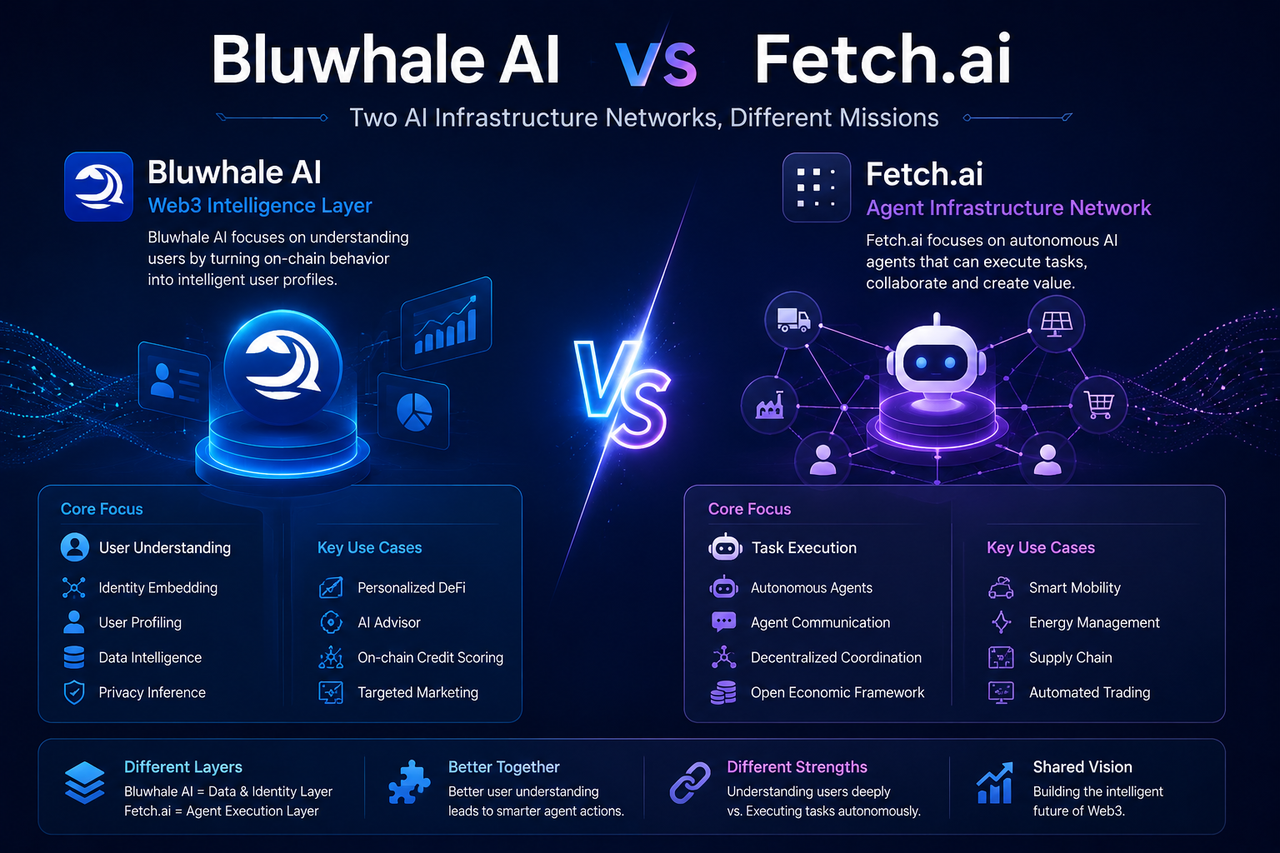
As the AI Agent, digital identity, and on-chain smart applications evolve, AI infrastructure is gradually becoming layered. The data layer helps AI acquire user understanding, while the agent layer helps AI execute tasks. Bluwhale AI and Fetch.ai are the leading projects in these two areas, respectively, which is why they are often compared side by side.
What Is Bluwhale AI?
Bluwhale AI is a Web3 Intelligence Layer designed to help AI systems understand on-chain users.
In the traditional internet, recommendation engines and smart applications rely on platform-accumulated user data to build profiling models. But in Web3, user actions are scattered across different blockchains and apps, making it hard for AI to form a unified picture.
Bluwhale AI uses Identity Embedding, behavioral analysis, and privacy-preserving computation to turn complex on-chain behaviors into machine-readable identity vectors. This allows AI Agents to grasp user preferences, risk profiles, and engagement patterns. As a result, Bluwhale AI is more of a data intelligence infrastructure than a task-executing AI network.
What Is Fetch.ai?
Fetch.ai is a blockchain network built around autonomous AI Agents. Its goal is to create an open economic network where Agents operate, collaborate, and trade independently. In this network, Agents can take on tasks for users, businesses, or even devices, exchanging resources and making joint decisions with other Agents.
Instead of focusing on user profiling and data comprehension, Fetch.ai prioritizes Agent action. The core question isn't "who is the user?" but "how to get the job done."
How Do the Problems They Solve Differ?
The key difference lies in the problems they address.
Bluwhale AI tackles the cognitive layer. In Web3, AI can see plenty of public data but struggles to understand what kind of user that data represents. Bluwhale AI uses identity embedding and profiling to give AI that user understanding.
Fetch.ai tackles the execution layer. Even if AI knows what the user wants, it still needs a network that can act and collaborate to complete real-world tasks. Fetch.ai provides that Agent execution framework.
From a tech stack angle, Bluwhale AI functions as a data layer helping AI build "understanding," while Fetch.ai serves as an execution layer helping AI gain "action capability."
How Do Their Data Capabilities Compare?
Data capability is one of the most striking differences.
Bluwhale AI's core value is rooted in data intelligence. It continuously analyzes user asset allocation, trading behavior, protocol interactions, and governance activity, using machine learning to generate user profiles. These profiles let AI Agents quickly recognize user identity and behavior patterns.
Fetch.ai also handles data, but its focus isn't building user cognitive models. Data in Fetch.ai primarily supports information exchange and collaborative decisions between Agents. It underpins Agent operations rather than forming a standalone data product.
So while both serve AI, their data priorities are completely different.
How Do Their Technical Architectures Differ?
Their architectures reflect their distinct directions.
Bluwhale AI's framework revolves around data understanding. Key modules include a data validation layer, identity embedding layer, and privacy inference layer. Together, they build a complete user profiling system and ensure data can be accessed by AI while preserving privacy.
Fetch.ai's framework revolves around Agent collaboration. Autonomous Agents in the network cooperate via communication protocols and economic incentives, relying on the underlying blockchain for identity verification and value settlement.
Thus, Bluwhale AI emphasizes data intelligence, while Fetch.ai emphasizes an Agent economic network.
How Do BLUAI and FET Tokens Differ in Role?
Token mechanisms often reveal a protocol's core value driver.
BLUAI is primarily used within the data network. Its value comes from data service calls, network incentives, node operations, and community governance. As more applications integrate Bluwhale AI, BLUAI will facilitate data flow and value exchange.
FET serves the Agent network. It's used for Agent deployment, resource access, service payments, and network governance. Its value is closely tied to Agent activity levels and collaboration density.
So BLUAI reflects the data intelligence ecosystem, while FET reflects the Agent economy ecosystem.
How Do Their Use Cases Differ?
Given their different positions, their use cases also diverge.
Bluwhale AI fits scenarios that require user understanding — such as personalized DeFi services, on-chain credit scoring, smart advisory, and targeted marketing — all of which rely on solid user profiles.
Fetch.ai fits automated execution scenarios — like smart transportation, energy management, supply chain coordination, and algorithmic trading — all of which depend on Agent autonomy and collaboration.
One focuses on understanding users; the other focuses on executing tasks. This distinction defines their different roles in the AI infrastructure stack.
Bluwhale AI vs Fetch.ai: Core Differences at a Glance
| Dimension |
Bluwhale AI |
Fetch.ai |
| Core Positioning |
Web3 Intelligence Layer |
Agent Infrastructure Network |
| Core Goal |
Understand Users |
Execute Tasks |
| Core Product |
User Profiles |
Autonomous Agents |
| Core Technology |
Identity Embedding |
Autonomous Agents |
| Data Capability |
Strong |
Medium |
| Agent Capability |
Supports Agents |
Core Agent Network |
| Source of Value |
Data Intelligence |
Agent Economy |
| Primary Use Cases |
Personalized Services |
Automated Collaboration |
Summary
Bluwhale AI and Fetch.ai are both key building blocks of Web3 AI infrastructure, but they operate at different layers.
Bluwhale AI uses Identity Embedding and user profiles to help AI understand on-chain users — solving the cognition problem. Fetch.ai uses an autonomous Agent network to help AI execute tasks — solving the action problem. Architecturally, Bluwhale AI sits closer to the data layer, while Fetch.ai aligns with the execution layer.
FAQs
Are Bluwhale AI and Fetch.ai in the same track?
Both are in the AI+blockchain space, but they target different areas. Bluwhale AI focuses on data intelligence and user profiling; Fetch.ai focuses on autonomous Agent networks and automated execution.
What is the core difference between Bluwhale AI and Fetch.ai?
The core difference is the problem they solve: Bluwhale AI helps AI understand users (cognitive layer), while Fetch.ai helps AI execute tasks (execution layer).
What is the difference between Identity Embedding and Autonomous Agents?
Identity Embedding builds user identity profiles so AI can understand users. Autonomous Agents execute tasks independently so AI can take action. They belong to different layers of the AI stack.
Can Bluwhale AI run AI Agents?
Bluwhale AI's core strength is data intelligence and identity profiling, not running Agents. Its main role is providing user understanding to AI Agents.
Does Fetch.ai provide user profiling services?
Fetch.ai centers on Agent collaboration and automated execution. User profiling and identity modeling are not its core products, which clearly distinguishes it from Bluwhale AI.