Unlike many traditional token designs, AVV does not carry access rights, membership tiers, or governance functions during its launch phase. Its core logic is a consumption-driven buyback and burn model: revenue from user consumption of AI services flows on-chain according to preset rules and ultimately results in the permanent burning of AVV.
This design tackles a persistent question: if users don't need to hold the token, how can its value be tied to product growth? AIVIVE's answer is to turn consumption behavior into supply changes at the protocol level, making usage integral to the economic cycle.
AVV Token Mechanism
The project adopts a "separate consumption from tokens" design philosophy. Users directly pay with stablecoins on the front end to access AI services, without needing to buy, hold, or manage AVV. The protocol handles value coordination in the background, automatically linking revenue to token supply logic. AVV is a protocol asset built around the AIVIVE Recursive AI Protocol. Its goal is not to function as a payment method but to capture the value feedback generated by protocol operation.
This structure gives users an internet-grade product experience while maintaining on-chain transparency. As platform usage grows, protocol revenue enters a subsequent buyback process, altering AVV's circulating supply.
Compared to the traditional "buy the token first, then use the product" path, AVV is more like a protocol-layer economic asset than a consumption gateway.
Functions of AVV Within the Protocol
AVV's first function is value coordination. The protocol uses AVV to link platform revenue to on-chain economic structure, so consumption behavior doesn't directly affect user operations but can indirectly impact asset supply. This prevents users from bearing token volatility while allowing the protocol to create a self-contained economic cycle.
The second function is network operational support. Since AVV is deployed on the Solana network, its liquidity, supply changes, and burn events are all publicly recorded. The protocol operates long-term through a standard asset structure rather than manual parameter adjustments.
The third function is long-term ecosystem mapping. As more applications emerge, multiple consumer products can theoretically plug into this cycle, making AVV independent of any single application and serving as a unified value carrier at the protocol layer.
How AIVIVE's Buyback and Burn Mechanism Works
AIVIVE's core mechanism is built on a three-phase cycle: user consumption, cross-chain aggregation, and automatic buyback and burn.
Phase one occurs on the user side. Users purchase AI usage credits from the platform and pay with USDC. The revenue doesn't flow directly into the token market; instead, it accumulates in the protocol's treasury pool on the Base network.
Phase two involves cross-chain aggregation. The system periodically checks the pool balance. When preset conditions are met, it completes USDC burning and reminting via a standard cross-chain protocol, transferring funds from Base to Solana. The entire process is publicly verifiable.
Phase three is automatic buyback and burn. Funds arriving on Solana automatically execute asset swaps, purchasing AVV from the market and immediately performing on-chain burns.
This design means the protocol doesn't promise future burns—they happen automatically when conditions are met.
How AVV Connects User Growth to Token Scarcity
AIVIVE aims to establish a "more usage, less supply" relationship.
Traditional token systems typically require users to keep buying assets to support demand. AVV shifts the demand source to product consumption. More users and higher usage frequency mean more protocol revenue, which in theory means more funds flowing into the buyback process.
In this structure, users don't need to understand tokenomics or actively participate in protocol operations. Consumption naturally becomes part of the protocol cycle.
This relationship doesn't guarantee price changes, but it creates a publicly verifiable supply adjustment logic that structurally links protocol growth to asset scarcity.
Over the long term, this design attempts to separate user experience from protocol economics while maintaining value feedback.
Source: aivive.ai
How AVV's Economic Model Is Designed
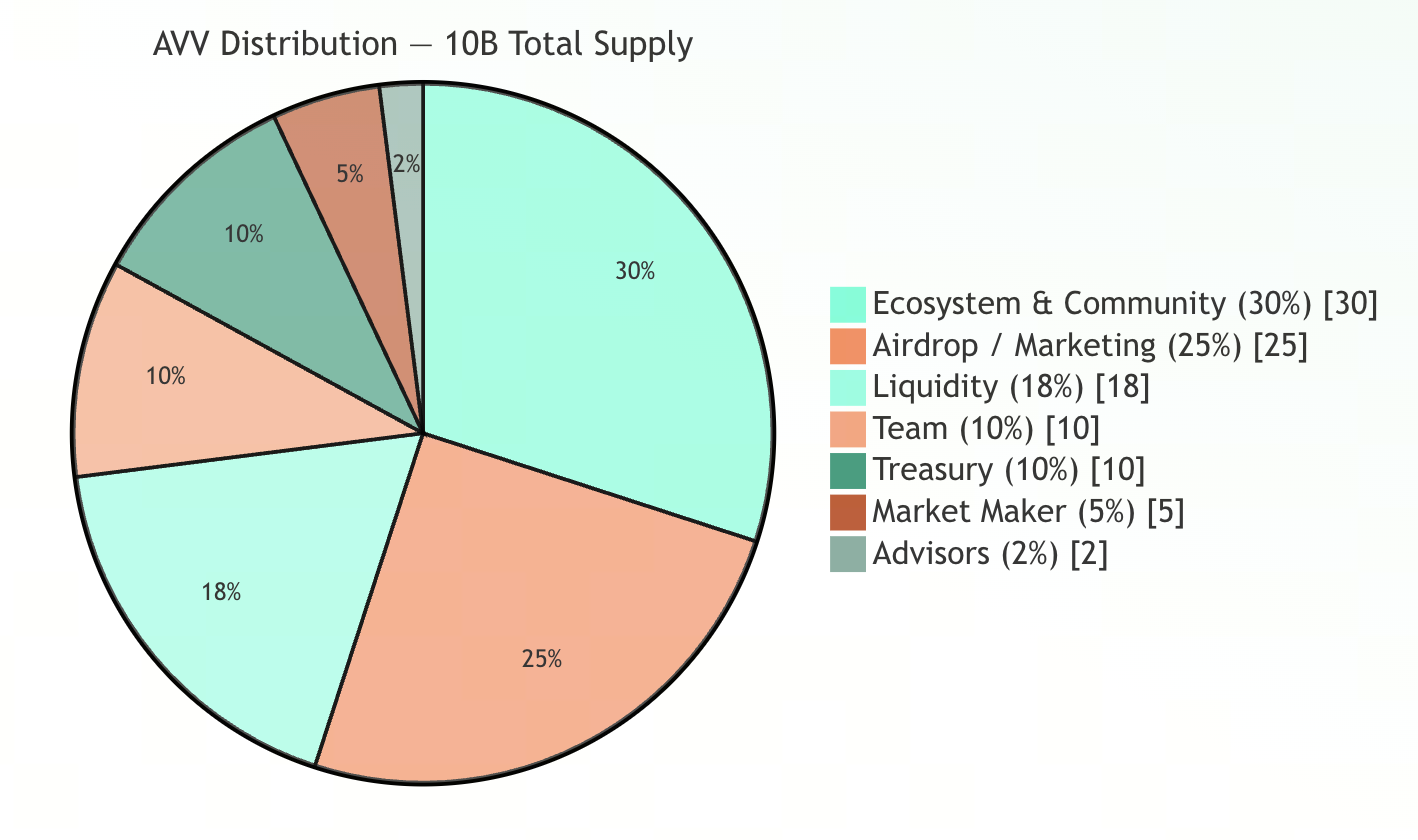
AVV has a total supply of 10 billion tokens, deployed on the Solana SPL standard network.
The protocol uses a fixed supply design. After deployment, no further issuance, pausing, or transfer taxes are possible. This means supply changes come primarily from burns, not new issuance.
| Allocation |
Allocation Percentage |
Quantity (AVV) |
Purpose |
| Team |
10% |
1,000,000,000 |
Core contributors; vesting: 2-month cliff + 10-month linear unlock |
| Liquidity |
18% |
1,800,000,000 |
Providing liquidity on exchanges and DEXs |
| Market Makers |
5% |
500,000,000 |
Operational liquidity for exchange listings |
| Ecosystem & Community Incentives |
30% |
3,000,000,000 |
Creator rewards, partner events, community projects |
| Airdrop / Marketing |
25% |
2,500,000,000 |
Launch airdrop and ongoing distribution activities |
| Treasury / DAO Reserve |
10% |
1,000,000,000 |
Long-term operations; vesting: 2-month cliff + 10-month linear unlock |
| Advisors |
2% |
200,000,000 |
Strategic advisors; vesting: 4-month cliff + 8-month linear unlock |
| Total |
100% |
10,000,000,000 |
- |
In the token allocation, ecosystem and community categories account for a high proportion. Ecosystem incentives make up 30%, and airdrop and marketing account for 25%, totaling 55%. The project aims to drive network growth through community expansion rather than relying on a concentrated token holding structure.
The team portion is 10% and uses an unlock schedule to control release pace. The project also explicitly states that it did not conduct a private sale or use an IDO model, aiming to reduce the risk of early concentrated selling pressure.
AVV's Value Capture Mechanism
AVV's value capture logic is built on a chain of "revenue → buyback → burn."
Traditional platforms typically keep revenue within the company, leaving no direct link between the protocol token and business growth. AIVIVE attempts to create this connection through transparent rules, allowing platform revenue to flow into the protocol's economic cycle.
Since users don't need to hold AVV, the protocol avoids making the token a barrier to entry. Users enjoy a low-friction experience while value changes happen behind the scenes.
The significance of this model lies not in short-term supply and demand but in establishing a long-term verifiable relationship: when real consumption grows, the protocol's supply logic changes accordingly.
Whether this model becomes a sustainable value network in the future depends on product growth rate, consumption scale, and ecosystem expansion.
Summary
AVV is the value anchor within the AIVIVE protocol. Its core function is not payment, governance, or access, but to connect platform revenue with token supply changes through transparent rules.
The project uses a consumption-driven buyback and burn structure, letting users participate in the protocol cycle simply by using the product, without the complexity of holding tokens.
Compared to traditional token models, AVV emphasizes public verifiability, supply coordination, and long-term consumption network building.
FAQ
What is the main role of AVV?
AVV captures the protocol's economic cycle, connecting product growth through revenue-driven buyback and burn.
Do users need to hold AVV to use AIVIVE?
No. Users pay with USDC for services and don't need to hold the token.
Will AVV be continuously issued?
No. AVV has a fixed total supply and cannot be minted after deployment.
How does the buyback and burn work?
When the protocol meets revenue conditions, it automatically purchases and burns AVV via a cross-chain process.
Is AVV a governance token?
It is not a governance token during the launch phase. Its core positioning is a protocol value coordination asset.







