Following the explosion in AI chip demand, the market's focus has pivoted from the chips themselves to an even more upstream link: semiconductor manufacturing equipment.
The logic is simple: as AI models enter the age of high-density computing, chip manufacturing complexity skyrockets, and advanced process nodes demand incredibly precise equipment. Who controls the most advanced manufacturing equipment holds the keys to next-gen chip production capacity. It's in this environment that Jusung Engineering is being repriced as a prime example of a Korean equipment company.
AI's Process Upgrade is Rewriting the Valuation Rules for Semiconductor Equipment
A key law of semiconductors: technology upgrades almost always start on the equipment side before moving to the chips. As AI chips push toward smaller nodes and higher density, traditional ALD (Atomic Layer Deposition) technology is hitting physical and cost limits. The industry is now hunting for new, more efficient, lower-waste pathways.
In this shift, an equipment company's value isn't just about its ability to make things—it's about its power to define how things are made.
That's the real reason behind the major revaluation sweeping the South Korean semiconductor equipment sector.
Jusung Engineering's Technology Path: The Breakthrough from ALD to ALG

Jusung Engineering's core transformation comes from its next-gen technology, ALG (Atomic Layer Growth). Unlike traditional ALD, which simply deposits materials, ALG builds thin-film structures through crystal growth. This improves crystal quality and reduces the need for certain traditional etching steps. This approach is seen as a potential way to boost yields in advanced processes and cut manufacturing costs.
Even more importantly, the company has announced the delivery of the world's first ALG equipment, moving the technology from R&D into commercial validation.
In the semiconductor world, this milestone is often the key trigger for valuation changes.
Why the Recent Price Surge? A Triple Play of Orders, Technology, and Expectations
Recent market action shows Jusung Engineering's stock surging rapidly with high volatility.
According to Korean market data, the stock jumped more than 20–25% in a single day after the ALG equipment news, briefly pushing its market cap to the top tiers of KOSDAQ market cap.
The market logic breaks down into three layers:
- Expectation shifts from tech breakthroughs. The market sees ALG as a potential pathway for next-gen processes.
- Revaluation of order forecasts. Investors are betting on Jusung entering the supply chain of major wafer fabs.
- The AI capex cycle expands. DRAM and advanced process investments are restarting, boosting the entire equipment chain.
However, it's crucial to note that Jusung's financials remain in flux. Revenue and profits haven't kept up with the stock's rally.
Structural Opportunities & Capital Flows in Korea's Semiconductor Equipment Chain
Korea's semiconductor strength goes beyond memory chips—it extends to its equipment and materials ecosystem. Driven by the AI cycle, capital is refocusing on equipment firms because chip fab expansion depends on equipment upgrades, which typically lead the industry cycle. The current structure of Korea's equipment chain is a textbook "expectation-driven rally," where stock prices run ahead of earnings. Jusung Engineering sits right in the middle: a tech breakthrough is here, but profit realization still lags.
How Gate's Korean Stock Trading Opens the Door to Equipment Stocks
With Gate's launch of Korean stock trading, the investment pathway has changed. Previously, accessing the KOSDAQ market required local brokers or complex cross-border accounts. Now, it's available through a unified account system.
The system's key changes include:
- USDT as the unified pricing and settlement asset.
- Integration of US, Hong Kong, and Korean stocks.
- Lower barriers for cross-market allocation.
- Unified asset management.
This brings mid-to-small-cap equipment stocks like Jusung Engineering into the view of global capital.
Trading Jusung Engineering on Gate: A Step-by-Step Path
Operationally, the process is streamlined. Users first complete account registration and identity verification, then transfer USDT from their spot account to their stock account as trading capital.
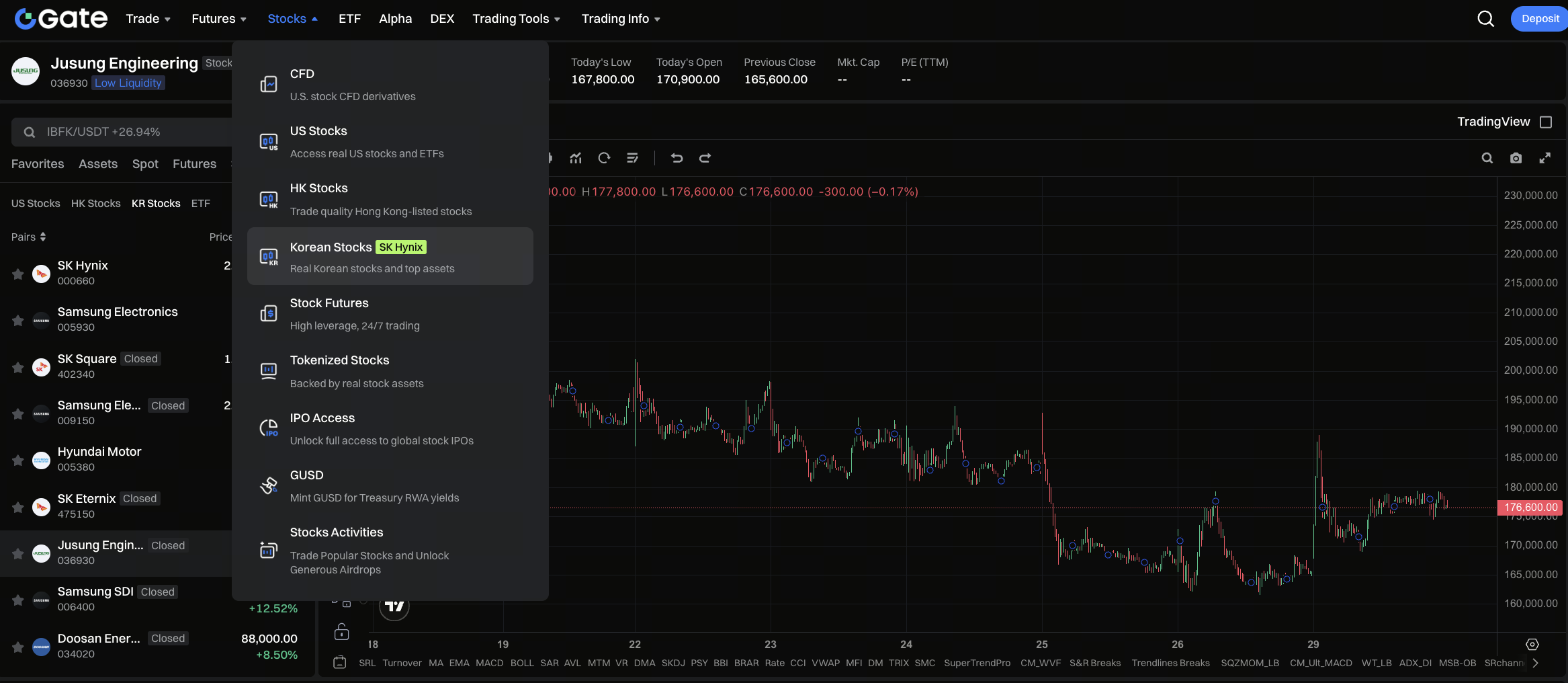
Enter the Korean Stock Trading market, search for Jusung Engineering or code 036930, and you'll find the trading interface. Place orders with market or limit options. Once executed, assets are automatically folded into the unified account system alongside assets from other markets.
The core takeaway: cross-market investing has shifted from being an "account opening problem" to an "asset allocation problem."
Financial Reality vs. Market Expectations: A Classic "Expectation-Driven Asset"
Jusung Engineering's current story is one of "expectations outpacing reality." On one hand, the market is excited about its ALG technology as a potential key player in next-gen process equipment. On the other hand, recent financials remain under pressure, with volatile revenue and unstable profitability.
This structure is common in semiconductor equipment: stocks tend to price in future orders first, not current profits.
Risk Structure: Equipment Cycles Meet Tech Uncertainty
Jusung's main risks come from two directions. First, the equipment industry is cyclical. Semiconductor capex rises and falls sharply; any slowdown in fab expansion can quickly slash equipment orders. Second, ALG's future is uncertain. Whether it becomes a mainstream technology remains to be proven over the long term.
Additionally, mid-to-small-cap equipment stocks face higher liquidity volatility, making prices more sensitive to news.
Conclusion: The Hidden Winner in the AI Process Revolution
Jusung Engineering isn't a short-term thematic play. It's a key equipment player embedded in the AI process upgrade chain. As AI chips push toward ever-higher density, equipment companies are morphing from "supporters" into "path definers."
With Gate integrating KOSDAQ equipment assets into its unified trading system, this formerly hard-to-reach segment of the supply chain is now entering a phase of global capital repricing.
FAQs
-
Q1: What does Jusung Engineering do?
A semiconductor equipment company focusing on ALD, ALG, display, and solar equipment.
-
Q2: What is ALG technology?
A novel crystal growth process technology, seen as a potential upgrade path from ALD.
-
Q3: Why has the stock been so volatile recently?
Driven by ALG tech progress and the AI semiconductor capex cycle.
-
Q4: Do I need a Korean broker to trade on Gate?
No. You can trade KOSDAQ stocks directly through Gate's unified account system.
-
Q5: Is it a growth stock or a cyclical stock?
It's a hybrid: "technology growth + strongly cyclical equipment stock."







