

ShizukaKazu

vip
Age 3.3 Yıl
Peak Tier 5
No content yet
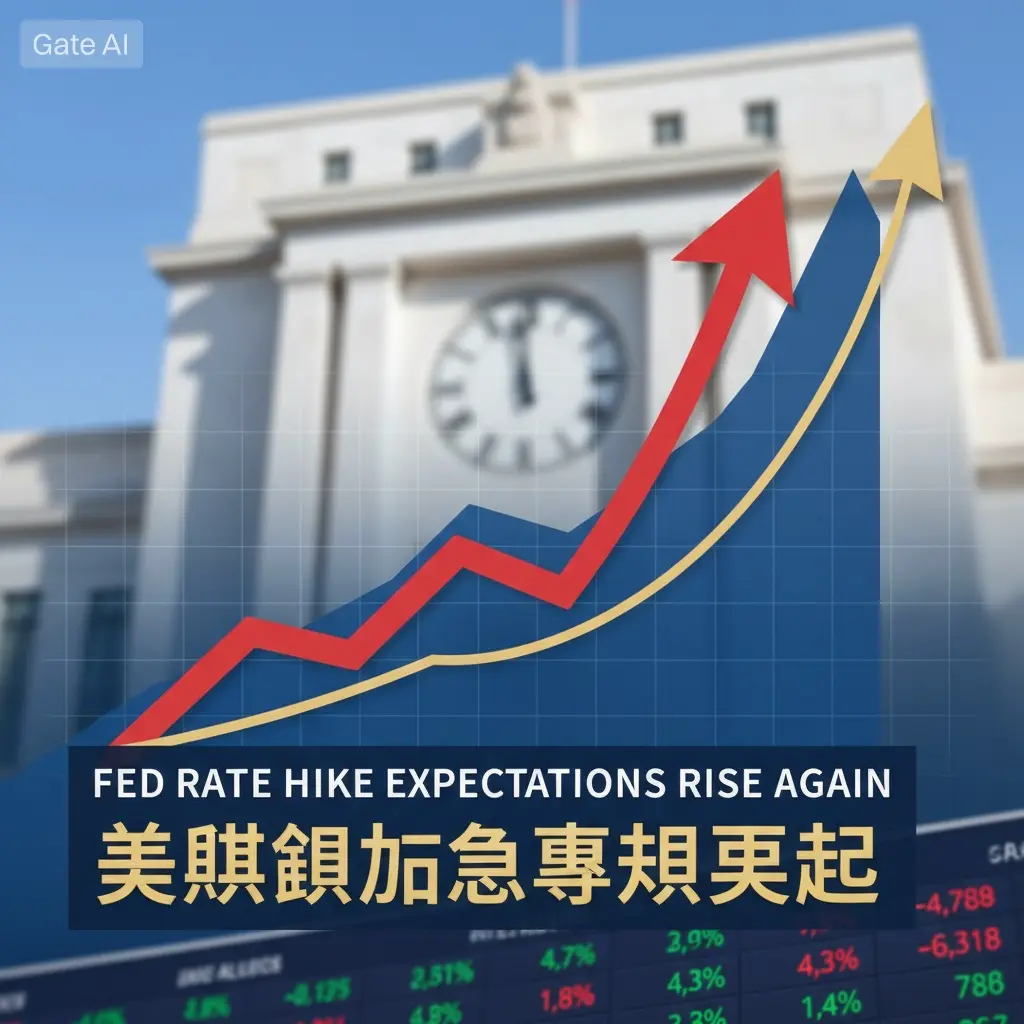
#美联储加息预期再起 The Federal Reserve's rate cut expectations have weakened. Why has the discussion of rate hikes resurfaced?
Recently, discussions about the Federal Reserve's monetary policy direction have heated up again. The previously widely anticipated prospects of rate cuts are experiencing marginal adjustments, and the possibility of rate hikes has re-entered the public eye. This change has sparked broad attention to the outlook for the U.S. economy and the Fed's policy path.
From market performance, the previously downplayed rate hike expectations are gradually returning. Although the latest
View Original
post-image
  • Reward
  • 3
  • Repost
  • Share
xxx40xxxvip:
To The Moon 🌕
View More
11 Minutes After the U.S. Stock Market Crash! Trump Suddenly Changes Tone: Giving Iran an Additional 10 Days
U.S. President Donald Trump stated on the 26th local time that, at Iran's government request, he will delay the "destruction" of Iran's energy facilities by 10 days, extending the deadline to 8:00 PM Eastern Time on April 6 (8:00 AM Beijing Time on April 7). He also added that negotiations are ongoing and progressing "very smoothly."
Observers noted that Trump announced this news 11 minutes after the U.S. stock market closed.
That day, U.S. stocks experienced the worst single-day declin
View Original
post-image
post-image
  • Reward
  • 3
  • Repost
  • Share
xxx40xxxvip:
To The Moon 🌕
View More
#国际油价重拾升势 Goldman Sachs repeatedly issues bullish reports on oil prices, suggesting that a high oil price era may persist long-term
Since March this year, international oil prices have increased by over 30%, exerting a profound impact on the global economic landscape. Recently, Goldman Sachs, an international investment bank, has released multiple reports, based on an assessment of supply disruption risks, further raising oil price expectations and predicting that the high oil price environment may be sustained for the long term.
In the reports, Goldman Sachs pointed out that the upward revisi
View Original
post-image
post-image
[The user has shared his/her trading data. Go to the App to view more.]
  • Reward
  • 16
  • Repost
  • Share
xxx40xxxvip:
To The Moon 🌕
View More
#Gate广场AI测评官 Using OpenClaw for quantitative trading, can it really make money?
Recently, a very popular name has emerged in the quant and crypto circles: OpenClaw. Many people call it the "AI Lobster Trader," and you often see promotions in communities like: "Turn $50 into $3,000 in two days," "Automated quant makes thousands of dollars in a day," "AI finds strategies and places orders automatically." It sounds like an automatic money-printing machine.
But the question is: how effective is OpenClaw for running quantitative trading in reality?
Today, we will clarify this from three perspectiv
View Original
post-image
Ryakpandavip
#Gate广场AI测评官 Using OpenClaw for quantitative trading, can it really make money?
Recently, a very popular name has emerged in the quant and crypto circles: OpenClaw. Many people call it the "AI Lobster Trader," and you often see promotions in communities like: "Turn $50 into $3,000 in two days," "Automated quant makes thousands of dollars in a day," "AI finds strategies and places orders automatically." It sounds like an automatic money-printing machine.
But the question is: how effective is OpenClaw for running quantitative trading in reality?
Today, we will clarify this from three perspectives: technology, actual results, and risks.
1. What exactly is OpenClaw?
First, the conclusion: OpenClaw is not a trading system per se. It is an AI Agent framework.
OpenClaw is an open-source platform for automated intelligent agents that can perform tasks using large models, such as:
- Automatically collecting data, analyzing information, calling APIs, executing scripts, triggering trading actions.
It was first launched by developer Peter Steinberger in 2025 and quickly became popular in the developer community. Simply put: OpenClaw = AI execution system, not = profit-making strategy. Many people confuse these two things.
2. Why is OpenClaw used for quant trading?
The reason is quite simple. Traditional quantitative trading has three parts:
1. Data
2. Strategy
3. Execution
OpenClaw excels at automation of execution. For example, it can: automatically fetch market data, run backtests, optimize parameters, monitor markets, place orders automatically, and even turn the entire process into a pipeline: idea → backtest → simulation → live trading. Some projects even promote: AI can automatically discover strategies and optimize parameters. So many start fantasizing: "AI trades for me, I just collect the profits." But reality is usually not that simple.
3. Actual results: it can run, but not necessarily make money
If you look at real user feedback, you'll notice an interesting phenomenon. OpenClaw can indeed run trades, but the returns vary greatly. Some say: an average monthly return of about 5%. Others suffer losses directly. The reason is simple: it’s not the AI that makes money, but the strategy.
The core of quant trading always boils down to three things: strategy logic, risk control, and market understanding. AI is actually unstable in these areas. If the strategy itself is poor, no matter how intelligent the automation system, it’s useless.
4. What is the true value of OpenClaw?
If you ask professional quant traders, most will give a more rational answer: the most valuable aspect of OpenClaw is its automation engineering capability. For example:
1. Automated research: AI can scan markets daily, analyze news, and detect abnormal volatility.
2. Automated backtesting: strategies can be automatically tested against historical data. Automated monitoring: when the market shows anomalies—volatility, drawdowns, price breakthroughs—the system automatically alerts.
Many engineers believe that the best use of OpenClaw is for research + monitoring + semi-automatic trading, rather than fully automatic order placement.
5. The real conclusion: if you only ask, "How effective is OpenClaw at running quantitative trading?" the answer is simple. It is not a money-making machine. It is more like an automated operation system for quant trading. If you have mature strategies, comprehensive risk controls, and technical skills, it can improve efficiency. But if you just want to "set up AI to automatically make money," the most likely result is: paying tuition fees.
There’s an old saying in the quant industry: automation doesn’t turn bad strategies into good ones. OpenClaw just automates trading. But what truly determines your profitability is never AI, but: your trading logic.

repost-content-media
  • Reward
  • 10
  • Repost
  • Share
xxx40xxxvip:
To The Moon 🌕
View More
#创作者冲榜 BTC drops below the 70,000 mark, ETH plunges sharply, is it time to buy the dip or wait and see?
As of the morning session on March 27, 2026, the crypto market experienced a collective pullback, with mainstream coins diverging in their movements. Bitcoin lost the key psychological level, Ethereum fell even more sharply, and the contract market saw widespread liquidations, with market panic quickly intensifying. Should we seize the opportunity to buy the dip or continue to wait for stabilization? This article provides a comprehensive overview of today's BTC and ETH行情, clarifies the logic
BTC-4,21%
ETH-3,76%
View Original
post-image
post-image
  • Reward
  • 14
  • Repost
  • Share
xxx40xxxvip:
To The Moon 🌕
View More
#美众议院听证会推进证券代币化 Breaking News! U.S. Congress Hearing Calls Out: Tokenized Securities Do Not Require New Regulations, Signaling a Major Turning Point in Crypto Regulation!
Salman Banaei, General Counsel of Plume Network, explicitly stated at the U.S. House Financial Services Committee hearing that tokenized securities should not be considered a completely new asset class, and there is no need to create entirely new regulatory rules or exemptions.
He advocates that regulation should be based on the economic nature and risks of financial products, rather than their technical form, and suggests in
BTC-4,21%
ETH-3,76%
View Original
post-image
post-image
post-image
[The user has shared his/her trading data. Go to the App to view more.]
  • Reward
  • 16
  • Repost
  • Share
discoveryvip:
To The Moon 🌕
View More
#预测市场正在影响BTC走势? The impact of prediction markets on Bitcoin's price movements is a complex and multidimensional question with no absolute consensus currently. However, it can be analyzed from several perspectives:
**Sentiment and Expectation Transmission**
Prediction markets reflect market participants' sentiment and expectations through traders' bets on specific events (such as Bitcoin price movements, macroeconomic policy changes, etc.). For example, if prediction markets show that most people are betting on Bitcoin's decline, this pessimistic sentiment may influence actual buying and selli
BTC-4,21%
View Original
post-image
post-image
[The user has shared his/her trading data. Go to the App to view more.]
  • Reward
  • 19
  • Repost
  • Share
discoveryvip:
To The Moon 🌕
View More
#国际油价下跌 Crude Oil Plummets: Pullback from $97 to $88 Influenced by Geopolitical De-escalation News
Affected by easing geopolitical tensions, international crude oil prices experienced a sharp decline on March 25-26. WTI crude futures fell from above $97 to around $88, a drop exceeding 9%; Brent crude futures also retreated from above $100 to around $93. Is this a short-term pullback in oil prices, or the beginning of a trend reversal? We need to analyze from multiple dimensions.
From a supply and demand fundamentals perspective, the crude oil market remains in a tight balance. Although OPEC+
View Original
post-image
post-image
  • Reward
  • 20
  • Repost
  • Share
Vortex_Kingvip:
2026 GOGOGO 👊
View More
#创作者冲榜 BTC oscillates at high levels with divergence intensifying, gold retreats, market enters directional choice window
BTC continues to operate within the 70K–73K range with multiple failed upside attempts, as the market transitions from uptrend to high-level oscillation phase. Global capital shows signs of fragmentation, with margin weakening in ETF liquidity combined with gold retreat, pushing the market into a directional choice window.
I. Market and Structure
BTC current price: approximately 71000--72,500
Operating range: 70500--72,800
Structure assessment: High-level oscillation conso
BTC-4,21%
XAUT2,5%
View Original
post-image
post-image
post-image
[The user has shared his/her trading data. Go to the App to view more.]
  • Reward
  • 20
  • Repost
  • Share
Vortex_Kingvip:
2026 GOGOGO 👊
View More
#创作者冲榜 Extreme Fear for 46 Days, Yet Bitcoin Still Holding Steady Above $70K—This Signal Is Not Simple
The Fear & Greed Index is only at 15, remaining stuck in the "extreme fear" zone for 46 consecutive days. Yet Bitcoin still remains above $70,000—this disconnect looks quite stark, but it truly reflects the current market state this morning.
Last Friday, BTC quickly rebounded from the panic low of $67,400 back to $71K, and now it’s oscillating within a narrow range between $68,970 and $71,300 to digest the moves. ETH is at $2,161, up 1% over the past 24 hours, and still holding the critical
BTC-4,21%
ETH-3,76%
SOL-4,02%
XRP-2,5%
View Original
post-image
post-image
  • Reward
  • 15
  • Repost
  • Share
Vortex_Kingvip:
To The Moon 🌕
View More
To celebrate the brand's 13th anniversary, Gate partners with the F1 Red Bull Racing Team to host "Racing the Future" outdoor exhibition at Victoria Harbour in Hong Kong from April 18 to 24. The exhibition will showcase the all-new racing car for the 2026 season, driver equipment, and a giant Max Verstappen helmet installation, allowing the public to experience top-tier racing engineering and speed aesthetics up close.
View Original
post-image
post-image
  • Reward
  • 10
  • Repost
  • Share
Vortex_Kingvip:
To The Moon 🌕
View More
#Clarity法案最新草案 Wall Street's guillotine: When the "yield-generating frenzy" of dollar stablecoins gets zeroed out with one click by politicians!
On Wall Street on March 24, 2026, the air was thick with the stench of blood. Just yesterday, those Web3 elites who were still swirling wine glasses in their Manhattan penthouses, celebrating crypto's march toward compliance, were kicked off the balcony by a policy draft that flew in from Washington.
Circle (ticker: CRCL), the stablecoin issuer that championed "absolute compliance," experienced an epic collapse immediately after the stock market open
View Original
post-image
post-image
Ryakpandavip
#Clarity法案最新草案 Wall Street's Guillotine: When the "Yield Frenzy" of Dollar Stablecoins Gets Reset to Zero by Politicians!
On Wall Street on March 24, 2026, the air was thick with the stench of blood. Just yesterday, those Web3 elites still clinking wine glasses in Manhattan penthouses celebrating cryptocurrency's compliance breakthrough were kicked off the terrace by a draft proposal flying in from Washington.
Circle (ticker: CRCL), the flagship "absolutely compliant" dollar stablecoin issuer, experienced an epic collapse upon opening on the U.S. stock market without warning, with its stock price plummeting 19% like a kite with a severed string, not only brutally breaching the 21-day moving average support level but also marking the most devastating single-day decline in the company's history.
In the face of this avalanche, no one could stand aside. As Circle's closest ally and primary distribution channel, crypto's first publicly-traded stock Cb (ticker: COIN) followed suit with a dive of around 9%, instantly breaking below the 50-day lifeline. The culprit behind all this was not a hacker attack, not a code vulnerability, but a newly revised draft bill called the "Digital Asset Market Clarity Act" (Clarity Act).
This text, finalized by Senators Thom Tillis and Angela Alsobrooks in closed-door meetings, used just one casual sentence to precisely sever the main artery of the entire centralized stablecoin industry: a comprehensive ban on any "passive yield" activities targeting stablecoin holders, and killing off any revenue structure that is economically "equivalent to interest." In this magical capital market, you thought you were running a decentralization revolution, but politicians saw it crystal clear—you were just using blockchain as a shell to run unlicensed deposit-taking, traditional banking operations. When the regulatory sickle finally swings down, those financial arbitrage games wrapped in geek jargon instantly reveal their true form.
Unplugging the Money-Printing Machine Called "Toll Fees"
To understand the underlying logic of this crash, you first need to peel away the glossy "tech company" veneer of stablecoin issuers and see how they actually make money. This isn't some unfathomable cyberpunk black magic at all—it's a brutally simple money-printing operation.
Take Circle as an example: USDC currently has a market cap of $78.6 billion. What does that mean? It means $78.6 billion in real, hard cash has been handed over to Circle for free. In the traditional financial world, when you deposit money in a bank, the bank grudgingly has to pay you interest. But in this crypto game called the "toll fee model," Circle takes these hundreds of billions and buys absolutely safe short-term U.S. Treasury bonds, harvesting risk-free hefty returns, while early USDC holders get nothing.
To spin this flywheel faster and get more people willing to convert their money into USDC, Circle and Cb constructed what could be called a genius "profit transmission pipeline." Although the previously passed GENIUS Act explicitly prohibited stablecoin issuers from directly paying interest to users, capital is always smarter than law.
Circle slices out a large portion of the massive returns generated by Treasury reserves and distributes them to Cb, while Cb then returns these funds through various "rewards programs" on its platform in disguised forms to users holding USDC. In analysts' eyes, USDC's yield business contributed nearly 20% of Cb's total revenue. This formed a perfect closed loop: users got deposit-like returns, platforms got massive liquidity, and issuers expanded market share.
But the latest draft of the "Clarity Act" is like a short-tempered perfectionist who directly kicks over this carefully designed profit-sharing table. The draft text explicitly states that not only is directly paying interest prohibited, but any "channel model economically equivalent to interest" must also be totally eliminated. It's like you're toll-collecting at a checkpoint. Previously, police didn't let you collect cash directly, so you had drivers scan a code to buy your overpriced bottled water. Now police tell you that as long as you make drivers pay, no matter what position you use, it all counts as robbery.
Amir Hajian, a digital asset researcher at Keyrock, put it perfectly: this directly drained the core driver of stablecoin adoption. When the money-printing machine's plug is ruthlessly pulled by politicians, Circle's stock price, which had skyrocketed 170% since February, naturally can only crash downward to value reality.
The Old Money's Fear and the Community Banks' Defense War
You might ask why Washington politicians suddenly came down so hard on stablecoin yield mechanisms. Is it really to protect those retail investors who got carried away gambling in crypto casinos?
Don't be naive. In this world, the only force that can make politicians so efficiently reach cross-party consensus is the extreme fear of Old Money in traditional finance. The essence of this legislation is not some normative guidance for technological innovation at all, but a naked-faced battle to defend traditional bank deposits. Over the past two years, traditional banking has had it rough, especially those community banks scattered across American states that rely on absorbing local residents' deposits to issue small and micro loans. When the Federal Reserve maintains a high-interest environment, traditional banks have to be stingy with deposit interest to control funding costs. And simultaneously, USDC in crypto exchanges can easily offer highly attractive "demand deposits rewards" by transmitting reserve returns.
The American Bankers Association's lobby group on Capitol Hill is famous for its iron fist. In their view, if stablecoins are allowed to continue implicitly paying interest, this is no longer crypto's self-entertainment in a niche circle, but blatantly siphoning off deposits from the traditional banking system. Capital is extremely smart—once the public realizes they only need to download a Cb app to get far higher passive returns than their corner community bank, a massive deposit migration becomes inevitable. This would be a devastating blow to the credit capacity and survival foundation of the traditional financial system. Therefore, the compromise result of this draft is extremely precise and vicious.
Legislators made a cut: allow stablecoin rewards based on "transaction activity," but absolutely prohibit passive yields based on "balances." In other words, you can encourage users to spend stablecoins, make transfers, and generate transaction flows like credit card points, but you absolutely cannot let users earn money just by sitting on cash in their accounts. Politicians use the law's boundaries to forcefully push stablecoins back to their original definition—a pure payment tool, not a high-yield deposit account dressed in digital clothes.
This is not just a dimensionality reduction attack on Circle's core business model, but a successful sniper strike by Wall Street's old-guard capital against Silicon Valley's financial upstarts.
Tether's Dark Humor: The "Reverse Compliance" Backstab of an Offshore Pirate
If Circle's stock crash is a tragedy, then something else that happened in the crypto market that day turned this play into an absurd black comedy. Just as Circle, obediently listening, undergoing full Deloitte audits year after year, and desperately kowtowing to American regulators, was being pressed face-first into the ground by its own government's legislation, its biggest rival, the offshore behemoth Tether frequently dancing in regulatory gray zones, dropped a bombshell the same day. Tether, with a market cap of $184 billion and firmly occupying the stablecoin throne, announced that it had hired one of the global "Big Four" accounting firms to conduct its first comprehensive, formal audit of its reserves. This news was absolutely the ultimate psychological blow to Circle.
Since its birth in 2014, Tether has been questioned by countless short-sellers and regulatory departments about its reserves' transparency. Previously, they only provided vague quarterly "proofs," refusing to even give proper audit reports. Leveraging this wild growth, USDT captured the vast majority of global liquidity. Now the plot has reversed. When Circle faces domestic legal constraints because it's too compliant and its revenue model is tightly controlled by American law, Tether, which has already made a fortune in outlaw mode, is using its massive profits to buy a credit endorsement from a top-tier auditing firm.
This is an extremely arrogant dimensionality reduction strike: the compliance barriers you Circle carefully constructed, I Tether can buy with money; and the domestic regulatory grinder you're now facing, I as an offshore issuer don't need to deal with at all. In Wall Street institutions' eyes, this contrast is extremely deadly. If Tether truly passes a complete Big Four audit and whitewashes its long-standing opacity label, its risk rating among institutional investors will drop significantly. On one side, there's USDC constrained by the "Clarity Act," facing legal lawsuits just for giving users a little interest; on the other side, there's USDT about to get top-tier endorsement and completely exempt from America's harsh domestic legislation. How would capital choose? This needs zero seconds of thought.
Tether announcing its audit at this critical moment is absolutely a carefully calculated PR campaign, not only stabbing Circle viciously in the back but flipping off the entire Washington regulatory system with a gleaming middle finger.
The Cruel Narrative: Degradation from "Yield-Bearing Assets" to "Entertainment Tokens"
The panic triggered by the draft continues to spread as its far-reaching restructuring of the entire crypto finance landscape is just beginning. Stablecoins stripped of their passive yield capability are facing a cruel genetic downgrade: they will be forced to degrade from a "yield-bearing asset" with compounding capability into a purely valueless medium with no time value—to put it bluntly, nothing but a pile of cyber entertainment tokens for transaction settlement only. This degradation is a structural blow to the decentralized finance (DeFi) ecosystem. Previously, large amounts of conservative capital were willing to stay on-chain because the underlying stablecoins themselves came with risk-free returns, providing a solid foundation for the entire DeFi lego tower. Once the "Clarity Act" completely blocks centralized issuers' profit transmission paths, those users accustomed to passive earnings will be forced to face two choices: either take on extreme smart contract risks and cascading liquidation risks, throwing stablecoins into those decentralized lending protocols that could collapse anytime to chase meager returns; or simply withdraw money back to the traditional banking system. Either outcome will cause irreversible shrinkage in the overall liquidity of the crypto market.
But capital will never sit idle. As Bitwise's research director Ryan Rasmussen predicted, this market will definitely spawn new workaround monetization schemes. Since you can't directly call it "interest" and can't be economically "equivalent to interest," each platform will definitely force their financial engineers to become literary masters and game designers. We can foresee that future crypto markets will be flooded with extremely complex "loyalty programs," "activity mining," or "ecosystem contribution rewards." Users may no longer earn returns simply because they have money in their accounts, but must complete meaningless clicks, transfers, or interactions on the platform daily to claim their piece of dividends. This is undoubtedly a massive regression and tragedy.
To cope with rigid regulatory language, the entire industry is forced to complicate, distort, and even gamify what were originally efficient and transparent yield distribution mechanisms. Clear Street analysts try to calm the market, arguing the current sell-off is an "shoot first, ask questions later" overreaction, after all Circle still holds 30% of a market destined to expand tenfold. But this cannot hide a cold fact: in the face of absolute regulatory supremacy, crypto's financial innovation remains too fragile to withstand a blow. The moment politicians reach compromise at the oak tables on Capitol Hill, the golden age of stablecoins making effortless money is completely nailed into history's coffin.
repost-content-media
  • Reward
  • 14
  • Repost
  • Share
Vortex_Kingvip:
To The Moon 🌕
View More
#Gate正式接入Polymarket When prediction markets are brought into centralized exchanges (CEX), the chemistry gets interesting. What was originally hardcore gameplay exclusive to Web3 natives is now being directly plugged into trading interfaces that anyone can operate with their eyes closed. Users no longer need to deal with cross-chain hassles, wallet signatures, and other user-hostile steps. The barrier to entry has been slashed to the floor.
Take Gate's integration of Polymarket as an example. This isn't just about adding a menu item. It's turning prediction markets into modular products and th
View Original
post-image
post-image
post-image
  • Reward
  • 13
  • Repost
  • Share
ybaservip:
2026 GOGOGO 👊
View More
#贵金属领涨 Intraday Rally! Iran Situation Takes New Turn! What's the Logic Behind the Gold Surge?
Today (March 25), intraday, as signals of easing tensions in Iran emerged, the US dollar index weakened, and the precious metals market surged significantly. As of press time, spot gold rose over 2%, COMEX gold futures climbed nearly 3%; spot silver rose over 3%, COMEX silver futures jumped over 5%. What will happen to gold prices going forward?
Earlier reports indicated that the US is seeking a one-month ceasefire to conduct negotiations with Iran. On the 24th, US President Trump told media at the W
View Original
post-image
[The user has shared his/her trading data. Go to the App to view more.]
  • Reward
  • 16
  • Repost
  • Share
ybaservip:
To The Moon 🌕
View More
#加密市场回涨 Reversal! Bitcoin Rallies Strongly Back to $71,000, Short Positions Liquidated for $44 Million, Institutional Divergence Escalates
Behind Bitcoin's Approach to $71,000 lies strong market rebound, brutal liquidation waves, and divergent institutional capital deployment.
V-Shaped Reversal, Holding Key Support Levels
Today's high touched $71,100. 24-hour volatility: highest $71,400, lowest $68,923. Intraday volatility was intense with fierce long-short battles. Support and resistance levels were repeatedly tested. Recent rebound from 24-hour low of $68,923 exceeded 2.8%. V-shaped reversa
BTC-4,21%
View Original
post-image
  • Reward
  • 13
  • Repost
  • Share
HighAmbitionvip:
Diamond Hands 💎
View More
🍀 Spring Date with Rewards, Raffle with Gifts! Growth Value Period 1️⃣ 7️⃣ Spring Raffle Extravaganza Begins!
Seize Spring's Good Fortune! 👉 https://www.gate.com/activities/pointprize?now_period=17
🌟 How to Participate?
1️⃣ Enter [Plaza] personal homepage, click the points icon next to your avatar to enter [Community Center]
2️⃣ Earn growth value by completing plaza or hot chat tasks such as posting, commenting, liking, and speaking
🎁 Every 300 points grants 1 raffle draw. Great prizes await you including 10g gold bars, Gate Red Bull gift boxes, VIP experience cards, and more!
Details 👉 h
View Original
  • Reward
  • 14
  • Repost
  • Share
xxx40xxxvip:
To The Moon 🌕
View More
#分享预测赢1000GT Are U.S.-Iran Relations About to Ease? It's Just Another Familiar Repeat of the Same Old Script
The conflict between the U.S., Israel, and Iran has now reached a symbolic turning point.
In recent days, there have been frequent reports of international mediation and secret resumption of U.S.-Iran negotiations, indicating that Iran has actually withstood the first wave of attacks and, through its asymmetric counterstrikes, has gained certain leverage. Especially the move to blockade the Strait of Hormuz, which has not only tied the global economy to the war machine but also subject
View Original
post-image
post-image
[The user has shared his/her trading data. Go to the App to view more.]
  • Reward
  • 16
  • Repost
  • Share
xxx40xxxvip:
To The Moon 🌕
View More
#加密市场回涨 Major Turnaround! Bitcoin Violently Rebounds and Reclaims the 70,000 Mark, Ethereum Surges Nearly 5%, Has the Bull Market Returned After 200,000 People Liquidated?
From breaking below 68,000 dollars to forcefully reclaiming the 70,000 level, Bitcoin took just one day! On March 24, the crypto market welcomed a long-awaited broad rally, with Bitcoin returning above 70,000 dollars and Ethereum briefly approaching 2,200 dollars. Over 170,000 investors were liquidated in the violent swings, with market sentiment quickly recovering from "extreme fear." Is this rebound a flash in the pan, or
BTC-4,21%
ETH-3,76%
SOL-4,02%
DOGE-1,83%
View Original
post-image
post-image
post-image
post-image
[The user has shared his/her trading data. Go to the App to view more.]
  • Reward
  • 17
  • Repost
  • Share
xxx40xxxvip:
To The Moon 🌕
View More
#创作者冲榜 #加密市场回涨 Geopolitical Easing Drives Rally, but Structural Risks in Crypto Market Remain Unresolved——In-Depth Analysis and Trading Strategy for Crypto Market on March 24
Driven by Trump's signals of easing US-Iran tensions, global risk assets experienced a correction rally, with Bitcoin rebounding above $70,000, gaining over 5% within 24 hours, while mainstream altcoins like Ethereum rallied in sync. However, liquidations across the network in the past 24 hours still reached $665 million, highlighting the market's inherent high volatility through a pattern of dual liquidations of both lo
BTC-4,21%
ETH-3,76%
View Original
post-image
post-image
post-image
[The user has shared his/her trading data. Go to the App to view more.]
  • Reward
  • 18
  • Repost
  • Share
xxx40xxxvip:
To The Moon 🌕
View More
#创作者冲榜 Global Markets in Shock: Gold Plummets 10%, A-Shares and Hong Kong Stocks Crushed, Only Bitcoin Holds Strong
Recently, global financial markets have been thrown into violent turmoil by an unresolved geopolitical conflict. The US-Iran military standoff has persisted for nearly a month without signs of easing. Iran's blockade of the Strait of Hormuz has strangled over 20% of global crude oil transportation, sending oil prices soaring and rapidly pushing up inflation expectations. The Federal Reserve's rate cut expectations have completely reversed, with calls for rate hikes reemerging. A
BTC-4,21%
View Original
post-image
post-image
[The user has shared his/her trading data. Go to the App to view more.]
  • Reward
  • 31
  • 2
  • Share
xxx40xxxvip:
To The Moon 🌕
View More
  • Pin