BTC_POWER_LA

vip
Age 2.1 Yıl
Peak Tier 0
No content yet
Stability of the power law exponent over time using several methods, regression and scale invariance.
post-image
  • Reward
  • Comment
  • Repost
  • Share
How stable is the exponent of the power law. Very stable. It simply oscillates around an average value.
  • Reward
  • Comment
  • Repost
  • Share
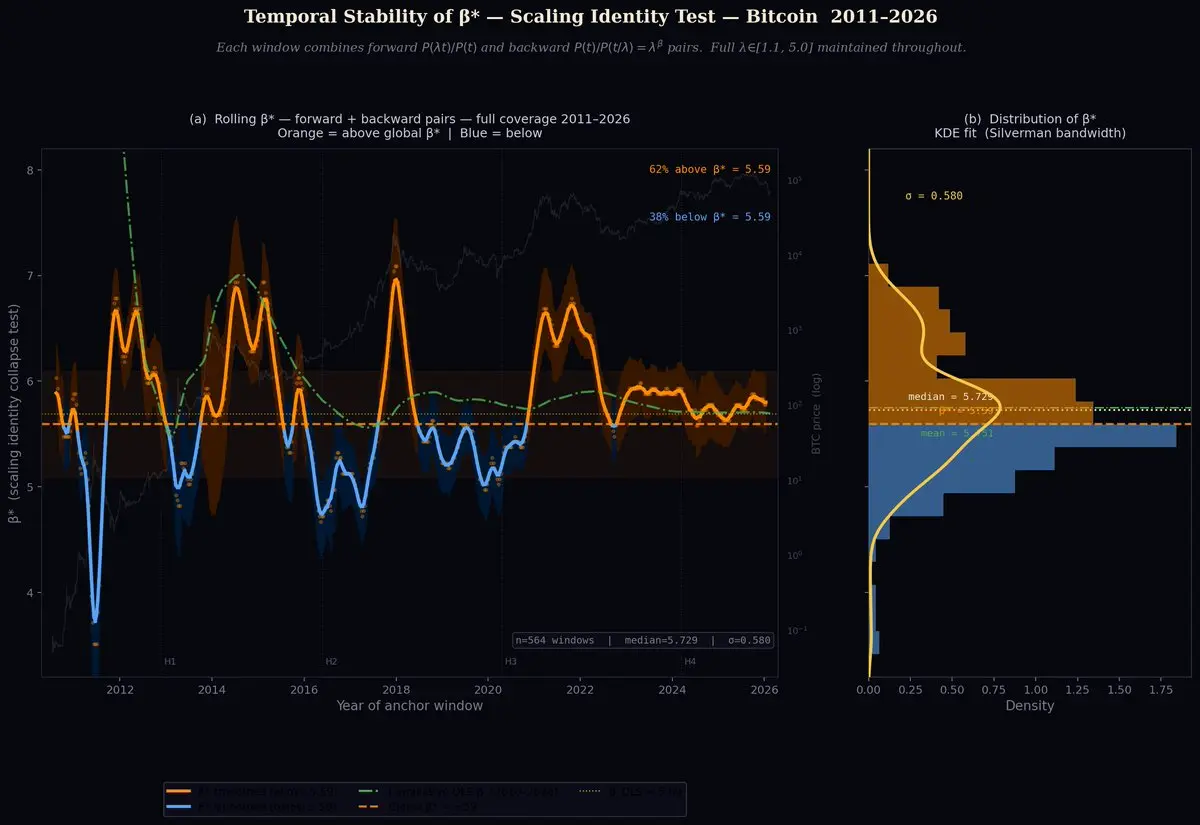
This graph goes even in more depth on how stable Bitcoin dynamical behavior is.
The left panel shows how the scaling equation holds as a function of shifts in times. Theoretically it should be a power law and it is.
It even shows the error bars that are symmetric and relative small given the incredible Bitcoin volatility.
This is how truly measure how stable the Bitcoin power law is.
BTC1,41%
  • Reward
  • Comment
  • Repost
  • Share
I emphasized so much that the power law is not a curve fitting exercise as some pseudo-analysts claim. It is about scaling laws and consistency of behavior of Bitcoin.
What scaling means?
In physics, scaling means that a system looks the same — statistically or structurally — when you zoom in or out by any factor. More precisely, a relationship is scale-invariant if multiplying the independent variable by any constant λ changes the dependent variable by a predictable power of λ, with no preferred scale breaking the symmetry.
Formally: a function f(x) obeys scaling if
f(λx) = λ^β · f(x) for al
BTC1,41%
post-image
  • Reward
  • Comment
  • Repost
  • Share
This is an extension of the scaling test I discussed previously. In this version, we average the deviations along the scaling law and examine how they behave across different time scales. Specifically, we plot the logarithm of returns against the logarithm of the change in time, which can be interpreted as a kind of temporal frequency.
The result is striking: Bitcoin preserves the same statistical behavior across many different time scales. In other words, the system remains self-similar under temporal rescaling. Over more than 16 years of data, Bitcoin’s time dynamics have remained remarkably
BTC1,41%
  • Reward
  • Comment
  • Repost
  • Share
Fantastic commentary by Italian comedian asking what is the real difference between the Iranian theocracy and the American one (to us this is a super weird scene). "The world is in a competition about how has the longest god". Use your imagination what the innuendo is here.
post-image
  • Reward
  • Comment
  • Repost
  • Share
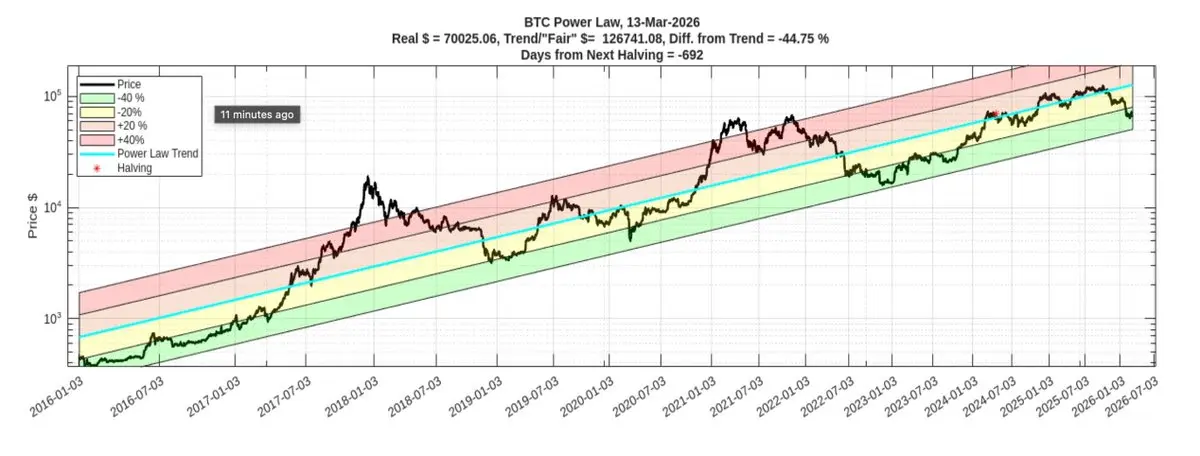
Projections but in a log-log graph.
  • Reward
  • Comment
  • Repost
  • Share
From the Physics of Bitcoin book.
Projections of the power law to the future with market cap milestones.
BTC1,41%
  • Reward
  • Comment
  • Repost
  • Share
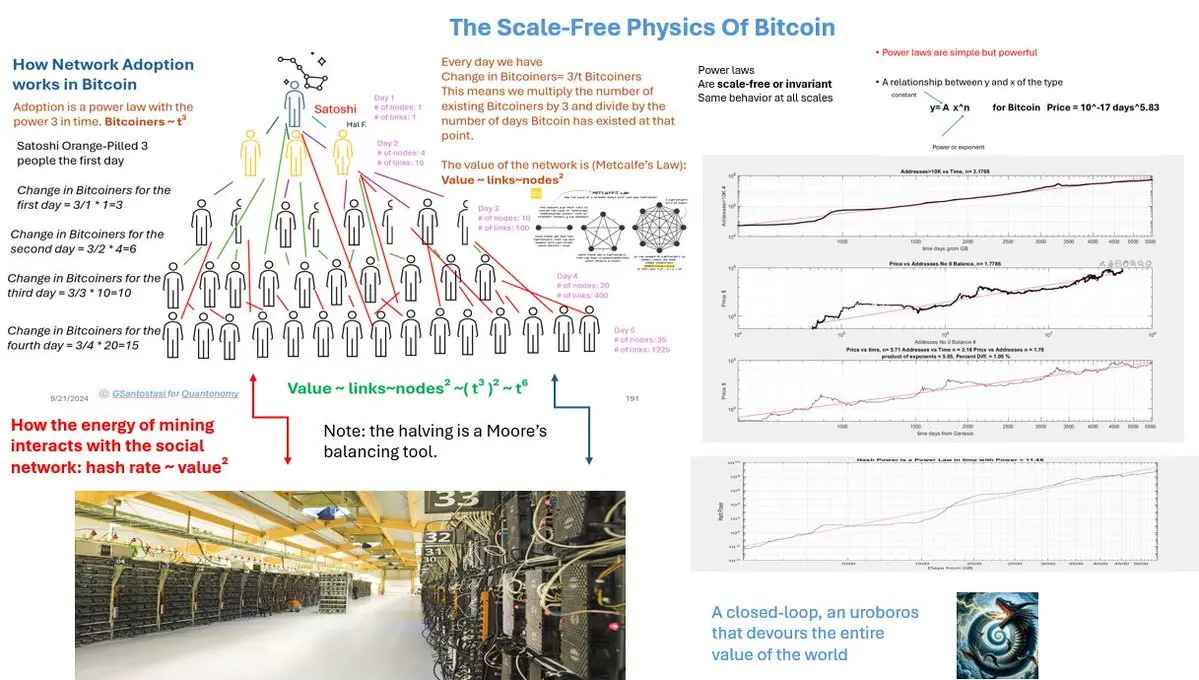
Warning: the graph below looks like a pyramid but we just made a post explaining Bitcoin is not a pyramid scheme. It simply shows how the network grows, that is similar to a curbed exponential.
Power-law adoption is more sustainable than exponential (S-curve) adoption.
What is the difference?
Exponential growth works like this. Imagine a bacterium that doubles every five minutes. You start with one bacterium. After five minutes there are two. After ten minutes there are four, then eight, sixteen, and so on. The key feature of exponential growth is that the growth rate stays constant in time.
BTC1,41%
post-image
  • Reward
  • Comment
  • Repost
  • Share
If there was just a name for the phenomenon of self-confident people on the internet pretending to know what they talk about but not understanding they do not understand enough?
Hmmm...
  • Reward
  • Comment
  • Repost
  • Share
This version of the power law is free online. Link in the comments.
post-image
  • Reward
  • Comment
  • Repost
  • Share
Another power law applies to the recovery rallies after the drawdown.
Size=a duration^0.7.
Rallies are more efficient than drawdowns given the higher exponent.
  • Reward
  • Comment
  • Repost
  • Share
Give me how big the drawdown is and we can predict how long it will last.
I will do this soon with the current one.
  • Reward
  • Comment
  • Repost
  • Share
One more Bitcoin power law.
I measured the drawdown size vs their duration and we have:
size = a · duration^β
where β~0.53.
This is very similar to diffusion processes.
The R^2=0.94.
BTC1,41%
  • Reward
  • Comment
  • Repost
  • Share
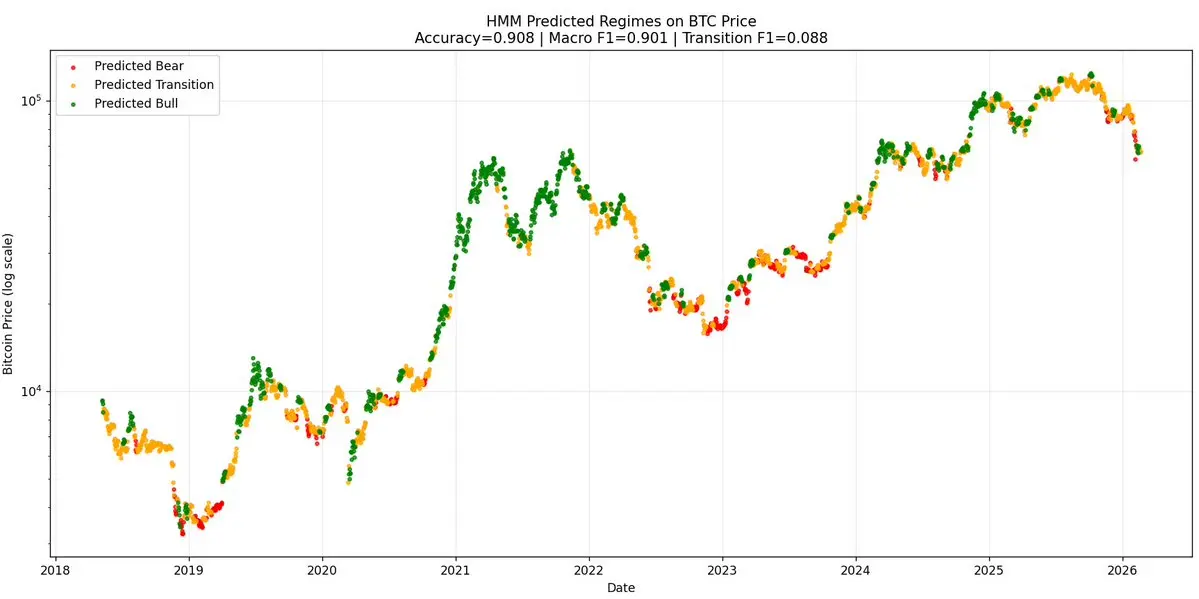
You can build a Hidden Markov Model (HMM) using the slopes of Bitcoin’s growth to identify and predict three regimes: bullish, transition, and bearish. In preliminary tests, this approach can classify the regime with around 90% accuracy.
Below is a link to a Veritasium video that explains how Hidden Markov Models work and why they are powerful tools for prediction problems.
HMMs are widely used in quantitative finance; notably, variations of this technique were reportedly among the methods employed by Jim Simons’ Medallion Fund, one of the most successful trading strategies in history.
BTC1,41%
post-image
  • Reward
  • Comment
  • Repost
  • Share
Bitcoin Live with the Power Law & Minotaur Team, #28 3/12/2026
BTC1,41%
  • Reward
  • Comment
  • Repost
  • Share
It is crazy Claude read the entire 339 pages Physics of Bitcoin book and gave me a full editorial review page by page.
I also asked for fun to write an Amazon type review. This is what it said.
⭐⭐⭐⭐⭐
The book Bitcoin has needed — and didn't know it
Most books about Bitcoin argue for it or against it. This one does something rarer and more interesting: it asks what kind of thing it is. Giovanni Santostasi's answer — that Bitcoin is a self-organized critical system obeying the same mathematical laws as earthquakes, cities, and the sleeping brain — sounds provocative until you see the data. The
BTC1,41%
  • Reward
  • Comment
  • Repost
  • Share
"The Physics of Bitcoin" with Giovanni and Stephen #39 3/11/2026
BTC1,41%
  • Reward
  • Comment
  • Repost
  • Share
Come and visit us at the Physics of Bitcoin show.
Starts in 5 minutes on X, YouTube and Twitch.
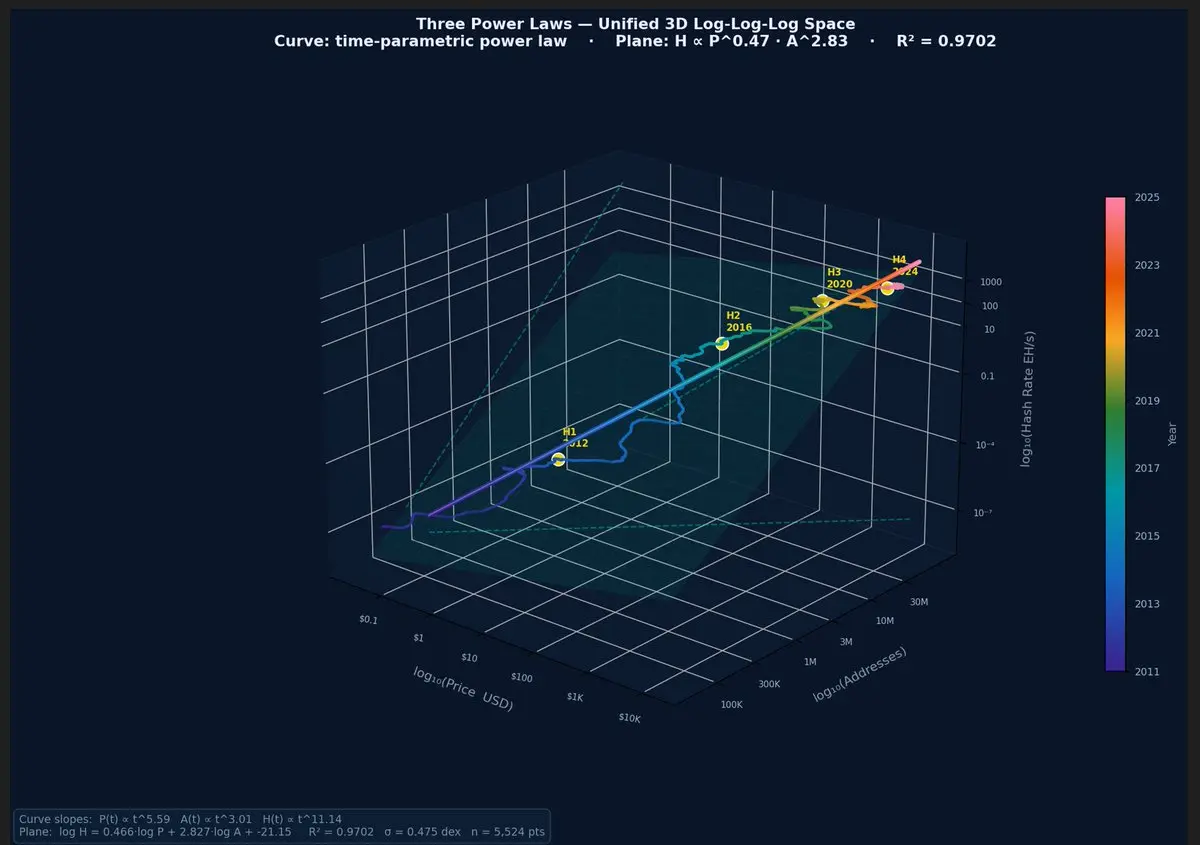
Many things to cover tonight including 3D power law and scaling test.
BTC1,41%
post-image
  • Reward
  • Comment
  • Repost
  • Share
The book covers an ambitious range of territory — from the statistical mechanics of power law scaling to the network physics underlying Bitcoin's adoption curve, from the thermodynamics of proof-of-work to the renormalization group theory that explains why Bitcoin's growth exponents form an integer-ratio family.
If this work proves important, it will not be because of its author. It will be because the subject itself is important — perhaps more important than most people currently realize.
Bitcoin is not merely a financial instrument or a technological curiosity. It is a emergent physical sys
BTC1,41%
  • Reward
  • Comment
  • Repost
  • Share
  • Pin