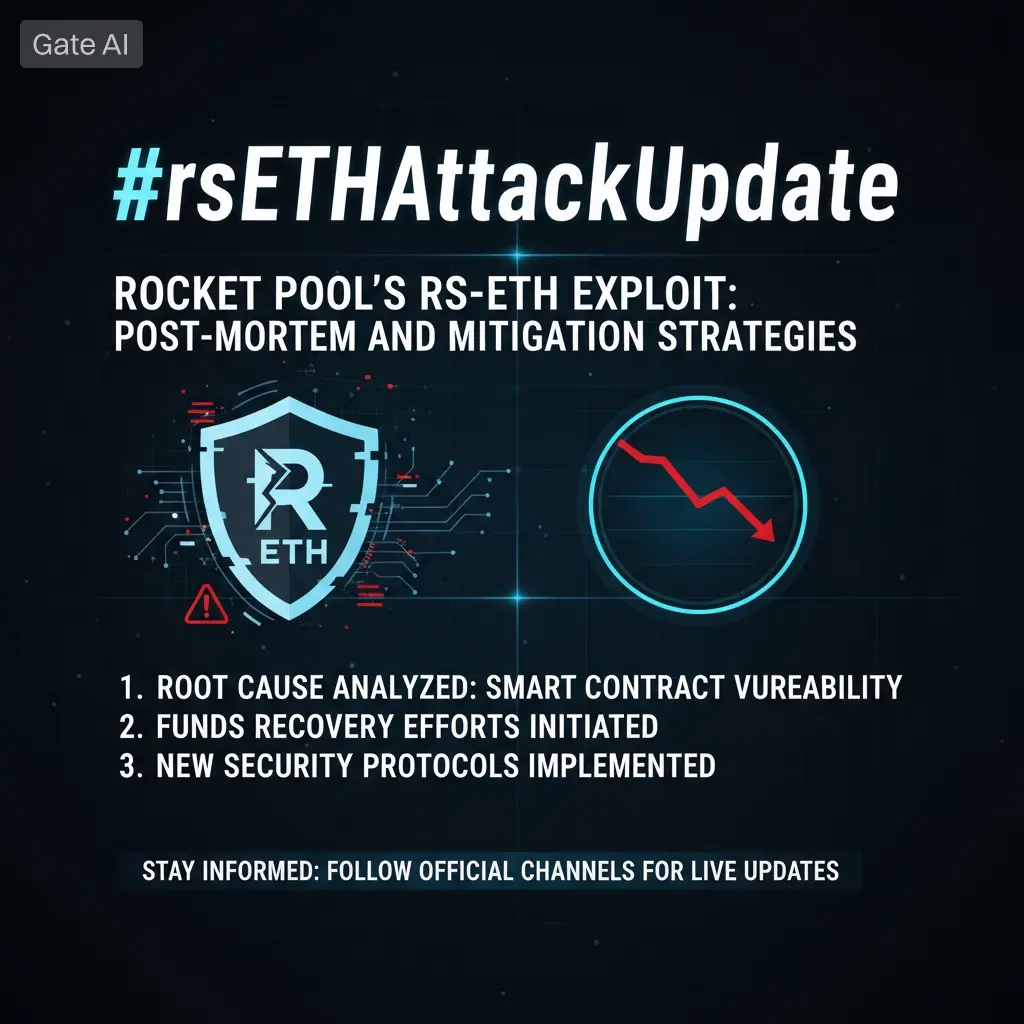
#rsETHAttackUpdate :
The rsETH Attack: A $292M DeFi Shock That Redefined Crypto Security in 2026
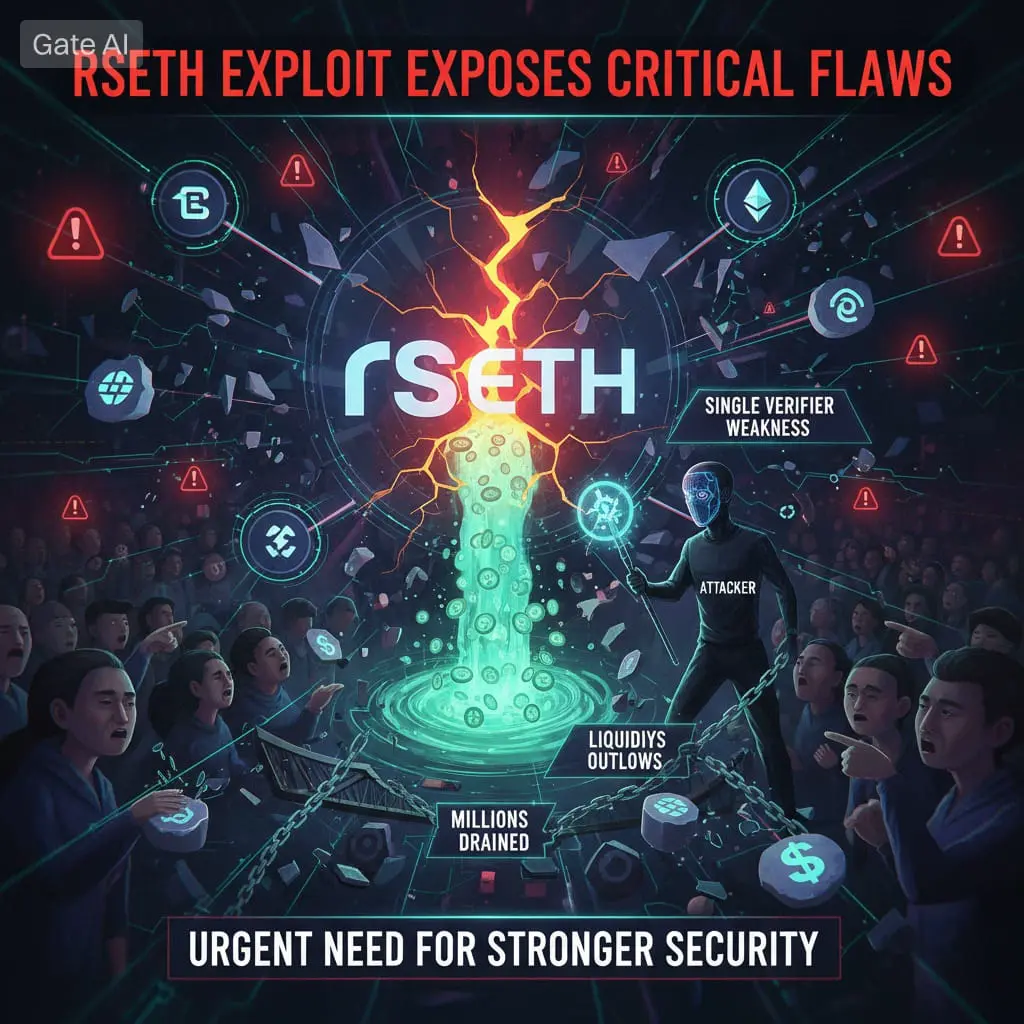
The crypto market was violently shaken on April 18, 2026, when KelpDAO’s rsETH ecosystem suffered a devastating exploit worth approximately $292 million. This was not just another DeFi hack—it became a systemic stress test for the entire decentralized finance ecosystem, exposing structural weaknesses in cross-chain infrastructure, collateral design, and protocol interdependence.
What followed was not only a token collapse—but a liquidity shock, confidence crisis, and a forced global reassessment of DeFi risk models.
🧠 Understanding rsETH and Its Role in DeFi
rsETH is a liquid restaking token issued by KelpDAO, allowing users to stake Ethereum while keeping liquidity active across DeFi platforms.
In simple terms:
Users stake ETH → receive rsETH
rsETH is used in lending, borrowing, and yield strategies
It acts as collateral across multiple DeFi ecosystems
This makes rsETH a systemically important asset in DeFi, meaning any instability affects not just one protocol—but many interconnected markets.
⚠️ How the $292M Exploit Happened
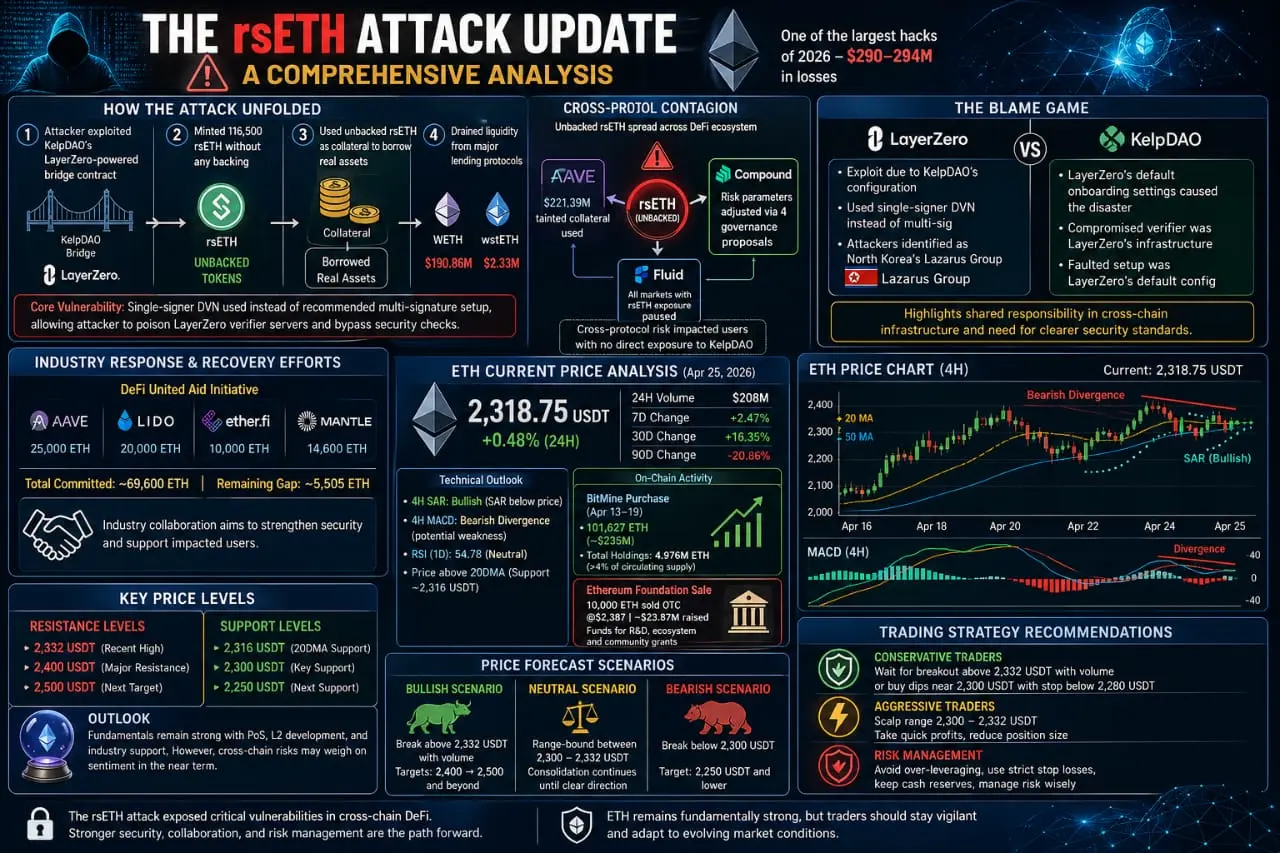
The attack exploited a critical flaw in KelpDAO’s cross-chain verification system, specifically within a LayerZero bridge adapter.
🔴 Core vulnerability:
KelpDAO used a single-verifier DVN (Decentralized Verifier Network) configuration.
Instead of requiring multiple independent confirmations, only one verifier approval was needed to validate cross-chain messages.
That single point of trust became the entry point for attackers.
🧨 Attack Execution Flow
The exploit unfolded in a highly structured sequence:
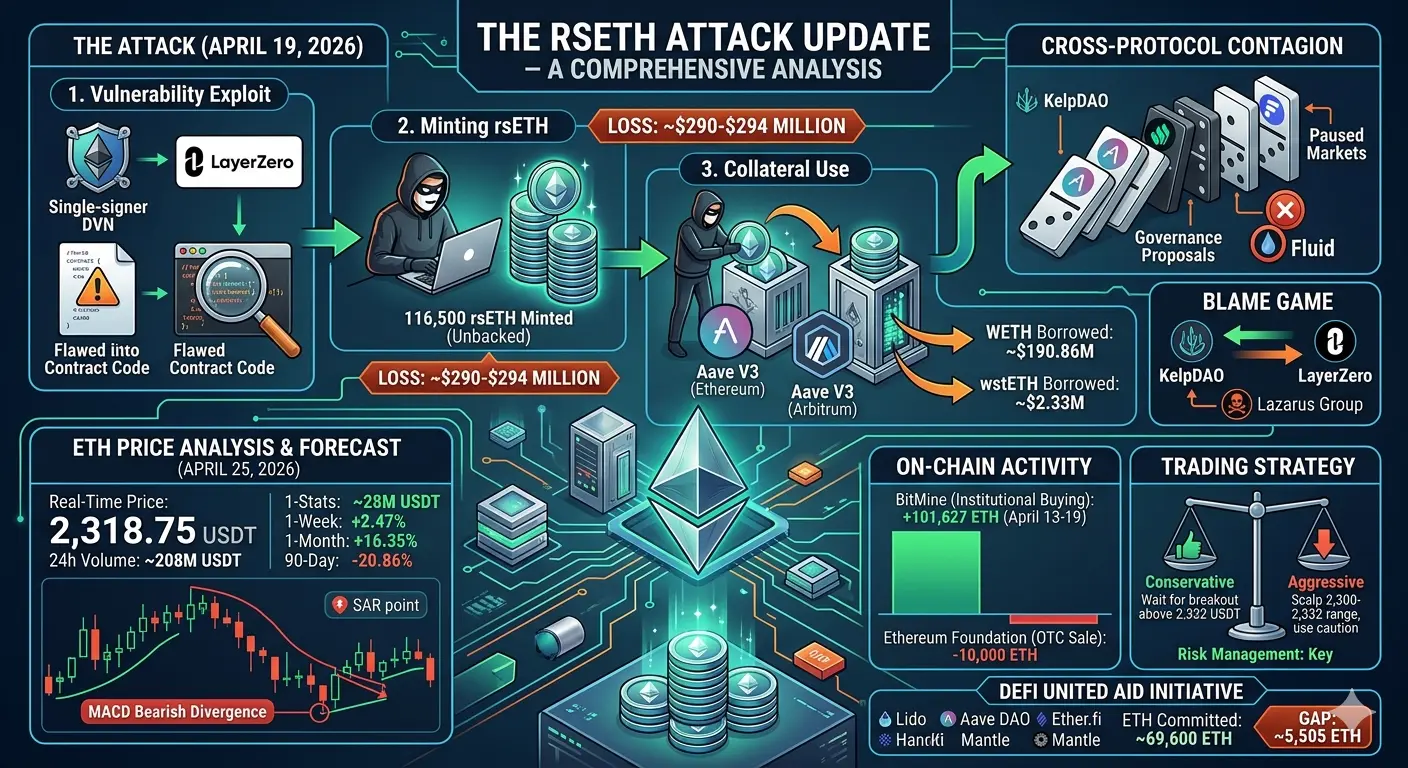
1. Fake Cross-Chain Messages
Attackers injected forged messages into the system, pretending legitimate deposits occurred across chains.
2. Minting Unbacked rsETH
The system incorrectly minted:
~116,500 rsETH tokens
Worth approximately $292 million
With no real ETH backing
3. DeFi Collateral Abuse
The attackers used rsETH as collateral on major lending protocols (including Aave) and borrowed real assets:
~52,834 WETH (Ethereum mainnet)
~29,782 WETH + 821 wstETH (Arbitrum)
4. Extraction of Real Liquidity
This created a massive imbalance between synthetic collateral and real assets, leading to systemic exposure.
📉 Immediate Market Reaction
The impact was instant:
rsETH sharply depegged from ETH
Ethereum experienced short-term pressure
DeFi tokens (especially lending protocols) dropped significantly
Trading volumes surged due to panic repositioning
Ethereum Price Context (Current Market)
At the time of market stabilization:
ETH Price: ~$2,320–$2,380 range
Market remained in a consolidation phase between $2,100–$2,400 zones
Despite the exploit, ETH remained structurally stable because the issue was not Ethereum itself—but a layered DeFi dependency failure.
💣 Systemic Impact: The DeFi Liquidity Shock
The most dangerous outcome was not the hack itself—but the liquidity chain reaction.
Key consequences:
Massive withdrawals from DeFi lending protocols
Sudden liquidity contraction across multiple chains
Collateral reassessment across lending platforms
Risk repricing across all synthetic assets
This resembled a “digital bank-run effect”, where fear spreads faster than technical fixes.
Aave and other lending platforms faced:
Rising bad debt exposure
Emergency asset freezes
Collateral re-evaluation processes
🛡️ Emergency Protocol Responses
🔹 KelpDAO Actions:
Paused rsETH minting and transfers
Suspended cross-chain operations
Began full reserve reconciliation
🔹 Aave Actions:
Froze rsETH collateral markets
Removed borrowing power from rsETH
Initiated risk containment procedures
🔹 Ecosystem Response:
Major DeFi players created emergency liquidity support pools to stabilize rsETH backing and reduce systemic damage.
📊 Ethereum Trading Strategy (Post-Exploit Market Structure)
Despite the chaos, ETH continues to trade within a structured macro range.
🟢 Current ETH Market Zone:
Range: $2,200 – $2,450
Bias: Neutral to slightly bearish consolidation
Volatility: Moderate, event-driven spikes
📈 ETH Trading Strategy (Simplified Institutional Approach)
1. Accumulation Zone Strategy
Range: $2,100 – $2,250
Considered long-term value accumulation zone
Suitable for gradual spot entry
Ideal for DCA (Dollar Cost Averaging)
2. Breakout Strategy
Trigger: Above $2,450
Confirms bullish expansion phase
Targets: $2,600 → $2,800
Momentum continuation likely if volume supports
3. Risk/Downside Strategy
If breakdown below $2,100:
Market enters deeper correction phase
Next support: $1,950–$2,000
Defensive positioning recommended
⚖️ Market Sentiment Shift After rsETH Attack
The event has permanently shifted market psychology:
Before:
High trust in cross-chain composability
Aggressive leverage usage
Strong confidence in synthetic collateral systems
After:
Increased skepticism toward bridged assets
Lower leverage appetite
Strong preference for native collateral (ETH, BTC)
Higher demand for protocol insurance models
🔍 Key Lessons for Crypto Investors
1. Composability is powerful—but fragile
One weak link can destabilize entire systems.
2. Cross-chain bridges remain high-risk infrastructure
Even advanced protocols can fail if verification is centralized.
3. Collateral ≠ safety
Synthetic assets require deeper risk analysis than native assets.
4. DeFi is now entering “risk maturity phase”
Security will matter more than speed or innovation.
📌 Final Outlook
The rsETH exploit is more than a hack—it is a defining moment for DeFi evolution.
While the immediate damage was severe, the long-term outcome may actually strengthen the ecosystem through:
Better bridge security standards
Improved collateral frameworks
Stronger risk management systems
More realistic leverage controls
Ethereum and DeFi markets have survived this shock—but the rules of the game are changing.
🚀 Closing Insight
In crypto, innovation always moves faster than regulation or security. The rsETH incident is a reminder that:
The future of DeFi will not be defined by how fast it grows—but by how well it survives its own complexity.
The rsETH Attack: A $292M DeFi Shock That Redefined Crypto Security in 2026
The crypto market was violently shaken on April 18, 2026, when KelpDAO’s rsETH ecosystem suffered a devastating exploit worth approximately $292 million. This was not just another DeFi hack—it became a systemic stress test for the entire decentralized finance ecosystem, exposing structural weaknesses in cross-chain infrastructure, collateral design, and protocol interdependence.
What followed was not only a token collapse—but a liquidity shock, confidence crisis, and a forced global reassessment of DeFi risk models.
🧠 Understanding rsETH and Its Role in DeFi
rsETH is a liquid restaking token issued by KelpDAO, allowing users to stake Ethereum while keeping liquidity active across DeFi platforms.
In simple terms:
Users stake ETH → receive rsETH
rsETH is used in lending, borrowing, and yield strategies
It acts as collateral across multiple DeFi ecosystems
This makes rsETH a systemically important asset in DeFi, meaning any instability affects not just one protocol—but many interconnected markets.
⚠️ How the $292M Exploit Happened
The attack exploited a critical flaw in KelpDAO’s cross-chain verification system, specifically within a LayerZero bridge adapter.
🔴 Core vulnerability:
KelpDAO used a single-verifier DVN (Decentralized Verifier Network) configuration.
Instead of requiring multiple independent confirmations, only one verifier approval was needed to validate cross-chain messages.
That single point of trust became the entry point for attackers.
🧨 Attack Execution Flow
The exploit unfolded in a highly structured sequence:
1. Fake Cross-Chain Messages
Attackers injected forged messages into the system, pretending legitimate deposits occurred across chains.
2. Minting Unbacked rsETH
The system incorrectly minted:
~116,500 rsETH tokens
Worth approximately $292 million
With no real ETH backing
3. DeFi Collateral Abuse
The attackers used rsETH as collateral on major lending protocols (including Aave) and borrowed real assets:
~52,834 WETH (Ethereum mainnet)
~29,782 WETH + 821 wstETH (Arbitrum)
4. Extraction of Real Liquidity
This created a massive imbalance between synthetic collateral and real assets, leading to systemic exposure.
📉 Immediate Market Reaction
The impact was instant:
rsETH sharply depegged from ETH
Ethereum experienced short-term pressure
DeFi tokens (especially lending protocols) dropped significantly
Trading volumes surged due to panic repositioning
Ethereum Price Context (Current Market)
At the time of market stabilization:
ETH Price: ~$2,320–$2,380 range
Market remained in a consolidation phase between $2,100–$2,400 zones
Despite the exploit, ETH remained structurally stable because the issue was not Ethereum itself—but a layered DeFi dependency failure.
💣 Systemic Impact: The DeFi Liquidity Shock
The most dangerous outcome was not the hack itself—but the liquidity chain reaction.
Key consequences:
Massive withdrawals from DeFi lending protocols
Sudden liquidity contraction across multiple chains
Collateral reassessment across lending platforms
Risk repricing across all synthetic assets
This resembled a “digital bank-run effect”, where fear spreads faster than technical fixes.
Aave and other lending platforms faced:
Rising bad debt exposure
Emergency asset freezes
Collateral re-evaluation processes
🛡️ Emergency Protocol Responses
🔹 KelpDAO Actions:
Paused rsETH minting and transfers
Suspended cross-chain operations
Began full reserve reconciliation
🔹 Aave Actions:
Froze rsETH collateral markets
Removed borrowing power from rsETH
Initiated risk containment procedures
🔹 Ecosystem Response:
Major DeFi players created emergency liquidity support pools to stabilize rsETH backing and reduce systemic damage.
📊 Ethereum Trading Strategy (Post-Exploit Market Structure)
Despite the chaos, ETH continues to trade within a structured macro range.
🟢 Current ETH Market Zone:
Range: $2,200 – $2,450
Bias: Neutral to slightly bearish consolidation
Volatility: Moderate, event-driven spikes
📈 ETH Trading Strategy (Simplified Institutional Approach)
1. Accumulation Zone Strategy
Range: $2,100 – $2,250
Considered long-term value accumulation zone
Suitable for gradual spot entry
Ideal for DCA (Dollar Cost Averaging)
2. Breakout Strategy
Trigger: Above $2,450
Confirms bullish expansion phase
Targets: $2,600 → $2,800
Momentum continuation likely if volume supports
3. Risk/Downside Strategy
If breakdown below $2,100:
Market enters deeper correction phase
Next support: $1,950–$2,000
Defensive positioning recommended
⚖️ Market Sentiment Shift After rsETH Attack
The event has permanently shifted market psychology:
Before:
High trust in cross-chain composability
Aggressive leverage usage
Strong confidence in synthetic collateral systems
After:
Increased skepticism toward bridged assets
Lower leverage appetite
Strong preference for native collateral (ETH, BTC)
Higher demand for protocol insurance models
🔍 Key Lessons for Crypto Investors
1. Composability is powerful—but fragile
One weak link can destabilize entire systems.
2. Cross-chain bridges remain high-risk infrastructure
Even advanced protocols can fail if verification is centralized.
3. Collateral ≠ safety
Synthetic assets require deeper risk analysis than native assets.
4. DeFi is now entering “risk maturity phase”
Security will matter more than speed or innovation.
📌 Final Outlook
The rsETH exploit is more than a hack—it is a defining moment for DeFi evolution.
While the immediate damage was severe, the long-term outcome may actually strengthen the ecosystem through:
Better bridge security standards
Improved collateral frameworks
Stronger risk management systems
More realistic leverage controls
Ethereum and DeFi markets have survived this shock—but the rules of the game are changing.
🚀 Closing Insight
In crypto, innovation always moves faster than regulation or security. The rsETH incident is a reminder that:
The future of DeFi will not be defined by how fast it grows—but by how well it survives its own complexity.