# rsETHAttackUpdate

84.11K
#rsETHAttackUpdate
RSETH ATTACK UPDATE — THE COMPLETE AND DEEPLY DETAILED ANALYSIS OF THE LARGEST DEFI EXPLOIT OF 2026
WHAT HAPPENED — THE INCIDENT IN FULL CONTEXT
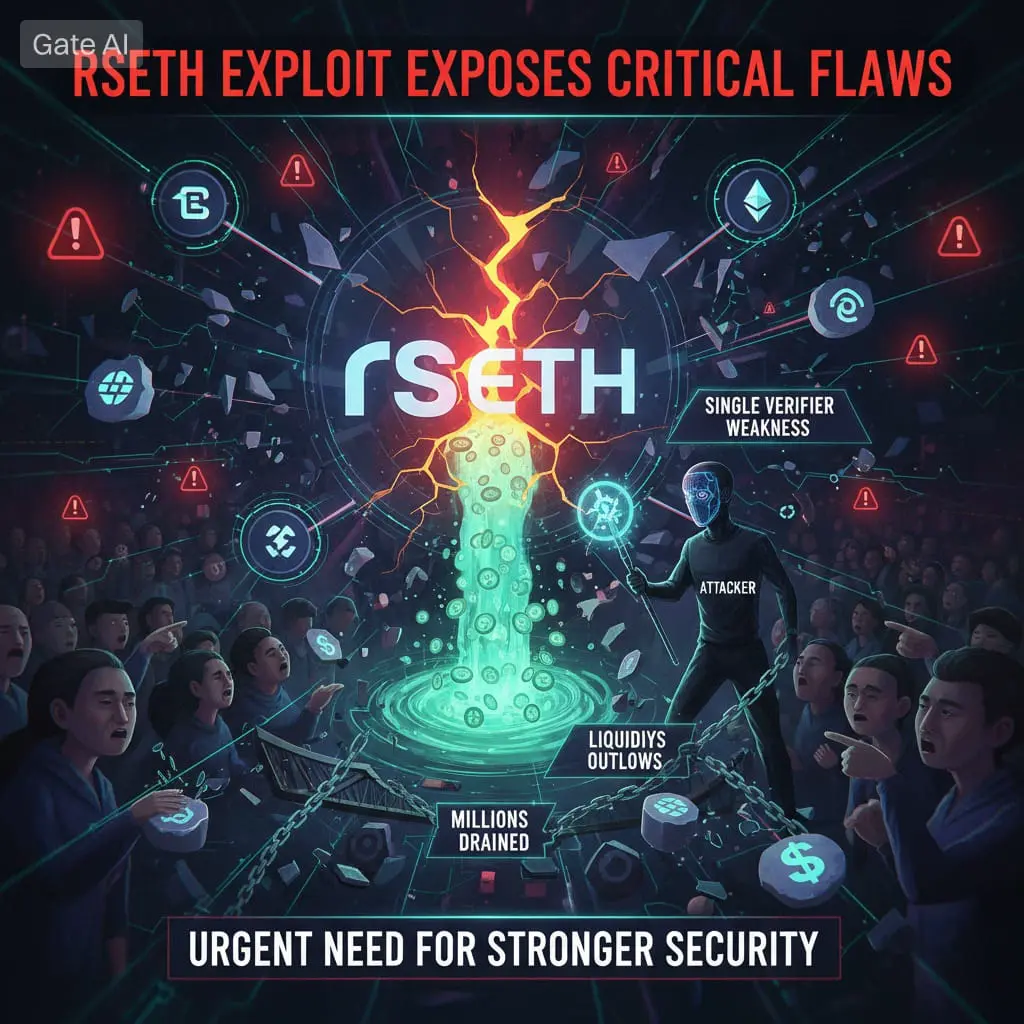
The decentralized finance world experienced one of its most damaging security breaches of 2026 on April 18, and the effects are still rippling through the ecosystem. An attacker drained approximately 116,500 rsETH from Kelp DAO’s LayerZero-powered bridge, worth around 292 million dollars and representing a significant portion of the circulating supply. The breach did not remain isolated. It triggered a chain reaction across lending
post-image
post-image
  • Reward
  • Comment
  • Repost
  • Share
#rsETHAttackUpdate
April 2026 will likely be remembered as a turning point for DeFi security. What initially appeared to be a protocol-specific exploit has now evolved into a full-scale stress test of cross-chain infrastructure, liquidity systems, and risk management across the entire crypto ecosystem.
The Incident: More Than Just a Hack
On April 18, the liquid restaking protocol KelpDAO became the target of one of the largest DeFi exploits of the year, with approximately 292–294 million dollars worth of rsETH drained.
But what makes this attack fundamentally different is this:
It wasn’t a
BTC0,16%
ETH0,42%
SOL1,77%
post-image
post-image
  • Reward
  • Comment
  • Repost
  • Share
#rsETHAttackUpdate 🚨
⚠️ $292M DeFi Exploit Exposes Critical Cross-Chain Risks
One of the largest DeFi attacks of 2026 has shaken the ecosystem.
KelpDAO’s rsETH protocol was exploited via a LayerZero bridge vulnerability — revealing deep structural flaws in cross-chain security.
🔍 What happened:
• Attacker minted 116,500 unbacked rsETH (18% supply)
• Exploited 1-of-1 validation system (single point of failure)
• Used fake cross-chain messages to unlock real assets
💥 Impact:
• ~83,000+ WETH extracted via Aave
• $7B+ liquidity withdrawn across DeFi
• Aave TVL dropped 23% ($6.2B loss)
• Panic s
AAVE2,28%
ARB2,39%
ZRO-0,87%
post-image
  • Reward
  • Comment
  • Repost
  • Share
#rsETHAttackUpdate :
The rsETH Attack: A $292M DeFi Shock That Redefined Crypto Security in 2026
The crypto market was violently shaken on April 18, 2026, when KelpDAO’s rsETH ecosystem suffered a devastating exploit worth approximately $292 million. This was not just another DeFi hack—it became a systemic stress test for the entire decentralized finance ecosystem, exposing structural weaknesses in cross-chain infrastructure, collateral design, and protocol interdependence.
What followed was not only a token collapse—but a liquidity shock, confidence crisis, and a forced global reassessment o
ETH0,42%
AAVE2,28%
ARB2,39%
HighAmbition
#rsETHAttackUpdate :
The rsETH Attack: A $292M DeFi Shock That Redefined Crypto Security in 2026
The crypto market was violently shaken on April 18, 2026, when KelpDAO’s rsETH ecosystem suffered a devastating exploit worth approximately $292 million. This was not just another DeFi hack—it became a systemic stress test for the entire decentralized finance ecosystem, exposing structural weaknesses in cross-chain infrastructure, collateral design, and protocol interdependence.
What followed was not only a token collapse—but a liquidity shock, confidence crisis, and a forced global reassessment of DeFi risk models.
🧠 Understanding rsETH and Its Role in DeFi
rsETH is a liquid restaking token issued by KelpDAO, allowing users to stake Ethereum while keeping liquidity active across DeFi platforms.
In simple terms:
Users stake ETH → receive rsETH
rsETH is used in lending, borrowing, and yield strategies
It acts as collateral across multiple DeFi ecosystems
This makes rsETH a systemically important asset in DeFi, meaning any instability affects not just one protocol—but many interconnected markets.
⚠️ How the $292M Exploit Happened
The attack exploited a critical flaw in KelpDAO’s cross-chain verification system, specifically within a LayerZero bridge adapter.
🔴 Core vulnerability:
KelpDAO used a single-verifier DVN (Decentralized Verifier Network) configuration.
Instead of requiring multiple independent confirmations, only one verifier approval was needed to validate cross-chain messages.
That single point of trust became the entry point for attackers.
🧨 Attack Execution Flow
The exploit unfolded in a highly structured sequence:
1. Fake Cross-Chain Messages
Attackers injected forged messages into the system, pretending legitimate deposits occurred across chains.
2. Minting Unbacked rsETH
The system incorrectly minted:
~116,500 rsETH tokens
Worth approximately $292 million
With no real ETH backing
3. DeFi Collateral Abuse
The attackers used rsETH as collateral on major lending protocols (including Aave) and borrowed real assets:
~52,834 WETH (Ethereum mainnet)
~29,782 WETH + 821 wstETH (Arbitrum)
4. Extraction of Real Liquidity
This created a massive imbalance between synthetic collateral and real assets, leading to systemic exposure.
📉 Immediate Market Reaction
The impact was instant:
rsETH sharply depegged from ETH
Ethereum experienced short-term pressure
DeFi tokens (especially lending protocols) dropped significantly
Trading volumes surged due to panic repositioning
Ethereum Price Context (Current Market)
At the time of market stabilization:
ETH Price: ~$2,320–$2,380 range
Market remained in a consolidation phase between $2,100–$2,400 zones
Despite the exploit, ETH remained structurally stable because the issue was not Ethereum itself—but a layered DeFi dependency failure.
💣 Systemic Impact: The DeFi Liquidity Shock
The most dangerous outcome was not the hack itself—but the liquidity chain reaction.
Key consequences:
Massive withdrawals from DeFi lending protocols
Sudden liquidity contraction across multiple chains
Collateral reassessment across lending platforms
Risk repricing across all synthetic assets
This resembled a “digital bank-run effect”, where fear spreads faster than technical fixes.
Aave and other lending platforms faced:
Rising bad debt exposure
Emergency asset freezes
Collateral re-evaluation processes
🛡️ Emergency Protocol Responses
🔹 KelpDAO Actions:
Paused rsETH minting and transfers
Suspended cross-chain operations
Began full reserve reconciliation
🔹 Aave Actions:
Froze rsETH collateral markets
Removed borrowing power from rsETH
Initiated risk containment procedures
🔹 Ecosystem Response:
Major DeFi players created emergency liquidity support pools to stabilize rsETH backing and reduce systemic damage.
📊 Ethereum Trading Strategy (Post-Exploit Market Structure)
Despite the chaos, ETH continues to trade within a structured macro range.
🟢 Current ETH Market Zone:
Range: $2,200 – $2,450
Bias: Neutral to slightly bearish consolidation
Volatility: Moderate, event-driven spikes
📈 ETH Trading Strategy (Simplified Institutional Approach)
1. Accumulation Zone Strategy
Range: $2,100 – $2,250
Considered long-term value accumulation zone
Suitable for gradual spot entry
Ideal for DCA (Dollar Cost Averaging)
2. Breakout Strategy
Trigger: Above $2,450
Confirms bullish expansion phase
Targets: $2,600 → $2,800
Momentum continuation likely if volume supports
3. Risk/Downside Strategy
If breakdown below $2,100:
Market enters deeper correction phase
Next support: $1,950–$2,000
Defensive positioning recommended
⚖️ Market Sentiment Shift After rsETH Attack
The event has permanently shifted market psychology:
Before:
High trust in cross-chain composability
Aggressive leverage usage
Strong confidence in synthetic collateral systems
After:
Increased skepticism toward bridged assets
Lower leverage appetite
Strong preference for native collateral (ETH, BTC)
Higher demand for protocol insurance models
🔍 Key Lessons for Crypto Investors
1. Composability is powerful—but fragile
One weak link can destabilize entire systems.
2. Cross-chain bridges remain high-risk infrastructure
Even advanced protocols can fail if verification is centralized.
3. Collateral ≠ safety
Synthetic assets require deeper risk analysis than native assets.
4. DeFi is now entering “risk maturity phase”
Security will matter more than speed or innovation.
📌 Final Outlook
The rsETH exploit is more than a hack—it is a defining moment for DeFi evolution.
While the immediate damage was severe, the long-term outcome may actually strengthen the ecosystem through:
Better bridge security standards
Improved collateral frameworks
Stronger risk management systems
More realistic leverage controls
Ethereum and DeFi markets have survived this shock—but the rules of the game are changing.
🚀 Closing Insight
In crypto, innovation always moves faster than regulation or security. The rsETH incident is a reminder that:
The future of DeFi will not be defined by how fast it grows—but by how well it survives its own complexity.
repost-content-media
  • Reward
  • Comment
  • Repost
  • Share
#rsETHAttackUpdate 🚨 Contained, But Not Ignored
The recent rsETH (KelpDAO) incident has moved into a controlled phase, with coordinated actions limiting further damage while investigations and recovery processes continue.
---
📊 Current Situation
• Rapid response helped contain the exploit
• A significant portion of funds has been frozen
• Linked wallets are being actively monitored and restricted
• Off-ramp routes for the attacker have been disrupted
The core protocol structure remains intact, with no critical failure in the smart contract layer.
---
🔍 Root Cause Focus
Initial findings indi
post-image
  • Reward
  • 2
  • Repost
  • Share
Lock_433:
LFG 🔥
View More
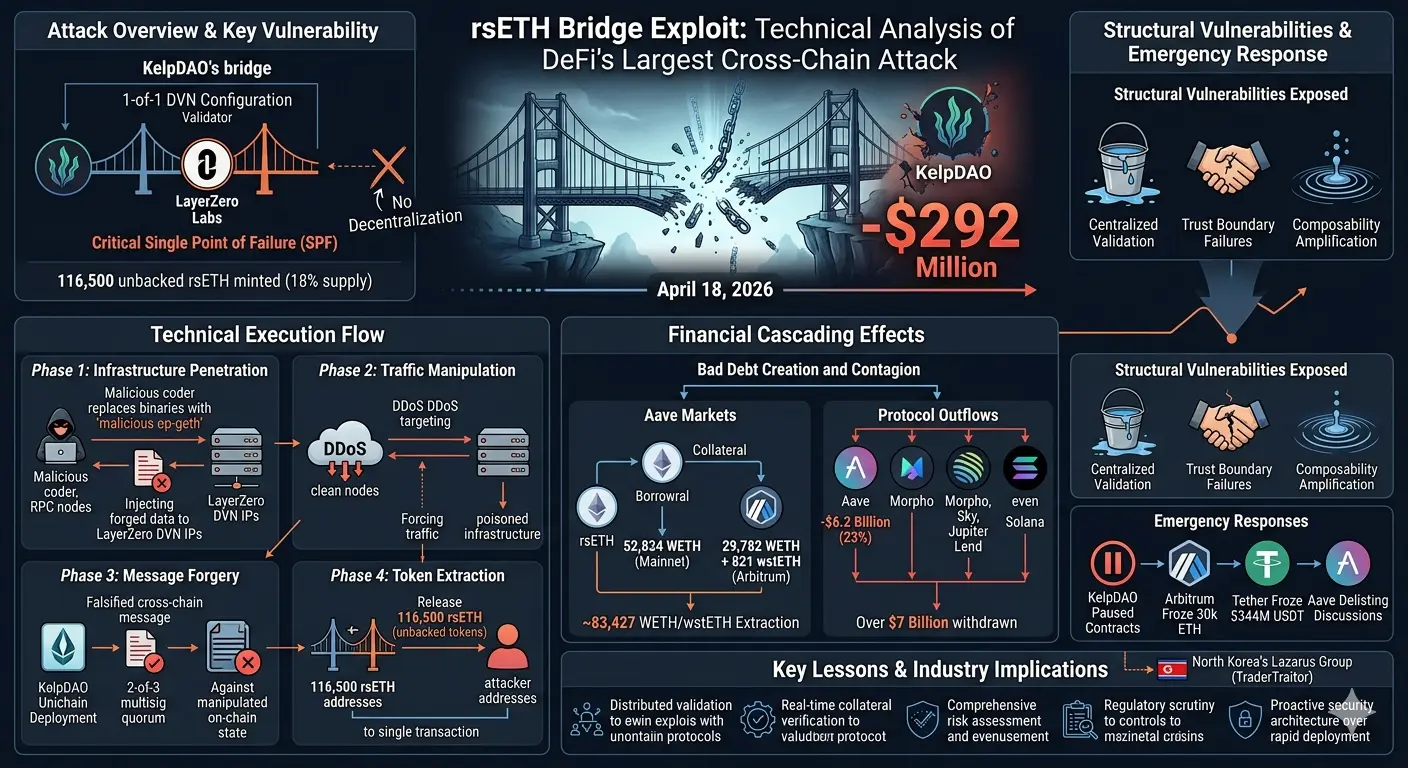
#rsETHAttackUpdate : Technical Analysis of DeFi's Largest Cross-Chain Attack
On April18,2026, KelpDAO's rsETH protocol suffered a $292 million exploit through its LayerZero bridge, marking one of DeFi's most significant security failures. This briefing examines the attack vectors, cascading effects, and structural vulnerabilities exposed.
Attack Overview
The attacker minted116,500 unbacked rsETH tokens (18% of total supply) by compromising KelpDAO's cross-chain infrastructure. The exploit targeted a critical architectural weakness: KelpDAO's bridge operated with a1-of-1 DVN (Decentralized Vali
ZRO-0,87%
AAVE2,28%
ETH0,42%
ARB2,39%
post-image
post-image
  • Reward
  • Comment
  • Repost
  • Share
#rsETHAttackUpdate – Detailed Incident Analysis and Community Guidance
The decentralized finance (DeFi) ecosystem has once again been shaken by a targeted exploit. Under the hashtag #rsETHAttackUpdate, security researchers and community members have reported a sophisticated attack vector affecting protocols integrated with rsETH – a liquid restaking token primarily associated with Kelp DAO and EigenLayer’s restaking infrastructure. This post provides a comprehensive, factual breakdown of the incident, its mechanics, impact assessment, and actionable safety measures. No illegal, phishing, or ma
post-image
  • Reward
  • 2
  • Repost
  • Share
GateUser-592977ca:
It’s really, really good to learn trading here, and it’s very, very great.
View More
#rsETHAttackUpdate
🚨 rsETH Incident 2026 – The Day DeFi Didn’t Break… But Everyone Realized It Can
There are days in crypto when nothing really changes — charts move, traders trade, noise continues — and then there are days like this, when suddenly the market goes quiet for a moment, not because nothing is happening, but because everyone is thinking at the same time, trying to process whether what just happened is a temporary disruption… or a deeper warning about the system itself.
The rsETH incident was not just another event — it was a reality check, a moment where confidence didn’t collap
ETH0,42%
HighAmbition
#rsETHAttackUpdate
🚨 rsETH Incident 2026 – The Day DeFi Didn’t Break… But Everyone Realized It Can
There are days in crypto when nothing really changes — charts move, traders trade, noise continues — and then there are days like this, when suddenly the market goes quiet for a moment, not because nothing is happening, but because everyone is thinking at the same time, trying to process whether what just happened is a temporary disruption… or a deeper warning about the system itself.
The rsETH incident was not just another event — it was a reality check, a moment where confidence didn’t collapse, but it paused, where belief didn’t disappear, but it questioned itself, and where the biggest realization wasn’t about loss… but about how easily trust can be tested in a system built on layers of assumptions.
🔥 Let’s Be Honest — This Wasn’t “Just Another Incident”
At the surface, it looks like a technical issue tied to rsETH, with an impact crossing $290 million, but if you reduce it to just numbers, you completely miss the point — because what actually happened here was something far more important:
👉 The system accepted something it shouldn’t have
👉 The ecosystem reacted after the fact
👉 And users realized how much they rely on things they never fully analyze
And that creates a very uncomfortable thought:
How many other risks exist that simply haven’t been triggered yet?
⚠️ The Part Nobody Likes To Talk About
We often celebrate DeFi for being permissionless, open, and innovative — but we rarely talk about the trade-off:
👉 More freedom = more responsibility
👉 More innovation = more unknowns
👉 More yield = more hidden complexity
And this incident exposed exactly that — not loudly, not dramatically, but quietly and effectively — by showing that sometimes the biggest risks are not in what we see… but in what we assume is safe without questioning it.
🧠 The Debate That’s Dividing The Market Right Now
Let’s address the elephant in the room — because this is where things get interesting.
🔴 Side A — “This Is A Structural Warning”
This side isn’t panicking — they’re observing carefully, and their argument is simple but powerful:
If one weak point in a system can allow invalid value to move across protocols, interact with liquidity, and influence markets, then maybe the system is not as robust as we think — maybe complexity has moved faster than security, and maybe users are operating in environments where the true risk is not visible at the surface level.
And their biggest concern is not this incident —
It’s the next one.
🟢 Side B — “This Is Exactly How Systems Improve”
The other side sees this completely differently — not as a failure, but as a necessary stress event, because no system becomes strong without being tested, and no weakness gets fixed until it is exposed.
From this perspective, what happened is not the breakdown of DeFi — it is the process of refining it, strengthening it, and forcing it to evolve beyond theoretical security into real-world resilience.
💡 So Who’s Right? Here’s The Truth…
Both sides are right — and that’s what makes this moment so important.
Because this isn’t a black-and-white situation.
👉 DeFi is not broken
👉 DeFi is not perfect
👉 DeFi is being tested
And the outcome of this test will define the next phase of the market.
📊 Now Let’s Talk About What Really Matters — PRICE
Because in the end, markets don’t lie — sentiment, fear, confidence… everything shows up in price.
💰 Ethereum Current Price: ~$2318
Now pause for a second and think about this…
After a major DeFi shock, after headlines, after uncertainty…
👉 ETH is still holding above $2300
👉 Monthly trend is still positive (~+16%)
👉 Market structure is still intact
That is not weakness.
That is controlled strength.
🔍 Expanded Price Zones (Where The Game Is Being Played)
📍 Support Levels (Where Buyers Defend):
• $2300 → Key psychological level
• $2280 → Short-term reaction zone
• $2250 → Strong support (if tested, high attention area)
📍 Resistance Levels (Where Sellers React):
• $2332 → Immediate breakout trigger
• $2360 → Supply pressure zone
• $2400 → Major psychological barrier
• $2500 → Momentum expansion target
📈 What The Chart Is Really Saying
This is not a trending market…
This is not a collapsing market…
👉 This is a decision zone
Price is compressing, volatility is tightening, and the market is preparing for a move — the only question is direction.
And here’s the key insight most traders miss:
👉 Big moves don’t start with noise
👉 They start with silence and compression
🏦 Smart Money Isn’t Loud — But It’s Active
While retail traders are reacting emotionally, smart money is doing something very different:
👉 Not rushing in
👉 Not running away
👉 Just positioning quietly
This is what rebalancing looks like — not panic, not hype, but calculated patience.
⚡ The Brutal Truth Most Traders Ignore
Let’s be real for a second —
Most people in DeFi are not losing money because of hacks…
They’re losing because they:
• Don’t understand what they’re using
• Chase returns without thinking
• Ignore risk until it hits
And this incident didn’t create that problem —
It just exposed it.
📈 Strategy Right Now — This Is Where You Win Or Lose
This is not the time to be emotional.
This is the time to be precise.
🟢 If You’re Careful:
Wait for confirmation above $2332 — don’t guess, react
🟡 If You’re Strategic:
Look at $2300 zone for controlled entries with risk defined
🔴 If You’re Aggressive:
Trade short-term, take profits fast, don’t overstay
👉 One rule above all:
Survive first. Profit second.
🚀 What Happens Next — The Bigger Picture
This moment will shape the future of DeFi, not because something went wrong, but because now:
• Builders will tighten systems
• Investors will think deeper
• Risk will be priced more accurately
• Weak structures will get exposed
👉 And that’s how systems evolve.
💬 Final Thought — Read This Carefully
The biggest danger in crypto is not volatility.
It’s not even technical failure.
👉 It’s false confidence.
repost-content-media
  • Reward
  • Comment
  • Repost
  • Share
#rsETHAttackUpdate 1. Incident Overview – Full Breakdown
The rsETH-related exploit was not just a minor glitch—it exposed a core weakness in DeFi infrastructure design. Attackers identified a vulnerability within the protocol’s smart contract system and executed transactions designed to bypass intended safeguards.
In most DeFi exploits, timing is everything. Here too, the attacker acted during a window where liquidity was high and monitoring systems had delayed reaction time. This allowed them to extract maximum value before intervention.
The incident created immediate shockwaves across the re
ETH0,42%
post-image
post-image
  • Reward
  • 3
  • Repost
  • Share
Yunna:
LFG 🔥
View More
#rsETHAttackUpdate
🚨 rsETH Incident 2026 – The Day DeFi Didn’t Break… But Everyone Realized It Can
There are days in crypto when nothing really changes — charts move, traders trade, noise continues — and then there are days like this, when suddenly the market goes quiet for a moment, not because nothing is happening, but because everyone is thinking at the same time, trying to process whether what just happened is a temporary disruption… or a deeper warning about the system itself.
The rsETH incident was not just another event — it was a reality check, a moment where confidence didn’t collap
ETH0,42%
HighAmbition
#rsETHAttackUpdate
🚨 rsETH Incident 2026 – The Day DeFi Didn’t Break… But Everyone Realized It Can
There are days in crypto when nothing really changes — charts move, traders trade, noise continues — and then there are days like this, when suddenly the market goes quiet for a moment, not because nothing is happening, but because everyone is thinking at the same time, trying to process whether what just happened is a temporary disruption… or a deeper warning about the system itself.
The rsETH incident was not just another event — it was a reality check, a moment where confidence didn’t collapse, but it paused, where belief didn’t disappear, but it questioned itself, and where the biggest realization wasn’t about loss… but about how easily trust can be tested in a system built on layers of assumptions.
🔥 Let’s Be Honest — This Wasn’t “Just Another Incident”
At the surface, it looks like a technical issue tied to rsETH, with an impact crossing $290 million, but if you reduce it to just numbers, you completely miss the point — because what actually happened here was something far more important:
👉 The system accepted something it shouldn’t have
👉 The ecosystem reacted after the fact
👉 And users realized how much they rely on things they never fully analyze
And that creates a very uncomfortable thought:
How many other risks exist that simply haven’t been triggered yet?
⚠️ The Part Nobody Likes To Talk About
We often celebrate DeFi for being permissionless, open, and innovative — but we rarely talk about the trade-off:
👉 More freedom = more responsibility
👉 More innovation = more unknowns
👉 More yield = more hidden complexity
And this incident exposed exactly that — not loudly, not dramatically, but quietly and effectively — by showing that sometimes the biggest risks are not in what we see… but in what we assume is safe without questioning it.
🧠 The Debate That’s Dividing The Market Right Now
Let’s address the elephant in the room — because this is where things get interesting.
🔴 Side A — “This Is A Structural Warning”
This side isn’t panicking — they’re observing carefully, and their argument is simple but powerful:
If one weak point in a system can allow invalid value to move across protocols, interact with liquidity, and influence markets, then maybe the system is not as robust as we think — maybe complexity has moved faster than security, and maybe users are operating in environments where the true risk is not visible at the surface level.
And their biggest concern is not this incident —
It’s the next one.
🟢 Side B — “This Is Exactly How Systems Improve”
The other side sees this completely differently — not as a failure, but as a necessary stress event, because no system becomes strong without being tested, and no weakness gets fixed until it is exposed.
From this perspective, what happened is not the breakdown of DeFi — it is the process of refining it, strengthening it, and forcing it to evolve beyond theoretical security into real-world resilience.
💡 So Who’s Right? Here’s The Truth…
Both sides are right — and that’s what makes this moment so important.
Because this isn’t a black-and-white situation.
👉 DeFi is not broken
👉 DeFi is not perfect
👉 DeFi is being tested
And the outcome of this test will define the next phase of the market.
📊 Now Let’s Talk About What Really Matters — PRICE
Because in the end, markets don’t lie — sentiment, fear, confidence… everything shows up in price.
💰 Ethereum Current Price: ~$2318
Now pause for a second and think about this…
After a major DeFi shock, after headlines, after uncertainty…
👉 ETH is still holding above $2300
👉 Monthly trend is still positive (~+16%)
👉 Market structure is still intact
That is not weakness.
That is controlled strength.
🔍 Expanded Price Zones (Where The Game Is Being Played)
📍 Support Levels (Where Buyers Defend):
• $2300 → Key psychological level
• $2280 → Short-term reaction zone
• $2250 → Strong support (if tested, high attention area)
📍 Resistance Levels (Where Sellers React):
• $2332 → Immediate breakout trigger
• $2360 → Supply pressure zone
• $2400 → Major psychological barrier
• $2500 → Momentum expansion target
📈 What The Chart Is Really Saying
This is not a trending market…
This is not a collapsing market…
👉 This is a decision zone
Price is compressing, volatility is tightening, and the market is preparing for a move — the only question is direction.
And here’s the key insight most traders miss:
👉 Big moves don’t start with noise
👉 They start with silence and compression
🏦 Smart Money Isn’t Loud — But It’s Active
While retail traders are reacting emotionally, smart money is doing something very different:
👉 Not rushing in
👉 Not running away
👉 Just positioning quietly
This is what rebalancing looks like — not panic, not hype, but calculated patience.
⚡ The Brutal Truth Most Traders Ignore
Let’s be real for a second —
Most people in DeFi are not losing money because of hacks…
They’re losing because they:
• Don’t understand what they’re using
• Chase returns without thinking
• Ignore risk until it hits
And this incident didn’t create that problem —
It just exposed it.
📈 Strategy Right Now — This Is Where You Win Or Lose
This is not the time to be emotional.
This is the time to be precise.
🟢 If You’re Careful:
Wait for confirmation above $2332 — don’t guess, react
🟡 If You’re Strategic:
Look at $2300 zone for controlled entries with risk defined
🔴 If You’re Aggressive:
Trade short-term, take profits fast, don’t overstay
👉 One rule above all:
Survive first. Profit second.
🚀 What Happens Next — The Bigger Picture
This moment will shape the future of DeFi, not because something went wrong, but because now:
• Builders will tighten systems
• Investors will think deeper
• Risk will be priced more accurately
• Weak structures will get exposed
👉 And that’s how systems evolve.
💬 Final Thought — Read This Carefully
The biggest danger in crypto is not volatility.
It’s not even technical failure.
👉 It’s false confidence.
repost-content-media
  • Reward
  • Comment
  • Repost
  • Share
Load More