Author: Nancy, PANews
Satoshi Nakamoto’s true identity remains a mystery that has persisted for 17 years in the crypto world. Speculation around this pseudonym has never stopped—candidates have ranged from cryptographers to corporate founders—but there has always been a lack of evidence strong enough to settle the matter once and for all.
Satoshi Nakamoto identity controversy flares up again, and a long-form investigation targets Adam Back
In this investigation, New York Times reporter John Carreyrou spent more than a year digging through decades of records, cryptography-punk email lists, and all of Satoshi Nakamoto’s publicly available text. Through cross-referencing from multiple angles—writing style, technical thinking, and historical context—he gradually narrowed the field down from more than 34k potential subjects, ultimately focusing on the 55-year-old British cryptographer Adam Back.
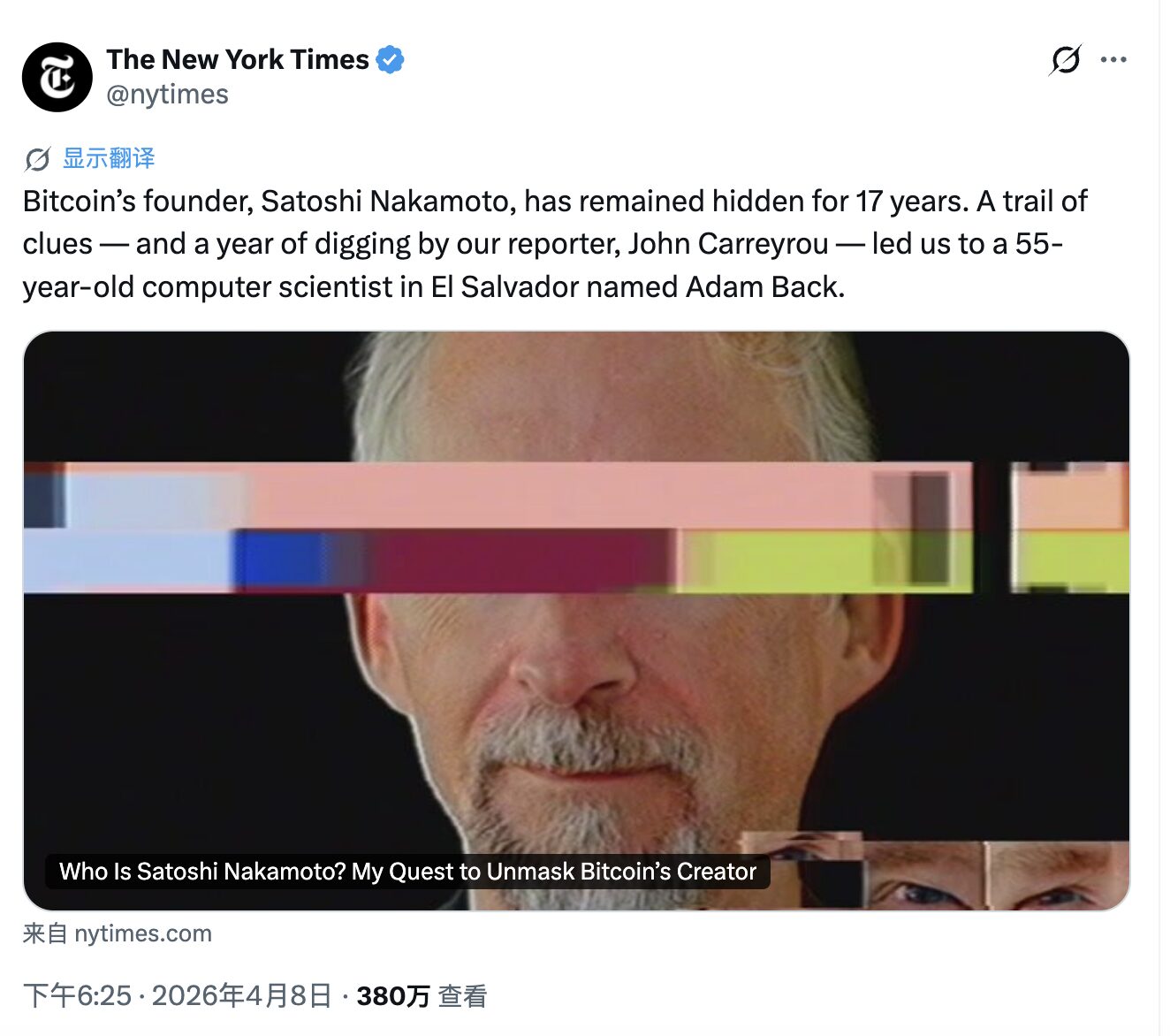 John Carreyrou is a well-known American investigative journalist. He has won the Pulitzer Prize twice and has drawn significant attention for deeply uncovering the Theranos healthcare fraud, which also led him to write the best-selling book Bad Blood.
The article notes that, judging from his background and experience, the identification is not without foundation. Back was one of the core members of early cryptography-punk circles, and those people are an important source of Bitcoin’s underlying ideas. The Times of London headline embedded in Bitcoin’s genesis block has long been viewed as a hint that its creator had a direct connection to the UK, and that aligns neatly with Back’s profile. More importantly, Back has been deeply involved in discussions about anonymous communication, encryption technology, and digital cash since the 1990s. His technical background, programming ability, and expertise in cryptography closely match the level demonstrated by Satoshi Nakamoto in the white paper and early communications.
On the technical blueprint, as early as the late 1990s, Back proposed an electronic cash concept on mailing lists that broke away from the traditional banking system. Its core elements included a decentralized network, a proof-of-work based on computational difficulty, controls on monetary scarcity, node distribution to resist attacks, and a verification system that did not require trusted third parties. These elements correspond—almost point by point—to the design in the Bitcoin white paper a decade later. In particular, the Hashcash mechanism invented by Back was adopted directly by Bitcoin as the basis for mining. And Back’s earlier idea of combining Hashcash with Wei Dai’s b-money is also precisely the technical path that Satoshi Nakamoto ultimately realized in Bitcoin. Based on these clues, the reporter believes Back is not only a participant in the relevant field, but more like an original designer of Bitcoin.
On the level of ideology, the article points out that Back and Satoshi Nakamoto are both deeply influenced by cryptography-punk concepts, emphasizing achieving personal privacy and freedom through cryptographic means and leaning toward a libertarian worldview. At the same time, in terms of concrete expression, the two also show consistency—for example, they both treat the traditional banking system as something that needs to be replaced, and they use technological means to criticize real-world financial crises and policies. This makes the question “Why create Bitcoin” seem almost inevitable in Back’s case.
Meanwhile, the writing style provides even more detailed supporting evidence. The investigation found that the two have many similarities in wording, grammar, and even some subtle writing habits, including the use of specific technical terminology, mixing British and American spellings, and inconsistent use of hyphens. A single trait may not be enough to prove anything, but when these traits appear together—in groups—the picture becomes harder to dismiss. Especially the unconventional hyphenation style for “proof-of-work” and rarer expressions such as “partial pre-image”: in that period, such usage was extremely uncommon within the cryptography community, and Back just happens to use it. With the help of AI’s large-scale filtering across multiple email lists, the candidate pool was narrowed down layer by layer, until only Back remained.
Cross-checking the timeline further reinforces this inference. Satoshi Nakamoto was active between 2008 and 2011, then suddenly disappeared. Back, during that period, was hardly publicly involved in Bitcoin discussions, but after 2011 he quickly entered the Bitcoin community and gradually became one of the key figures. Around 2013, when the outside world began speculating about Satoshi Nakamoto’s BTC holdings, Back was also nearly simultaneously active on key forums. Even during the 2015 block size dispute, a letter regarded as a “Satoshi return” showed positions and wording highly consistent with Back’s prior viewpoints. These clues are difficult to explain entirely as coincidence.
Although Back submitted emails in the past with Satoshi Nakamoto to prove he was not the person himself, the reporter believes there are clear logical contradictions in those emails. When asked to provide more crucial email metadata, Back never responded. In face-to-face interviews with the reporter, Back denied it multiple times, but could not provide a reasonable explanation for key time nodes, suggesting a degree of evasion. This defensive reaction stands in sharp contrast to his image of technical confidence. Even in one conversation, when the reporter mentioned Satoshi Nakamoto’s classic line, “I’m better at code than writing,” Back’s response showed a similar natural slip of “writing as if inserting himself,” which the reporter interpreted as an unconscious “accidental leak.”
Even so, the article also points out that these clues still remain at a highly correlated level, not decisive evidence. What can truly settle the matter once and for all is still only a private-key signature.
Community skepticism continued, and the person denied it multiple times
Adam Back is a well-known cryptographer and Bitcoin pioneer. In response to the identity reveal by The New York Times, Back quickly denied it.
John Carreyrou is a well-known American investigative journalist. He has won the Pulitzer Prize twice and has drawn significant attention for deeply uncovering the Theranos healthcare fraud, which also led him to write the best-selling book Bad Blood.
The article notes that, judging from his background and experience, the identification is not without foundation. Back was one of the core members of early cryptography-punk circles, and those people are an important source of Bitcoin’s underlying ideas. The Times of London headline embedded in Bitcoin’s genesis block has long been viewed as a hint that its creator had a direct connection to the UK, and that aligns neatly with Back’s profile. More importantly, Back has been deeply involved in discussions about anonymous communication, encryption technology, and digital cash since the 1990s. His technical background, programming ability, and expertise in cryptography closely match the level demonstrated by Satoshi Nakamoto in the white paper and early communications.
On the technical blueprint, as early as the late 1990s, Back proposed an electronic cash concept on mailing lists that broke away from the traditional banking system. Its core elements included a decentralized network, a proof-of-work based on computational difficulty, controls on monetary scarcity, node distribution to resist attacks, and a verification system that did not require trusted third parties. These elements correspond—almost point by point—to the design in the Bitcoin white paper a decade later. In particular, the Hashcash mechanism invented by Back was adopted directly by Bitcoin as the basis for mining. And Back’s earlier idea of combining Hashcash with Wei Dai’s b-money is also precisely the technical path that Satoshi Nakamoto ultimately realized in Bitcoin. Based on these clues, the reporter believes Back is not only a participant in the relevant field, but more like an original designer of Bitcoin.
On the level of ideology, the article points out that Back and Satoshi Nakamoto are both deeply influenced by cryptography-punk concepts, emphasizing achieving personal privacy and freedom through cryptographic means and leaning toward a libertarian worldview. At the same time, in terms of concrete expression, the two also show consistency—for example, they both treat the traditional banking system as something that needs to be replaced, and they use technological means to criticize real-world financial crises and policies. This makes the question “Why create Bitcoin” seem almost inevitable in Back’s case.
Meanwhile, the writing style provides even more detailed supporting evidence. The investigation found that the two have many similarities in wording, grammar, and even some subtle writing habits, including the use of specific technical terminology, mixing British and American spellings, and inconsistent use of hyphens. A single trait may not be enough to prove anything, but when these traits appear together—in groups—the picture becomes harder to dismiss. Especially the unconventional hyphenation style for “proof-of-work” and rarer expressions such as “partial pre-image”: in that period, such usage was extremely uncommon within the cryptography community, and Back just happens to use it. With the help of AI’s large-scale filtering across multiple email lists, the candidate pool was narrowed down layer by layer, until only Back remained.
Cross-checking the timeline further reinforces this inference. Satoshi Nakamoto was active between 2008 and 2011, then suddenly disappeared. Back, during that period, was hardly publicly involved in Bitcoin discussions, but after 2011 he quickly entered the Bitcoin community and gradually became one of the key figures. Around 2013, when the outside world began speculating about Satoshi Nakamoto’s BTC holdings, Back was also nearly simultaneously active on key forums. Even during the 2015 block size dispute, a letter regarded as a “Satoshi return” showed positions and wording highly consistent with Back’s prior viewpoints. These clues are difficult to explain entirely as coincidence.
Although Back submitted emails in the past with Satoshi Nakamoto to prove he was not the person himself, the reporter believes there are clear logical contradictions in those emails. When asked to provide more crucial email metadata, Back never responded. In face-to-face interviews with the reporter, Back denied it multiple times, but could not provide a reasonable explanation for key time nodes, suggesting a degree of evasion. This defensive reaction stands in sharp contrast to his image of technical confidence. Even in one conversation, when the reporter mentioned Satoshi Nakamoto’s classic line, “I’m better at code than writing,” Back’s response showed a similar natural slip of “writing as if inserting himself,” which the reporter interpreted as an unconscious “accidental leak.”
Even so, the article also points out that these clues still remain at a highly correlated level, not decisive evidence. What can truly settle the matter once and for all is still only a private-key signature.
Community skepticism continued, and the person denied it multiple times
Adam Back is a well-known cryptographer and Bitcoin pioneer. In response to the identity reveal by The New York Times, Back quickly denied it.
 “I am not Satoshi Nakamoto.” In a post responding to the claims, Back said he had been paying close attention to cryptography, online privacy, and the positive social impact of electronic cash for a long time. Therefore, starting around 1992, he actively participated in relevant applied research, discussing electronic cash and privacy technologies in cryptography-punk mailing lists—an involvement that also brought up Hashcash and other ideas. Early on, there were indeed many attempts to create decentralized electronic cash, but at its core it was continuously exploring a system design similar to Bitcoin.
Back further explained that because he was extremely active in the cryptography-punk mailing lists—far more than others—his likelihood of commenting on topics like electronic cash was higher, which made it easier for investigators to associate his statements with Satoshi Nakamoto. But this is only a statistical bias. The remaining evidence is the result of coincidences and people with similar experiences and interests using similar phrasing.
He also said that Satoshi Nakamoto needed specific skills and experience to invent Bitcoin, and that he and many others in the preceding decade of design attempts were “so close to the final solution, yet never actually reached the core.” Even though he doesn’t know who Satoshi Nakamoto is, this anonymous status has been beneficial to Bitcoin.
In fact, this is not the first time Back has publicly denied related speculation. Over the past few years, Back has denied it multiple times and even tried to explain why Satoshi Nakamoto chose anonymity, saying that Bitcoin would reform money and the risks of separating currency from the state would be greater. Now some countries are gradually accepting Bitcoin, and related regulations are becoming more open; but in some countries it is still in a gray area or illegal. Therefore, even core developers could face enormous risks from an early exposure of identity.
The controversy surrounding the report also spread quickly throughout the crypto community. Bitcoin core developer Jameson Lopp said Satoshi Nakamoto could not be caught through stylistic analysis. Painting Adam Back with such flimsy evidence is truly shameful.
Crypto finance researcher FatMan said Back is a role-player who exaggerated his relationship with Bitcoin through humble-style self-promotion, packaging a weekend project called Hashcash as Bitcoin’s predecessor and using that to build influence and even raise funding. Back is not the true inventor of Bitcoin; Satoshi Nakamoto is someone else and should be respected for privacy. He should not be subjected to public speculation or exposure.
Crypto KOL Todd also raised multiple rebuttals, mainly including:
“I am not Satoshi Nakamoto.” In a post responding to the claims, Back said he had been paying close attention to cryptography, online privacy, and the positive social impact of electronic cash for a long time. Therefore, starting around 1992, he actively participated in relevant applied research, discussing electronic cash and privacy technologies in cryptography-punk mailing lists—an involvement that also brought up Hashcash and other ideas. Early on, there were indeed many attempts to create decentralized electronic cash, but at its core it was continuously exploring a system design similar to Bitcoin.
Back further explained that because he was extremely active in the cryptography-punk mailing lists—far more than others—his likelihood of commenting on topics like electronic cash was higher, which made it easier for investigators to associate his statements with Satoshi Nakamoto. But this is only a statistical bias. The remaining evidence is the result of coincidences and people with similar experiences and interests using similar phrasing.
He also said that Satoshi Nakamoto needed specific skills and experience to invent Bitcoin, and that he and many others in the preceding decade of design attempts were “so close to the final solution, yet never actually reached the core.” Even though he doesn’t know who Satoshi Nakamoto is, this anonymous status has been beneficial to Bitcoin.
In fact, this is not the first time Back has publicly denied related speculation. Over the past few years, Back has denied it multiple times and even tried to explain why Satoshi Nakamoto chose anonymity, saying that Bitcoin would reform money and the risks of separating currency from the state would be greater. Now some countries are gradually accepting Bitcoin, and related regulations are becoming more open; but in some countries it is still in a gray area or illegal. Therefore, even core developers could face enormous risks from an early exposure of identity.
The controversy surrounding the report also spread quickly throughout the crypto community. Bitcoin core developer Jameson Lopp said Satoshi Nakamoto could not be caught through stylistic analysis. Painting Adam Back with such flimsy evidence is truly shameful.
Crypto finance researcher FatMan said Back is a role-player who exaggerated his relationship with Bitcoin through humble-style self-promotion, packaging a weekend project called Hashcash as Bitcoin’s predecessor and using that to build influence and even raise funding. Back is not the true inventor of Bitcoin; Satoshi Nakamoto is someone else and should be respected for privacy. He should not be subjected to public speculation or exposure.
Crypto KOL Todd also raised multiple rebuttals, mainly including:
-
Satoshi Nakamoto sent Back emails in a natural tone to ask questions. At the time, Bitcoin had not yet become famous, so it is unlikely to be a “double act”;
-
The Bitcoin codebase uses C++, which is completely different from Adam Back’s programming style;
-
Although Back’s Blockstream company funded core Bitcoin developers to some extent, various commercialized operations (for example, sidechains, hardware wallets, and holding large amounts of Bitcoin) do not fit;
-
Back has even said he regrets not getting involved in Bitcoin mining earlier, and his理念 is more aligned with the idea of a store of value rather than early Bitcoin electronic cash;
-
Back tends to apply for patents, while Satoshi Nakamoto chose fully open-source.
A repeated identity farce fell through again and again—no ironclad proof to this day
An anonymous identity added lasting mystery to Satoshi Nakamoto, and the potential attribution and movement of his roughly 1.1 million BTC (about $7.7 billion) holdings have continued to keep market attention locked in.
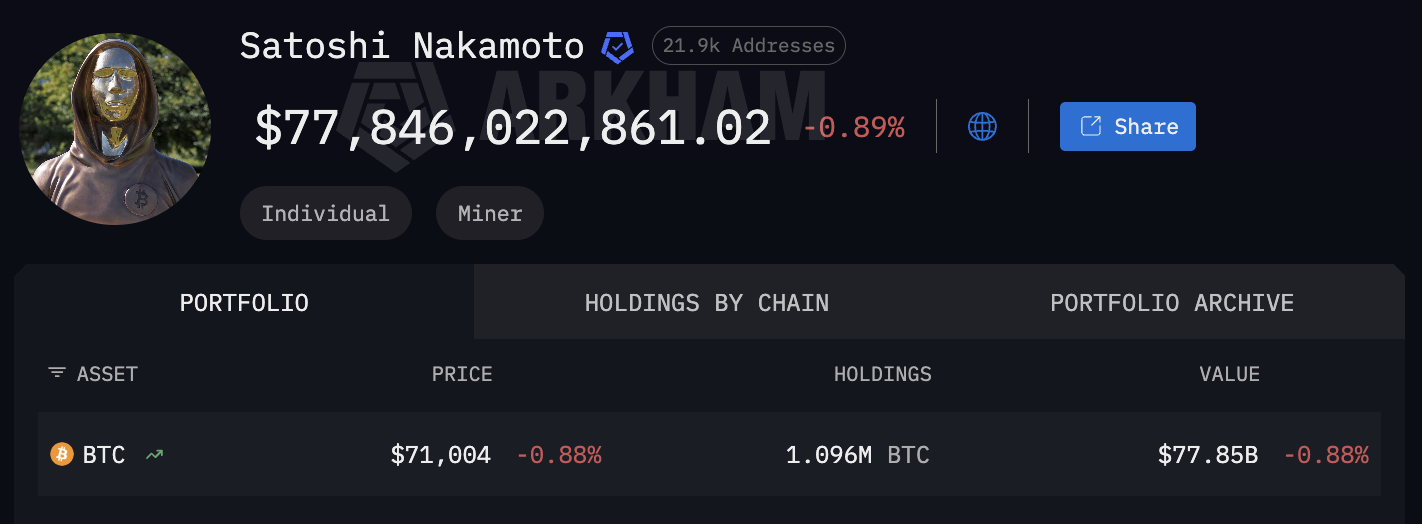 Over the past decade or so, speculation about this pseudonymous figure has kept coming up.
In 2014, the U.S. news magazine Newsweek identified Dorian Nakamoto, a Japanese-American physicist living in California, as Satoshi Nakamoto, sparking widespread attention. However, the person involved subsequently and clearly denied it, saying he had nothing to do with Bitcoin’s creation. The report was gradually debunked in later investigations and caused significant trouble for his personal life as well.
In 2016, Australian computer scientist Craig Wright repeatedly claimed to be Satoshi Nakamoto and even applied for copyright on the Bitcoin white paper and the original Bitcoin code. However, in the end, the court ruled that Wright’s claims were not valid, stating that much of the evidence he submitted was forged. He was found to be in contempt of court and, at the end of 2024, was sentenced to 12 months in prison, suspended for two years.
In 2024, the HBO documentary Money Electric: The Bitcoin Mystery shifted its focus to Canadian Bitcoin developer Peter Todd, triggering a new round of discussion. But Todd immediately denied the inference, calling the accusations absurd and providing evidence to refute them. At the same time, due to security concerns, he acted discreetly for a period. In the same year, Stephen Mollah, a person from the UK, claimed to be Satoshi Nakamoto at an unveiling event in London, but he likewise failed to provide verifiable evidence and was quickly dismissed by the community.
Most of these attempts to reveal the identity caused waves of public opinion in the short term, but none of them managed to end the mystery with ironclad proof. As time passes, Satoshi Nakamoto’s anonymity has instead become part of Bitcoin’s narrative. Today, Bitcoin’s network has been operating for years; its value comes more from global consensus than from the founder’s identity aura.
Over the past decade or so, speculation about this pseudonymous figure has kept coming up.
In 2014, the U.S. news magazine Newsweek identified Dorian Nakamoto, a Japanese-American physicist living in California, as Satoshi Nakamoto, sparking widespread attention. However, the person involved subsequently and clearly denied it, saying he had nothing to do with Bitcoin’s creation. The report was gradually debunked in later investigations and caused significant trouble for his personal life as well.
In 2016, Australian computer scientist Craig Wright repeatedly claimed to be Satoshi Nakamoto and even applied for copyright on the Bitcoin white paper and the original Bitcoin code. However, in the end, the court ruled that Wright’s claims were not valid, stating that much of the evidence he submitted was forged. He was found to be in contempt of court and, at the end of 2024, was sentenced to 12 months in prison, suspended for two years.
In 2024, the HBO documentary Money Electric: The Bitcoin Mystery shifted its focus to Canadian Bitcoin developer Peter Todd, triggering a new round of discussion. But Todd immediately denied the inference, calling the accusations absurd and providing evidence to refute them. At the same time, due to security concerns, he acted discreetly for a period. In the same year, Stephen Mollah, a person from the UK, claimed to be Satoshi Nakamoto at an unveiling event in London, but he likewise failed to provide verifiable evidence and was quickly dismissed by the community.
Most of these attempts to reveal the identity caused waves of public opinion in the short term, but none of them managed to end the mystery with ironclad proof. As time passes, Satoshi Nakamoto’s anonymity has instead become part of Bitcoin’s narrative. Today, Bitcoin’s network has been operating for years; its value comes more from global consensus than from the founder’s identity aura.
Disclaimer: The information on this page may come from third parties and does not represent the views or opinions of Gate. The content displayed on this page is for reference only and does not constitute any financial, investment, or legal advice. Gate does not guarantee the accuracy or completeness of the information and shall not be liable for any losses arising from the use of this information. Virtual asset investments carry high risks and are subject to significant price volatility. You may lose all of your invested principal. Please fully understand the relevant risks and make prudent decisions based on your own financial situation and risk tolerance. For details, please refer to
Disclaimer.


