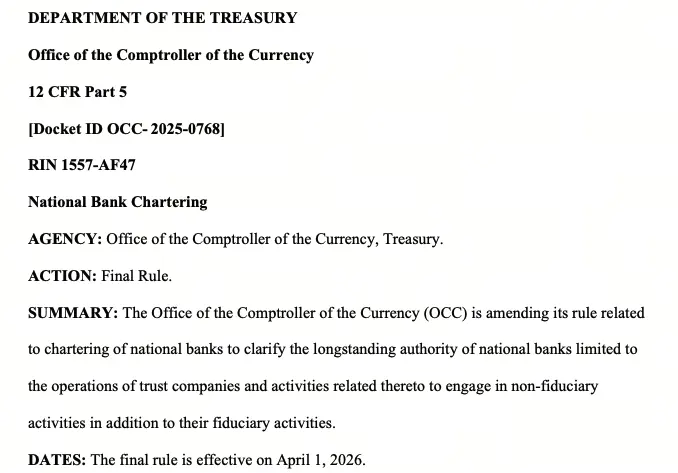
The Office of the Comptroller of the Currency (OCC) announced revisions to regulations related to national bank charters, officially permitting national trust banks to engage in non-trust activities while performing trust duties, thereby eliminating previous industry concerns about the compliance of such activities. For Ripple, Circle, and other companies that have conditionally received national trust bank licenses, this regulation opens a crucial pathway into the U.S. banking system.
OCC Revises Trust Bank Regulations: Key Policy Insights
 (Source: OCC)
The final OCC regulation confirms that national trust banks can conduct ancillary banking activities beyond solely trust services. Previously, there was industry concern: whether companies holding trust charters had the authority to engage in broader banking operations. The OCC’s final ruling explicitly answers this question — yes, they can.
Major crypto companies with conditional OCC trust bank licenses
Ripple: Expanding crypto asset custody services; recently partnered with Figment to extend custody to staking services on Ethereum and Solana.
Circle: USDC stablecoin issuer; leveraging this to strengthen its business presence within the U.S. banking compliance framework.
Paxos: Deepening its involvement in blockchain settlement; expanding institutional services through bank system integration.
This is a significant policy victory for the cryptocurrency industry, which has actively advocated for the finalization of these rules. Such integration further accelerates the convergence of cryptocurrencies and traditional finance (TradFi).
Federal Reserve’s Simplified Master Account Program: The Next Step for Crypto Access to Payment Systems
In addition to OCC policies, the Federal Reserve is advancing a “Simplified Master Account” plan, which, if implemented, would allow companies like Ripple and Circle limited access to the Fed’s payment system. Fed Governor Chris Waller proposed this plan, with plans to announce related regulations in Q4 of this year.
However, this plan faces clear resistance. The crypto industry and banking sector are at odds; banks believe crypto companies should not have direct access to the Fed’s payment system, and the Colorado Bankers Association has warned that such accounts could facilitate rapid fraud.
Fed Governor Michelle Bowman stated during a Senate Banking Committee hearing that the Fed is working with other banking regulators to develop regulations covering capital and liquidity requirements for stablecoin issuers (including those mandated by the GENIUS Act), clarifying which digital asset activities are permitted, and is open to providing regulatory feedback on new use cases. The regulatory framework for crypto companies entering the U.S. banking system is gradually taking shape, though final rules will take time to implement.
Frequently Asked Questions
Q: What does the OCC new regulation mean for Ripple?
A: The OCC allows national trust banks to engage in non-trust activities (including non-trust custody services), enabling Ripple, which has received conditional approval, to hold and manage customer crypto assets within a compliant framework without traditional fiduciary responsibilities. This provides a clear legal basis for Ripple’s entry into the U.S. banking system and expansion of institutional custody services.
Q: Besides Ripple, which other crypto companies benefit from the OCC new regulation?
A: Circle, Paxos, and Crypto.com have also received conditional approval for OCC national trust bank licenses, benefiting from this regulatory revision alongside Ripple, marking the first tier of crypto firms integrating into the regulated U.S. banking system.
Q: How are the Fed’s Simplified Master Account plan and the OCC regulation related?
A: Both are complementary pathways for crypto companies to access the U.S. financial system. The OCC regulation addresses the scope of trust bank activities; the Fed’s plan further allows these companies to directly connect to the payment system, though it faces greater resistance from the banking industry and is still under development.
Disclaimer: The information on this page may come from third parties and does not represent the views or opinions of Gate. The content displayed on this page is for reference only and does not constitute any financial, investment, or legal advice. Gate does not guarantee the accuracy or completeness of the information and shall not be liable for any losses arising from the use of this information. Virtual asset investments carry high risks and are subject to significant price volatility. You may lose all of your invested principal. Please fully understand the relevant risks and make prudent decisions based on your own financial situation and risk tolerance. For details, please refer to
Disclaimer.
Related Articles
Ethereum Governance Solution Tally Announces Shutdown, Gradual Operations Halt Begins by Month's End
Ethereum governance solution Tally announced its shutdown after five years of operations, citing unfavorable market conditions and lack of business model support. CEO Bertram stated that the feasibility of token issuance could not be determined. Tally will gradually cease operations by the end of this month, but will work with enterprise clients to develop transition plans.
GateNews57m ago
PayPal Stablecoin PYUSD Expands to 70 Markets Globally, Now Available in Singapore and Colombia
PayPal announced that its USD stablecoin PYUSD has expanded to 70 markets globally, including Singapore and several countries in South America, allowing users to conduct real-time cross-border remittances at lower costs. PYUSD is regulated and offers reward programs, which enhances user asset retention incentives and accelerates capital flow, improving merchant operational flexibility.
ChainNewsAbmedia1h ago
PayPal Stablecoin PYUSD Expands to 70 Countries in Latin America and Asia-Pacific, Simultaneously Opens Retail Token Holding Yield Earning
Payment giant PayPal announced on March 17 that its stablecoin PayPal USD (PYUSD) is expanding to 70 markets globally, offering low-cost cross-border payment services. Users can hold PYUSD to earn rewards, and B2B settlement times are significantly reduced to just minutes, demonstrating PayPal's aim to leverage blockchain technology to disrupt the traditional payment system.
動區BlockTempo5h ago
CFTC approves! Phantom Wallet receives a "no-action exemption," allowing the integration of compliant derivatives trading
The U.S. CFTC issued a no-action letter to crypto wallet developer Phantom, permitting it to integrate regulated derivatives trading interfaces without registering as a broker. The exemption comes with three major compliance requirements, including risk and conflict of interest disclosures, marking a gradual blurring of lines between DeFi and traditional markets, with significant implications for clarifying regulation of non-custodial wallets.
動區BlockTempo7h ago
AI is no longer the exclusive domain of tech giants! Tether launches QVAC—has the moment arrived for everyone to have their own LLM?
Tether announced that its AI infrastructure, QVAC Fabric, has launched the world's first cross-platform BitNet LoRA fine-tuning framework, enabling large language models to be trained on consumer-grade hardware. This technology allows devices like smartphones to complete model fine-tuning, significantly reducing AI development costs, enabling AI decentralization, and making it possible to use AI anytime and anywhere in the future.
ChainNewsAbmedia9h ago
HSBC and Standard Chartered Near Hong Kong Stablecoin Licenses
Hong Kong regulators received 36 stablecoin license applications but plan to approve only a few issuers.
HSBC and Standard Chartered are expected among the first licensed HKD stablecoin issuers.
The licensing framework builds on a sandbox program launched in 2024 to test stablecoin
CryptoFrontNews9h ago


