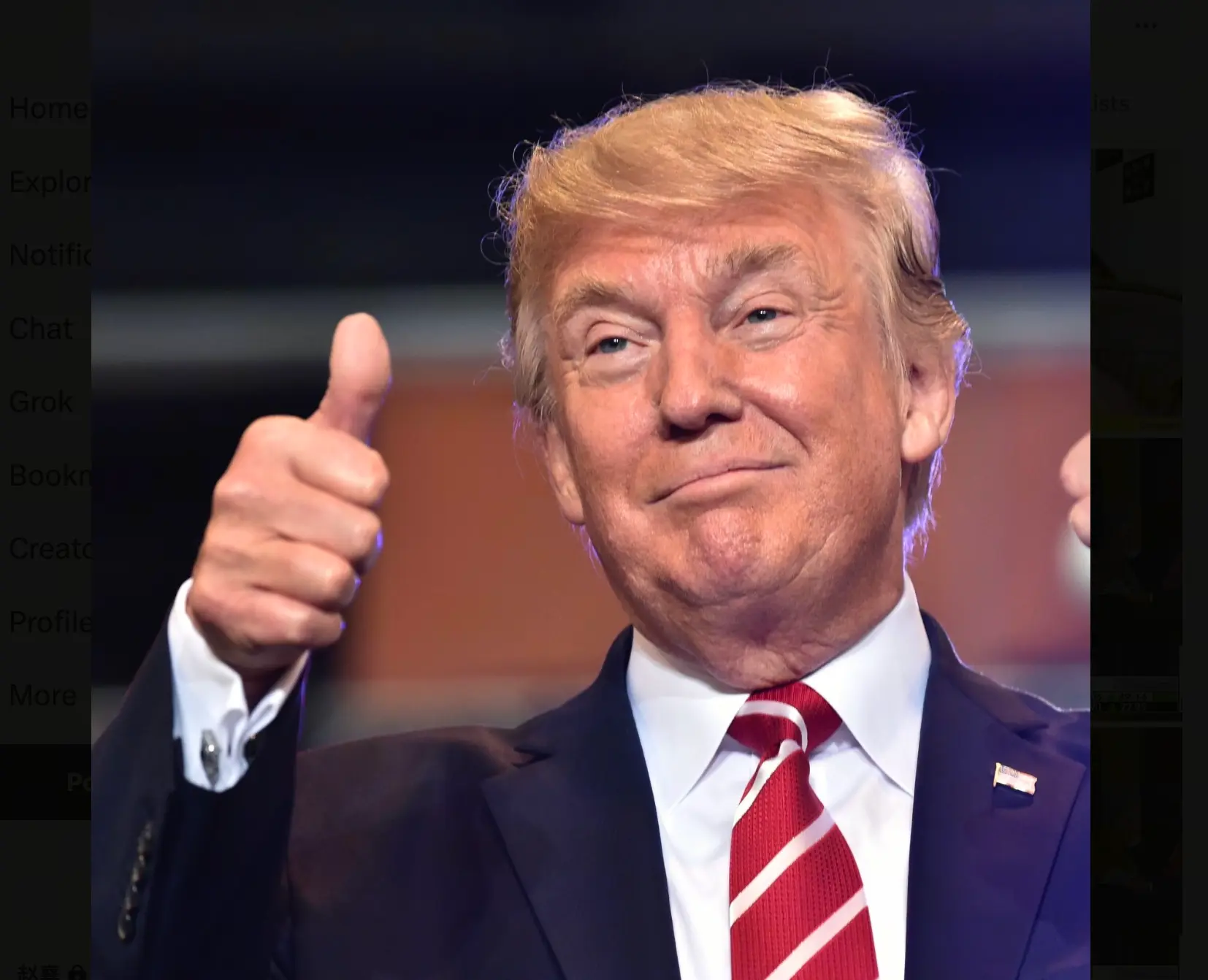
On February 9, 2026, a clip from a Donald Trump interview ignited viral confusion, appearing to show him regret his nomination of Kevin Warsh for Federal Reserve Chair.
In full context, Trump was labeling his 2017 choice of Jerome Powell over Warsh a “big mistake,” while lavishly praising his current nominee. This distinction is critical, as Trump’s exuberant support—including a wildly optimistic 15% growth target—signals an intense White House push for a dramatically more accommodative Federal Reserve. For financial and crypto markets, this represents a potential regime shift: from the inflation-fighting posture of the early 2020s toward a growth-at-all-costs, liquidity-friendly monetary policy that could re-inflate asset prices across the board.
The Viral Misdirection: Dissecting Trump’s “Mistake”
The market-moving event of February 9th was not a policy announcement, but a classic case of narrative fragmentation in the social media age. A truncated video clip of Donald Trump on Fox Business, containing the phrase “I made a big mistake,” spread rapidly across platform X. The out-of-conclip catalyzed immediate speculation: was the former President already backtracking on his high-profile nomination of Kevin Warsh to lead the Federal Reserve?
The full interview context revealed a different, more significant story. Trump’s regret was historical, not current. He was reflecting on his 2017 decision to heed then-Treasury Secretary Steven Mnuchin’s advice and appoint Jerome Powell instead of Warsh, whom he called the “runner-up” at the time. Far from expressing doubt about his present choice, Trump used the segment to champion Warsh as a “high-quality person” capable of extraordinary performance.
The most jaw-dropping moment was Trump’s projection that under Warsh, the U.S. economy could achieve growth “as much as 15%”—a figure so far beyond historical norms that it instantly framed the coming Fed tenure not as a steady custodianship, but as a high-stakes experiment in aggressive stimulus. The viral confusion, ultimately clarified by fact-checkers and full-video posts, obscured the real headline: the President is setting historically unprecedented expectations for his incoming Fed Chair, telegraphing intense political pressure for loose money.
The Mechanism: From Political Signal to Market Repricing
The chain reaction from Trump’s comments to market movements is a masterclass in forward-looking price discovery. Markets are not reacting to a change in current interest rates, but to a profound shift in the expected future path of monetary policy. The mechanism works through a recalibration of the “Fed put”—the belief that the central bank will intervene to support markets.
First, Trump’s explicit linkage of Warsh to turbocharged growth and his disdain for Powell’s relative restraint is interpreted as a direct political command for lower interest rates. Analysts and traders infer that Warsh’s confirmation hearing and subsequent policy will align with this executive branch preference for abundant liquidity. This leads to a repricing of forward rate curves, with expectations for rate cuts in 2026 and 2027 increasing.
Second, the comments fuel speculation about a return to quasi-fiscal monetary policies, reminiscent of yield curve control or direct coordination between the Treasury and Fed to fund government spending at low rates. Such policies, which blur the line between monetary and fiscal authority, are highly inflationary for asset prices. The beneficiary of this shift is anything sensitive to liquidity and low yields: growth stocks, long-duration bonds, and particularly non-yielding, speculative assets like cryptocurrencies.
The entities under pressure are those positioned for sustained high rates and Fed independence, such as the U.S. dollar and traditional inflation hedges that might be overwhelmed by massive liquidity. The immediate market response—speculation in crypto and risk assets—is a bet that the Fed’s primary mandate under Warsh will shift from price stability to facilitating growth and managing government debt, a fundamental change in the rules of the game.
Deconstructing the “Warsh Policy Put”: A Three-Part Market Thesis
The Growth Mandate Override: Trump’s 15% growth target is politically untethered from economic reality, suggesting the administration will prioritize visible economic expansion over controlling inflation, leading to a permissive Fed.
The Liquidity Guarantee: The explicit preference for Warsh over the more independent Powell is read as a guarantee that the Fed will ensure deep, cheap liquidity to fuel government initiatives and financial markets, reviving the “everything rally.”
The Institutional Green Light: Warsh’s known, measured openness to financial innovation (including crypto) provides a cover of legitimacy for this shift, allowing markets to price in not just liquidity, but potential regulatory tailwinds for digital assets.
The Crypto Angle: Digital Assets as a Primary Liquidity Conduit
For the cryptocurrency sector, the Warsh narrative is particularly potent. It provides a macro-economic rationale for a bull run that transcends niche adoption cycles. In this new paradigm, Bitcoin and other major digital assets are not just technological bets; they are viewed as high-beta, non-sovereign liquidity sinks.
Historically, when the market anticipates expansive Fed policy, capital flows into assets perceived as hedges against currency debasement. Gold often plays this role. However, the modern, digital-era version of this trade increasingly includes Bitcoin and, by correlation, the broader crypto complex. A Warsh Fed promising ample liquidity is seen as weakening the long-term value proposition of the U.S. dollar, making finite, decentralized digital assets comparatively more attractive.
Furthermore, Warsh’s personal history—with investments in crypto projects like Basis and Bitwise—provides a tangible, if often overstated, connection. The market is not betting that Chair Warsh will directly endorse Bitcoin; it is betting that the macro-environment he is appointed to create is structurally bullish for hard, digital assets. This turns crypto from a peripheral risk-on asset into a core holding in a portfolio designed for monetary reflation.
Contradictions and Challenges: The Hawkish Past vs. the Dovish Future
The most intriguing tension in this market narrative is Kevin Warsh’s own established reputation. His record as a Fed Governor (2006-2011) and his public writings peg him as an inflation hawk and a critic of an overly large Fed balance sheet. He has advocated for fiscal restraint and central bank independence. The market’s instantaneous repricing of him as a liquidity dove is a bet not on his personal philosophy, but on his political malleability under intense pressure from the President who appointed him.
This sets up several potential future paths, each with distinct market implications. In one scenario, Warsh conforms to Trump’s vision, leveraging his hawkish credentials to lend credibility to initially aggressive policies before pivoting to sustain growth. In another, a “bait-and-switch” occurs, where Warsh’s confirmation is followed by a reassertion of traditional Fed orthodoxy, leading to a violent market correction as the “policy put” vanishes.
Prediction markets, like Polymarket, which show a 95% probability of Warsh’s confirmation, are betting on the former. The market is essentially judging that in a contest between a Fed Chair’s established ideology and direct, relentless pressure from the White House with a 15% growth target, the political pressure will win. This perceived subordination of the Fed is itself a regime change that reduces long-term economic predictability but increases short-term speculative incentives.
Future Pathways: Scenarios for a Warsh-Led Fed
The trajectory of monetary policy and market performance under a confirmed Chair Warsh is not predetermined. We can envision three plausible scenarios based on the interplay of politics, economics, and personality.
Scenario 1: The Accommodationist (Highest Short-Term Probability)
Warsh fully embraces the growth mandate, overseeing rapid rate cuts, a resumption of balance sheet expansion, and explicit coordination with the Treasury. This validates the current market rally, leading to a powerful, liquidity-driven bull market in risk assets and crypto. However, it plants the seeds for severe inflation and market instability later in the term, potentially making Warsh the “fall guy” Trump’s critics predict.
Scenario 2: The Institutionalist (Significant Medium-Term Risk)
After confirmation, Warsh surprises markets by reverting to his hawkish instincts, prioritizing Fed independence and inflation control once in office. This would cause a sharp, painful reversal in markets—a “policy tantrum” where the promised liquidity fails to materialize. Crypto, as the most speculative segment, would likely experience a deep correction as the macro tailwind vanishes.
Scenario 3: The Pragmatic Manager (Most Complex Path)
Warsh attempts a middle course, providing enough accommodation to satisfy political demands while using his credibility to gradually temper expectations and prevent the economy from overheating. This would result in a volatile, whipsawing market that trades on every nuance of Fed communication, benefiting tactical traders but creating anxiety for long-term investors.
Practical Impact on Traders, Institutions, and Long-Term Holders
Different market participants must navigate this uncertainty with distinct strategies.
For agile traders and hedge funds, the immediate play is to position for increased volatility and correlation between traditional finance and crypto. Strategies might include long positions in Bitcoin futures paired with shorts in the U.S. dollar index, or options plays on the CBOE’s Volatility Index (VIX) to hedge against a potential narrative collapse.
For institutional allocators and family offices, the implication is a reassessment of strategic asset allocation. If the “Fed put” is now explicitly political and aimed at growth, the case for increasing portfolio exposure to alternative stores of value—including a dedicated allocation to Bitcoin—strengthens. It becomes a hedge against policy success (inflation) rather than just policy failure.
For long-term crypto holders and builders, the macro shift provides a valuable tailwind but also a warning. Capital may flow in more easily, but the sector’s fate becomes more tightly coupled to Washington politics than to technological milestones. The focus must remain on building durable utility, as macro-driven rallies can reverse just as quickly. The key is to use any liquidity-fueled bull market to strengthen fundamentals, not just celebrate price appreciation.
Who is Kevin Warsh? A Profile of the Nominee
What is Kevin Warsh’s Background? Kevin Warsh is a former Federal Reserve Governor, serving from 2006 to 2011 during the Global Financial Crisis. He previously worked at Morgan Stanley and served in the White House. He is currently a distinguished visiting fellow at the Hoover Institution and a lecturer at Stanford University’s Graduate School of Business.
His Policy Positioning (Pre-Nomination): Warsh has been publicly critical of the Fed’s post-2008 extended balance sheet expansion, warning of financial distortions and asset bubbles. He has emphasized the importance of market signals and advocated for a rules-based, predictable monetary policy to preserve Fed independence.
His Connection to Crypto: Warsh has personal investment exposure to the digital asset space, having invested in projects like the Basis stablecoin (which later shut down) and Bitwise Asset Management. His public comments have framed Bitcoin primarily as a potential store of value or “digital gold,” displaying a cautious, institutional curiosity rather than a revolutionary zeal. This nuanced understanding makes him a unique figure: a Fed nominee with firsthand experience in the crypto ecosystem, yet grounded in traditional central banking orthodoxy.
Conclusion: The Dawn of Politicized Liquidity
The viral confusion over Trump’s “big mistake” ultimately clarified a far more consequential truth: the U.S. is embarking on a deliberate experiment in** **politically-directed monetary policy. The nomination of Kevin Warsh is not merely a personnel change; it is the vehicle for a stated goal of unprecedented growth, with the implicit promise of the liquidity required to pursue it.
For markets, this represents a fundamental shift in the source of price direction. Alpha will increasingly be found not in predicting corporate earnings, but in decoding political intentions and their translation into central bank actions. Cryptocurrency, often dismissed as a speculative bubble, may find its next major valuation chapter written not by Satoshi Nakamoto, but by the political pressures exerted on the Federal Reserve.
The Warsh nomination, therefore, is a signal that the 2026-2030 market cycle will be defined by the tension between political demands for growth and economic limits of inflation. Whether Warsh becomes the architect of a new prosperity or the scapegoat for its inevitable excesses, his tenure will be defined by the 15% growth target that has already begun to reshape the investment landscape. In this new regime, all assets, from Treasuries to Bitcoin, will be revalued through the lens of politicized liquidity.


