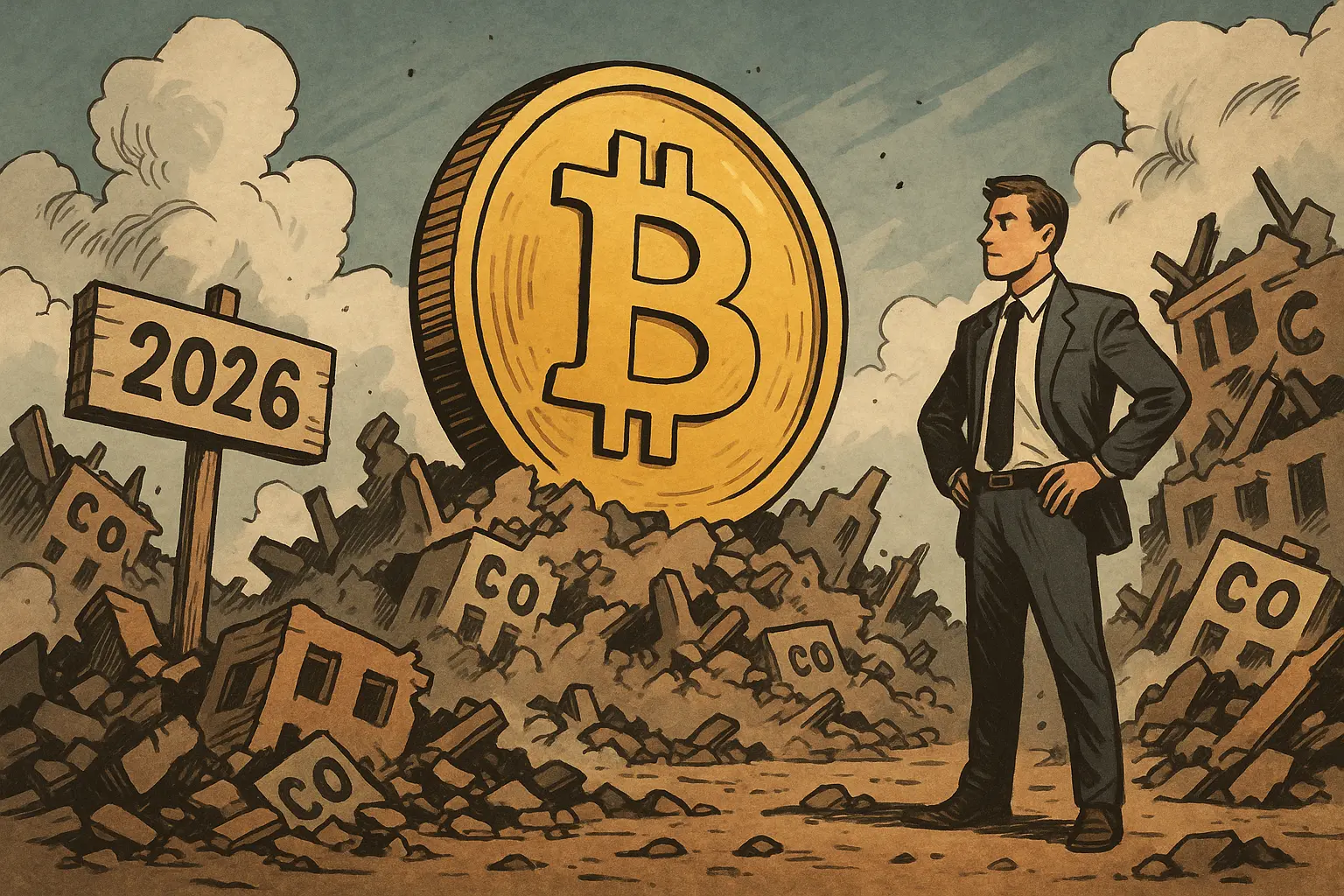
Digital Asset Vaults (DAT) companies face a survival crisis. MoreMarkets CEO Altan Tutar stated that looking ahead to 2026, the prospects for DAT are bleak, with most disappearing. The number of crypto treasury companies surged from 70 in 2025 to over 130, but after Bitcoin’s peak, their stock prices plummeted, and their market caps even fell below the value of their crypto holdings. The market warns that these companies are unlikely to survive the next recession.
mNAV Collapse: The Fatal Flaw of Altcoin Asset Vaults

(Source: YouTube)
The core valuation metric for digital asset vault companies is mNAV (Market Value Net Asset Ratio), which is the ratio of a company’s market cap to the value of its held crypto assets. When mNAV is greater than 1, it indicates that the market perceives the company to have additional value beyond its crypto holdings. However, when mNAV drops below 1, investors question: why not just buy cryptocurrencies directly instead of through a company with a market cap lower than its holdings?
Tutar clearly pointed out that crypto funds focused on altcoins “will be the first to be hit,” because they cannot sustain an mNAV above 1. This collapse is already happening. After Bitcoin reached its peak in October, the overall crypto market declined, causing many DAT companies’ mNAVs to enter a “roller coaster” pattern, crushing investor confidence.
More severely, Tutar predicts that “flagship DATs with large assets like Ethereum, Solana, and XRP will soon follow.” This means that even digital asset vault companies focusing on mainstream coins are not immune to elimination. The reason is that their business models are too simplistic: merely buying and holding cryptocurrencies, waiting for prices to rise. This strategy works in a bull market but becomes completely unattractive in a bear or sideways market.
Those funds performing worse and having to sell crypto assets to cover operational costs face even greater problems. Chow pointed out that these companies “view accumulation as a marketing strategy, without proper fund frameworks to support it.” When operating costs continuously drain cash flow, and crypto assets depreciate, these companies are forced to sell holdings, further lowering mNAV and creating a death spiral.
Rise of ETFs: The Shrinking Survival Space for Digital Asset Vault Companies
The rapid development of cryptocurrency ETFs is the biggest threat to digital asset vault companies. First Digital CEO Vincent Chok said investors are turning to crypto ETFs as a simple way to gain “regulated exposure” to digital assets. Compared to digital asset vaults, ETFs have multiple advantages: higher liquidity, lower trading costs, greater regulatory transparency, and no operational risk for the company.
By 2025, as US regulators relax rules on yield offerings, asset management firms are launching ETF products that include staking yields. This directly erodes the differentiation advantage of digital asset vaults that offer “additional yields.” Investors can now gain exposure to crypto assets and staking yields through a single ETF, without needing to buy shares of a complex-operating digital asset vault company whose mNAV might fall below 1.
Even more critically, ETF expense ratios typically range from 0.2% to 0.5%, far lower than the operational costs of digital asset vaults. These vaults need to maintain management teams, compliance departments, and technical infrastructure, which ultimately erodes shareholder value. When ETFs can provide the same or better services at lower costs, the fundamental value of digital asset vaults is called into question.
Chok emphasized that the digital asset vault model needs to evolve to “meet TradFi’s expectations for transparency, auditability, and compliance.” He suggested that digital asset vaults “partner with professional TradFi infrastructure to ensure operations meet institutional standards for token screening and asset management.” However, this transformation requires significant investment and time, which most small to medium-sized digital asset vaults cannot afford.
Three Key Traits of Survivors in 2026
Sustainable Revenue Generation: Capable of generating ongoing income through on-chain tools, staking, or lending strategies, and passing these yields to shareholders, rather than relying solely on price appreciation.
Structured Capital Management Framework: Treating crypto assets as digital capital with active management, featuring professional risk controls and asset allocation strategies, rather than speculative hoarding.
Institutional-Level Transparency and Compliance: Meeting the expectations of institutional investors for transparency, auditability, and compliance, enabling competition with ETFs on equal footing.
From Speculation to Structured Finance Paradigm Shift
Chow emphasized: “This model needs to shift from speculative to structured financial management. Digital asset vault holders should not just hold Bitcoin, but consider actively managing their holdings as digital capital within a transparent, yield-generating system.” This statement highlights the fundamental difference between 2026 survivors and those eliminated.
Tutar believes that the most likely winning crypto purchasing companies are those that, besides holding large crypto reserves, can also provide additional value—such as “delivering strong, sustained returns on their crypto holdings and passing these returns to stakeholders.” This extra value could include: on-chain lending yields, market-making services, cross-chain arbitrage strategies, or institutional-grade custody solutions.
Chow pointed out that the digital asset vault companies that will reap the greatest benefits in 2025 are those using “on-chain tools to generate sustainable yields or collateralize assets to gain liquidity during market downturns.” These companies not only benefit from price increases in a bull market but, more importantly, can generate cash flow during bear or sideways markets, maintaining mNAV above 1.
First Digital’s Chok emphasized that successful digital asset vaults “possess disciplined asset allocation strategies, operational liquidity, and view Bitcoin as part of their financial planning, not the entire strategy.” This means diversified allocations, maintaining sufficient cash reserves for operations, and treating crypto assets as long-term strategic assets rather than short-term speculative tools.
For the upcoming 2026 wipeout, investors should reassess the investment value of digital asset vault companies. Those relying solely on the “buy-and-hold” narrative may see their stock prices sharply shrink within the next 12 months. Conversely, companies capable of providing structured yields, meeting institutional standards, and establishing TradFi partnerships may emerge as true winners after the shakeout. This is not just a survival race but a crucial turning point for the crypto industry’s shift from speculation to maturity.
Disclaimer: The information on this page may come from third parties and does not represent the views or opinions of Gate. The content displayed on this page is for reference only and does not constitute any financial, investment, or legal advice. Gate does not guarantee the accuracy or completeness of the information and shall not be liable for any losses arising from the use of this information. Virtual asset investments carry high risks and are subject to significant price volatility. You may lose all of your invested principal. Please fully understand the relevant risks and make prudent decisions based on your own financial situation and risk tolerance. For details, please refer to
Disclaimer.
Related Articles
Two newly created addresses withdrew 9,519 ETH from a certain CEX, worth about $20 million.
Gate News message: On April 1, according to Onchain Lens monitoring, two newly created addresses jointly withdrew 9,519 ETH from a certain CEX, worth approximately $20 million.
GateNews1m ago
From Ethereum Knowledge Into Opportunity: Bitcoin Everlight App Now Offering 21% APY Rewards
In early 2026, Ethereum staking continues to expand despite the sustained turbulence in prices across the broader cryptocurrency market. Participation in protocol staking remains high even as the returns compress. This reinforces Ethereum’s role as one of the core infrastructure assets while
CryptoPotato36m ago
Base58 Labs’ BASIS 2026 Blueprint Forges a New Standard for BTC, ETH, SOL & PAXG
[PRESS RELEASE – London, UK, March 17th, 2026]
New roadmap positions BASIS as an institutional-grade digital asset management platform built for macro volatility, tokenized safe-haven demand, and frictionless Web3 onboarding.
Base58 Labs today unveiled the BASIS 2026 Technical Blueprint &
CryptoPotato43m ago
The Good and Bad News for Ethereum (ETH) After Dumping Below $2K
ETH joined the market-wide correction over the past few days, dropping from $2,200 to a three-week low of $1,970 before it recovered slightly to the current $2,000.
This is the asset’s most crucial level for the time being, and it’s close to breaking below it. As such, analysts have rushed to
CryptoPotato44m ago
BTC & ETH Entering a New Era? Analysts Say Yes — This Platform Is Already Paying Real BTC Rewards
Grayscale called it the “dawn of the institutional era.” Bitwise predicted Bitcoin will break its four-year cycle and set new all-time highs. Bitcoin Suisse published a scenario where Bitcoin approaches $180,000 and Ethereum reaches $8,000 on the back of Fed rate cuts and accelerating institutiona
CryptoPotato1h ago
Could the Iran war be nearing an end? U.S. stocks rally broadly, and Bitcoin rebounds to 68K
As investors expected the Iran war might come to an end, the three major U.S. stock indexes surged sharply, and the cryptocurrency market rose across the board as well. Bitcoin rebounded to around 68K. Iran’s president said he is willing to end the fighting, but it must be guaranteed that there will be no more aggression. U.S. economic data showed consumer confidence is improving, but analysts warned that optimism may be premature.
ChainNewsAbmedia1h ago


