December 29, Bitcoin price opened this week’s trading near $87,800, with a slight intraday increase of about 0.8%, and a 24-hour trading volume reaching $13.6 billion. Despite remaining in extreme fear territory, institutional investors are adding to their positions against the trend. MicroStrategy currently holds 671,268 BTC, valued at approximately $58.6 billion. The TradFi banking sector in the US and UAE is showing unprecedented interest.
MicroStrategy’s 670,000 BTC Holdings Reveal Institutional Confidence
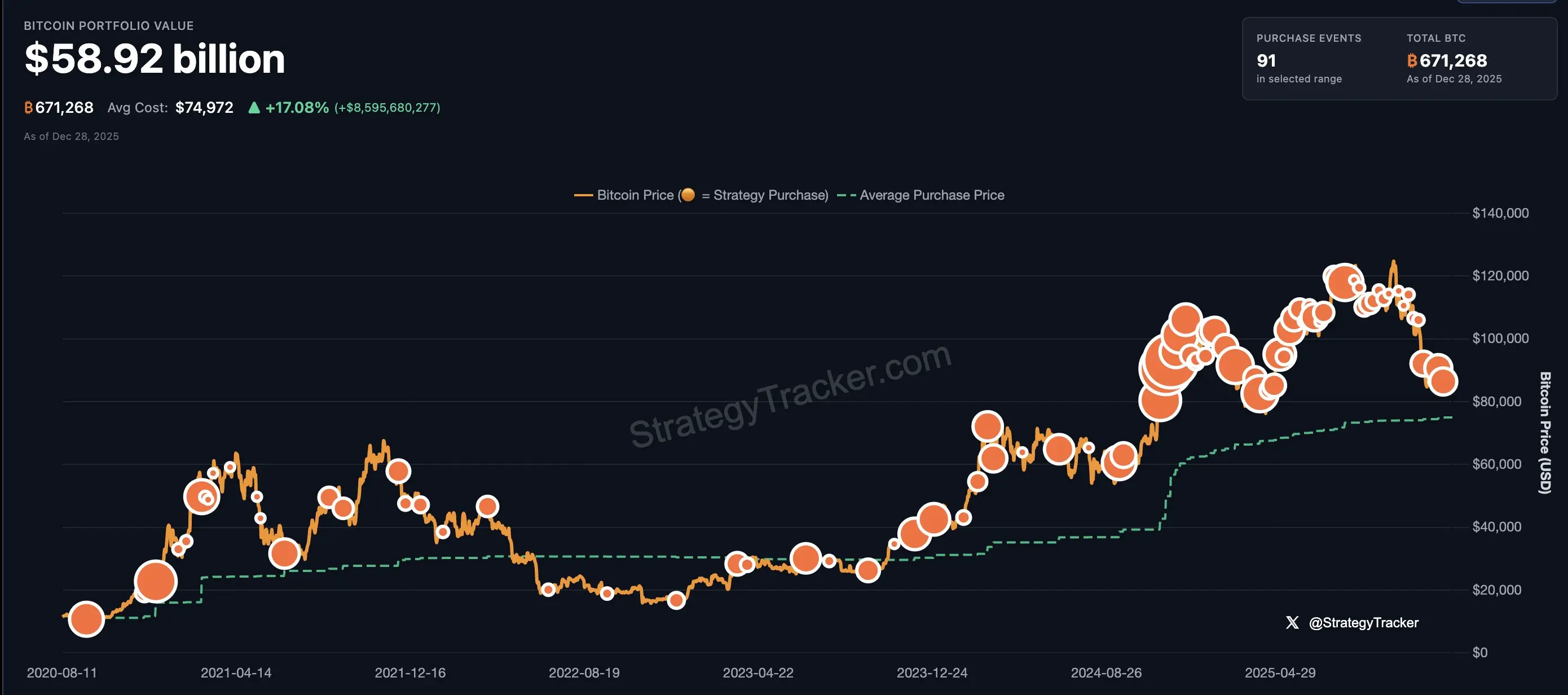
(Source: StrategyTracker)
Why did Bitcoin rise today? The most direct answer comes from continuous institutional buying. MicroStrategy CEO Phong Le recently stated on the Coin Stories podcast that short-term price fluctuations and long-term adoption trends are often confused by the market. Although Bitcoin’s price has fallen about 30% from its October all-time high of $126,080, its fundamentals are rarely as strong as they are now.
On December 28, MicroStrategy founder Michael Saylor posted again on X platform about Bitcoin Tracker, which may disclose additional holdings data this week.
MicroStrategy itself has demonstrated firm support for Bitcoin, currently holding up to 671,268 BTC, worth about $58.6 billion at current prices. More intriguingly, the company’s stock trading price is currently below the value of its Bitcoin holdings, indicating a discount that reflects market focus on short-term movements rather than fundamentals. From MicroStrategy’s cost basis perspective, even if Bitcoin prices fluctuate within the current range, the company continues to accumulate rather than reduce holdings. This contrarian behavior exemplifies smart money acting in extreme panic.
The persistence of institutional buying is key to understanding why Bitcoin rose today. Unlike retail investors who tend to exit when the fear index hits bottom, institutions like MicroStrategy have longer investment horizons and deeper research capabilities. Their buying decisions are based on long-term judgments of Bitcoin’s supply mechanism, global monetary policies, and digital asset penetration, rather than short-term chart fluctuations. This difference in capital nature makes the current price range an ideal window for institutions to accumulate.
Three Major Signals of Changing Attitudes in TradFi Banking Sector
US banking regulation easing expectations are rising. Phong Le specifically mentioned that the US banking sector’s interest in Bitcoin is unprecedented. This shift is not sudden but the result of gradually clarifying regulatory environments. The Office of the Comptroller of the Currency (OCC) in the US has shifted from strict restrictions to cautious openness regarding banks holding crypto assets, with several regional banks exploring Bitcoin custody services for clients.
UAE becomes a Bitcoin hub in the Middle East. The active participation of UAE banks provides a geopolitical dimension to today’s Bitcoin rise. Dubai and Abu Dhabi have become global centers for digital assets, with local banks not only providing fiat channels for crypto exchanges but also directly involved in designing Bitcoin-related financial products. This deep integration of TradFi and native crypto enterprises is creating new liquidity sources.
Fundamental Changes in Bank Asset Allocation Logic. Previously, TradFi institutions viewed Bitcoin as a speculative tool, but with Bitcoin ETFs approved in the US and hundreds of billions of dollars flowing in, banks are beginning to incorporate it into their asset allocation frameworks. From a risk hedging perspective, Bitcoin’s low correlation with traditional stocks and bonds makes it an effective tool for institutional diversification.
Technical Outlook Shows Potential for Breakout After Compression
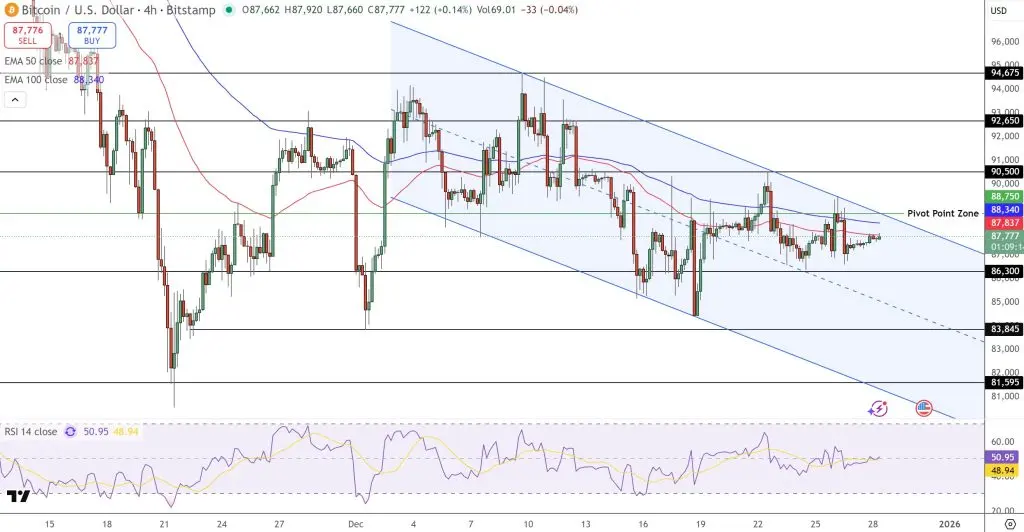
(Source: Trading View)
From the 4-hour chart, Bitcoin is currently in a descending channel, with the upper boundary around $94,600 and the lower boundary around $86,300. The current price at $87,800 is near the lower channel line, which often indicates the short-term direction. The appearance of many spinning top and doji candlestick patterns suggests upward momentum has stalled but not reversed, and the market is waiting for a new catalyst.
Bitcoin’s price is oscillating between the 50-day and 100-day moving averages, indicating a balanced medium-term trend. The Relative Strength Index (RSI) hovers around 50, neither overbought nor oversold, showing a temporary equilibrium of bulls and bears. Under continued institutional buying support, this setup often leads to an upward breakout rather than a breakdown.
If Bitcoin breaks above $88,600, the chart indicates it could test $90,500, with further upside targets at $92,500. This stair-step upward pattern aligns with typical institutional accumulation behavior, as large buy orders tend to be placed in batches at key resistance levels, forming clear step structures. Conversely, if Bitcoin fails to hold $86,300, the next support is at $84,450, an area with significant previous trading volume and strong support.
Extreme Fear Index Signals Nearing Reversal
Since mid-December, the crypto Fear & Greed Index has remained in extreme fear territory, currently around 22. Historical data shows that when this index stays below 25 for an extended period, it often marks an extreme sentiment zone, followed by technical rebounds or trend reversals. This is not because fear itself disappears, but because most of the selling pressure has been released during extreme panic, leaving long-term believers holding positions at lower costs, less affected by short-term volatility.
Another reason for today’s Bitcoin rise is that some investors are beginning to realize the disconnect between current extreme fear and improving fundamentals. On one hand, the fear index has bottomed out; on the other, institutional holdings are at record highs, and TradFi banking attitudes are shifting. This divergence often signals that prices are about to correct the mispricing relative to fundamentals. In terms of capital distribution, Bitcoin’s market cap is $1.75 trillion, with a daily trading volume of $13.6 billion. This liquidity level indicates the market is not experiencing panic selling but is in a controlled range-bound oscillation.
Market Outlook: Consolidation or Deep Correction
Currently, Bitcoin is not in a collapse but more in a stagnation phase, waiting for the next move. Given the ongoing institutional support and stable supply levels, this consolidation period should be viewed as preparation for the next cycle rather than a reason for excessive fear. Phong Le emphasizes that the participation of TradFi banks will play a larger role in the coming years, and this structural change’s impact cycle far exceeds short-term price fluctuations.
For traders, the clear operational framework for today’s Bitcoin rise is: if the price breaks above $88,600 and sustains, with increased volume, it confirms a short-term rebound trend. If it falls below $86,300, attention should be paid to the support at $84,450. However, considering institutional holdings and TradFi involvement, the probability of a rebound after a deep correction is increasing.
Disclaimer: The information on this page may come from third parties and does not represent the views or opinions of Gate. The content displayed on this page is for reference only and does not constitute any financial, investment, or legal advice. Gate does not guarantee the accuracy or completeness of the information and shall not be liable for any losses arising from the use of this information. Virtual asset investments carry high risks and are subject to significant price volatility. You may lose all of your invested principal. Please fully understand the relevant risks and make prudent decisions based on your own financial situation and risk tolerance. For details, please refer to
Disclaimer.


