CZ has urged cryptocurrency wallets to implement stronger defenses against “address poisoning” scams following a high-profile incident where an investor lost approximately $50 million in USDT.
- CZ advocates for automated blocking of spoofed addresses, hiding dust spam, and enhanced send warnings.
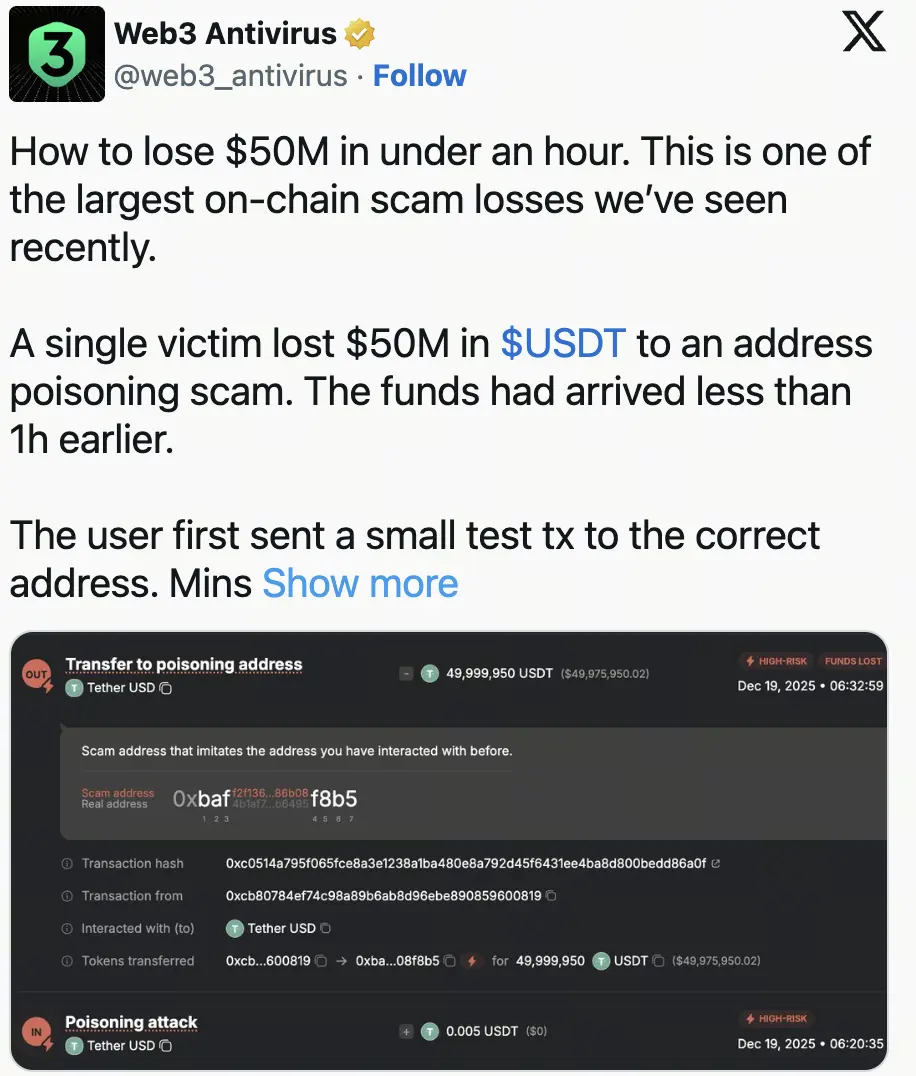
- The December 19 theft saw a whale accidentally transfer 49,999,950 USDT to a look-alike address.
- Crypto exchange security monitors millions of poisoned addresses; phishing losses remain a major sector threat.
(Sources: X)
In a post titled “Let’s Eradicate the Poison Scams,” CZ proposed industry-wide measures to combat address poisoning at the wallet level. He noted that exchange Wallet already incorporates such checks and called for broader adoption to protect users proactively.
How Address Poisoning Scams Work
Address poisoning exploits user habits by sending small “dust” transactions from fake addresses designed to mimic legitimate ones in your history—often differing by just one or two characters.
Victims later copy the poisoned address when intending to send funds to a trusted contact, unknowingly routing assets to scammers.
The recent case involved a large holder mistakenly pasting a spoofed address from their transaction log, resulting in the near-$50 million USDT transfer. On-chain analysis shows the attacker rapidly split and laundered proceeds, routing portions through mixers like Tornado Cash.
Cointelegraph reports internal detection has flagged ~15 million poisoned addresses network-wide. ScamSniffer recorded $7.77 million in phishing-related losses across 6,344 victims in November alone, while CertiK estimates total 2025 crypto thefts at $3.3 billion—with phishing and wallet exploits a leading cause.
CZ’s Proposed Wallet-Level Solutions
CZ outlined practical features wallets should adopt:
- Blacklist Integration: Query real-time databases of known poisoned addresses and block/warn before confirming sends.
- Dust Spam Filtering: Automatically hide negligible “dust” transfers that clutter histories and enable poisoning.
- Smart Warnings: Flag potential spoofs (e.g., matching first/last characters) and prompt extra verification when pasting from history.
These changes target human error without requiring protocol-level overhauls, offering a software-based shield against one of crypto’s most prevalent scam vectors.
Why This Matters for the Industry
Address poisoning preys on routine behaviors like copy-pasting, making it both common and devastating. Wallet-side protections could dramatically reduce success rates if implemented broadly.
As self-custody grows in popularity, proactive security at the interface level becomes essential. CZ’s call highlights a collective responsibility: neutralizing high-impact, low-tech exploits through simple but effective UI and backend improvements.
The incident serves as a reminder that even sophisticated users remain vulnerable to social engineering tactics. Wider adoption of these safeguards could mark a meaningful step toward safer everyday crypto interactions.
Disclaimer: The information on this page may come from third parties and does not represent the views or opinions of Gate. The content displayed on this page is for reference only and does not constitute any financial, investment, or legal advice. Gate does not guarantee the accuracy or completeness of the information and shall not be liable for any losses arising from the use of this information. Virtual asset investments carry high risks and are subject to significant price volatility. You may lose all of your invested principal. Please fully understand the relevant risks and make prudent decisions based on your own financial situation and risk tolerance. For details, please refer to
Disclaimer.


