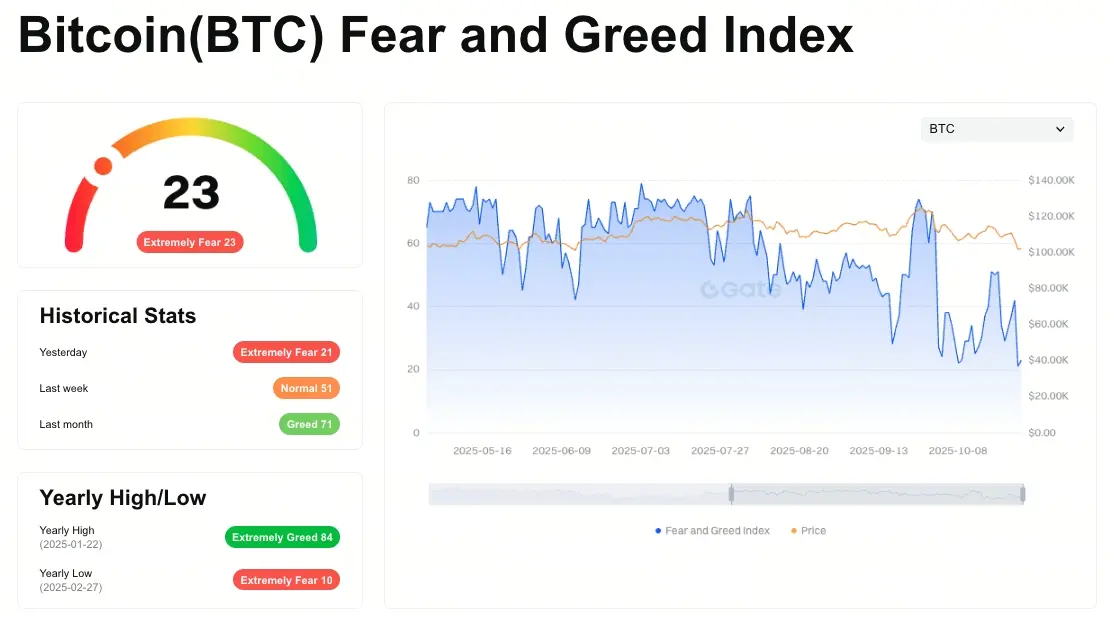
November 5 Cryptocurrency Market Analysis shows that Bitcoin is priced at $102,121, with a low of $98,951. The Fear and Greed Index is at 23 points, indicating an “Extreme Fear” stage, reflecting low investor confidence. In altcoins, GX surged by 43.33%, and NANO increased by 33.89%. Institutional investment continues, with publicly listed companies holding over 1 million coins, and ETH spot trading volume surpassing BTC.
BTC Falls Below $100,000, ETH Trading Volume Overtakes
Bitcoin temporarily fell below the $100,000 mark, with a daily trading range of $98,951-$107,288. Institutional holdings remain strong, with publicly listed companies holding over 1 million coins—a significant milestone indicating that corporate adoption of Bitcoin as a balance sheet asset is accelerating. The 1 million BTC, at current prices, is worth about $1 trillion, representing substantial corporate capital allocation.
On the technical side, Bitcoin is oscillating near $110,000 in the short term, with increased bullish and bearish battles. From today’s cryptocurrency market analysis, the $100,000 level has become a key psychological threshold. Falling below it, the immediate support is at $98,200; if broken, it could test $92,800. Resistance above is at $105,250; a breakout would challenge the $110,000 level again. The death cross of the 50-day and 100-day EMA confirms a short-term bearish dominance, but the oversold RSI at 29 suggests a potential technical rebound.
Ethereum is currently priced at $3,232, down 1.65% in 24 hours, with a 24-hour trading volume of $975 million, trading within a range of $3,057-$3,651. Notably, spot trading volume has surpassed BTC for the first time, indicating ongoing ecosystem development. This is a historic shift, as Bitcoin’s spot volume has traditionally led all other cryptocurrencies. The surpassing of Ethereum’s trading volume may reflect several factors: increased DeFi activity, NFT market recovery, Layer-2 ecosystem prosperity, and rising institutional interest in Ethereum’s smart contract platform.
Technically, Ethereum oscillates around $4,300, with frequent institutional activity. From a cryptocurrency market analysis perspective, Ethereum’s relative strength is slightly below Bitcoin’s, but its overall structure remains healthy. Key support is at the $3,000 psychological level; if broken, a deeper correction may occur. Resistance is at $3,650; a breakout could challenge the $4,000 level.
Core Data Comparison Between BTC and ETH
BTC trading volume: $2.1 billion | ETH trading volume: $975 million (historically surpassing spot volume)
BTC institutional holdings: over 1 million coins | ETH ecosystem: ongoing development
BTC technical outlook: oscillating near $110,000 | ETH technical outlook: oscillating around $4,300
Three Major Altcoins Surge Against the Trend as Safe Havens
In altcoins, GX is priced at $0.000148, up 43.33% in 24 hours, leading the market. NANO is at $1.17, up 33.89%, ranking second. SDN is at $0.033, up 25.77%, ranking third. Such counter-trend surges during overall market declines are rare and indicate capital defensive rotation.
GX’s 43.33% increase may be driven by project-specific positive news or technical breakthroughs. In cryptocurrency market analysis, small-cap coins’ rapid rise is often driven by single catalysts such as exchange listings, partnership announcements, technical upgrades, or community activities. Investors should exercise caution with such surges, as small-cap coins tend to have lower liquidity and are more susceptible to manipulation. Rapid rises are often followed by sharp corrections.
NANO, as an established fast payment coin,’s 33.89% increase may reflect renewed market focus on payment use cases. When Bitcoin and Ethereum transaction fees are high, NANO’s zero fees and instant confirmation advantages can attract capital. SDN (Shiden Network), a smart contract platform in the Polkadot ecosystem,’s 25.77% rise may be related to the overall recovery of the Polkadot ecosystem.
These three altcoins share characteristics of relatively small market cap, unique technical features, and resilience during major coin declines. From a cryptocurrency market analysis perspective, this capital rotation pattern often appears during market adjustments: when large assets lack clear direction, speculative capital flows into smaller assets seeking high returns. However, this rotation is usually short-lived; once mainstream coins stabilize and rebound, capital quickly flows back, and altcoins may rapidly give up their gains.
Fear and Greed Index at 23, Signaling a Bottoming Opportunity in “Extreme Fear”
(Source: Gate)
The Fear and Greed Index stands at 23 points, in the “Extreme Fear” stage, indicating low market sentiment and investor confidence. This is one of the most important indicators in today’s cryptocurrency market analysis. The Fear and Greed Index combines factors such as volatility, trading volume, social media sentiment, market dominance, and trend, with a range from 0 to 100. 0-24 indicates extreme fear, 25-49 fear, 50-74 greed, and 75-100 extreme greed.
A reading of 23 suggests market sentiment is approaching despair. Historical data shows that when the Fear and Greed Index drops to 20-25, it often signals a good medium- to long-term buy opportunity. After the FTX collapse in November 2022, the index fell into single digits, and Bitcoin rebounded from $15,000 to $30,000 over the following months. In early 2023, the index hovered around 20-30, and Bitcoin entered a new bull run.
The current reading of 23 indicates market panic has been largely priced in, with most sellers having exited, leaving mainly long-term believers or low-cost holders, unlikely to continue selling at current levels. This supply exhaustion creates conditions for a price rebound. However, extreme fear could deepen further; if new negative news emerges—such as regulatory crackdowns, exchange collapses, or macro crises—the index could fall below 10, and prices could decline further.
From a liquidity health perspective, BTC and ETH prices are relatively stable, with good trading depth and liquidity, offering short-term arbitrage opportunities. This technical liquidity analysis provides a basic environment for traders’ decision-making. Good liquidity means large trades won’t significantly impact prices, and arbitrage opportunities suggest market pricing efficiency has not been fully lost.
Short-term Trading and Mid-term Allocation Strategies
Short-term trading suggests entering around $100,000 for BTC and $3,200 for ETH. These levels are key supports and psychological thresholds. From a risk-reward perspective in cryptocurrency market analysis, building positions at these levels offers relatively favorable allocation opportunities. If prices rebound from here to recent highs, BTC could gain 10-15%, and ETH 25-30%.
Set take-profit and stop-loss at ±5% for BTC and ±7% for ETH. This asymmetric stop-loss reflects the different volatility profiles of the two assets. Bitcoin, as the largest market cap cryptocurrency, has lower volatility; a 5% stop-loss is sufficient to avoid normal price fluctuations triggering a sale. Ethereum’s higher volatility requires a wider stop-loss. For take-profit, consider scaling out at +10%, +20%, and +30%, selling 30%, 40%, and 30% respectively.
Position management recommends conservative allocation of 20-30%, aggressive 40-50%, with a medium-high risk profile. This tiered approach considers different investors’ risk tolerances. Conservative investors should only allocate 20-30% of total capital to crypto, with the rest in traditional assets or cash. Aggressive investors can increase to 40-50%, but not beyond 50%, given systemic risks in the crypto market.
For mid-term investment, the trend is mainly oscillation and cautious bullishness. Recommended allocation: 60% BTC and 40% ETH, balancing Bitcoin’s stability with Ethereum’s growth potential. Key focus should be on SEC regulatory developments, as any policy changes could significantly impact the market. Scenario analysis suggests maintaining flexible positions and controlling drawdowns, adjusting dynamically based on market changes.
Investment Strategy Framework Summary
Short-term Entry Points: BTC at $100,000, ETH at $3,200
Stop-loss Settings: BTC ±5%, ETH ±7%
Position Allocation: Conservative 20-30%, Aggressive 40-50%
Mid-term Allocation: BTC 60%, ETH 40%
Time Frame: Expect stabilization within 1-3 months
Key Monitoring: SEC regulatory developments, institutional fund flows
Core Risks and Market Outlook
Core risks include systemic risks (global macroeconomic uncertainty), individual coin risks (regulatory changes), liquidity risks (market sentiment fragility), and regulatory risks (SEC enforcement). From a cryptocurrency market analysis risk management perspective, these factors are currently elevated.
Systemic risks involve multiple global economic challenges: US government shutdown, Federal Reserve hawkish stance, geopolitical tensions, overvalued stock markets. These could trigger broader financial market adjustments, with cryptocurrencies as high-risk assets being most affected. Regulatory risks include the SEC’s stance; although somewhat more friendly under the Trump administration, enforcement actions against specific projects or exchanges remain possible.
Market outlook suggests short-term oscillation and cautious medium-term optimism. Catalysts include clearer regulatory policies, institutional investment flows (especially ETF funds), and major technological upgrades or applications. The expected time frame for gradual stabilization is 1-3 months, based on historical correction cycles and current technical indicators.
If Bitcoin can hold support at $98,200 and re-establish above $100,000, coupled with positive ETF fund inflows and a rising Fear and Greed Index, the market could enter a new rally from December to January 2026. Conversely, if key supports are broken, the correction may extend into the first quarter of 2026, but as long as the long-term trend remains intact, it should be viewed as an accumulation opportunity rather than a panic exit signal.


