Overview
In February 2026, multiple ecosystem indicators on the Gate platform continued to improve. The core scale and user activity of Gate Earn remained at high levels, with steady growth across major assets. Meanwhile, the Gate TradFi Web portal officially launched, enabling full multi-terminal coverage across both the App and web platforms. Under the unified account system, users can now directly trade traditional financial assets—including forex, metals, indices, commodities, and selected equities. By introducing a USDT margin mechanism, the MT5 trading system, and trading APIs, Gate has further strengthened its multi-asset trading capabilities and institutional-grade infrastructure.
On the on-chain ecosystem front, Gate Perp DEX maintained stable operations throughout February, reflecting sustained demand for on-chain derivatives trading. At the same time, Gate Layer continued to see steady growth in on-chain addresses and transaction volume. Launchpool and HODLer Airdrop programs continued to attract staking participation, while the CandyDrop campaign drove contract trading volume past $15 billion, further boosting overall ecosystem activity.
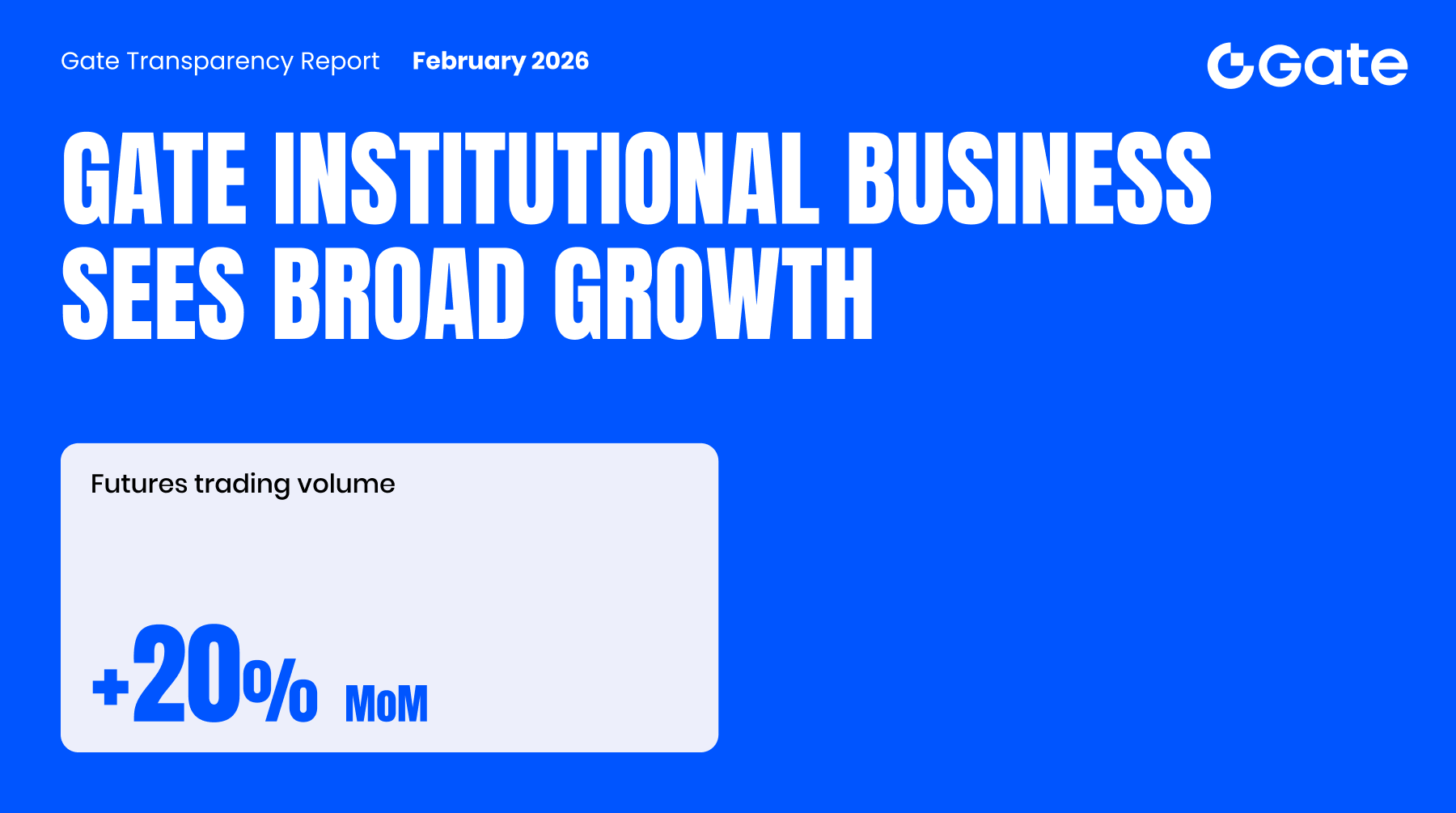
Several core business segments also delivered strong performance in February. Institutional business also maintained robust growth, with average daily institutional derivatives trading volume rising 20% month-over-month. Meanwhile, the CrossEx cross-exchange trading system, third-party custody network, and the 3.0 infrastructure upgrade continued to advance, further strengthening Gate’s institutional service capabilities.
In terms of security, compliance, and global expansion, Gate’s Malta entity, Gate Technology Ltd, has been granted a Payment Institution (PI) license by the Malta Financial Services Authority (MFSA) under the EU’s Payment Services Directive 2 (PSD2) framework. This milestone makes Gate one of the earliest crypto-native companies in Europe to receive this level of regulatory approval, further reinforcing its long-term strategy of connecting traditional finance with Web3 infrastructure across the European market.
At the industry level, Gate Founder and CEO Dr. Han delivered a keynote speech on the main stage at Consensus HK, sharing forward-looking insights on the evolution of Intelligent Web3. He also joined industry leaders at several high-level gatherings—including the Gate Ventures executive dinner, an industry reception, and the institutional-focused event “Gate Institutional Circle”—to discuss the convergence of AI, Web3, and traditional finance. During the events, Gate brought together nearly 100 institutional representatives for in-depth discussions on cross-exchange infrastructure, unified account systems, and institutional-grade services, highlighting Gate’s multi-dimensional strategy across community ecosystem development, technological innovation, and institutional business.
Platform Highlights
Trading Scale Expands as TradFi and AI Trading Capabilities Upgrade
Gate’s trading scale and market share continued to grow. According to the latest report from CoinDesk, Gate ranks third globally in spot market share among centralized exchanges and fourth in derivatives market share. During the period, the platform’s spot trading volume exceeded $74 billion, representing an approximately 11% month-over-month increase, placing it among the top three exchanges within the AA–A rated category. In derivatives, Gate held around 11% market share, while open interest accounted for roughly 10% among retail-focused exchanges, reflecting strong liquidity and sustained market participation.
In the area of traditional financial asset trading, Gate TradFi is emerging as a new growth engine. In February, its monthly trading volume reached $95 billion, with the highest single-day trading volume exceeding $12 billion. With the launch of its dedicated web interface, Gate TradFi has also officially concluded its public beta phase. Users can trade global CFD assets—including forex, equities, and metals—using USDT as margin, with execution powered by the MT5 trading system, further enabling cross-market trading between crypto assets and traditional financial instruments.
At the same time, Gate introduced GateAI, integrating natural-language trading capabilities that allow users to execute spot trades and manage wealth products through conversational commands. By combining AI-driven analysis with trading execution, Gate continues to enhance user experience and operational efficiency. Overall, the platform is steadily evolving from a traditional crypto exchange into a comprehensive digital financial platform spanning spot, derivatives, TradFi asset trading, and AI-powered trading tools.
Ecosystem Expansion and Security & Compliance
Gate’s Multi-Asset Campaigns Remain Highly Active, with Airdrop Incentives and Trading Volume Growing in Tandem
During February, Gate’s multi-asset trading capabilities continued to grow steadily, while on-chain and trading-related metrics remained active,reflecting sustained engagement across multi-asset trading and on-chain interaction scenarios.
In terms of asset incentive programs, HODLer Airdrop and Launchpool continued to attract strong user participation. HODLer Airdrop launched 2 new projects in February. The peak APR reached 149.29% for the PACT project. The total GT staked reached 25,489,368.43, equivalent to approximately $178 million in staking value. Launchpool also introduced 2 new projects, distributing $367,415 in total rewards. The highest APR reached 540.16% during the final hour of the ELON project, with 25,407 participants.
CandyDrop launched 7 projects in February, attracting more than 190,000 participation entries. Among them, the popular ETH campaign recorded over 50,000 participants. The event also drove significant trading activity, with CandyDrop-related derivatives trading volume exceeding $15.2 billion and spot trading volume reaching $280 million. In addition, the campaign generated approximately $3.6 million in net deposits, further boosting activity across the platform’s multi-asset trading ecosystem.
Gate Earn Sees Steady Growth as User Activity and Capital Retention Increase
Gate Earn maintained stable growth, with both its core scale and user activity remaining at high levels. During the period, cumulative subscription volume approached 1.8 billion USDT. In terms of user participation, the platform recorded over 300,000 average daily participants and more than 400,000 average daily holding users, demonstrating its continued effectiveness in both user acquisition and capital retention. Meanwhile, several new projects were launched during the period, further boosting capital participation and overall user engagement.
From an asset structure perspective, holdings of major assets continued to trend upward. USDT holdings approached 800 million, BTC holdings reached several thousand coins, and ETH holdings exceeded 60,000 coins, with all three major assets posting varying degrees of growth. Overall, amid a volatile market environment, Gate Earn continues to absorb allocation demand for stablecoins and major crypto assets, further strengthening its role as a high-liquidity capital management tool and a key entry point for platform wealth management services.
Gate TradFi Web Launches, Unifying Crypto and Traditional Asset Trading Under One Account
The Gate TradFi section has officially launched its web portal, marking the end of the public beta phase. With the introduction of the web interface, TradFi services now support both App and web terminals, enabling users to trade global traditional financial assets—including forex, metals, indices, commodities, and selected popular equities—directly within a single Gate account system, further expanding the platform’s multi-asset trading scenarios.
In terms of the capital framework, USDT is used as the margin asset, automatically displayed internally as USDx on a 1:1 basis. The trading mechanism integrates the MT5 system and adopts CFD rules aligned with traditional financial markets. Gate has also launched TradFi trading APIs and adjustable multi-leverage mechanisms, while officially including TradFi trading volume in Gate VIP tier calculations, further bridging the trading ecosystem between crypto assets and traditional financial markets.
Gate Perp DEX Surpasses 1 Million Monthly Transactions as On-Chain Activity Continues to Rise
Gate Perp DEX maintained stable operations throughout February, reflecting continued strong demand for on-chain derivatives trading.
Amid rising market volatility and increasing derivatives demand, the platform maintained strong trading depth and user participation. Structurally, on-chain perpetual contracts are becoming an important high-frequency trading scenario and a key complement to the platform’s broader multi-asset derivatives ecosystem.
As Gate continues to optimize on-chain liquidity and trading infrastructure, Perp DEX is gradually strengthening its role in improving trading efficiency and expanding the decentralized derivatives market.
Gate Layer Transactions Rise 14% as Network Activity and Ecosystem Development Progress
In February, Gate Layer recorded 100,589,906 on-chain addresses and over 28.5 million transactions. Compared with January, while the address base continued to expand steadily, on-chain transaction volume increased by more than 14%, indicating sustained growth in network activity and ecosystem usage.
On the ecosystem side, on February 6, the Gate Layer partner project Espresso launched an airdrop for Gate Layer users, further boosting user participation and on-chain engagement. In addition, on February 11, 2026, the Gate Chain mainnet completed the v21 upgrade, providing ongoing support for network performance and underlying stability, and promoting coordinated ecosystem development across both infrastructure and application layers.
Launchpool Projects Deliver Strong Returns, Peak APR Exceeds 540% in Final Hour
In February, Gate Launchpool introduced two new projects, maintaining a focus on high-quality listings. In terms of performance, the project ELON recorded a peak APR exceeding 540% during the final hour of the campaign, demonstrating notable short-term yield potential. As a key mechanism for new asset launches and user incentives, Launchpool allows users to obtain new project tokens and additional rewards through staking, while simultaneously supporting early-stage liquidity and community engagement for newly listed projects.
While steadily distributing rewards, Launchpool continues to attract users to participate in staking and mining activities, playing a positive role in increasing platform capital activity and enhancing exposure for new projects.
HODLer Airdrop Staking Reaches $178 Million as Participation Remains Stable
In February, the HODLer Airdrop program continued to revolve around the GT staking ecosystem. During the period, more than 25.4 million GT were staked. The total staking value reached approximately $178 million. Overall, participation among GT holders in the airdrop program remained stable, with the staking mechanism continuing to support platform token holding and utility demand.
At the project level, two airdrop projects were launched during February. Among them, the PACT project recorded a peak APR close to 150% during the campaign. Through the HODLer Airdrop mechanism, new projects can distribute tokens directly to GT holders, while also strengthening the connection between the platform token ecosystem and project communities.
CandyDrop Drives Over $15 Billion in Futures Volume and $280 Million in Spot Trading
The CandyDrop trading campaign remained highly active in February. During the event period, futures trading volume exceeded $15 billion, while spot trading volume reached $280 million, accompanied by approximately $3.6 million in net deposits. The combination of trading incentives and reward distribution continued to stimulate user participation, generating a noticeable increase in both trading activity and capital inflows.
A total of seven projects were featured in CandyDrop during the month, with more than 190,000 cumulative participants. Among them, the ETH campaign attracted over 50,000 participants, making it one of the most popular events of the month. Overall, CandyDrop continues to play an important role in expanding user participation and strengthening trading engagement across the platform.
Gate Continues Upgrading AI Trading Infrastructure, Launches MCP Tools to Enable Standardized Agent Integration
In February 2026, Gate continued advancing product and technology upgrades centered on the concept of “AI × Trading Infrastructure,” making notable progress in intelligent interaction and trading capabilities. The platform introduced a voice input feature that allows users to complete queries and commands through natural language, improving mobile trading efficiency. At the same time, the AI floating entry point has been expanded to P2P and wealth management sections, strengthening a unified intelligent interaction interface and improving accessibility across different business scenarios. Meanwhile, Gate continues to connect the full intelligent trading workflow, from semantic understanding and strategy evaluation to trade execution—gradually enabling natural language operations across trading and wealth management scenarios. These include intelligent order placement for products such as Dual Currency, Simple Earn, and On-chain Earn, as well as expanded support for spot trading, Launchpool subscriptions, and Gate Pay gift card features.
At the infrastructure level, on February 2 Gate completed the packaging and verification of its first batch of MCP (Model Context Protocol) Tools, becoming the first trading platform to launch MCP Tools. The initial release includes 17 tools covering core data capabilities for both spot and derivatives markets, including trading pair information, K-line and market data, order book depth, funding rates, and risk signals. These tools can be directly accessed by AI Agents through standardized protocols for use in market analysis, strategy modeling, and risk assessment. With continued improvements in model capabilities and interaction experience, Gate is gradually building a trading capability framework designed for AI Agents, advancing AI from information analysis toward executable intelligent trading workflows.
On-chain Earn TVL Reaches $1.213 Billion in February, with BTC and ETH Holdings Remaining Strong
During February, On-chain Earn did not add new tokens, but the overall capital scale remained stable. Data shows that BTC holdings reached a monthly peak of 2,660.95 BTC on February 11, while ETH holdings climbed to 167,700 ETH on February 24. GUSD holdings reached 129 million on February 1. In terms of total value locked, On-chain Earn recorded a monthly peak TVL of $1.213 billion on February 1, ending the month at $1.044 billion on February 28.
Compared with historical records, the platform’s capital scale remains close to previous highs. The historical peak for BTC holdings stands at 2,677.05 BTC (September 9), while ETH reached a historical high of 169,800 ETH (January 26). GUSD’s historical peak reached 238 million (September 25), with real-time data on that day briefly surpassing 300 million. Overall, the On-chain Earn capital pool remains at a relatively high level, reflecting sustained user participation and strong capital retention on the platform.
ETF Business Maintains Strong Growth as Trading Volume Surges to New Highs
In February 2026, Gate’s ETF segment achieved another major leap in trading activity, further expanding the platform’s market share and brand influence in the ETF sector. At the same time, user activity and participation surged, further reinforcing Gate’s leading position in the ETF segment while continuing to drive innovation across the industry.
As of February, the platform supported 320 curated ETF trading pairs. Through dynamic adjustments and structural optimization of the product matrix, Gate further concentrated liquidity and reduced trading costs, precisely targeting the most valuable market opportunities. This approach provides users with a more professional and efficient environment for hedging and leveraged trading.
In terms of ecosystem development, Gate continued to refine ETF product operations. The launch of ETF trial funds and trading fee rebate vouchers significantly improved the user experience for exploring trading strategies at lower cost. Combined with ongoing improvements to product interaction and interface logic, the platform has further enhanced the smoothness and accessibility of ETF trading, laying a stronger foundation for the long-term activity and sustainable growth of its ETF business.
Copy Trading System Upgraded as User Base Continues to Expand
In February, the Gate copy trading ecosystem continued to expand, with the number of new copy trading users increasing by 13% month-over-month, alongside growth in the total number of participants. During the month, Gate completed a comprehensive upgrade of its copy trading system, optimizing the product experience across three key dimensions: intelligence, transparency, and efficiency. The new system introduces a position replication mode, allowing users to synchronize the current positions of lead traders with a single click. It also features transparent profit-sharing displays, clearly showing revenue distribution ratios. Functionally, the platform launched multi-dimensional smart leaderboards and a filtering system with five categories and eight selection criteria, enabling users to identify suitable trading strategies more efficiently. Additionally, trader profiles now display both simple return rate and net asset value (NAV) return, providing a more comprehensive performance view. The overall interface and copy trading dashboard have also been redesigned, placing lead traders at the center of the display structure, further improving decision-making efficiency and strategy management for users.
Trading Bot Ecosystem Expands Rapidly as AI Strategy Access Is Upgraded
The Gate trading bot ecosystem continued its rapid expansion, with new users increasing by 23.1% month-over-month. Amid a volatile market environment, spot-based strategies maintained stable performance. In particular, the Spot Martingale and Spot Grid strategies both recorded steady growth in investment capital and user adoption, highlighting the persistent demand for automated strategies in fluctuating market conditions.
At the same time, the Gate App introduced a comprehensive upgrade to the trading bot homepage. By integrating the bot homepage with the Trading Plaza, simplifying strategy categories, and upgrading Ultra AI capabilities, the platform significantly improved its information architecture and interaction logic. As a result, strategy presentation has become clearer, filtering more precise, and trading operations more efficient. The upgrade also enhances strategy recommendation transparency and AI matching efficiency, creating a more intuitive and integrated intelligent trading entry point for users.
Institutional Futures Trading Volume Rises 20% as Cross-Exchange Infrastructure Advances
In February, despite market volatility and seasonal holiday effects, Gate’s institutional business maintained solid growth, with both spot and derivatives trading expanding in parallel. Institutional average daily futures trading volume increased by 20% month-over-month, reflecting continued growth in trading activity. At the same time, the platform continued to strengthen its institutional-grade infrastructure, including upgrades to the CrossEx cross-exchange trading system, the third-party custody network, and its API architecture. CrossEx now supports trading pairs across major exchanges and is gradually expanding into European and North American markets, enabling institutions to capture cross-market liquidity opportunities with higher capital efficiency and competitive fee structures. Meanwhile, Gate is accelerating the rollout of its 3.0 core infrastructure upgrade and deepening cooperation with multiple custody providers to enhance asset security and settlement systems. On the institutional services side, the platform has introduced customized policies such as market maker whitelists and interest-free lending, while continuing to strengthen connections with global market makers, asset managers, and custodians through initiatives such as the Institutional Circle program.
Security, Transparency, and Global Expansion
Guided by its global expansion strategy, Gate continues to advance its compliance and regulatory framework, steadily building a growing compliance network across major jurisdictions worldwide. By continuously obtaining key licenses and regulatory approvals, Gate is further strengthening its role within the global digital financial infrastructure.
Gate Secures Malta Payment Institution (PI) License, Strengthening EU Stablecoin Payment Infrastructure
Gate’s Malta-based entity, Gate Technology Ltd, has obtained a Payment Institution (PI) license from the Malta Financial Services Authority (MFSA) under the EU’s Second Payment Services Directive (PSD2). This milestone makes Gate one of the earliest crypto-native companies in Europe to receive this level of regulatory approval, further reinforcing its long-term strategy of connecting traditional finance and Web3 infrastructure across the European market.
Prior to this, Gate had already obtained a MiCA license, allowing it to provide trading and custody services. With the addition of the PSD2 license, Gate is now expanding its payment services across the EU through the passporting mechanism, enabling broader access to regulated financial services within the region. The license highlights Gate’s strong commitment to regulatory compliance and global standards, while strengthening its capability to bridge traditional financial systems with Web3 applications, supporting the development of a more secure, seamless, and efficient user ecosystem.
Currently, multiple Gate-affiliated entities have obtained or completed regulatory registrations, licensing applications, authorizations, or approvals across several jurisdictions, including Malta, Cyprus, the Bahamas, Japan, Australia, and Dubai.
Community Building and Brand Activities
Gate Square Launches Lunar New Year Engagement Campaign and Content Mining Incentives to Boost Community Creativity
Gate Square has rolled out a series of initiatives centered on community interaction and content creation, including red envelope rewards, creative challenges, and content mining incentives, to further enhance user participation and community activity. During the Lunar New Year period, Gate Square launched a themed interactive campaign encouraging users to engage with the community and earn rewards. At the same time, Gate Square strengthened its content mining incentive mechanism by introducing additional reward pools and creator commission programs, offering more earning opportunities for creators and users. After publishing high-quality content, creators can receive trading fee rebates, effectively improving the conversion between content engagement and trading activity. Through continuous optimization of its creator incentive system and community engagement mechanisms, Gate Square aims to foster a more vibrant, diverse, and sustainable community ecosystem.
Gate Fun Introduces Community “Bullet Comment” Feature to Enhance Interactive Experience
Gate Fun has officially launched a community bullet comment (danmaku) feature, displaying posts from each token’s community as scrolling comments above the token’s information page. The feature prioritizes the latest real-time content while ranking historical posts by popularity, allowing users to stay updated on key community discussions while browsing token details. As the first community-driven meme launch platform, Gate Fun continues to enhance the user interaction experience. The new feature strengthens the real-time connection between information display and community discussions, improving user engagement and immersion while boosting content dissemination efficiency and overall community activity.
Gate Founder Dr. Han Speaks on the Consensus HK Main Stage on the Evolution of Intelligent Web3
On February 12, Gate Founder and CEO Dr. Han was invited to speak on the Consensus HK main stage, delivering a keynote focused on Intelligent Web3 and sharing forward-looking insights into the future development of digital assets.
Dr. Han noted that traditional finance (TradFi), Web3, and AI are moving from parallel development toward deep integration: traditional finance provides the foundation for asset systems, Web3 enhances value transfer efficiency, and AI is reshaping how value is allocated. Through this convergence, digital assets are evolving from simple trading tools into intelligent financial infrastructure.
He further emphasized that as application scenarios expand, the focus of Web3 is shifting—from improving trading efficiency to enabling more complex system coordination and value management. In response to this trend, Gate continues to advance GateAI capabilities and TradFi product offerings, supporting diversified asset allocation and industry development. The speech highlighted Gate’s vision for the future of Web3 under intelligent transformation and offered strategic insights for the broader industry.
Gate Ventures Hosts Exclusive Networking Dinner During Consensus, with Opening Remarks by Dr. Han
On February 10, Gate Ventures hosted an exclusive networking dinner at The Peninsula Hong Kong during Consensus. Gate Founder and CEO Dr. Han delivered opening remarks, sharing insights on the structural evolution of the financial industry and the convergence of emerging technologies. From the perspective of collaboration among traditional finance, Web3, and AI, Dr. Han highlighted how previously separate systems are gradually converging, with technology and institutional frameworks jointly reshaping value transfer and trust mechanisms. He noted that the industry is transitioning from single-paradigm competition to multi-system collaboration, entering a new stage focused on long-term value creation and sustainable growth.
The event featured keynote speeches and roundtable discussions in a curated networking format, providing participants from different sectors with a high-quality environment for dialogue and collaboration.
Gate Hosts High-Level Reception at Consensus HK to Discuss AI, Web3, and RWA Trends
On February 11, Gate hosted a high-level reception during Consensus HK, welcoming over 1,000 industry guests. Gate Founder and CEO Dr. Han delivered a keynote titled “What’s the Next Big Thing in Crypto”, sharing his latest insights on industry trends.
Dr. Han suggested that 2026 could mark a structural turning point for the crypto market. Real-world assets (RWA) and TradFi assets are accelerating on-chain integration, while traditional financial systems and crypto infrastructure are increasingly converging. At the same time, AI agents tailored for Web3 are entering practical use, becoming key infrastructure for improving interaction efficiency and asset management. Meanwhile, DEX, CEX, and AI integration is accelerating, giving rise to more unified platform models.
In line with these trends, Gate continues to advance its strategy for Web3 scalability and platform integration. Alongside strengthening GateAI’s analytics and risk management capabilities, the platform has upgraded Gate DEX and expanded its TradFi product suite, enriching multi-asset trading and allocation scenarios. Through a unified account system, Gate is integrating CEX, DEX, and AI capabilities to lower barriers to cross-market participation and promote collaboration between traditional finance and the crypto ecosystem.
Gate Institutional Circle Event Concludes Successfully, Bringing Together Institutional Leaders
On February 12, Gate hosted the institutional-focused event “Gate Institutional Circle: CrossEx · Next-Gen Cross-Exchange Trading Infrastructure” in Hong Kong. The event explored the development of institutional-grade infrastructure, unified cross-exchange account systems, and collaborative industry models, bringing together nearly 100 institutional representatives.
The program included keynote speeches, roundtable discussions, a networking dinner, and an awards ceremony. Gate Founder and CEO Dr. Han delivered a keynote analyzing structural changes in payment systems and traditional finance within the crypto space. Gate CCO Simon Ren shared insights on global expansion and institutional business development under a compliance-driven framework, while Addis Hu, Head of Global Institutional Business at Gate, outlined the platform’s overall strategy for institutional infrastructure development.
Education, Research, and Media Influence
Gate Research Continues to Strengthen Research Output, Delivering Multi-Dimensional Market Insights Across Industry Trends
During February, Gate Research maintained a stable and high-frequency publishing cadence, continuously releasing a wide range of research content covering market movements, macro trends, and industry developments. Publications included daily reports, VIP daily reports, weekly reports, monthly reports, and thematic research reports. Topics focused on crypto market trends, institutional capital flows, ETF inflows, the RWA narrative, AI and Web3 integration, as well as emerging projects and on-chain ecosystem developments, providing users with timely and structured market analysis.
At the same time, Gate Research continued to expand its in-depth research efforts, publishing multiple thematic reports and case studies. These included topics such as the PayFi pathway for Web2–Web3 integration, a case study on prediction market platform Kalshi, and analyses of on-chain ecosystems and industry trends. By combining high-frequency market observation with deep industry research, Gate Research continues to deliver forward-looking insights and structured analysis, further enhancing the professionalism and influence of the platform’s research content.
Gate Learn Expands Its Educational Content Ecosystem to Support User Learning and Industry Awareness
During February, Gate Learn continued to expand its educational content ecosystem, publishing diverse learning materials covering industry education, trading knowledge, and market insights. Content formats included knowledge articles, wiki entries, market hotspot explainers, original articles, Chinese-language courses, and curated industry content.
Among them, 332 knowledge articles were published, alongside 67 curated industry articles, 20 wiki entries, and 20 hotspot explainers. Several Chinese-language courses and original pieces were also released, further enriching the platform’s crypto education resource system.
Content topics covered trading strategies, on-chain ecosystems, RWA infrastructure, AI and Web3 development, and major market events. Representative topics included Gate ETF trading strategy analysis, explanations of RWA operational mechanisms, analysis of the TON and Telegram ecosystem, and research on stablecoins and crypto market trends. By combining structured educational resources with timely industry insights, Gate Learn provides users with clear learning pathways and a comprehensive gateway to understanding the digital asset industry.
Gate Blog Continues to Enrich Its Content Ecosystem with Diverse Topics Covering Industry Trends and Platform Updates
During February, Gate Blog maintained a high publishing frequency, delivering a wide range of articles covering industry developments, platform updates, and market trends. A total of nearly 1,000 articles were published. This multi-layered content structure further strengthened the platform’s information distribution capabilities and diversified user reading scenarios.
In terms of content focus, Gate Blog emphasized crypto market developments, industry events, platform product updates, and Web3 ecosystem growth. By combining timely news updates with in-depth interpretation, the blog provides users with continuously updated industry insights and market perspectives. The diversified content matrix also strengthens the platform’s reach and communication efficiency across global audiences.
Dr. Han Featured on the Cover of Entrepreneur Middle East: Leading the Future of Crypto with Vision
Gate Founder and CEO Dr. Han appeared on the cover of the February 2026 issue of Entrepreneur Middle East and was recognized as a “Visionary Builder.” In the cover feature interview, he shared insights from building a globally leading digital asset trading platform over the past 15 years and emphasized that security, transparency, and innovation are core pillars of Gate’s global development strategy.
The report highlighted that Gate began in 2013 as a one-person startup and has since grown into a global organization with over 2,000 employees and offices worldwide. Dr. Han emphasized that regulatory compliance, proof of reserves, and open-source audits are key mechanisms for safeguarding user assets and building long-term trust while helping bridge traditional finance and Web3.
Gate continues to pursue a global compliance strategy, with multiple entities registered, licensed, or approved in jurisdictions including Malta, Italy, Gibraltar, and the Bahamas.
Dr. Han also noted that the platform’s product ecosystem continues to evolve. Beyond centralized trading, Gate now offers DeFi and tokenized TradFi products, providing users with greater control over their assets. He believes that stablecoins and tokenized assets will become foundational components of the future financial system, while AI will significantly improve the crypto user experience in 2026. Through next-generation products such as Gate DEX, Gate Fun, and GateAI, Gate is advancing its long-term vision of building a compliant, secure, and user-friendly Intelligent Web3 financial ecosystem.
CoinDesk: Gate Ranks Top Three in Spot Market Share and Top Four in Derivatives
According to the latest exchange evaluation report released by CoinDesk, Gate ranked third globally in centralized exchange spot market share and fourth in derivatives market share so far this year. During the month, Gate recorded $74.4 billion in spot trading volume, representing a month-on-month increase of 11.1%. Among exchanges rated AA–A, Gate ranked among the top three by spot trading volume, with the leading platforms collectively accounting for approximately 50.2% of total market volume. In the derivatives market, Gate held a trading volume market share of 11.2%. In terms of open interest, Gate ranked among the top three retail-focused exchanges, accounting for 10.1% of the market, highlighting its sustained trading activity and capital capacity. In addition, Gate TradFi’s cumulative trading volume in February has surpassed $95 billion, with a single-day peak exceeding $12 billion. Gate has also launched GateAI and introduced natural language trading functionality, enabling users to execute spot and wealth management orders through conversational commands. Overall, Gate continues to demonstrate strong market performance and ongoing product innovation.
Dr. Han Shares Long-Term Strategy for TradFi and Intelligent Web3 in Odaily Interview
In an interview with Odaily, Gate Founder and CEO Dr. Han stated that the current “cooling” phase in the crypto market is cyclical, while accelerated AI development could become a key driver of industry structural transformation.
Based on this view, Gate has introduced the concept of Intelligent Web3, aiming to lower the barriers to on-chain interaction and strategy execution through AI. This allows users to express complex trading intentions using natural language. To support this vision, Gate launched GateAI, integrating market analysis, risk alerts, and strategy assistance while exploring AI Agent–based interaction models to redefine how users engage with trading platforms. Regarding industry trends, Dr. Han remains optimistic about crypto payments, RWA infrastructure, and DEX development, noting that tokenization of traditional assets will expand investment allocation opportunities.
Gate has already expanded into the TradFi sector, supporting 144 asset categories including metals, stocks, indices, forex, and commodities, with cumulative trading volume exceeding $70 billion. By combining intelligent technology with multi-asset infrastructure, Gate is building a more extensible ecosystem that continues to redefine the role of digital asset exchanges.
BeInCrypto: Dr. Han Says AI Will Fundamentally Reshape Trading Within Two Years
In an interview with BeInCrypto, Gate Founder and CEO Dr. Han stated that artificial intelligence will fundamentally reshape trading methods within the next two years. As crypto products become increasingly complex and operational barriers continue to rise, Gate has introduced AI agent-assisted features to help users understand token information, platform functions, and trading strategies.
Dr. Han believes AI will not only improve the user experience but also enhance capital efficiency and allocation through continuous operation and large-scale information processing. Looking ahead, Gate plans to replace traditional interfaces with natural language interaction, enabling automated trade execution and yield management. The platform is advancing its next strategic phase through the combined integration of AI capabilities and multi-asset infrastructure.
Conclusion
Looking ahead, Gate will continue to maintain steady growth in its core trading business while accelerating the development of multiple product lines, including ETF products, institutional services, and automated trading solutions. At the same time, the platform is expanding the integration of TradFi and on-chain ecosystems.
With ongoing improvements to on-chain infrastructure such as Perp DEX and Gate Layer, the platform’s multi-asset trading scenarios and on-chain derivatives markets continue to expand, driving stronger user participation and capital activity.
Supported by continued regulatory progress and global expansion strategies, Gate is gradually evolving from a traditional crypto trading platform into a comprehensive digital asset infrastructure connecting crypto assets, traditional finance, and on-chain ecosystems. Its long-term growth potential and industry influence are expected to strengthen further.
Disclaimer:
This content does not constitute an offer, solicitation, or recommendation. You should always seek independent professional advice before making investment decisions. Gate may restrict or prohibit all or part of its services for users from restricted regions. For more information, please read the User Agreement via: https://www.gate.com/user-agreement.
Gate Team
Gateway to Crypto
Trade over 4,500 cryptocurrencies safely, quickly, and easily on Gate
Take Action Now
Sign up and claim up to $10,000 in welcome rewards
Invite friends and earn a 40% commission
Stay Connected
Visit Gate's official website
Download the Gate App | Desktop
Follow us on X (Twitter) to get more bonuses
Join our Telegram community to discuss trending topics
Engage with our global community for the latest insights
Transparency & Security
Check our 100% Proof of Reserves


