- The US SEC requested the Court of Appeals to extend the pause of its pending appeal in relation to the Ripple case.
- Legal experts assured that there’s nothing to be upset about in line with the recent developments.
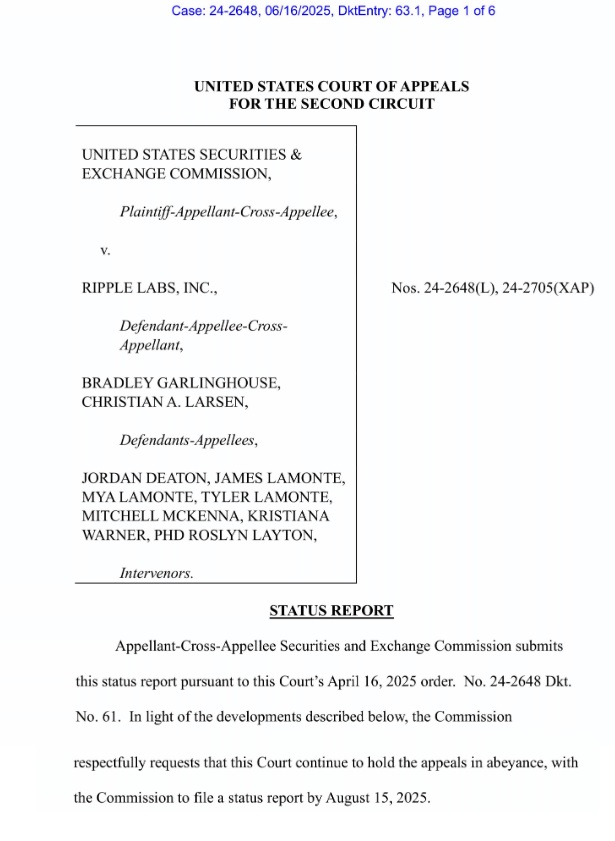
The US Securities and Exchange Commission (SEC) recently submitted a motion to the Second Circuit Court of Appeals in relation to its pending case against Ripple Labs and its key executives. In compliance with the appellate court’s directive for the agency to submit a report 60 days from its April 16 ruling, the regulator has instead requested for the judicial body to continue holding the parties’ appeals in abeyance.
 Source: James Filan via X## Reason for the Pause in the SEC and Ripple Appeal
The move comes after Judge Analisa Torres of the Southern District Court of New York denied the SEC and Ripple’s joint motion to reverse her standing decision on their landmark case. Two years ago, she notably ruled that XRP is not a security, but the manner in which Ripple sold it to institutional investors qualified as a securities offering. As a result, the judge ordered the company to pay the SEC a $125 million fine.
Not contented with the lower court’s judgment, the SEC, which was then under the regime of former Chair Gary Gensler, brought the case to the Court of Appeals. However, the change in the administration prompted negotiations between the regulator and the company.
ADVERTISEMENTFollowing the SEC and Ripple’s settlement agreement during the course of their appeal, they asked the lower court to adopt the terms of their deal, including the reduction of the company’s fine to $50 million and reversal of the injunction preventing the sale of XRP to institutional investors. Torres rejected the motion due to the parties’ failure to provide a sufficient reason or “exceptional circumstances” that warrant modification of the earlier judgment.
In light of the recent developments, the SEC and Ripple have refiled their motion. Meanwhile, the litigants asked for the appellate court’s extension of its existing pause as they await the lower court’s move.
The Court Will Eventually Rule in Favor of the Settlement Agreement
Previously, John Deaton, a crypto lawyer and advocate, assured in an interview that the court will eventually have to rule in the SEC and Ripple’s motion. However, the ball lies in the appellants’ court now.
ADVERTISEMENTHence, the movants must present a convincing argument as to why Torres should reverse her judgment in a case that she worked on for several years.
ADVERTISEMENT
Disclaimer: The information on this page may come from third parties and does not represent the views or opinions of Gate. The content displayed on this page is for reference only and does not constitute any financial, investment, or legal advice. Gate does not guarantee the accuracy or completeness of the information and shall not be liable for any losses arising from the use of this information. Virtual asset investments carry high risks and are subject to significant price volatility. You may lose all of your invested principal. Please fully understand the relevant risks and make prudent decisions based on your own financial situation and risk tolerance. For details, please refer to
Disclaimer.


