As Ethereum enters 2026, the network is poised for significant upgrades aimed at dramatically improving Layer 1 (L1) scalability, interoperability, and user experience.
The two major hard forks—Glamsterdam (mid-2026) and Heze-Bogota (end-2026)—will introduce perfect parallel transaction processing, substantial gas limit increases, higher data blob capacity, and a gradual shift toward zero-knowledge (ZK) validation. These changes set the stage for Ethereum L1 to approach 10,000 transactions per second (TPS) in the future, while Layer 2s (L2s) could handle hundreds of thousands TPS. Additional focus on cross-chain seamless operation, privacy enhancements, and censorship resistance will make 2026 a pivotal year for Ethereum’s evolution. For developers and users searching Ethereum roadmap 2026, Glamsterdam fork, or Ethereum scaling updates, these upgrades promise a more efficient, inclusive, and resilient network.

(Sources: X)
Glamsterdam Fork: Parallel Processing and Gas Limit Boost
The Glamsterdam hard fork, targeted for mid-2026, is finalizing its Ethereum Improvement Proposals (EIPs) with two headline features:
- Block Access Lists (EIP-7928): Enables “perfect parallel processing” by allowing transactions to specify data access in advance, reducing conflicts and enabling simultaneous execution.
- Enshrined Proposer-Builder Separation (ePBS): Formalizes the separation of block proposal and building, improving MEV management and network efficiency.
Combined, these changes will:
- Raise Gas Limit: From ~60 million today to 200 million, unlocking higher throughput.
- Prepare for ZK Transition: ~10% of validators expected to switch from re-execution to ZK proof verification.
- Path to 10,000 TPS: L1 scaling foundation, though full target likely post-2026.
While technical names dominate for now, community nicknames like “Firedancer” may emerge for client diversity efforts.
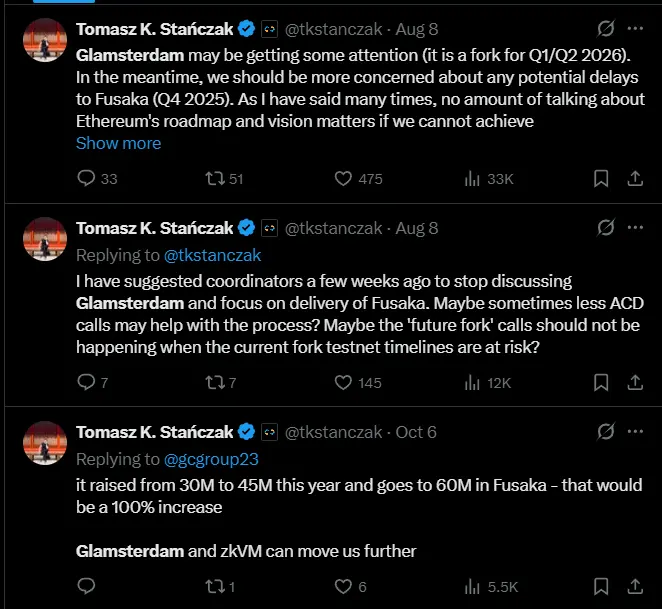
(Sources: X)
Increased Data Blobs: Supercharging Layer 2 Scaling
Data blobs—introduced with EIP-4844 (Dencun)—will see major expansion:
- Blob Count: Potentially 72+ per block (from current levels).
- L2 Impact: Enables rollups to process hundreds of thousands TPS collectively.
- User Experience: Innovations like ZKsync’s Atlas upgrade allow mainnet balances with L2-fast execution.
This blob boost makes Ethereum the settlement layer for massive parallel L2 activity.
Heze-Bogota Fork: Interoperability, Privacy, and Censorship Resistance
The year-end Heze-Bogota fork targets:
- Ethereum Interoperability Layer: Seamless cross-L2 communication and asset movement.
- Privacy Focus: Enhanced tools for private transactions and data.
- Censorship Resistance: Stronger protections against block-level exclusion.
These features address long-standing user pain points in multi-rollup environments.
Why 2026 Is Crucial for Ethereum Scaling
- L1 Throughput: Parallel execution + gas hikes lay groundwork for higher native TPS.
- L2 Explosion: Blob increases supercharge rollup capacity.
- ZK Shift: Gradual validator transition to proof verification reduces resource needs.
- User-Friendly: Abstraction and interoperability lower barriers.
While 10,000 TPS on L1 remains a multi-year goal, 2026 upgrades position Ethereum for exponential effective scaling via L2s.
In summary, Ethereum’s 2026 roadmap—headlined by Glamsterdam (parallel processing, 200M gas limit) and Heze-Bogota (interoperability, privacy)—will drive L1 efficiency, L2 explosion via more blobs, and a 10% ZK validator shift. These changes set the network on a path to higher TPS, better user experience, and stronger resilience. Monitor core dev calls and EIP discussions for finalized details on this transformative year for Ethereum scaling.
Disclaimer: The information on this page may come from third parties and does not represent the views or opinions of Gate. The content displayed on this page is for reference only and does not constitute any financial, investment, or legal advice. Gate does not guarantee the accuracy or completeness of the information and shall not be liable for any losses arising from the use of this information. Virtual asset investments carry high risks and are subject to significant price volatility. You may lose all of your invested principal. Please fully understand the relevant risks and make prudent decisions based on your own financial situation and risk tolerance. For details, please refer to
Disclaimer.
Related Articles
BlackRock Transfers 15,101 ETH and 566 BTC to Major CEX, Worth $75.96M
BlackRock recently transferred over $35 million in ETH and $41 million in BTC through its ETFs to a major CEX, totaling nearly $76 million in value.
GateNews1h ago
On-Chain Trader 0x049b Opens 20x Leveraged Long on BTC and ETH, Accumulates $5.17M Profit in Two Months
A trader known as 0x049b has opened a 20x leveraged long position, buying 269 BTC and 8,586 ETH. Over two months, they executed 47 trades, achieving a 63.83% win rate and a total profit of $5.17 million.
GateNews2h ago
Gate Idle Coin Wealth ETH 7-day fixed-term financial management additional reward pool is live; subscribe to enjoy a 10% annualized return bonus.
Gate News, according to Gate’s official announcement
Gate’s Yuebi Bao launches an ETH 7-day term wealth management product with an additional rewards pool. Subscription users can enjoy a 10% annualized return bonus. This rewards pool cumulatively provides 500,000 OFC in additional rewards, using a first-come, first-served mechanism.
The additional rewards will be distributed to users’ accounts on a daily basis in the form of an equivalent amount of OFC. The platform has an overall cap on the total activity rewards and a limit on the maximum amount each individual user can receive.
GateAnnouncement5h ago
USDC Treasury Mints 250 Million USDC on Ethereum Network
On April 15, 2025, the USDC Treasury minted 250 million USDC on Ethereum, indicating potential institutional demand. USDC is backed by dollar reserves and operates under regulatory frameworks like the U.S. Stablecoin Act of 2024.
GateNews6h ago
BlackRock Bitcoin ETF pulls in 612 million yuan over seven days, and investors keep adding to their positions despite losses
Data from April 13 shows that weekly net inflows into Bitcoin spot ETFs reached $786 million. Of this, BlackRock’s IBIT accounted for $612 million alone, indicating market concentration. Although IBIT investors are facing paper losses, they continue to add to their positions, reflecting an institutional strategy of lowering the average cost through averaging. For other crypto assets, Ethereum ETF inflows were $187 million, XRP fund inflows were $12 million, and Solana products saw outflows of $6 million.
MarketWhisper7h ago


