Who Created Bitcoin? Uncovering the Truth Behind Satoshi Nakamoto and the Latest Identity Developments

Beginner
Quick Reads
Last Updated 2026-03-26 00:37:34
Reading Time: 1m
Who Created Bitcoin—A Comprehensive Analysis: From the mystery of Satoshi Nakamoto’s identity to the latest leads, controversies, and market implications, this article offers an in-depth exploration of the origins of Bitcoin and the ongoing debate about its creator.

The Origin of Bitcoin
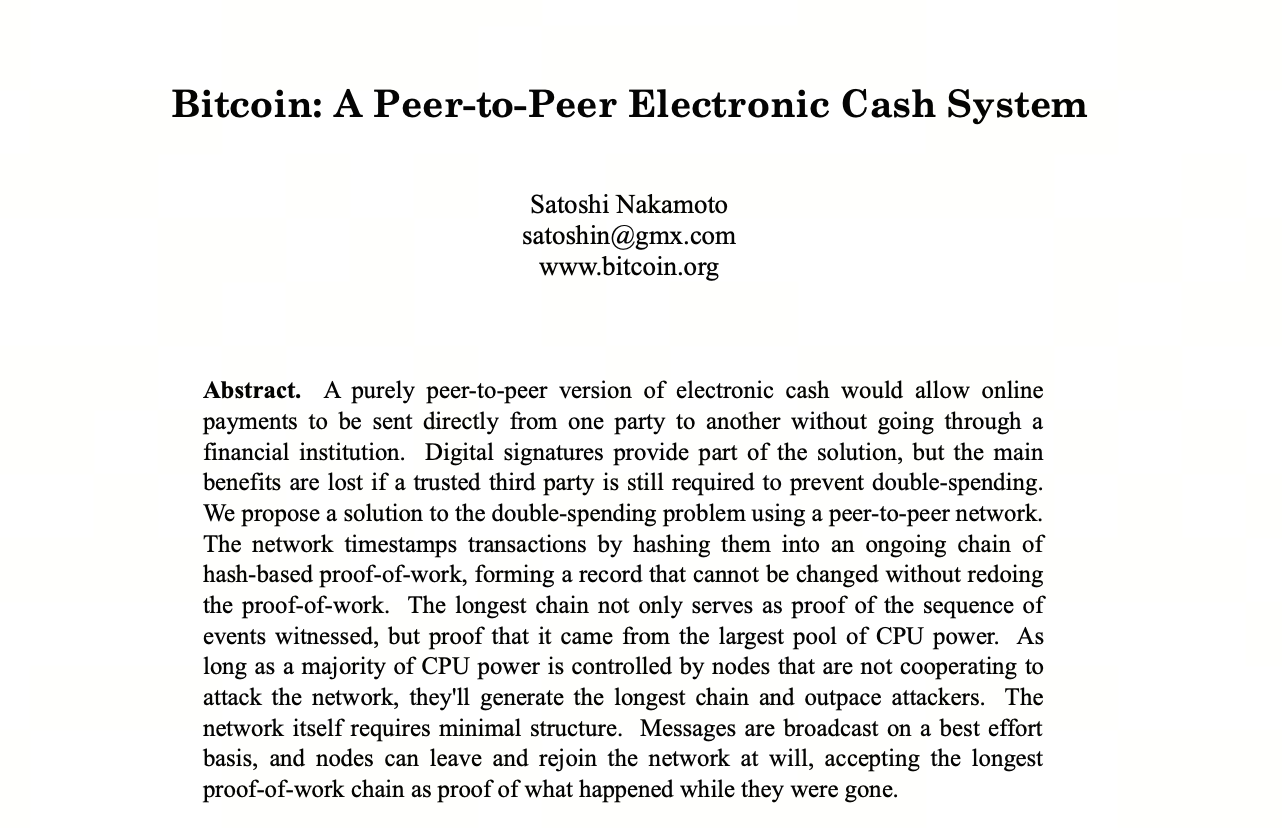

Image: https://bitcoin.org/bitcoin.pdf

Bitcoin emerged in 2008, when Satoshi Nakamoto published the white paper “Bitcoin: A Peer-to-Peer Electronic Cash System” on a cryptography mailing list. This document introduced the concept of a peer-to-peer electronic cash system that operates without any centralized authority. In 2009, the genesis block of Bitcoin was mined, officially launching the first blockchain network.

Bitcoin’s core architecture incorporates proof-of-work, cryptographic signatures, and a distributed node consensus model—mechanisms that established the foundation for the broader blockchain ecosystem.

Who Is Satoshi Nakamoto?

Satoshi Nakamoto is recognized as Bitcoin’s creator, though the name is clearly an alias and not a publicly confirmed identity. After limited interactions with developers between 2009 and 2010, Nakamoto vanished and has not reappeared in any form. Due to this anonymity, the true identity remains unconfirmed to this day.

Satoshi left very few clues—such as coding style, email habits, and possible timezone inferences—but none offer conclusive proof.

Recent Updates on the Identity

Over the past year, renewed discussion about Bitcoin’s founder has been sparked by several factors:

  • Anonymous transfers of large BTC amounts from early addresses have led to speculation about whether Satoshi Nakamoto remains active in the community.
  • New documentaries and media reports have introduced additional theories, seeking to identify the original Bitcoin development team.
  • Blockchain analytics teams have tracked old addresses, but still cannot reach definitive conclusions.

Despite the growing volume of information, none of these developments directly verify Satoshi Nakamoto’s identity—they simply fuel further debate.

Craig Wright Ruling

Australian entrepreneur Craig Wright has repeatedly claimed to be Satoshi Nakamoto, the inventor of Bitcoin, attempting to prove his claim through copyright filings, interviews, and supporting documents.

However, a series of British court rulings have categorically rejected his assertions. Judges found he failed to present cryptographically valid evidence or demonstrate real contributions to the white paper or early Bitcoin code. These judgments provided overwhelming evidence, erasing his credibility within the crypto community.

Potential Candidates

Several individuals are frequently mentioned within the community:

  • Adam Back: Creator of Hashcash. His technical background aligns with Bitcoin’s philosophy, leading to some speculation, though he has denied involvement.
  • Nick Szabo: Originator of the smart contract concept. His writing style has been compared to the Bitcoin white paper, but there is no public evidence linking him to Bitcoin’s creation.
  • Peter Todd: An early developer cited in some documentaries, but he has explicitly denied being Satoshi Nakamoto.
  • Dorian Nakamoto: Was mistakenly identified by the media due to the similarity of his name, but was quickly ruled out.

All candidates are based on speculation or behavioral analysis, lacking scientific or legal substantiation.

The Significance of the Founder’s Identity for the Market

Although Bitcoin’s architecture is fundamentally decentralized, the founder’s identity continues to influence market sentiment and price:

  • If the more than one million BTC held in early Satoshi Nakamoto wallets were moved, it could trigger significant market volatility.
  • Confirmation that the founder is a particular country, institution, or notable individual could shift regulatory approaches and industry sentiment.
  • Revealing the true identity could reshape academic perspectives on Bitcoin’s early technological development.

As a result, the question of Bitcoin’s creator is not only a matter of technological history but also deeply connected to market psychology.

Conclusion

To date, the identity of Bitcoin’s creator remains unresolved. “Satoshi Nakamoto” is likely an anonymous cryptography expert or a collective pseudonym for a team. Regardless of the true identity, Bitcoin has become the world’s most successful decentralized asset, with its value and influence far exceeding that of its founder.

Author: Max
Disclaimer
* The information is not intended to be and does not constitute financial advice or any other recommendation of any sort offered or endorsed by Gate.
* This article may not be reproduced, transmitted or copied without referencing Gate. Contravention is an infringement of Copyright Act and may be subject to legal action.

Related Articles

What is Fartcoin? All You Need to Know About FARTCOIN
Intermediate

What is Fartcoin? All You Need to Know About FARTCOIN

Fartcoin (FARTCOIN) is a representative meme coin within the Solana ecosystem based on an AI-driven narrative. Its core concept originated from an experiment aimed at exploring the "boundaries between AI Agents and humor." More than just a digital asset with social attributes, the project deeply couples absurd humor culture with on-chain financial logic by integrating autonomous AI interaction models.
2026-04-04 22:01:19
Gold Price Forecast for the Next Five Years: 2026–2030 Trend Outlook and Investment Implications, Could It Reach $6,000?
Beginner

Gold Price Forecast for the Next Five Years: 2026–2030 Trend Outlook and Investment Implications, Could It Reach $6,000?

Analyze current gold price trends alongside authoritative five-year forecasts, integrating an evaluation of market risks and opportunities. This gives investors insight into the potential trajectory of gold prices and the main drivers expected to shape the market over the next five years.
2026-03-25 18:13:30
Aster vs Hyperliquid: Which Perp DEX Will Prevail?
Beginner

Aster vs Hyperliquid: Which Perp DEX Will Prevail?

Aster and Hyperliquid are the two representative protocols of the "purpose-built L1 path" within the current decentralized perpetual exchange (Perp DEX) sector. As a pioneer in the field, Hyperliquid has built a deep liquidity moat through its highly mature order book architecture and strong community consensus. Conversely, Aster, as a rising challenger, seeks to leapfrog the competition in high-performance trading through more aggressive multi-chain aggregation logic, private transaction modules, and an underlying execution environment optimized for 2026 market demands.
2026-03-24 11:58:33
AI-Native Settlement Layers: How United Stables Is Building the Next Financial Rail
Beginner

AI-Native Settlement Layers: How United Stables Is Building the Next Financial Rail

Stablecoins were originally designed as dollar substitutes within exchanges, primarily used for asset pricing and trade settlement. As on-chain financial ecosystems have matured, their role has expanded beyond simple payments to include collateral assets, cross-chain liquidity mediums, and unified settlement units. In particular, as AI systems and automated agents begin to participate directly in economic activity, demand has risen sharply for programmable value units capable of instant settlement. This shift is pushing stablecoins toward the role of foundational financial infrastructure.
2026-03-25 03:16:17
Aerodrome Tokenomics: How ve(3,3) Powers Base's Most Profitable DEX
Beginner

Aerodrome Tokenomics: How ve(3,3) Powers Base's Most Profitable DEX

AERO is the native token of Aerodrome Finance, a core decentralized exchange and liquidity protocol in the Base ecosystem. It is primarily used for liquidity incentives and ecosystem operations. veAERO is a governance NFT that users receive by locking AERO, representing both voting power and the right to share protocol revenue. Through a dual track structure of AERO as a utility token and veAERO as a governance credential, Aerodrome separates liquidity usage value from long term governance power, allowing participants to act as liquidity providers, governance decision makers, and revenue sharers within the same system.
2026-03-25 06:40:31
The ve(3,3) Flywheel Explained: How AERO Tokenomics Powers Aerodrome’s DeFi Economy
Beginner

The ve(3,3) Flywheel Explained: How AERO Tokenomics Powers Aerodrome’s DeFi Economy

In the competition for DeFi liquidity, high-inflation mining alone is no longer enough to build lasting advantages. Aerodrome applies the ve(3,3) economic model to redesign token emissions, voting mechanisms, and revenue distribution, creating a liquidity flywheel centered on governance and cash flow. This article examines AERO tokenomics, the veAERO locking mechanism, and protocol revenue models to explain how Aerodrome builds a sustainable DeFi economic system.
2026-03-25 06:41:58





