In a Web3 environment where multi-chain and multi-product expansion is accelerating, multi token architectures have increasingly revealed problems such as fragmented liquidity, confusing value narratives, and higher user friction. Through a unified token model and an asset interchange design, Vision reorganizes application layer and technology layer functions, reduces coordination friction across modules, and improves liquidity concentration and ecosystem integration efficiency. At the same time, VSN becomes a value gateway connecting CeFi and DeFi, allowing platform growth to map more directly to a single asset and offering a structural approach to Web3 infrastructure to scale and reach broader adoption.
This article starts with Vision (VSN)’s positioning and unified token architecture, explains how BEST and PAN evolved and why they were merged, analyzes the mechanism that converts legacy assets into VSN and the implications for holders, and discusses the return logic, potential risks, and future catalysts under a unified model. The goal is to help readers understand how Vision uses a single token to reshape value flow and product integration across a Web3 ecosystem.
Project Overview of Vision (VSN)
(Source: vision.now)
Vision (VSN) is the native token of the Bitpanda Web3 ecosystem. It is positioned as a unified asset with both utility and governance functions, serving as the value hub connecting wallets, public chains, cross chain protocols, and token issuance infrastructure. By integrating the former dual token model of BEST and PAN, VSN establishes a single token architecture that links centralized and decentralized product lines, enabling users to use one token for payments, governance, staking, and platform benefits, and becoming a core asset for Bitpanda’s Web3 financial infrastructure.
Understanding the Roles of Vision, BEST, and PAN
Before Vision was introduced, BEST and PAN served different layers of the ecosystem. BEST functioned as Bitpanda’s platform benefits token, centered on trading fee discounts, user loyalty, and ecosystem incentives, mainly serving the trading and product layer. PAN, also known as Pantos, was positioned as cross chain interoperability infrastructure, focused on multi-chain asset transfers and foundational technical expansion.
As Bitpanda moved further toward Web3 development, application layer and technology layer functions began to converge. Their usage scenarios gradually overlapped, and previously clear boundaries became less distinct. In this context, a multi token structure increased integration costs and raised the user learning curve, which became an important backdrop for the creation of a unified token model.
Unified Token Architecture: Why Build an Asset Interchange?
As the multi token model exposed issues such as fragmented liquidity and a blurred value narrative, building an asset interchange became an important step toward unification. Vision chose to consolidate functions previously distributed across BEST and PAN into VSN. In practice, this creates a single value hub that allows different product lines and technical modules to grow together at the same asset layer.
In the past, running multiple tokens could offer modular benefits. However, as the platform expanded into DeFi, cross chain systems, and broader Web3 infrastructure, fragmentation increased integration costs and made it harder for users to understand how the ecosystem fits together.
The purpose of the asset interchange is to bring previously separated value flows back into one place. Functions such as trading fee benefits, governance rights, cross chain capabilities, and ecosystem incentives no longer rely on separate tokens, but are unified into VSN. From a market perspective, this can improve liquidity concentration and strengthen narrative consistency. From a product perspective, it reduces friction across modules and sets a foundation for deeper multi-chain and multi-product integration.
Conversion Mechanism: How to Convert Legacy Assets Into VSN
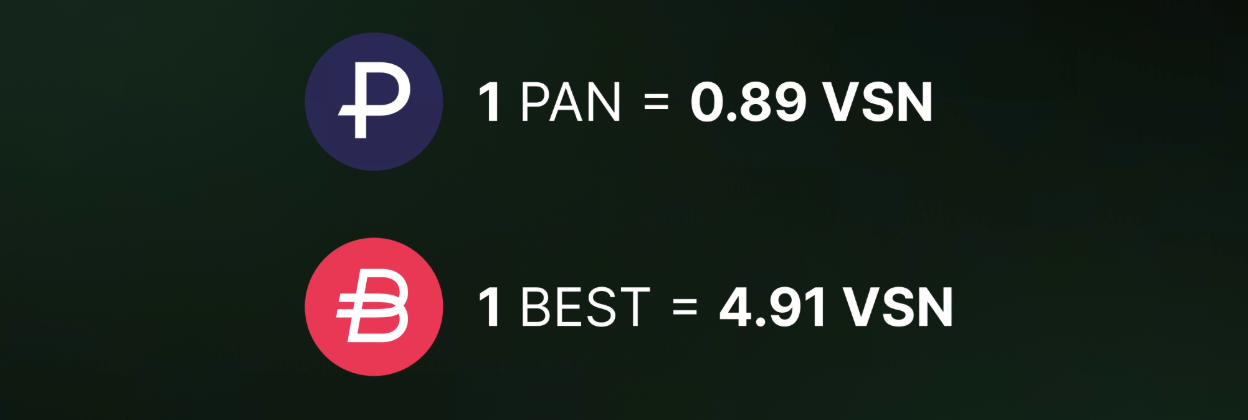
Under Vision’s unified token architecture, the migration of legacy assets to VSN is designed as a conversion mechanism that balances fairness and market stability. Through official conversion channels, holders can directly map BEST and PAN into VSN at fixed ratios, where 1 BEST = 4.91 VSN and 1 PAN = 0.89 VSN.
To prevent short-term volatility or price manipulation from affecting conversion outcomes, the exchange rates are calculated based on the average daily closing prices over the 30 days preceding the announcement. The reference period ends on March 25, 2025, and any subsequent price fluctuations do not affect the conversion ratios. This approach ensures a predictable and equitable migration process for all participants.
(Source: VSN_Unofficial)
At the execution level, the platform will suspend trading for BEST and PAN and provide an on chain or in platform conversion process to ensure a smooth liquidity transition and avoid disruption to user holdings. With a defined time window, transparent calculation method, and advance notice, this migration consolidates asset value while quickly centralizing governance and ecosystem incentives into VSN, reducing structural friction caused by multiple assets running in parallel.
Impact on Holders: Return Opportunities Under Vision’s Unified Architecture
For holders, the biggest change in a unified token model is that value capture becomes simpler. When all product and service growth maps to VSN, holders no longer need to allocate across multiple tokens. Instead, they can participate in ecosystem expansion through a single asset. This structure can deepen liquidity and strengthen market expectations around overall platform growth.
A unified architecture can also create new sources of returns, such as more concentrated staking rewards, governance incentives, or cross product revenue distribution mechanisms. As the boundary between CeFi and DeFi continues to blur, VSN has the potential to become a value gateway across multiple usage scenarios within the ecosystem.
At the same time, holders should also consider the systemic volatility risk of a single token model. When all functions concentrate on one asset, price movements can affect the ecosystem more directly. As a result, understanding token economics and risk management becomes more important.
Key Catalysts That May Drive VSN Price Performance
Future price momentum for VSN is primarily linked to real ecosystem adoption and changes in token demand structure.
- Increased real-world RWA adoption: If Vision Chain and Vision Protocol attract more institution-grade RWA capital, on-chain transaction volume and fee generation may increase, strengthening practical demand for VSN.
- Rising staking participation: As more users participate in staking to pursue stable returns, circulating supply may become increasingly locked, providing structural support to token supply dynamics.
- Exchange listings and market-making programs: Listings on additional major exchanges combined with structured market-making efforts can improve liquidity, reduce slippage, and attract broader capital participation.
- Successful ecosystem project deployment: Launch platforms and ecosystem partners that achieve sustained adoption can generate recurring token usage and staking demand, forming longer-term and repeatable sources of value.
Conclusion: A New DeFi Landscape Enabled by Vision’s Unified Token Architecture
The merger of BEST and PAN into Vision (VSN) is not only a token level consolidation, but also a shift in how Web3 ecosystems are designed. As platforms evolve from single products toward multi-chain and multi-module ecosystems, unified token models are increasingly becoming a new direction. The central challenge for the next generation of exchanges and Web3 infrastructure is how to balance integration efficiency with systemic risk.
In this context, the rollout of MiCA also positions Europe as one of the most institutionally advantaged markets for Web3 and RWA development, further strengthening its role as a bridge between traditional finance and Web3.
FAQ
Why did Vision (VSN) integrate BEST and PAN instead of keeping a multi token structure?
As an ecosystem expands, a multi-token model can lead to fragmented liquidity, overlapping functionality, and unclear narratives. By consolidating BEST and PAN into VSN, Bitpanda brings trading benefits, cross-chain capabilities, and governance functions into a single asset. This allows growth across all products to be reflected in one token, lowers user complexity, and improves overall capital efficiency.
How can BEST and PAN holders convert to VSN? Will market prices affect the result?
Holders can convert their assets to VSN through official conversion channels using fixed ratios: 1 BEST = 4.91 VSN and 1 PAN = 0.89 VSN. These ratios were calculated based on the average closing prices over the 30 days prior to the announcement. Subsequent market price fluctuations do not affect the conversion outcome, ensuring a fair and predictable migration process.
What is the biggest impact of a unified token model for general holders?
The main impact is a simplified investment path. Previously, exposure needed to be spread across multiple tokens. With the unified model, holding VSN provides participation in the broader Bitpanda Web3 ecosystem, along with access to staking rewards, governance rights, and cross-product value accumulation. At the same time, investors assume more concentrated exposure to the price volatility of a single asset.