In blockchain systems, smart contracts cannot directly access off-chain financial data, which is why oracle networks are required as a bridge. Pyth Network was built to address this need, with a focus on delivering high-frequency, low-latency, and reliable market data.
Unlike conventional oracle models, Pyth does not rely on secondary data aggregation. Instead, its data comes directly from first-party sources such as exchanges, market makers, and financial institutions. This structure more closely reflects how prices are formed in real markets, making it particularly well-suited for derivatives pricing and high-frequency trading environments.
The Overall Operational Framework of Pyth Network
Pyth’s system can be understood as a three-layer process: data generation, data processing, and data distribution. Importantly, this workflow is not confined to a single blockchain but operates through coordinated off-chain and on-chain components.
Data is first submitted by multiple independent institutions, each providing asset prices along with confidence intervals. This information is then processed within an aggregation layer, producing a unified and standardized price. Finally, the data is delivered to various blockchains when needed, where it can be consumed by smart contracts.
A key design principle here is the separation between price creation and price consumption.
At its foundation, Pyth Network relies on a multi-source data input model. Participants include exchanges, market makers, and financial institutions, all of which submit real-time pricing data directly to the network.
Each data submission includes not only the price itself but also a confidence interval that reflects the expected range of variation. This allows the system to remain robust even when data quality varies across sources.
Because the data originates from direct market participants, Pyth’s pricing is generally closer to real-time market conditions compared to traditional aggregated oracle systems.
Once multiple providers submit pricing data, the system performs off-chain aggregation and standardization. This process typically involves filtering outliers, applying weighted calculations, and combining confidence intervals.
The result is a single, unified market price along with its associated uncertainty range. This standardized output becomes the reference data used by on-chain applications.
The significance of this stage lies in transforming multiple independent market perspectives into a single, reliable price feed.
Core Mechanism of Pyth Network: How the Pull Oracle Works
The most distinctive feature of Pyth Network is its Pull Oracle mechanism.
Unlike traditional oracle systems that continuously push updates on-chain, Pyth keeps high-frequency pricing data off-chain. When a smart contract requires the latest price, it actively requests the data, triggering an on-chain update at that moment.
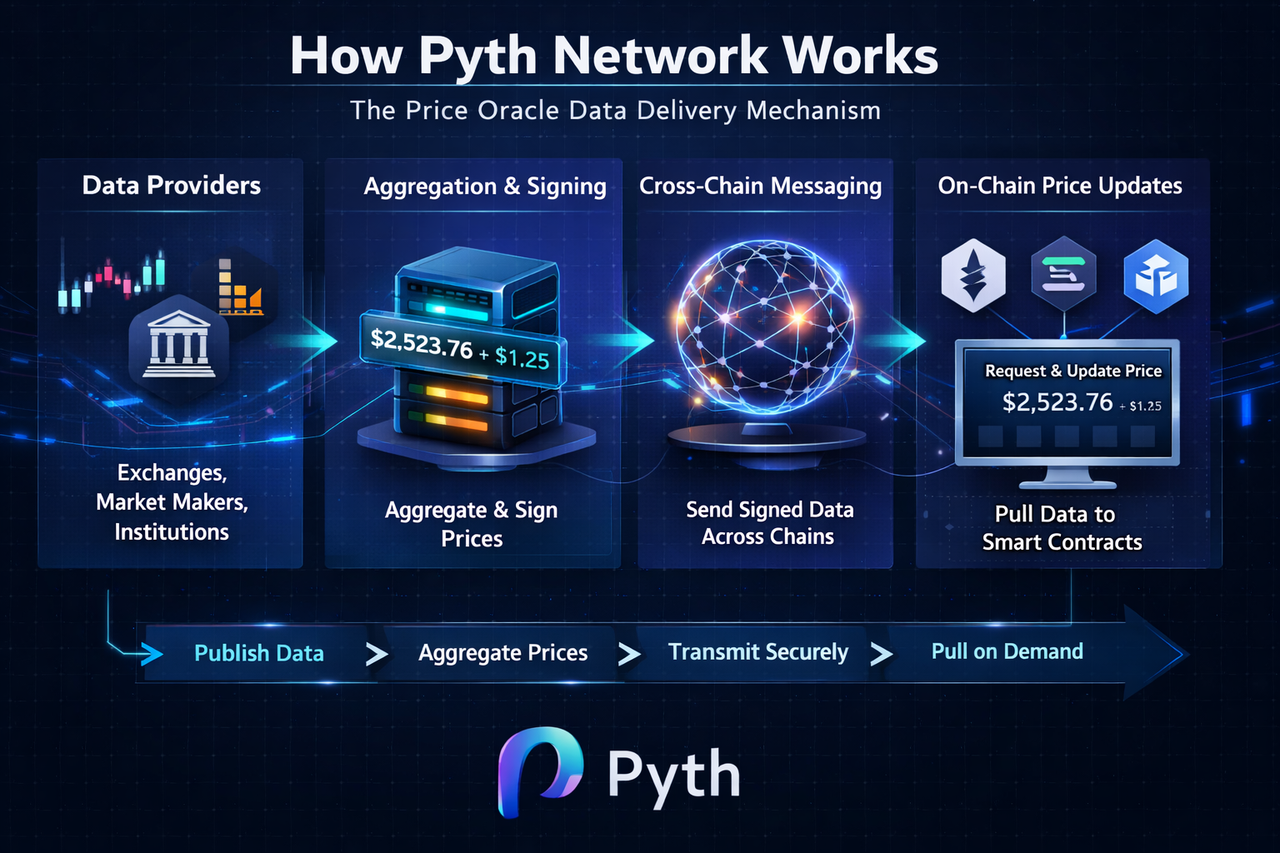
This approach transforms on-chain updates from a continuous expense into an on-demand cost. It significantly reduces gas usage while allowing extremely high-frequency updates to occur off-chain.
In practice, a single transaction often performs two actions simultaneously: fetching the latest price and executing logic based on that data.
Data Transmission Path: From Off-Chain Systems to Multi-Chain Networks
Pyth’s data flow extends beyond a single blockchain, operating instead as a cross-chain distribution system.
Price data is continuously updated and aggregated off-chain, then packaged into standardized, signed data messages. These messages are distributed across multiple blockchain networks, such as Ethereum and Solana.
When a smart contract requests price data, it verifies the signature and retrieves the latest value, completing the data consumption process.
This architecture allows Pyth to function as a shared data layer across multiple ecosystems rather than being tied to a single chain.
Key Differences Between Push and Pull Models
Traditional oracle systems typically use a Push model, where price updates are broadcast to the blockchain at regular intervals. While straightforward, this approach can become costly in high-frequency environments.
Pyth’s Pull model shifts control to the user or application. Data is only brought on-chain when needed, while off-chain updates can occur at a much higher frequency without incurring constant costs.
From a system design perspective, this results in clear advantages in scalability and cost efficiency.
The Role of Pyth Network in the DeFi Ecosystem
Pyth’s high-frequency pricing data is widely used across decentralized finance applications, including derivatives pricing, collateral valuation in lending protocols, and automated liquidation systems.
In these use cases, even small delays in price updates can directly impact risk management. By minimizing latency and enabling near real-time data access, Pyth allows smart contracts to operate based on conditions that closely reflect live markets.
Conclusion
The core innovation of Pyth Network lies in shifting oracle design from continuous on-chain data broadcasting to a hybrid model of high-frequency off-chain updates combined with on-demand on-chain access. This approach reduces costs while significantly improving update frequency and scalability.
Through a coordinated process of data collection, off-chain aggregation, cryptographic verification, and cross-chain distribution, Pyth establishes itself as a high-performance financial data infrastructure for multi-chain ecosystems. It plays a critical role as the pricing data layer in modern DeFi applications.
FAQ
How are prices generated in Pyth Network?
Prices are derived from data submitted by multiple independent financial institutions, aggregated off-chain, and accompanied by confidence intervals to reflect uncertainty.
Why does Pyth use a Pull mechanism?
The Pull model avoids the high cost of continuous on-chain updates while enabling more frequent off-chain data refreshes, improving overall efficiency.
Is Pyth data real-time?
Off-chain updates occur at near real-time frequency, while on-chain data is updated on demand when triggered by user transactions.
How does Pyth ensure data reliability?
It combines multi-source validation, outlier filtering, and cryptographic signature verification to maintain data integrity and consistency.
What is the main difference between Pyth and traditional oracles?
The primary differences lie in the data delivery model, Push versus Pull, cost structure, and cross-chain scalability.
Does Pyth support multiple blockchains?
Yes, its data can be verified and used across multiple blockchain networks through cross-chain communication mechanisms.