River is a cross-chain stablecoin system designed around the concept of Chain Abstraction. Its objective is to address the structural fragmentation of assets and liquidity in multi-chain environments. Through its core components, satUSD and the Omni-CDP architecture, users can deposit collateral on one blockchain while minting a stablecoin natively on another. The process does not rely on cross-chain bridges, wrapped assets, or manual network switching, allowing capital to move across multi-chain ecosystems with minimal friction.
As DeFi continues to expand, parallel multi-chain deployment has become common. However, cross-chain asset movement still depends heavily on bridges, which concentrate security risk, fragment liquidity, and reduce capital efficiency. River approaches the issue at the level of capital structure by introducing a stablecoin-centric chain abstraction model. Collateral state, minting authority, and risk controls are decoupled from any single blockchain, allowing capital to maintain a consistent operational state across multiple networks. This design aims to improve liquidity utilization and provide a more scalable infrastructure-level solution for multi-chain DeFi.
This article explains River’s overall design and positioning, outlines the structural challenges faced by multi-chain DeFi, and introduces Chain Abstraction as an evolution at the capital layer. It then examines how Omni-CDP operates, the cross-chain synchronization architecture behind it, and how this model affects DeFi capital efficiency and the role of stablecoins, helping readers understand how River attempts to reshape capital operations in a multi-chain context.
River Overview

(Source: RiverdotInc)
River is a cross-chain stablecoin system built on the principle of Chain Abstraction. It is designed to address structural fragmentation of assets and liquidity across blockchains. Through satUSD and the Omni-CDP architecture, users can deposit collateral on one chain and mint a stablecoin natively on another, without relying on bridges, wrapped assets, or manual network switching. This design allows capital to move across multi-chain ecosystems in a more native and continuous manner.
As the DeFi ecosystem grows, River focuses on capital operations rather than individual applications. By using a stablecoin as the central coordination asset, it integrates cross-chain collateralization, yield distribution, and user contribution mechanisms into a single system. This structure is intended to support capital circulation across chains while improving liquidity efficiency and system scalability, positioning River as a stablecoin protocol with infrastructure-oriented characteristics.
Structural Challenges In Multi-Chain DeFi: Why Cross-Chain Bridges Become Sources Of Risk
Over the past several years, DeFi expansion has largely followed a pattern of more blockchains and more bridges. To move assets across chains, users typically lock assets on a source chain, mint a mapped representation, and then circulate that representation on a destination chain.
At a structural level, bridges function as asset substitution mechanisms:
- Native assets are locked
- The destination chain uses high-trust IOU representations
- Asset state and liquidation logic are separated
This leads to three long-term issues.
First, security risk becomes concentrated. Bridges act as single points of failure, and many of the largest DeFi exploits historically have occurred at cross-chain bridges.
Second, liquidity becomes fragmented. Each chain maintains its own wrapped version of the same asset, with liquidity depth split across networks.
Third, capital efficiency declines. Collateral remains locked on the source chain and cannot natively participate in capital circulation on other chains.
These issues cannot be addressed at the UX layer, but stem from misalignment at the structural level.
What Is Chain Abstraction? From Account Abstraction To Capital Abstraction
When chain abstraction is discussed, it is often associated with account abstraction, gas abstraction, or simplified network switching. These approaches primarily operate at the interaction layer. River’s approach to Chain Abstraction focuses on a deeper question: does capital state need to be bound to a single blockchain?
In traditional DeFi architectures, assets, debt positions, minting authority, and liquidation logic are tightly coupled to one chain. This makes multi-chain deployment largely a frontend expansion rather than true capital interoperability. Capital abstraction shifts the focus away from hiding chain complexity and toward maintaining consistent collateral state, risk parameters, and minting rights across multiple chains.
How Does Omni-CDP Work?
Omni-CDP is River’s core infrastructure component. Its key innovation lies in separating and reorganizing three elements of a traditional CDP system:
- The location of collateral assets
- Where minting occurs
- System-level risk management and liquidation logic
Under the Omni-CDP architecture, users can:
- Deposit BTC, ETH, BNB, or LST on one chain
- Have the collateral state synchronized in real time
- Mint satUSD natively on another chain
Throughout this process, assets are neither wrapped nor bridged.
Minting is not triggered by asset movement, but by authorization based on synchronized collateral state. This design allows minting rights to function across chains as a native capability.
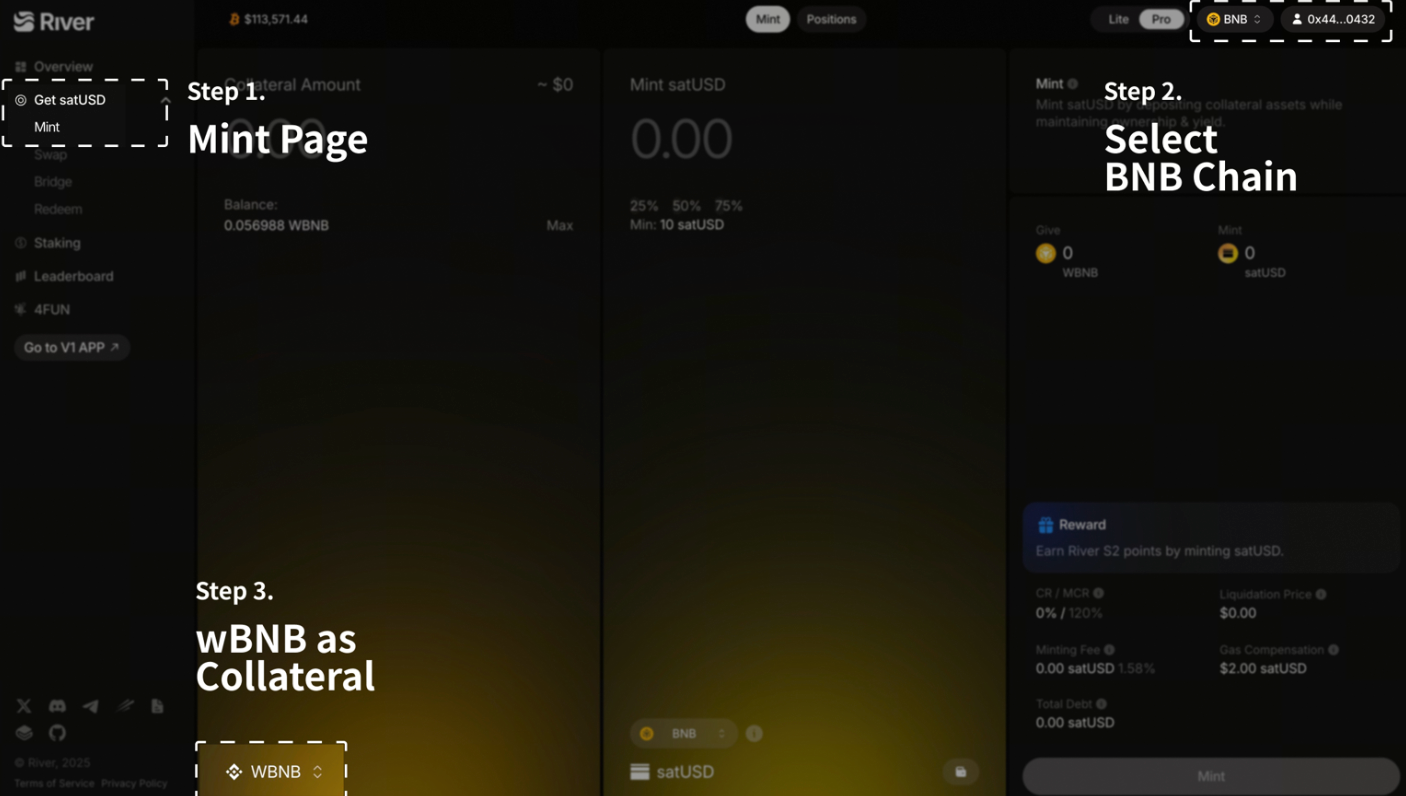
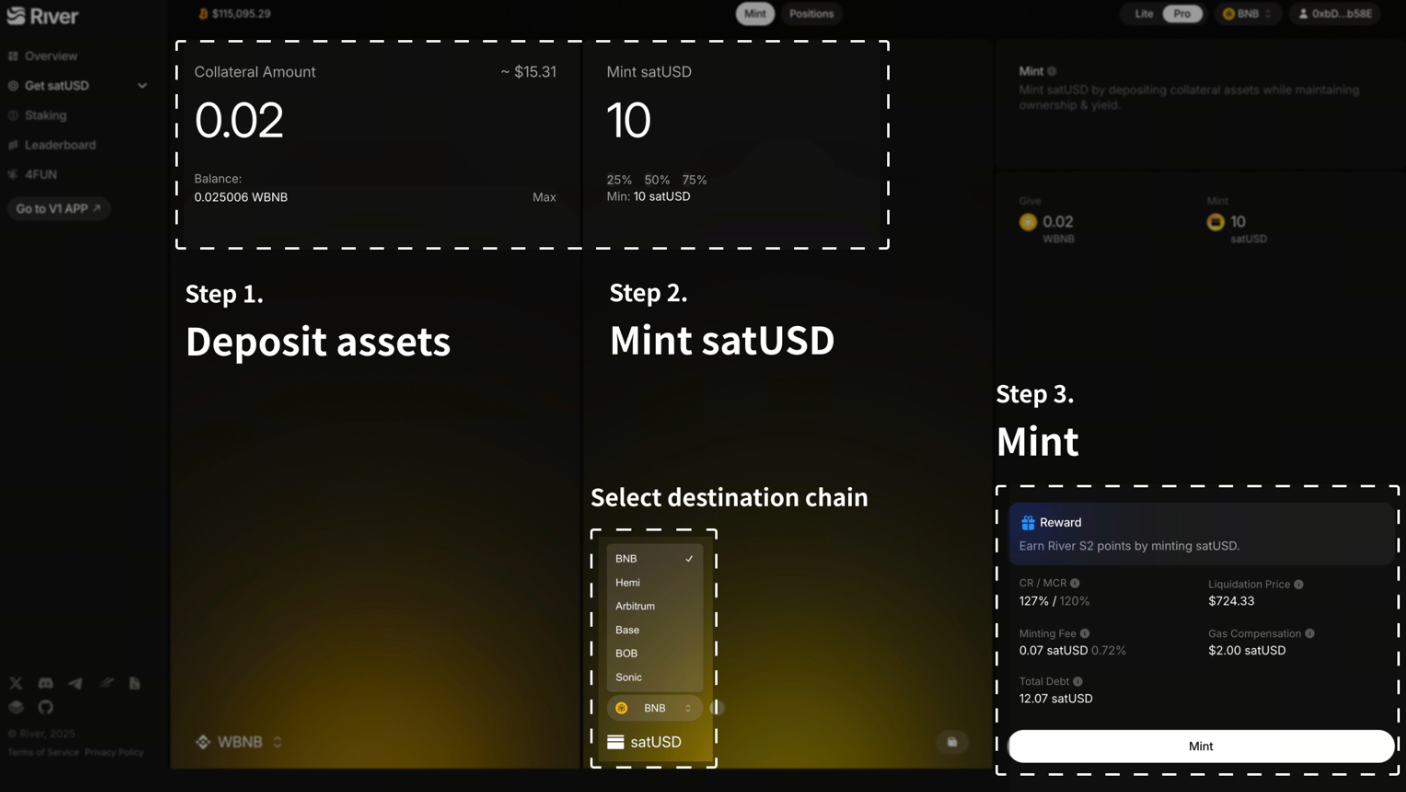
How To Use Omni-CDP
1.Select a chain
Connect a wallet and choose the source chain.
(Source: docs.river)
2.Select collateral assets
Choose the asset to deposit as collateral for minting satUSD.
(Source: docs.river)
3.Mint satUSD
Click “Mint” to receive satUSD on the target chain.

(Source: docs.river)
The Role Of LayerZero OApp And OFT In Omni-CDP
Omni-CDP relies on two standards provided by LayerZero:
- OApp, or omnichain applications
- OFT, or omnichain fungible tokens
OApp enables contracts on different chains to share a single, synchronized state, including collateral ratios, minting limits, and risk parameters. OFT ensures that satUSD maintains a unified supply logic across chains rather than existing as multiple wrapped versions. With this design, risk management and minting decisions are no longer tied to any individual chain, but to the system as a whole.
How Omni-CDP Affects DeFi Capital Efficiency
When collateral is no longer locked to a single chain, capital efficiency in DeFi changes at a structural level:
- Collateral can support liquidity across multiple chains
- Stablecoins function as true cross-chain capital hubs
- Yield strategies are no longer confined to one ecosystem
Omni-CDP does not represent faster bridging. It represents a model where bridging is no longer a required operation.
Summary
Omni-CDP illustrates a shift in DeFi from bridging assets to synchronizing capital state. When minting authority and risk management can operate across chains, a multi-chain environment gains a more consistent capital foundation. River’s Chain Abstraction approach is not focused on interface-level simplification, but on restructuring capital at the protocol level.